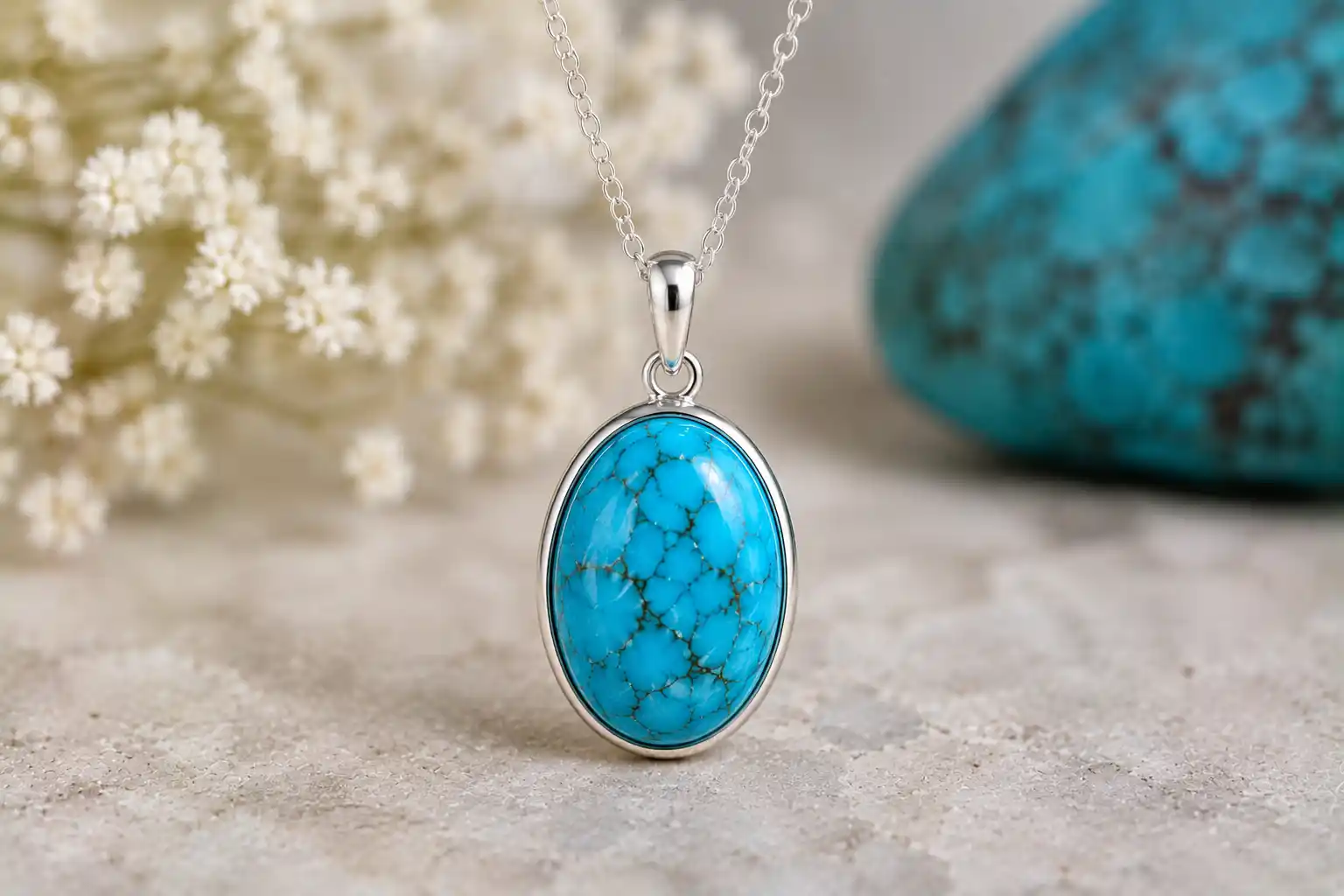
Turquoise Necklaces and Pendants: A Style Guide
Turquoise necklaces can feature one smooth sky-blue cabochon, a strand of matrix-rich beads, geometric inlay, a carved pendant or an elaborate silver composition containing many individually set stones. Because Turquoise is opaque, its appeal depends on body color, matrix, cutting, polish and craftsmanship rather than transparency or faceted brilliance.
A necklace is also one of the safer ways to wear this comparatively soft and porous gemstone. It keeps the material away from much of the impact experienced by bracelets and rings, although perfume, cosmetics, skin oil, chain abrasion and weak bails can still cause damage.
The best piece combines accurately represented Turquoise with construction strong enough to support the pendant or strand. Treatment, backing, drill-hole condition, artist attribution, chain strength and clasp design deserve as much attention as color.
Turquoise Necklaces at a Glance
| Feature | What to Consider |
|---|---|
| Mineral | Turquoise |
| Composition | Hydrated copper-aluminum phosphate |
| Typical colors | Blue, greenish blue, blue-green and green |
| Mohs hardness | Approximately 5–6 |
| Transparency | Opaque to rarely semitranslucent |
| Popular formats | Solitaire pendant, bead strand, station necklace, inlay, cluster and squash blossom |
| Best protective setting | Full or substantial partial bezel |
| Main structural concern | Bail, chain, stringing and clasp strength |
| Common treatments | Waxing, oiling, dyeing, stabilization and reconstruction |
| Main care risks | Cosmetics, solvents, heat, prolonged moisture and abrasion |
| Safest cleaning | Minimal warm soapy water when material and construction permit |
| Birthstone association | December |
What Is a Turquoise Necklace?
A Turquoise necklace is a neck-worn design containing Turquoise cabochons, beads, carvings, inlay or natural-form pieces.
The material may be untreated natural Turquoise, stabilized natural stone, dyed material, reconstructed composite or an imitation. These categories can appear similar in photographs but differ in value, durability and care.
Natural Turquoise forms in dry geological environments as copper-bearing groundwater reacts with aluminum- and phosphorus-rich minerals. Copper creates much of the blue color, while iron and other factors can move the appearance toward green.
The Turquoise meaning guide explains the mineral’s formation, history and symbolism. This page concentrates on necklace construction, buying and wear.
Why Turquoise Works Well in Necklaces
Turquoise benefits from being kept away from the hands.
A pendant or short strand receives fewer direct blows than a ring and less desk contact than a bracelet. Consequently, fine untreated material, artist-cut cabochons and thin inlay can often be worn more safely at the neckline.
Opaque color also remains visible without a deep faceted pavilion. A relatively thin cabochon can therefore create substantial face-up impact without excessive weight.
Long pendants still need caution because they can swing against counters, sinks and seat belts. Perfume, hairspray and skincare products can also reach stones worn close to the neck.
Solitaire Turquoise Pendants
A solitaire pendant places one cabochon at the center of the design.
Oval cabochons create a classic outline, while rounds, rectangles, shields, teardrops and freeforms can emphasize a particular matrix pattern.
The stone should face forward and lie flat. A poorly balanced bail can turn the pendant sideways or make it rotate continuously.
The cabochon should fit the bezel evenly, without visible movement or broad gaps. Its surface needs a polish appropriate to the material rather than a thick, artificial-looking coating.
A large pendant should have enough backing support to prevent flexing or pressure against a thin stone.
Bezel-Set Pendants
A bezel is generally the safest conventional setting for Turquoise.
The metal surrounds the cabochon and protects its relatively soft edge. It also suits the stone’s opaque character because no side light is required to reveal its color.
A full bezel provides maximum protection. A partial bezel exposes more of the outline but leaves selected areas vulnerable.
The metal should follow the cabochon closely without crushing it. Uneven pressure can damage porous, fractured or thin-backed material.
Yellow gold creates a warm luxury appearance, while sterling silver offers strong contrast with blue and green stones.
Backed Turquoise Cabochons
Some Turquoise cabochons are attached to a backing before setting.
Backing can support thin natural material, improve cutting yield and create a level base for mounting. It is common in certain commercial and traditional jewelry contexts.
A backed stone is not automatically fake. However, the seller should disclose it because the visible cabochon may not extend through the complete apparent thickness.
Inspect the underside when possible. A joining line, dark support layer or adhesive may be visible.
Price should reflect the Turquoise quality and the proportion of backing rather than the setting’s complete depth.
Turquoise Bead Necklaces
Bead necklaces may use round, barrel-shaped, nugget, disk or graduated Turquoise beads.
A strong strand should show consistent finishing and clean drill holes. Natural variation may remain desirable, particularly in matrix-rich or multicolor material.
Inspect the holes for chips, pale interiors and concentrated dye. Cracks spreading outward from the opening can weaken a bead.
Large beads produce substantial weight. Stringing material, knotting, clasp strength and connecting rings must support the complete necklace.
The Turquoise buying guide provides the broader material-quality and seller-evaluation process.
Knotted Turquoise Strands
Knots between beads reduce direct contact and limit loss if the cord breaks.
This construction is useful for valuable untreated strands and large beads whose weight would create strong impacts against one another.
The knots should sit close to the beads and remain even in size.
Silk creates a flexible drape but can absorb moisture and cosmetics. High-quality synthetic cord may provide greater resistance, depending on the design.
A necklace should be restrung when the cord stretches, frays or becomes visibly soiled.
Heishi-Style Necklaces
Heishi-style necklaces use many thin drilled disks fitted closely into a smooth strand.
Producing high-quality heishi requires extensive cutting, drilling, grinding and sorting. Artist-made examples should not be treated as interchangeable with mass-produced disk beads.
The pieces should lie evenly without sharp projections. Thin disks can chip around their holes when the stringing becomes loose.
When a seller attributes the necklace to a particular maker or community, that information should be supported by provenance rather than inferred from appearance alone.
The complete design may carry artistic and cultural value far beyond the raw weight of Turquoise.
Graduated Bead Necklaces
A graduated strand places larger beads or cabochons near the center and smaller elements toward the clasp.
The transition should remain smooth in diameter, body color and matrix character.
One oversized, pale or heavily treated bead can interrupt the complete line.
Larger center beads require stronger stringing and create greater pressure on the clasp.
Measure the necklace’s actual length and total weight. A broad graduated strand can sit much closer to the neck than a fine chain of the same stated length.
Turquoise Station Necklaces
A station necklace places individual cabochons or beads at intervals along a chain.
The open spacing creates a lighter contemporary appearance and uses less gemstone material than a complete strand.
Bezel-set stations protect the edges and help keep the stones facing outward.
Each connection should remain strong enough to tolerate repeated movement. Thin solder points between chains and stations can fail before the Turquoise shows visible wear.
An adjustable station necklace is useful when the wearer’s preferred length is uncertain.
Turquoise Cluster Necklaces
Cluster necklaces arrange several cabochons into one pendant or a connected series of settings.
The stones may match closely or deliberately vary in color and matrix.
Every bezel needs to remain intact. A loose cabochon can collect dirt, shift or eventually fall from the setting.
The backing plate should distribute weight across the pendant rather than allowing one thin connection to support everything.
Large clusters are best worn at a length that prevents repeated impact against tables and counters.
Turquoise Inlay Necklaces
Inlay uses thin pieces of Turquoise fitted into recessed metal or another stable backing.
The pieces may create geometric bands, landscapes, figures, mosaics or alternating patterns with shell, coral, jet and other materials.
The joins should remain tight and level. Raised edges, missing sections and visible gaps may indicate damage or weak construction.
Inlay commonly depends on adhesive and should not be soaked.
Repairs require a jeweler or lapidary artist familiar with stone inlay. Ordinary machine polishing can damage the Turquoise and neighboring materials.
Squash Blossom Necklaces
Squash blossom necklaces are closely associated with Diné silverwork and developed through a complex history of Indigenous, Spanish colonial and intercultural design influences.
A typical composition includes silver beads, blossom-shaped elements and a central crescent-shaped naja. Turquoise may appear in individual bezels or extensive clusters.
Not every necklace using these visual elements is artist-made or accurately attributed.
Ask for the maker’s identity, marks, provenance and seller documentation. Avoid reducing a living artistic tradition to a generic fashion description.
A substantial authentic necklace should be evaluated as jewelry, art and cultural work rather than priced only by silver and stone weight.
Diné, Zuni and Hopi Attribution
Diné, A:shiwi/Zuni, Hopi and other Southwestern artists maintain distinct and evolving jewelry traditions.
Zuni makers are particularly associated with sophisticated inlay, needlepoint, petit point and cluster work, although individual artists work in many styles.
Hopi jewelry is often recognized for silver overlay, but Hopi artists also produce stone-set and contemporary designs.
Diné artists create a broad range of silver, gold, stamped, inlaid, bead and cabochon jewelry.
Appearance alone cannot prove authorship. Credible attribution names the artist and community rather than applying a vague “tribal” label.
Natural Turquoise Necklaces
Untreated Turquoise has not been intentionally dyed, stabilized, waxed or reconstructed.
Fine compact material can accept a strong polish and may retain color better than porous chalky rough.
Untreated status can support higher value, particularly when combined with documented locality and recognized artistry.
It does not make a necklace immune to cosmetics, skin oils or scratching.
The invoice should clarify whether “natural” means naturally mined or specifically untreated.
Stabilized Turquoise
Stabilized Turquoise contains polymer, resin, wax or another substance introduced into its pores.
The treatment improves strength, color saturation and polish.
Stabilized beads and cabochons can be practical for necklaces, especially when the design receives frequent handling.
However, stabilized material should be disclosed and normally valued below fine untreated stone of similar appearance.
The treated Turquoise guide explains stabilization, dyeing, reconstruction and synthetic products in detail.
Dyed and Reconstructed Turquoise
Dye can deepen pale or uneven color.
Possible clues include intense color in fractures, pores and drill holes, along with paler chipped areas.
Reconstructed Turquoise combines powdered or fragmented mineral with a binder. It may contain genuine Turquoise but remains a manufactured composite.
“Block Turquoise” frequently refers to resin or plastic made to resemble the gemstone and may contain little or no natural mineral.
These products can be decorative and durable when represented honestly.
Turquoise Imitations
Dyed Howlite and Magnesite are common Turquoise substitutes.
Glass, ceramic, resin and plastic can also reproduce blue-green color and matrix.
Bubbles, mold seams, repeated patterns and pale interiors provide clues, although high-quality imitations can be convincing.
The real-versus-fake Turquoise guide covers authentication in depth.
Natural lookalikes can be compared through the Amazonite versus Turquoise and Larimar versus Turquoise guides.
Evaluating Turquoise Color
Turquoise can be sky blue, blue-green or green.
Even robin’s-egg blue remains highly recognized, but green and matrix-rich material also has established artistic and collector appeal.
Color should be judged under daylight-equivalent and ordinary indoor light.
A digitally enhanced photograph may make the stone appear cleaner, brighter or more blue than it looks in person.
Uniform color does not prove treatment. Fine untreated Turquoise can be remarkably even.
The types of Turquoise guide explains the main colors, patterns and commercial categories.
Evaluating Matrix
Matrix is the host rock or mineral-filled fracture pattern that remains with the Turquoise.
Fine spiderweb lines, broad brown veins and irregular dark patches can all occur naturally.
Matrix should complement the pendant or strand rather than weaken its structure.
Artificial matrix may be painted, molded or introduced into a composite.
Color and matrix cannot prove a specific mine. Named-source claims require provenance.
Named-Mine Claims
Mine names can affect collector interest and price.
However, sellers sometimes apply a famous locality name based only on color or matrix resemblance.
A credible named-mine necklace should have supporting records from the miner, cutter, artist, dealer or prior owner.
Laboratory testing can establish mineral identity and treatment more readily than precise mine origin.
The Turquoise price guide explains how provenance, treatment and artistry influence value.
Pendant Bails
The bail connects the pendant to the chain and carries its full weight.
A fixed bail controls orientation but limits compatible chains. A hinged bail allows movement and may help a large pendant settle flat.
An enhancer bail can attach a pendant to pearls, beads or thicker chains, provided the hinge and lock remain secure.
The chain should pass through without scraping the Turquoise or binding against the metal.
A large silver cluster should not depend on one thin decorative loop.
Chain Strength
Cable chains work well for small and medium pendants.
Box, wheat and substantial rope chains can support heavier cabochons and silverwork.
Fine snake chains may kink, while textured chains can rub against the back of a wide pendant.
The chain should support the complete pendant weight with a reasonable safety margin.
Confirm whether the listed necklace includes the displayed chain before comparing prices.
Necklace Length
Short lengths keep the pendant near the collarbone and limit swinging.
Medium lengths work with many cabochons and open necklines.
Long necklaces suit high collars and layered clothing but expose the pendant to more impact.
An adjustable chain provides flexibility for gifts.
Measure an existing necklace the wearer already likes rather than relying solely on labels such as princess or matinee.
Clasps
Lobster clasps suit many pendant chains and lighter bead strands.
Box clasps with secondary safety catches are appropriate for valuable or heavy necklaces.
Toggle clasps are decorative but can open when the necklace becomes slack.
Magnetic clasps offer convenience but may release unexpectedly.
Connecting rings should be soldered or sufficiently substantial.
The clasp should remain proportionate to the complete necklace weight.
December Birthstone Necklaces
Turquoise is one of December’s birthstones, together with Tanzanite and Zircon.
The December birthstone guide explains the calendar tradition, while the December birthstone jewelry guide compares gift formats.
An adjustable pendant avoids ring or bracelet sizing.
A birthstone label does not confirm that the material is untreated, natural or accurately attributed.
Symbolism
Modern traditions associate Turquoise with protection, communication, friendship, travel and wisdom.
A necklace near the throat may be used as a reminder to communicate clearly, although the physical placement does not create a medical effect.
The Turquoise healing-properties guide provides the complete spiritual discussion.
Symbolism should not replace material disclosure, artist attribution or practical safety.
Comparing Other Turquoise Jewelry
A Turquoise bracelet receives more skin-oil exposure and desk contact.
Turquoise earrings offer low-impact wear and require pair matching.
The Turquoise ring guide focuses on hand-level impact and protective settings.
Necklaces generally provide the safest format for large cabochons, bead suites, inlay and significant artist-made compositions.
Cleaning Turquoise Necklaces
Put the necklace on after applying perfume, lotion, sunscreen and cosmetics.
Wipe it with a soft cloth after wear.
When the material and construction permit, use a cloth or soft brush lightly dampened with warm mild soapy water. Avoid prolonged soaking.
Do not use steam, ultrasonic equipment, bleach, ammonia, alcohol, acetone, acids or abrasive compounds.
The Turquoise jewelry-cleaning guide provides the detailed method.
Spiritual Cleansing
Sound, visualization and placement on a clean dry cloth are conservative options.
Water immersion, salt and prolonged sunlight can affect porous stone, dye, wax, polymer, cord and adhesive.
The Turquoise cleansing guide covers symbolic methods separately.
The water and light risks can be compared in which crystals can go in water and which crystals fade in sunlight.
Storage
Fasten the clasp before storage.
Lay bead strands in a natural curve rather than folding them sharply.
Store heavy pendants so they cannot swing against the chain or other jewelry.
Quartz, Topaz, Sapphire and Diamond can scratch Turquoise.
The stone also appears in the blue gemstones guide, green gemstones guide, crystals beginning with T and gemstones beginning with T.
Final Perspective
A Turquoise necklace should be evaluated through three connected questions: what the material is, who made the piece and whether the construction can support regular wear.
Fine untreated cabochons, stabilized bead strands, reconstructed composites and artist-made silver necklaces can all be legitimate products when represented accurately. Their prices and care requirements should reflect those differences.
Once disclosure and attribution are clear, inspect the bail, chain, stringing and clasp. Those components determine whether the necklace can protect its Turquoise rather than becoming the source of damage.
Frequently Asked Questions
1. Is Turquoise suitable for necklaces?
Yes. Necklaces protect Turquoise from much of the impact experienced by bracelets and rings.
2. Which pendant setting protects Turquoise best?
A full or substantial partial bezel provides strong edge protection.
3. Is backed Turquoise fake?
No. Backing can support thin natural material, but it should be disclosed because it affects apparent thickness and value.
4. Is stabilized Turquoise good for necklaces?
Yes. Stabilization can improve strength and resistance to oils, although treated status should be disclosed.
5. How can dyed Turquoise beads be recognized?
Color concentrated around pores, fractures and drill holes can provide clues, but laboratory testing may be needed.
6. Is matrix desirable in a Turquoise necklace?
It can be. Value depends on pattern, structural condition, provenance, craftsmanship and buyer preference.
7. What is a squash blossom necklace?
It is a necklace form closely associated with Diné silverwork, commonly incorporating blossom elements and a central crescent-shaped naja.
8. How can an Indigenous artist-made necklace be authenticated?
Look for an identified maker, credible provenance, community-specific attribution and a transparent seller.
9. Which chain is best for a heavy Turquoise pendant?
A proportionate cable, box, wheat or other substantial chain can work when the bail and clasp are equally strong.
10. Can Turquoise necklaces get wet?
Brief controlled cleaning may be acceptable, but soaking should be avoided because stone, treatment, cord and adhesive can be affected.
11. Can Turquoise necklaces be cleaned ultrasonically?
No. Steam and ultrasonic cleaning should be avoided.
12. How should a Turquoise necklace be stored?
Fasten the clasp and keep the necklace in a padded compartment away from harder gemstones, heat, cosmetics and solvents.