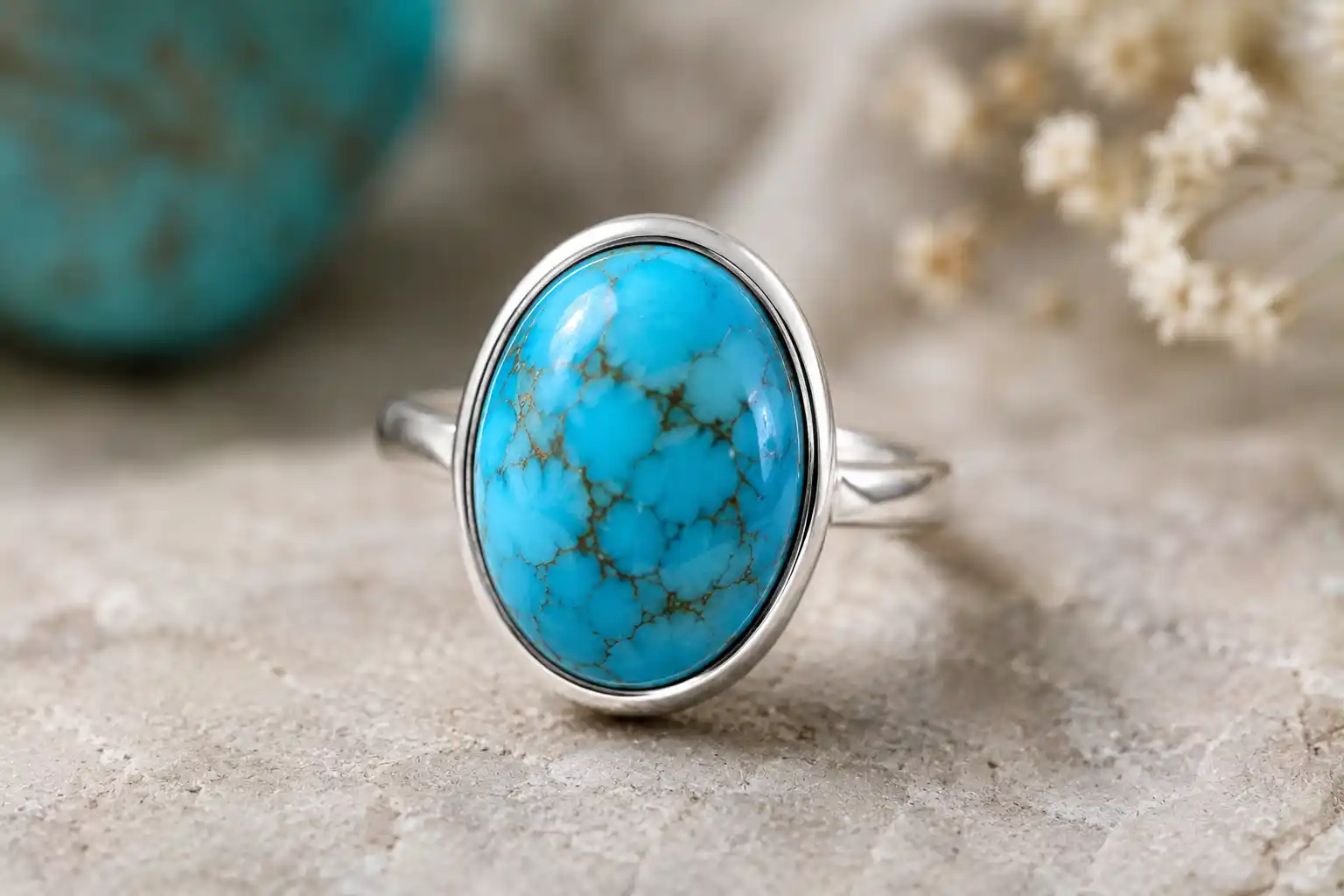
Turquoise Rings: Styles and Buying Tips
Turquoise rings place vivid blue or green color in one of the most visible jewelry positions. The stone may appear as a smooth solitaire cabochon, a matrix-rich cluster, an inlaid band, a carved signet or an artist-made silver composition containing several individually set pieces.
The hand is also the most demanding location for Turquoise. The mineral ranks only about 5–6 on the Mohs scale, is often porous and can be altered by skin oil, cosmetics, solvents and repeated abrasion.
A ring can still be worn successfully when the material is represented accurately and protected by strong construction. A low bezel, sound cabochon, stable shank and realistic wearing routine matter more than choosing the largest available stone.
Turquoise Rings at a Glance
| Feature | What to Consider |
|---|---|
| Mineral | Turquoise |
| Typical colors | Blue, greenish blue, blue-green and green |
| Mohs hardness | Approximately 5–6 |
| Transparency | Opaque |
| Popular styles | Bezel solitaire, cluster, signet, inlay, cocktail and engagement ring |
| Safest setting | Low full bezel |
| Main wear risks | Scratching, impact, cosmetics, chemicals and treatment wear |
| Common treatments | Waxing, oiling, dyeing, stabilization and reconstruction |
| Daily-wear suitability | Careful wear, preferably with compact or stabilized material |
| Main fit concern | Large tops rotating or striking adjacent fingers |
| Safest cleaning | Minimal warm soapy water when appropriate |
| Birthstone connection | December |
Is Turquoise Suitable for Rings?
Turquoise can be used in rings, but it requires more care than Quartz, Garnet, Topaz, Sapphire or Diamond.
Its surface is soft enough to be scratched by ordinary mineral dust containing Quartz. Repeated desk contact can gradually dull the polish.
Porous untreated material may absorb skin oils, lotion and moisture. Stabilized Turquoise is often more practical because treatment fills the pore structure and improves strength.
No treatment makes the gemstone indestructible. A well-protected ring should still be removed for cleaning, exercise, gardening and manual work.
The Turquoise meaning guide provides the complete mineral profile. This page focuses on ring construction, buying and wear.
Bezel-Set Turquoise Rings
A full bezel is the strongest conventional setting for Turquoise.
The metal surrounds the cabochon and protects its edge from impact and abrasion.
A good bezel follows the stone evenly without broad gaps. The upper rim should remain smooth and securely pressed without crushing the cabochon.
A low setting keeps the gemstone close to the hand and reduces snagging.
Because Turquoise is opaque, a closed back does not diminish transmitted light. The setting can therefore prioritize protection and structural support.
Turquoise Solitaire Rings
A solitaire places one cabochon at the center of the ring.
Oval stones are classic, while rounds, rectangles, shields, triangles and freeforms create different visual proportions.
The cabochon should remain balanced over the shank. A large off-center stone can rotate and strike nearby objects.
The surface needs an even polish without deep pits, open fractures or unstable edges.
A broad shank often supports a large center better than a thin fashion band.
Turquoise Signet Rings
Signet-style rings combine Turquoise with a broad metal top.
The stone may be bezel set, flush mounted, carved or used as inlay.
A low signet profile protects the cabochon and distributes weight across the finger.
The shoulders should remain smooth against neighboring fingers. Excessive width can become uncomfortable even when the top looks balanced.
A signet ring can be worn by anyone. Marketing conventions do not determine who can choose a broad or substantial design.
Turquoise Cluster Rings
Cluster rings arrange several cabochons into floral, geometric or radiating patterns.
The stones may match in blue color or deliberately vary in green, matrix and shape.
Every bezel requires inspection. A loose stone can move, collect debris or fall out before the rest of the ring appears damaged.
The backing plate should remain strong enough to support the complete cluster without flexing.
Large raised clusters are better suited to occasional wear because they strike hard surfaces more easily.
Turquoise Inlay Rings
Inlay places thin pieces of Turquoise into a channel or recessed design.
The stone may form continuous stripes, geometric mosaics or alternating sections with shell, coral, jet and other materials.
The surface should remain smooth and level. Gaps, lifting edges and missing pieces indicate wear or weak adhesion.
Inlay rings should not be soaked because water and cleaning solutions can affect adhesive and backing.
Repair requires someone experienced with lapidary inlay. Heavy machine polishing can remove or damage the stone.
Turquoise Cocktail Rings
Large Turquoise cabochons can create dramatic cocktail rings.
A broad stone displays color, matrix and provenance more clearly than a small calibrated cabochon.
The size also increases impact exposure and top weight.
A large ring needs substantial shoulders and a comfortable shank to limit rotation.
Cocktail designs are generally safer for controlled occasions than constant daily wear.
The most impressive size is not automatically the best purchase if the stone is porous, heavily backed or held by weak construction.
Turquoise Engagement Rings
Turquoise can be used in an engagement ring when the wearer understands its care requirements.
The material offers distinctive color and can carry personal, artistic or cultural significance.
It is less scratch resistant and chemically stable than Sapphire, Diamond or many Garnets. Consequently, it is not a maintenance-free choice for uninterrupted daily wear.
A low full bezel and compact cabochon provide the strongest practical design.
A separate activity ring may protect a valuable or artist-made Turquoise engagement ring during exercise, travel and manual tasks.
The green engagement-ring stones guide and blue engagement-ring stones guide provide broader alternatives.
Natural Turquoise Rings
Untreated natural Turquoise has not been dyed, stabilized, waxed or reconstructed.
Fine compact material can take a strong polish and may wear successfully in a protected ring.
Untreated status can add value when supported by color, provenance and craftsmanship.
However, porous natural stone can absorb oils more readily than stabilized material.
The seller should state clearly whether “natural” means mined material or specifically untreated Turquoise.
Stabilized Turquoise Rings
Stabilization introduces polymer, resin, wax or another substance into porous material.
The treatment improves strength, polish and resistance to discoloration.
For frequent ring wear, stabilized Turquoise may be a practical choice.
It should still be disclosed and priced below fine untreated material of similar appearance.
The treated Turquoise guide explains the differences among stabilized, dyed, reconstructed and synthetic products.
Dyed Turquoise Rings
Dye can create a stronger or more uniform blue.
Color may concentrate in fractures, pores and around the edge of a backed cabochon.
A scratch, chip or worn spot can reveal a paler interior.
Some dyes are reasonably stable, while others fade or react to cosmetics and solvents.
Do not use acetone, alcohol or abrasive polishing to test a ring. These methods can permanently damage it.
Reconstructed and Block Turquoise
Reconstructed Turquoise is made from powdered or fragmented mineral held together with a binder.
The result may contain genuine Turquoise but remains a manufactured composite.
Block Turquoise often refers to resin or plastic imitation and may contain no natural mineral.
Composite products can be durable and attractive when disclosed.
They should not be sold as one solid, untreated natural cabochon.
Turquoise Imitations in Rings
Dyed Howlite and Magnesite are common imitations.
Glass, ceramic, resin and plastic can also reproduce blue-green color and matrix.
Possible clues include bubbles, mold seams, repeated patterns and white chipped interiors.
The real-versus-fake Turquoise guide provides the full authentication process.
Natural lookalikes can be compared through Amazonite versus Turquoise and Larimar versus Turquoise.
Evaluating Turquoise Color
Natural Turquoise ranges from sky blue to green.
Fine even blue is highly recognized, but attractive green and matrix-rich stones can also carry collector and artistic value.
Examine the ring under daylight-equivalent and ordinary indoor light.
Photography and display lighting can make a stone look brighter and more blue than it is.
Uniform color does not prove dye. Likewise, variation does not prove untreated origin.
The types of Turquoise guide explains the major colors and patterns.
Evaluating Matrix
Matrix is the host-rock or mineral-filled pattern remaining with the Turquoise.
Fine spiderweb lines, brown veins and dark patches can be natural.
The pattern should suit the cabochon’s outline and setting.
A structural crack should not be romanticized as desirable matrix if it threatens durability.
Artificial matrix may be painted, molded or created in composite material.
Matrix appearance cannot prove a specific mine.
Backing and Ring Construction
Backing supports thin Turquoise and creates a flat base for setting.
It can be a legitimate lapidary technique, especially for large cabochons or valuable surface color.
The seller should disclose backing because the visible Turquoise may be much thinner than the complete setting suggests.
A substantial metal plate can also support the cabochon from below.
Inspect whether the ring’s apparent gemstone depth comes from natural stone, backing, adhesive or a hollow setting.
Artist-Made Southwestern Rings
Turquoise rings are created within distinct Diné, A:shiwi/Zuni, Hopi and other Southwestern artistic traditions.
Diné work may include stamping, substantial bezels, clusters, cast forms and contemporary designs.
Zuni artists are particularly associated with intricate inlay, needlepoint, petit point and cluster settings, though individual practices vary.
Hopi artists are often recognized for silver overlay but also produce stone-set and contemporary jewelry.
A visual style does not prove authorship. Significant rings should have an identified maker, community-specific attribution and credible provenance.
Maker’s Marks and Provenance
A maker’s mark can support attribution, but marks may be copied or shared by artists with similar initials.
Provenance includes invoices, gallery records, prior ownership, artist biographies and direct purchase documentation.
A generic “Native American style” label does not identify an artist or community.
Buying directly from artists, tribally affiliated businesses and transparent galleries provides a stronger chain of attribution.
Artistic value should be considered separately from the raw Turquoise and silver weight.
Choosing the Metal
Sterling silver provides classic contrast and supports a wide range of artist-made traditions.
Yellow gold creates a warmer, more formal frame.
Rose gold may emphasize green Turquoise, while oxidized silver makes pale blue material appear brighter.
The metal must remain structurally appropriate. Thin bezels, weak shoulders and open connecting elements undermine any precious-metal advantage.
Nickel sensitivity should be considered in plated or mixed-alloy rings.
Ring Size and Fit
A broad Turquoise ring generally fits more tightly than a narrow band.
Measure the finger using a ring with a similar shank width.
Large cabochons can make the ring top-heavy. A broad shank, sizing beads or an internal stabilizing bar may reduce rotation.
Try normal movements such as typing, gripping a cup and putting on clothing.
The ring should not press painfully against neighboring fingers or catch constantly.
Resizing
Simple metal shanks may be resized, but the Turquoise often needs to be removed before torch work.
Heat can damage untreated stone, dye, wax, resin, backing and adhesive.
Inlay bands, full-pattern designs and complex clusters may have limited resizing options.
Discuss adjustment before purchase rather than assuming every ring can be altered substantially.
A replacement cabochon may be difficult to match if the original stone is lost or damaged.
December Birthstone Rings
Turquoise is one of December’s birthstones, together with Tanzanite and Zircon.
The December birthstone guide explains the modern tradition.
A Turquoise ring provides an opaque, historically significant alternative to transparent blue stones.
The December birthstone jewelry guide compares rings with necklaces, earrings and bracelets.
Birthstone identity does not confirm natural origin, treatment or artist attribution.
Symbolism
Modern traditions associate Turquoise with protection, communication, friendship and travel.
A ring keeps the stone visible and can act as a reminder to pause before speaking or making a decision.
These associations are spiritual rather than medical effects.
The Turquoise healing-properties guide owns the complete symbolism and practice discussion.
Comparing Other Turquoise Jewelry
A Turquoise bracelet displays multiple stones but receives significant desk contact.
Turquoise earrings provide lower-impact wear and avoid sizing.
A Turquoise necklace can safely accommodate larger cabochons, bead strands and important artist-made designs.
Rings offer maximum visibility to the wearer and require the most disciplined protection.
Cleaning Turquoise Rings
Remove the ring before applying lotion, sunscreen, perfume or household cleaners.
Wipe it with a soft dry cloth after wear.
When the material and construction permit, use a cloth or soft brush lightly dampened with warm mild soapy water. Do not soak it.
Avoid steam, ultrasonic cleaning, alcohol, acetone, bleach, ammonia, acids and abrasive compounds.
The Turquoise jewelry-cleaning guide provides the full process.
Daily Wear
Remove the ring before washing dishes, swimming, showering, exercising, gardening and working with tools.
Do not stack it tightly beside Quartz, Topaz, Sapphire or Diamond bands.
Avoid striking the cabochon against ceramic, stone and metal surfaces.
Stabilized material may tolerate daily life better than porous untreated stone, but it still needs chemical protection.
The gemstone hardness chart and gemstone toughness-versus-hardness guide explain its position among other jewelry materials.
Storage
Keep the ring in a separate padded compartment.
Do not allow harder gemstones or rough metal to rub against the Turquoise.
Avoid heat, prolonged intense sunlight and solvent fumes.
An artist-made cluster or inlay ring should not be compressed beneath heavy jewelry.
Turquoise also appears in the blue gemstones guide, green gemstones guide, crystals beginning with T and gemstones beginning with T.
Final Perspective
A Turquoise ring can provide exceptional color, personal significance and artistic character, but it should not be purchased as though it were a hard transparent gemstone.
Begin with precise material disclosure. Then consider backing, treatment, maker attribution and whether the setting protects the cabochon.
A modest, accurately represented stone in a low secure bezel will usually provide more lasting satisfaction than a larger ring whose color, provenance and construction remain uncertain.
Frequently Asked Questions
1. Is Turquoise durable enough for rings?
It can be worn in rings with care, although its hardness of approximately 5–6 makes it vulnerable to scratching and abrasion.
2. Which setting protects Turquoise best?
A low full bezel provides the strongest conventional edge protection.
3. Can a Turquoise ring be worn every day?
Careful regular wear is possible, especially with compact or stabilized material. Remove it for water, chemicals and physical work.
4. Is stabilized Turquoise good for rings?
Yes. Stabilization improves strength and resistance to discoloration, although it should be disclosed.
5. Is backed Turquoise fake?
No. Backing is a legitimate support technique, but it should be disclosed because it affects apparent thickness and value.
6. Is green Turquoise lower quality?
Not automatically. Natural green Turquoise can be attractive and collectible.
7. Is matrix a crack?
Matrix is associated host material or mineralized pattern. An open structural fracture is different and may weaken the ring.
8. Can Turquoise be used in an engagement ring?
Yes, when the wearer accepts its softness, porosity and need for a protective setting and careful habits.
9. How can an artist-made Turquoise ring be authenticated?
Look for a named maker, credible provenance, community-specific attribution and a transparent seller.
10. Can a Turquoise ring be resized?
Many simple shanks can be resized after removing the stone. Inlay and complex cluster designs may have strict limits.
11. Can Turquoise rings be cleaned ultrasonically?
No. Steam and ultrasonic cleaning should be avoided.
12. How should a Turquoise ring be stored?
Keep it separately in a padded compartment away from harder gemstones, cosmetics, solvents, heat and prolonged sunlight.