Tourmaline Necklaces and Pendants Guide
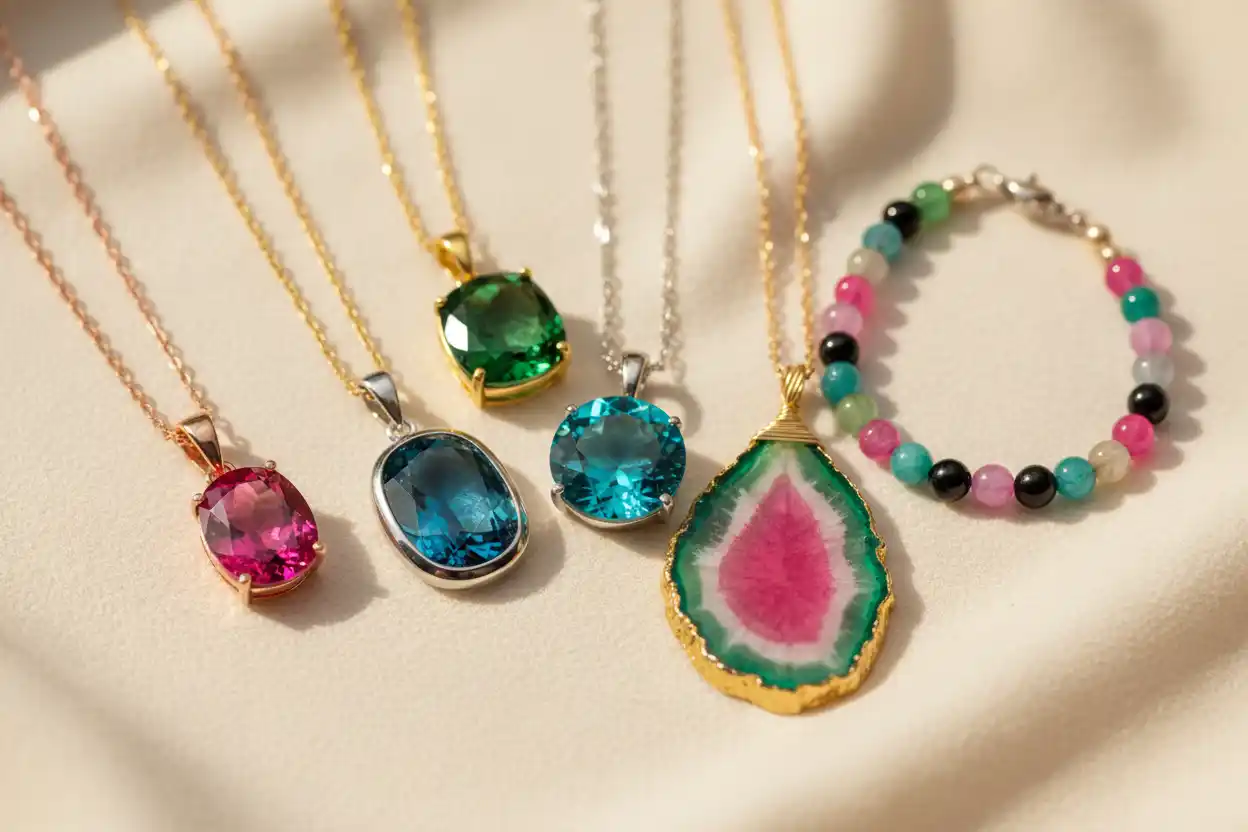
Tourmaline necklaces range from delicate pink or green solitaires to large crystal pendants, neon copper-bearing gems, black bead strands and Watermelon Tourmaline slices with distinct pink and green zones. The family’s exceptional color range makes it possible to create an entire necklace using one broad mineral group without repeating one visual effect.
The necklace format also suits Tourmaline physically. It keeps valuable or heavily included gems away from the repeated impacts experienced by rings and bracelets. Nevertheless, chain strength, bail design, setting protection, pendant balance, color orientation and treatment disclosure remain essential.
A large attractive stone is only part of a successful necklace. The structure holding it must safely manage the complete weight and preserve the face-up appearance intended by the cutter.
Tourmaline Necklaces at a Glance
| Feature | What to Consider |
|---|---|
| Gem family | Borosilicate Tourmaline group |
| Common gem species | Elbaite, Dravite, Uvite and Schorl |
| Available colors | Pink, red, green, blue, black, yellow, orange and multicolor |
| Mohs hardness | Approximately 7–7.5 |
| Toughness | Fair |
| Important optical feature | Strong pleochroism |
| Popular necklace styles | Solitaire, halo, slice pendant, bead strand, station, lariat and graduated line |
| Most important structural feature | Bail and chain proportionate to total pendant weight |
| Common treatments | Heat, irradiation and occasional fracture filling |
| Best cleaning | Warm water, mild soap and a soft brush |
| Main necklace advantage | Large visible gems with reduced impact exposure |
| Birthstone association | October |
What Is a Tourmaline Necklace?
A Tourmaline necklace may contain one faceted gemstone, a polished cabochon, a natural crystal section, a color-zoned slice or a complete strand of beads.
Many transparent colored gems used in fine jewelry belong to elbaite. The completed Elbaite guide explains this important species.
Opaque black material is generally Schorl. Brown and yellow stones may include Dravite, while some green material can belong to Uvite or related species.
The main Tourmaline meaning guide owns family mineralogy, formation and symbolism. This article concentrates on necklace construction and gemstone selection.
Why Tourmaline Works Well in Necklaces
Tourmaline has useful hardness but only fair toughness.
A necklace reduces the chance of direct impact and avoids the repeated pressure applied to ring stones. This makes it a strong format for large, valuable, highly included or color-zoned material.
Tourmaline’s pleochroism can also benefit from slight pendant movement. Different colors or levels of darkness may appear as the stone changes angle.
Long pendants need extra caution because they can strike counters, sinks and seat belts.
A short or medium-length pendant usually provides the best balance between movement, visibility and protection.
Solitaire Tourmaline Pendants
A solitaire pendant places one faceted Tourmaline at the center of attention.
Ovals, cushions and emerald cuts are common. Pears create a natural vertical drop, while rounds offer symmetry.
Tourmaline’s elongated crystal growth often leads to long rectangular or oval cuts.
The stone should show attractive color when hanging naturally. A gem that only becomes bright when tilted may look dark during wear.
The setting should remain proportionate. A large Tourmaline on a very fine chain can create an obvious structural weak point.
Bezel-Set Pendants
A bezel surrounds most or all of the gemstone’s edge with metal.
It provides strong protection and reduces snagging, making it useful for included gems and color-zoned slices.
A full bezel creates a smooth outline. A partial bezel exposes more of the gemstone but leaves selected edges open.
The jeweler must close the metal gradually. Excessive pressure can extend a fracture.
The bezel should not obscure the most important color boundary, particularly in bicolor and Watermelon Tourmaline.
Prong-Set Pendants
Prongs reveal more of the gemstone and create a lighter-looking setting.
Four prongs provide an open appearance but less redundancy. Six prongs offer additional retention for large rounds and ovals.
Long pears and marquises need V-shaped protection at their tips.
The prongs should avoid surface-reaching fractures.
A low basket keeps the stone closer to the body, while a high setting increases movement and snagging.
The complete gallery must remain strong enough for the stone’s weight.
Halo Pendants
A halo surrounds Tourmaline with small colorless or contrasting gems.
Diamond and white Sapphire accents can brighten pink, red, green and blue centers.
The accent girdles should not touch the Tourmaline directly.
A halo can also provide partial impact protection around the edge. However, every small setting creates another maintenance point.
A compact single halo usually remains lighter than a tall double surround.
The center should retain visual dominance rather than disappearing inside excessive decoration.
Tourmaline Crystal Pendants
Some pendants retain the natural prismatic crystal shape.
Tourmaline crystals often show vertical striations and triangular or rounded triangular cross sections.
A partially polished crystal may preserve natural texture while smoothing the wearing surface.
The attachment method is critical. A drilled hole can weaken a narrow termination, while a metal cap depends on adhesive and mechanical fit.
Wire wrapping should not apply concentrated pressure to fractured crystal areas.
Natural points and rough edges can catch fabric or scratch skin. A pendant intended for regular wear needs a stable, comfortable finish.
Watermelon Tourmaline Slice Pendants
Watermelon Tourmaline slices show pink interiors surrounded by green rims, sometimes with a pale zone between them.
Slices may be cut across the crystal to reveal concentric color or lengthwise to show parallel bands.
Thin edges are vulnerable to chipping. A protective frame or carefully designed bezel improves durability.
Drilled slices should have enough material around the hole to resist cracking.
The dedicated Watermelon Tourmaline necklace guide owns slice selection, orientation and setting details. Broader identity belongs in the completed Watermelon Tourmaline meaning guide.
Bicolor Tourmaline Pendants
Bicolor Tourmaline may show pink and green, green and colorless, blue and green or other combinations.
The color division should appear deliberate when the pendant hangs.
Long rectangular cuts can display the transition from one end to the other. Pear cuts may place one color at the point and another near the wider base.
A muddy or poorly positioned boundary can reduce visual impact.
The setting and bail should preserve the intended top-to-bottom orientation.
Multicolor stones should be valued according to color quality, cutting and rarity rather than the number of colors alone.
Tourmaline Bead Necklaces
Bead necklaces can combine black Schorl, translucent pink material, green elbaite or a full rainbow.
Round beads are common, while faceted beads add surface sparkle.
A good strand should show consistent polish and clean drilling. Natural color variation may remain desirable.
Knots between valuable beads reduce contact and limit loss if the cord breaks.
Large beads create substantial weight. The stringing material, clasp and connecting rings must match that load.
Color concentrated around drill holes can indicate dye.
Graduated Tourmaline Strands
A graduated strand places larger beads or faceted stones near the center.
The transition should remain smooth in size and brightness.
A rainbow strand may graduate by both diameter and color. The sequence needs deliberate planning so that one unusually dark bead does not dominate.
Large center beads require stronger cord and careful knotting.
The clasp should balance the visual and physical weight of the necklace.
Fine matched strands may warrant professional restringing rather than elastic or lightweight craft cord.
Tourmaline Station Necklaces
Station necklaces place individual gems at intervals along a chain.
This format gives each color space and uses fewer gemstones than a complete line necklace.
Bezel-set stations protect the edges and help control orientation.
Every station should face outward when worn. A poorly balanced setting may flip and reveal a duller or darker crystal direction.
The connections must remain strong. Repeated flexing at one weak solder joint can eventually cause failure.
Adjustable station necklaces are practical gifts when the preferred length is uncertain.
Graduated Faceted Necklaces
A graduated faceted necklace may contain a complete suite of matched Tourmalines.
Uniform-color necklaces require close matching. Rainbow designs require compatible brilliance and a controlled progression.
Strong pleochroism complicates assembly because every gem must remain attractive from its mounted direction.
The necklace should articulate smoothly around the neck rather than forming rigid corners.
A substantial box clasp and secondary safety are appropriate for a valuable suite.
Retaining replacement stones can be useful because matching one missing Tourmaline years later may be difficult.
Tourmaline Lariats and Y-Necklaces
Lariat and Y-necks use one or more Tourmaline drops below a central point.
Pear shapes, briolettes and elongated crystals fit the vertical format.
Movement reveals pleochroism but increases impact risk.
A sliding mechanism must remain secure. Two drops should not strike each other repeatedly.
Long necklaces should be removed before leaning over hard surfaces.
The bail or connecting loop must support the repeated swinging motion without wearing through.
Pink Tourmaline Necklaces
Pink Tourmaline ranges from nearly colorless blush to intense magenta.
A pendant allows a larger stone to show more saturation than a small calibrated gem.
The completed Pink Tourmaline guide covers symbolism and identity.
Visible inclusions are common. A pendant can safely display included material when fractures remain structurally stable and the setting protects the edges.
Rose gold creates a soft tonal appearance, while white metal strengthens contrast.
Irradiation-related color should be disclosed.
Rubellite Necklaces
Rubellite offers stronger red to pinkish-red color.
Fine material can remain richly colored in different lighting, unlike weaker pink stones that turn brownish.
Large Rubellite pendants may show inclusions, but color can outweigh perfect clarity when the stone remains lively and sound.
A protective halo or bezel suits heavily included material.
The completed Rubellite buying guide explains quality. Market context appears in the Rubellite price guide.
Green Tourmaline Necklaces
Green Tourmaline ranges from yellowish green and olive to forest, emerald and blue-green.
The completed Verdelite guide explains the common green variety name.
Dark green stones can become nearly black along one crystal direction.
A pendant should be judged face-up in normal light. Excessive depth and poor orientation can weaken the color.
Long emerald cuts often suit the original crystal and create an elegant vertical pendant.
Yellow gold warms olive and forest green, while white metal emphasizes cooler shades.
Indicolite Necklaces
Indicolite is blue to greenish-blue Tourmaline.
A necklace is an excellent format for large dark-blue material because it avoids ring-level impact while allowing the cutter to preserve size.
The gem should remain visibly blue rather than appearing black indoors.
Strong pleochroism and cutting orientation are central quality factors.
The completed Indicolite buying guide owns the detailed purchasing process.
White gold and platinum generally support its cool color.
Paraíba Tourmaline Necklaces
Copper-bearing Tourmaline can show electric blue, green and blue-green color.
A pendant may feature one small but intensely colored center or a larger included gem valued primarily for its exceptional hue.
Copper-bearing identity and geographic origin require proper testing rather than visual assumption.
The dedicated Paraíba Tourmaline necklace guide owns setting and chain decisions for this premium variety.
The completed Paraíba Tourmaline buying guide covers reports, color and origin.
Black Tourmaline Necklaces
Black Tourmaline is usually worn as a bead strand, polished point or opaque cabochon.
Large crystal pendants should be inspected for deep fractures and unstable terminations.
A capped crystal needs both secure adhesive and a suitable mechanical fit.
Black bead strands require clean drill holes and strong stringing because they can become heavy.
Silver and white metals create contrast, while yellow gold provides a warmer ceremonial appearance.
Claims of extreme rarity are generally inappropriate for common Schorl.
Cat’s-Eye Tourmaline Pendants
Parallel tube-like inclusions can produce chatoyancy.
Cabochons are cut so a reflected band crosses the stone.
Green, blue and pink cat’s-eye material occurs.
A pendant should hang in the orientation that keeps the eye visible from the front.
The eye is often broader and softer than that in fine cat’s-eye Chrysoberyl.
Highly included cat’s-eye Tourmaline should receive a protective setting and conservative cleaning.
Evaluating Color
Color should remain attractive when the pendant is viewed from its normal hanging position.
Strong retail lights can mask darkness or grayness.
Rotate the gemstone to observe pleochroism. Some color change is normal, but the face-up direction should remain the most appealing.
Bright pure colors are often valuable, although muted and earthy Tourmalines can still create attractive jewelry.
The planned Tourmaline color meaning guide handles symbolism. The completed Tourmaline price guide explains market value.
Evaluating Clarity
Clarity expectations differ by variety.
Pink and red material commonly contains visible liquid-filled tubes and fractures. Green and blue Tourmaline is often expected to look cleaner.
A pendant can accommodate included material more safely than a ring, but structural fractures still matter.
Inspect the gemstone from the side and back. Metal may conceal cracks near the girdle.
Oil or resin filling should be disclosed because it changes care and repair requirements.
Evaluating Cut
Tourmaline’s long crystal form frequently produces elongated gems.
A well-cut pendant should return light evenly without an obvious window.
Dark stones may require cutting choices that reduce the effect of the closed crystal axis.
A deep stone can retain weight while appearing smaller. Compare millimeter dimensions rather than relying only on carats.
The cut should suit the pendant orientation. One end should not appear unnecessarily dark when it becomes the top.
Treatments
Heating is used to alter or improve some colors and is generally stable.
Irradiation can produce or intensify pink, red and yellow colors. Some irradiation-created color can fade with heat or strong light.
Fracture filling with oils or resins may reduce the visibility of surface-reaching cracks.
The completed Tourmaline buying guide provides the full treatment and quality workflow.
Written disclosure becomes especially important when natural color or untreated status supports a premium price.
Necklace Length
A short or collarbone-length chain limits swinging and suits many solitaires.
Medium lengths accommodate larger pendants and high necklines.
Long chains make a stronger visual statement but expose the gem to more impact.
An adjustable chain offers versatility when the wearer’s preferred position is uncertain.
Measure an existing necklace rather than relying entirely on retail labels.
The pendant should lie flat without crowding the neckline.
Choosing the Chain
Cable chains provide a simple and reliable foundation.
Box and wheat chains offer greater substance for large Tourmalines and crystal pendants.
Snake chains create a smooth appearance but can kink.
Rope chains add texture that may compete with heavily color-zoned gems.
The chain must support the complete pendant weight, including metal and accent stones.
Confirm whether the chain is included before comparing prices.
Bail Construction
The bail connects the pendant to the chain and carries its full weight.
A fixed bail controls orientation. A hinged bail allows movement and may help the pendant lie flat.
Hidden bails preserve a seamless appearance but can be difficult to inspect.
Enhancer bails allow attachment to pearls or thick chains, although their hinges require maintenance.
The chain should pass through without binding or excessive movement.
A drilled pendant needs sufficient material around the hole. Fractures near the bail can expand with wear.
Clasp Security
Lobster clasps suit many pendant chains.
Box clasps with safety catches are appropriate for heavy bead strands and graduated suites.
Magnetic clasps may release unexpectedly and are rarely ideal for valuable Tourmaline necklaces.
Connecting rings should be soldered or sufficiently substantial.
The clasp should engage clearly without excessive force, gaps or sharp edges.
A heavy necklace may need a clasp large enough to operate comfortably.
Choosing the Metal
Yellow gold suits red, pink, yellow and warm green Tourmaline.
Rose gold complements pale pink and peach shades.
White gold and platinum emphasize blue, blue-green and vivid cool colors.
Sterling silver offers a lower-cost option for black beads and commercial gems, but thin findings may not support heavy pendants.
Metal allergies and maintenance requirements should be considered alongside color.
October Birthstone Necklaces
Tourmaline is an October birthstone together with Opal.
The completed October birthstone guide explains the calendar tradition.
An adjustable pendant is a practical gift because it avoids ring and wrist sizing.
Pink is the most familiar October Tourmaline choice, while rainbow strands represent the family’s complete color range.
The completed October birthstone jewelry guide compares necklaces with other formats.
Comparing Other Tourmaline Jewelry
Tourmaline earrings provide similar protection and require careful pair matching.
A Tourmaline bracelet creates repeated color but receives more impact.
The planned Tourmaline ring guide will focus on protective settings and hand wear.
A necklace is generally the strongest format for large gems, slices, heavy beads and natural crystal pendants.
Cleaning Tourmaline Necklaces
Clean Tourmaline with warm water, mild soap and a soft brush.
Support heavy pendants over a bowl or closed drain.
Work gently around the bail, gallery, drill holes and clasp.
Rinse briefly and dry thoroughly.
Do not use steam or ultrasonic equipment. Heat, thermal shock, liquid inclusions and filled fractures may cause damage.
Avoid soaking cords, silk, leather, glue and treated beads.
The completed guide to cleaning Tourmaline jewelry provides complete instructions.
Storage
Fasten the clasp before storage.
Lay bead strands in their natural curve instead of folding them sharply.
Hang long chains from a suitable organizer or store them flat.
Prevent heavy pendants from swinging inside travel cases.
Keep Tourmaline separate from Topaz, Sapphire and Diamond. It can also scratch softer gems.
Tourmaline appears in the crystals beginning with T and gemstones beginning with T directories.
Final Perspective
A Tourmaline necklace should preserve the stone’s strongest face-up color while supporting its complete physical weight. Pleochroism, zoning and elongated cutting make orientation as important as carat size.
After evaluating the gemstone, inspect the bail, chain and clasp as one system. A well-balanced pendant or professionally strung necklace will provide more lasting value than a larger stone that turns sideways, hangs from weak findings or depends on undisclosed treatment for its appearance.
Frequently Asked Questions
1. Is Tourmaline suitable for necklaces?
Yes. Necklaces expose Tourmaline to less impact than rings and bracelets, making them one of its safest formats.
2. Which pendant setting protects Tourmaline best?
A low full or partial bezel provides strong edge protection. Substantial prongs can also work for sound stones.
3. Why does a Tourmaline pendant change color as it moves?
Tourmaline is strongly pleochroic and can display different colors or darkness along different crystal directions.
4. Are Watermelon Tourmaline slices fragile?
Thin slices can chip around their edges or drilled holes, so they benefit from protective frames and careful wear.
5. Is Paraíba Tourmaline suitable for a necklace?
Yes. Pendants protect valuable copper-bearing Tourmaline well, although identification and origin claims deserve laboratory documentation.
6. Are pink Tourmaline necklaces commonly treated?
Some pink and red colors may be created or strengthened by irradiation. Heat and fracture filling also occur in Tourmaline.
7. Which chain is best for a large Tourmaline pendant?
A properly proportioned cable, box or wheat chain can work well. The bail and clasp must also support the complete weight.
8. Is Black Tourmaline too heavy for necklaces?
Large beads and crystal points can become heavy, so strong stringing, a secure clasp and appropriate length are important.
9. Does a Tourmaline necklace need a laboratory report?
Routine commercial necklaces may not. Reports become useful for valuable Paraíba, Rubellite, Indicolite or exceptional natural-color gems.
10. Can Tourmaline necklaces be layered?
Yes, but separate the lengths so the gemstone does not strike harder pendants or rough metal.
11. Can Tourmaline be cleaned ultrasonically?
No. Warm soapy water is recommended because inclusions, treatments and thermal sensitivity create risk.
12. How should a Tourmaline necklace be stored?
Fasten the clasp and place the necklace in a padded compartment away from harder gemstones and heavy jewelry.