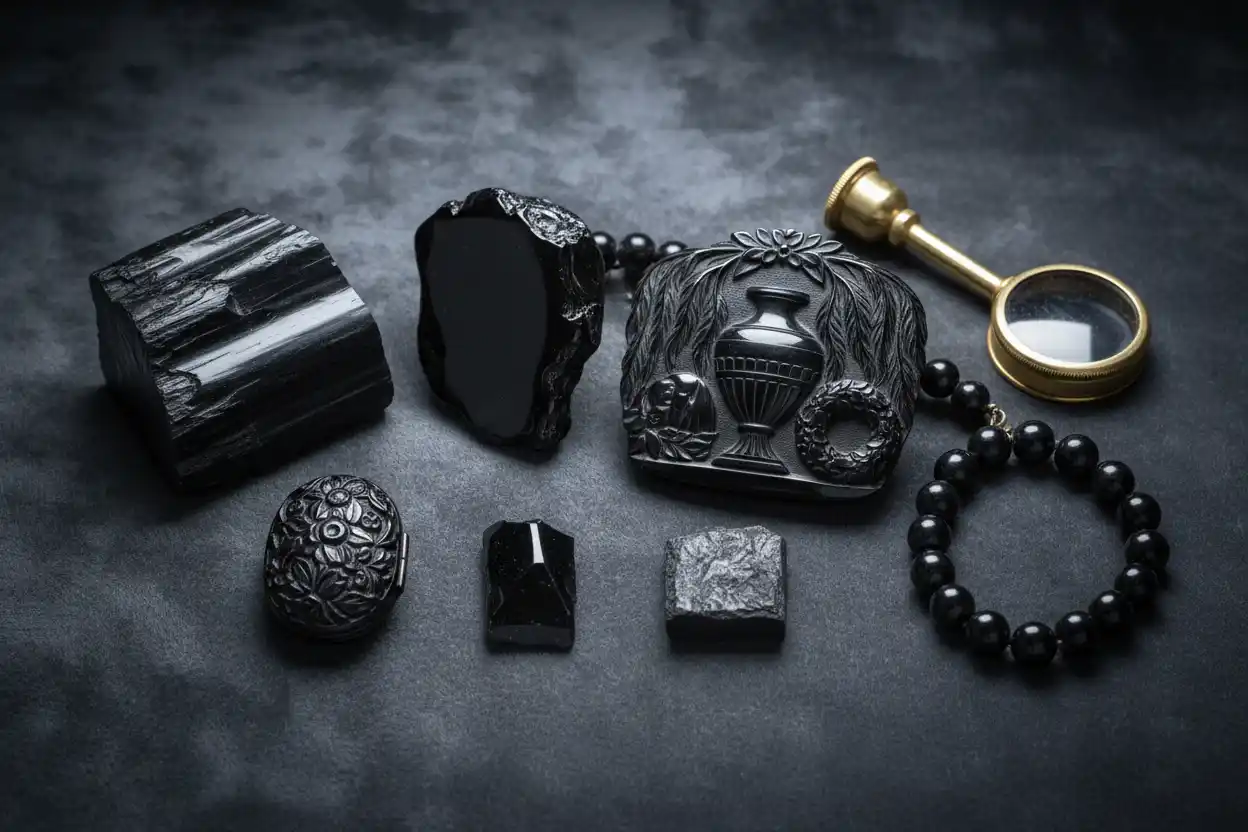
Where to Buy Real Jet and Avoid Glass or Plastic Imitations
Real Jet is an organic gem material formed from altered ancient wood. It is usually opaque black or very dark brown, remarkably lightweight and capable of taking a deep, velvety polish.
The market also contains black glass, vulcanite, ebonite, bog oak, cannel coal, anthracite, horn, modern plastic and molded composites sold as Jet. Several of these substitutes have their own historical significance, particularly in Victorian mourning jewelry, but they should not receive a genuine Jet description or provenance premium.
The Jet meaning and properties guide covers the material’s origin, history and traditional symbolism. This buying guide focuses on dealers, locality claims, antique jewelry, common simulants, repairs and nondestructive ways to assess a purchase.
Jet Is an Organic Gem Material
Jet is not a crystalline mineral. Instead, it is carbon-rich fossil wood altered through burial and geological processes.
That origin separates Jet from Black Obsidian, Onyx, Shungite and most other opaque black gems. Those materials can resemble Jet visually while differing substantially in composition, density, hardness and durability.
Jet is also different from petrified wood. In conventional petrified wood, the original organic structure becomes mineralized or replaced largely by silica and other minerals. Jet remains an organic carbon-rich material related to lignite.
The Amber guide provides a useful comparison with another lightweight organic gem. Amber formed from ancient plant resin, whereas Jet formed from wood.
Whitby Jet and Geographic Naming
Whitby Jet is the best-known historic variety. It comes from Jurassic strata along the North Yorkshire coast around Whitby, England.
Material from that source became particularly important for carved ornaments and mourning jewelry. Fine Whitby Jet can take a smooth, deep polish while remaining light enough for large necklaces, brooches and earrings.
However, Whitby is not the only source of natural Jet. Jet and related workable carbonaceous materials have also been associated with Spain, France, Germany, Türkiye, Russia, the United States and other regions.
A genuine Jet object does not automatically qualify as Whitby Jet. When a seller charges for Whitby provenance, ask for:
- A direct sourcing record from a recognized Whitby cutter or dealer
- An antique invoice or historical collection label
- Documentation from a workshop known to use local rough
- A professional identification that addresses the material and construction
Appearance alone rarely proves the exact geological source.
Choose the Product Form Before Shopping
| Jet product | Best source | Main buying concern |
|---|---|---|
| Natural rough | Specialist Jet dealer or fossil-material supplier | Material stability, source and hidden fractures |
| Modern carved jewelry | Established Jet workshop | Genuine source material, workmanship and treatment |
| Antique brooch | Antique-jewelry specialist | Glass, vulcanite, bog oak, replacement findings and repairs |
| Bead necklace | Jet or antique specialist | Pressed material, mixed beads and rethreading |
| Cameo or relief carving | Experienced dealer | Molded vulcanite, resin and surface restoration |
| Loose cabochon | Organic-gem dealer | Jet versus glass, coal and plastic |
| Mourning-jewelry suite | Specialist auction or dealer | Matching construction, period findings and provenance |
| Archaeological-style reproduction | Museum or specialist maker | Clear disclosure as reproduction |
| Raw beach-found piece | Requires caution | Legal collection, stability and accurate identification |
Antique jewelry needs both material identification and period authentication. A genuine Jet bead restrung recently remains real Jet, but its market value differs from an intact original necklace.
Where to Buy Genuine Jet
Specialist Whitby Jet workshops
A reputable workshop that cuts and carves documented Jet is a strong source for modern jewelry.
The seller should explain where the rough came from, whether the object was carved from one solid piece and which metal or adhesive secures it.
Ask for photographs of the reverse. Genuine workmanship should remain finished rather than relying only on a polished display face.
Antique-jewelry dealers
Victorian mourning jewelry frequently includes Jet, but it also includes glass, vulcanite, bog oak, gutta-percha, horn and other black materials.
A knowledgeable dealer should describe the material separately from the date and style. “Victorian black mourning brooch” does not prove Jet.
Request a condition report covering chips, cracks, reattached components, replacement pins, restrung beads and later polishing.
Gem and mineral shows
Shows allow you to compare Jet with black glass and coal-related materials in person.
Jet should feel unexpectedly light for its size. Glass normally feels substantially heavier, while many plastics feel similarly light.
Use a loupe to inspect carving marks, mold seams, bubbles, chips and surface texture. Avoid streak, scratch, flame and heated-needle tests because they permanently damage organic materials and antique objects.
The crystal identification guide explains why several nondestructive observations provide more reliable evidence than one damaging test.
Established online stores
The online gemstone buying guide covers seller identity, protected payment methods and return terms.
For Jet, request exact-item photographs under neutral light. Highly reflective studio lighting can make black glass and coated plastic look deceptively similar.
Ask the seller to show the back, edges, findings and any drilled holes. Those areas frequently reveal molded construction, glass chips or repairs.
Specialist auctions
Important antique Jet jewelry may appear through established jewelry, costume or regional-history auctions.
Read the catalog description carefully. “Attributed to Whitby” is weaker than documented provenance, while “Jet-style” can indicate an unidentified black material.
Request a written material assessment and restoration statement before bidding.
What Genuine Jet Looks and Feels Like
Jet is usually black, though thin edges or worn areas may reveal dark brown tones.
The polished surface can look glassy from one angle and softly velvety from another. Fine hand-polished Jet often produces a deep black appearance without the cold, mirror-like quality of glass.
Its low density is one of the most useful buying clues. A large Jet brooch or bead strand may feel surprisingly light.
Broken or chipped Jet may expose a brownish-black interior. Depending on quality and structure, fractures can be conchoidal, splintery or related to the original wood texture.
The material is softer than quartz, Onyx and most conventional gemstones. Scratches, abrasions and rounded carving details are therefore common on antique pieces.
Those signs support age and wear but do not prove Jet by themselves.
Jet Versus Black Glass
Black glass was widely used as a Jet substitute and is often called French Jet or Vauxhall glass in the antique market.
Glass is generally heavier and colder to the touch. Faceted glass ornaments may also show extremely sharp molded or cut reflections.
Under magnification, glass can reveal round bubbles, flow lines, mold marks and conchoidal chips. However, not every glass object contains obvious bubbles.
Jet carvings are usually cut, while many glass ornaments were molded or pressed. Repeated identical designs across several pieces can indicate glass production.
A polished black glass bead may be attractive and historically appropriate. It should simply be identified as glass rather than natural Jet.
Jet Versus Vulcanite and Ebonite
Vulcanite is hardened rubber, and ebonite is a related hard-rubber material. Both were used extensively for black jewelry.
Molded vulcanite can reproduce intricate designs and may imitate carved Jet convincingly. Because molds were reused, identical brooches and links are relatively common.
Older vulcanite may fade from black to dark brown or olive-brown, especially on exposed surfaces. File marks or unfinished molded texture may appear on the reverse.
The material may also have a rubber-like odor when warmed through handling, though smell is subjective and should not be used as a destructive test.
A brown streak cannot reliably separate vulcanite from Jet. Professional inspection of construction and surface texture is more useful.
Jet Versus Bog Oak
Bog oak is ancient waterlogged wood preserved in peat or marsh environments. It can become dark brown or nearly black and was also carved into mourning jewelry.
Visible wood grain, lathe lines and fibrous texture may distinguish bog oak from high-quality Jet.
Bog-oak carvings often retain a woody surface rather than Jet’s uniformly compact polish. Nevertheless, dark polished pieces can be difficult to identify from photographs.
Bog oak is a legitimate historic material, but it should not be sold as Jet.
Jet Versus Cannel Coal and Anthracite
Cannel coal and anthracite can appear black and glossy. Some carbonaceous materials are close enough to Jet that visual separation becomes difficult.
Coal substitutes may be heavier, more granular or less stable during fine carving. Their polish may also differ from quality Jet.
However, a brown streak or coal-like appearance is not enough to establish true gem Jet. Laboratory analysis may be necessary for valuable material.
The seller should avoid treating every polished coal fragment as Whitby Jet.
Jet Versus Black Onyx
Black Onyx is generally dyed Chalcedony and has substantially greater hardness and density than Jet.
A black Onyx cabochon feels heavier, resists scratching better and usually has a more stone-like coldness.
The completed guide to buying real Black Obsidian addresses volcanic glass, while Jet belongs to a separate organic-material market.
The black gemstones guide provides broader comparisons among Jet, Onyx, Obsidian, Tourmaline and other dark materials.
Modern Plastic and Resin Imitations
Plastic can be molded into beads, cameos, brooches and large ornaments.
Warning signs include obvious mold seams, repeated patterns, soft scratches and a uniform plastic surface. Some resins contain fillers that increase their weight, so lightness alone cannot prove Jet.
Resin reproductions may imitate museum artifacts or antique mourning pieces. Ethical sellers identify them clearly as replicas.
The fake-crystal buyer’s guide provides broader checks for plastic, resin, glass and composite materials.
Pressed and Reconstituted Jet
Small Jet fragments or powder can be mixed with binder and molded into beads or decorative objects.
Such material may contain genuine Jet while lacking the structure of one solid natural piece.
Mold seams, binder-rich chips and identical designs can support reconstructed manufacture.
Pressed products may be practical and affordable. However, they should not receive the same description or value as a carving cut from one natural piece of documented Jet.
The gemstone treatments guide explains the distinction between minor repair and substantial composite construction.
Antique Jewelry Construction
Jet is lightweight enough for large Victorian earrings, necklaces and brooches. That advantage also means antique findings and connections require careful inspection.
Look for:
- Replaced brooch pins or hinges
- Modern adhesive around mounts
- Restrung necklaces
- Missing beads or links
- Repaired carvings
- Mixed glass and Jet components
- Chips concealed by metal settings
- Later lacquer or surface polish
A replacement finding does not make the Jet fake, but it affects historical integrity and price.
In linked necklaces and bracelets, inspect how each component was joined. Cut-and-glued Jet construction differs from molded vulcanite links.
How to Evaluate Loose Beads
A genuine Jet strand should feel light compared with a similar glass necklace.
Beads may show slight variations in dimensions, polish and internal brown tones. Perfectly identical molded forms deserve additional scrutiny.
Inspect drill holes. They can reveal brownish material, wear, chips, binder or a contrasting substrate beneath a black coating.
Determine whether the strand contains all Jet or a mixture of Jet, glass and later replacement beads.
For antique strands, ask whether the cord, clasp and bead order are original.
How to Evaluate Carvings
Hand-carved Jet commonly shows subtle tool marks and slight variation rather than perfect molded repetition.
Inspect the deepest recesses and reverse. Molded substitutes may show seams, flattened details or unfinished backs.
Fine antique reliefs can be delicate. Check noses, floral edges, leaves and openwork sections for repairs.
A thick glossy coating may conceal scratches and alter the traditional surface. Ask whether lacquer, wax or resin was applied.
Buying Jet Rings and Brooches
Jet is relatively soft and brittle, so large exposed rings face more wear than brooches, pendants or earrings.
The gemstone hardness chart places Jet well below quartz-family gems. The gemstone toughness-versus-hardness guide explains why an organic material can scratch and chip even when it survives careful everyday handling.
Brooches should have stable findings and no active crack around the pin plate.
For rings, choose a protected setting and avoid designs with thin carved edges.
Value and Pricing
Jet prices vary according to material quality, provenance, age, craftsmanship, condition and historical significance.
Modern documented Whitby Jet can command more than generic natural Jet because the locality and workshop tradition add value.
Antique pieces may receive premiums for:
- Original Victorian construction
- Exceptional carving
- Rare mourning motifs
- Complete matching suites
- Historical ownership
- Recognized workshop attribution
- Original boxes and receipts
- Minimal restoration
Black glass and vulcanite antiques can also be collectible. Their value should reflect their true material and design history rather than a false Jet label.
The gemstone pricing guide explains why craftsmanship and provenance can outweigh raw-material cost.
Questions to Ask the Seller
Ask whether the seller identifies the piece as natural Jet, Whitby Jet, glass, vulcanite, bog oak, coal or reconstructed material.
When Whitby origin affects price, request the documentation supporting that claim.
For antiques, ask which components are original and whether beads were restrung, polished, glued or replaced.
Request photographs of the reverse, findings, drill holes and all damaged areas.
Confirm whether lacquer, wax, resin or black coating is present. Finally, obtain a return policy that permits professional nondestructive examination.
Professional Identification
Experienced gemologists and antique-Jet specialists combine weight, surface texture, construction, magnification and material analysis.
Raman spectroscopy, infrared spectroscopy, X-ray imaging and other analytical methods can distinguish many organic materials, glass, rubber and plastics.
However, closely related carbonaceous materials may remain difficult to separate conclusively. A laboratory may identify an object as Jet or lignite-related material without proving Whitby origin.
Geographic provenance therefore depends heavily on collection records and supply-chain evidence.
Cleaning and Storage
Use a soft dry cloth for routine care. When additional cleaning is necessary, use a barely damp cloth and dry the piece immediately.
Avoid prolonged soaking, ultrasonic cleaning, steam, alcohol, acetone, perfume, hairspray and household chemicals.
Heat can damage Jet, adhesives and vulcanite. Never use a hot needle, flame or burn test.
Store antique pieces separately so harder jewelry cannot scratch them. Support heavy brooches from the body rather than pulling on the pin or carved edge.
The J crystal directory, J gemstone directory and visual gemstone guide provide broader classification context.
Frequently Asked Questions
1. Is Jet a mineral?
No. Jet is an organic, carbon-rich material formed from ancient wood rather than a crystalline mineral species.
2. Is all genuine Jet from Whitby?
No. Natural Jet occurs in several regions. Whitby Jet refers specifically to documented material from the North Yorkshire source.
3. Is French Jet real Jet?
No. French Jet generally refers to black glass used as a Jet imitation.
4. How can I tell Jet from black glass?
Jet is normally much lighter and less cold-feeling. Glass may show bubbles, mold features and sharper reflective surfaces, though professional examination is safer.
5. Is magnetic Jet genuine?
Jet is not naturally strongly magnetic. Magnetic behavior suggests another material or an attached metal component.
6. Does real Jet leave a brown streak?
It often does, but vulcanite, bog oak and related materials may also leave brown streaks. Streak testing damages polished objects and is not conclusive.
7. Should I use a hot needle to test Jet?
No. Heated-needle and burn tests damage the object, release fumes and are inappropriate for jewelry or antiques.
8. Can Jet jewelry contain glue?
Yes. Original construction, repairs and reattached components may use adhesive. The seller should disclose later restoration.
9. Is vulcanite valuable?
Historic vulcanite jewelry can be collectible, but it should be valued and described as vulcanite rather than Jet.
10. Is Jet suitable for everyday jewelry?
Pendants, earrings and brooches can be worn carefully. Rings and bracelets face greater scratching and impact risk.
11. Do antique Jet pieces need laboratory reports?
Not always. A recognized antique-Jet specialist may provide sufficient assessment, while high-value or disputed pieces can justify laboratory analysis.
12. What is the biggest warning sign in a Jet listing?
Be cautious when a heavy, cold or strongly molded black object is sold as rare Whitby Jet without reverse photographs, provenance or material testing.
Buy the Material and the History Together
Jet’s appeal comes from its organic origin, light weight, deep polish and extraordinary carving tradition. A genuine purchase should make sense both as a material and as a crafted object.
Choose a seller who can distinguish Jet from glass, vulcanite and bog oak, explain every repair and support any Whitby claim with evidence rather than appearance alone.
Safety note: Do not burn Jet or test it with a hot needle. Combustion and heated organic materials can release irritating fumes, while the test permanently damages the object. Cutting or polishing should use professional dust control and suitable eye and respiratory protection.