Rhodolite Garnet Necklaces and Pendants: Complete Style Guide
A rhodolite garnet necklace displays the garnet family’s traditional red color with a brighter raspberry, rose-red or purplish-red character. Fine rhodolite generally shows less brown and black extinction than ordinary dark almandine, making it particularly effective in pendants and necklaces that receive light from several directions.
Rhodolite belongs to the pyrope–almandine garnet series rather than forming a separate mineral species. It is normally transparent, singly refractive and durable enough for regular necklace wear when the stone is sound and the setting is secure.
Necklaces also protect rhodolite better than rings and bracelets. The stone remains away from most hard surfaces, although chain strength, bail design, pendant balance and contact with cosmetics still require attention.
This guide focuses on necklace construction, pendant styles, chain lengths, setting choices, comfort and styling. Loose-stone color, clarity and cut selection are covered in the rhodolite garnet buying guide, while current cost factors remain within the completed rhodolite garnet price guide.
Rhodolite Garnet Necklaces at a Glance
| Style | Appearance | Best use | Main concern |
|---|---|---|---|
| Solitaire pendant | One central rhodolite | Everyday and gift jewelry | Bail and stone orientation |
| Halo pendant | Rhodolite surrounded by small accents | Formal or engagement-inspired styling | Cleaning beneath the halo |
| Bezel pendant | Smooth metal frame | Frequent wear and minimal snagging | Deep metal can darken the stone |
| Three-stone pendant | Graduated or symbolic trio | Anniversary and milestone gifts | Visual and physical balance |
| Cluster pendant | Several smaller garnets | Strong color at moderate cost | Small prongs and trapped residue |
| Station necklace | Rhodolites spaced along a chain | Lightweight everyday layering | Chain twisting and stone flipping |
| Graduated necklace | Stones increase toward the center | Formal and traditional jewelry | Matching many stones accurately |
| Beaded necklace | Continuous faceted or smooth beads | Casual, vintage and artisanal looks | Drill holes and string condition |
| Lariat necklace | Open or adjustable drop | Modern styling and variable length | Sliding components and end weight |
| Choker | Close-fitting line near the neck | Strong contemporary color | Precise sizing and comfort |
Why Rhodolite Works Well in Necklaces
The completed rhodolite garnet meaning guide explains its mineral identity and traditional symbolism.
Rhodolite’s purple-red color tends to remain visible in moderate sizes. This helps a pendant stand out without requiring a very large stone.
Movement also improves its appearance. As the pendant shifts against clothing or skin, light enters the crown and pavilion from changing angles. A stone that looks dark in a fixed display may become livelier when suspended.
Rhodolite is available in standard calibrated sizes and many familiar cuts. That makes it practical for both single-stone pendants and repeated necklace designs.
Compared with the broader garnet necklace guide, rhodolite jewelry occupies a narrower color range and should display recognizable raspberry, rose or purplish-red tones.
Solitaire Rhodolite Pendants
A solitaire pendant places one garnet at the center of the design.
Round brilliants create even sparkle and suit both modern and traditional settings. Ovals provide a larger-looking colored area for their width, while cushions offer broad flashes and soft corners.
A pear-shaped rhodolite creates a natural downward line. Its pointed end should receive a V-prong, bezel or another protective structure.
The pendant should hang with the table facing forward rather than tilting toward the floor. A fixed bail can maintain orientation, while a freely moving bail adds motion but may allow the piece to turn.
Open-backed settings generally preserve brightness. Completely enclosed cups can make a medium-dark rhodolite appear deeper and less lively.
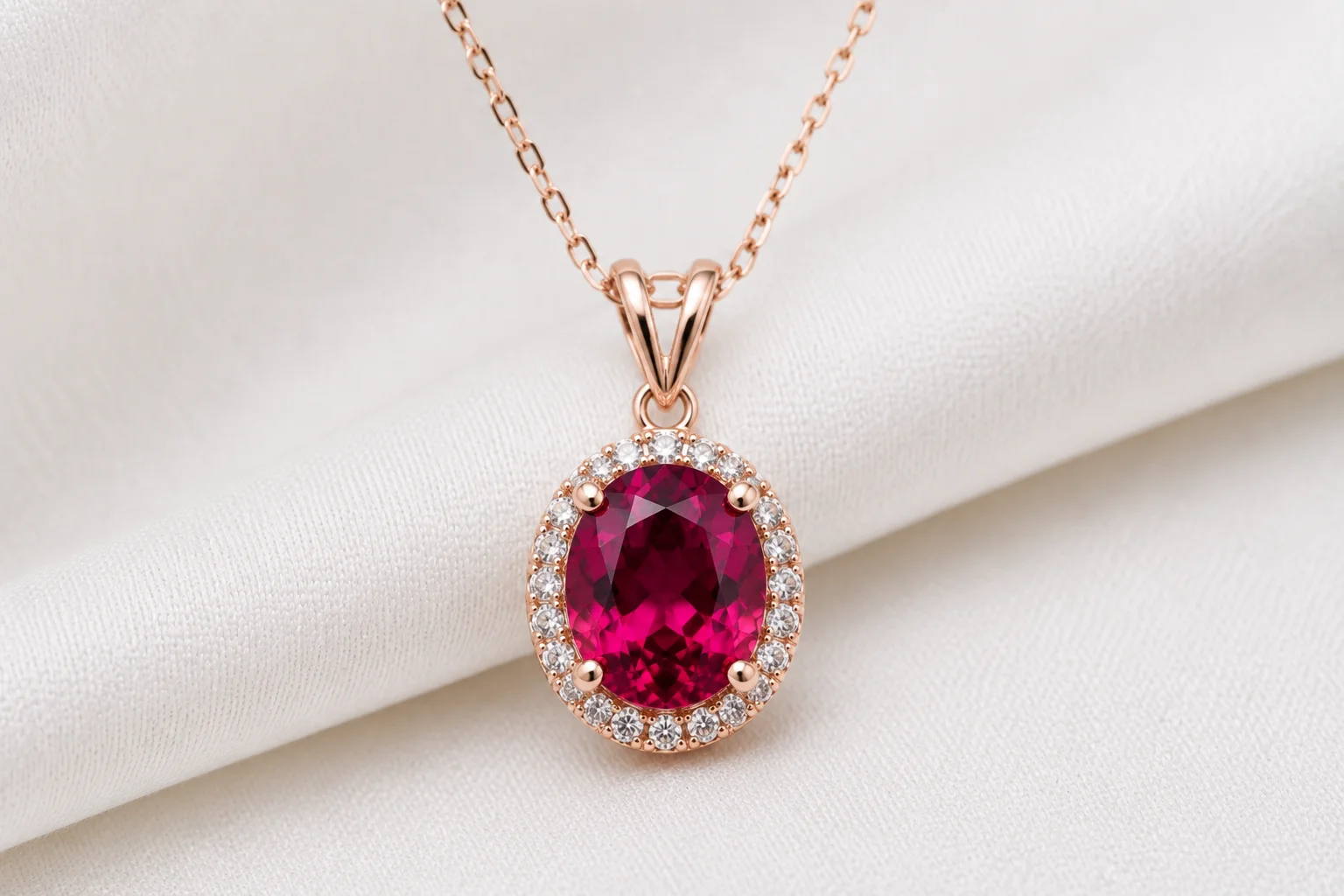
Halo Pendants
A halo surrounds rhodolite with diamonds, white sapphires or another contrasting material.
The border enlarges the visual footprint and makes the center color appear more saturated.
White accents create crisp contrast. Rose-gold halos produce a softer tonal look, while pink sapphire accents can shift the overall appearance toward magenta.
The halo should follow the center stone evenly. Gaps, tilted accents or inconsistent prongs make the pendant look poorly finished.
Residue collects easily beneath small halo stones. An open gallery allows a soft brush to reach the back.
A halo should enhance rather than conceal the center. If the accents are too large, the rhodolite can lose its role as the principal gemstone.
Bezel-Set Pendants
A bezel surrounds the stone’s girdle with metal.
This construction protects edges, minimizes snagging and produces a smooth profile suitable for frequent wear.
A full bezel can make dark material look even deeper if it blocks too much light. Open-backed bezels and thinner rims help preserve brilliance.
A partial bezel exposes more of the stone while protecting selected sides. The metal must contact the gemstone precisely without gaps that allow movement.
Bezel settings are especially practical for travel, office wear and necklaces worn beneath scarves or layered clothing.
Three-Stone Pendants
Three-stone pendants may represent past, present and future, three family members or another personal sequence.
The design can use three rhodolites or combine rhodolite with diamonds, pink sapphires or complementary garnets.
Graduated stones usually create the best balance, with the largest gemstone at the bottom or center.
All three rhodolites should share a similar hue and tone. A pale pink stone beside two deep burgundy stones may look accidental unless the color graduation is deliberate.
The links between articulated stones should move smoothly without allowing the components to overlap.
Cluster Pendants
Cluster pendants arrange several smaller rhodolites into floral, geometric or abstract designs.
They provide substantial surface color without the cost of one equally large clean stone.
Round gems are most common because they fit closely together. Pears and marquises can form petals or star-like patterns.
Shared prongs reduce visible metal but may secure more than one stone. Damage to one shared prong can loosen multiple garnets.
Check the cluster from the side. Each stone should sit at the same intended height rather than tilting irregularly.
Station Necklaces
Station necklaces place rhodolites at intervals along a fine chain.
They create a lighter and more casual look than a continuous gemstone strand.
Bezel-set stations reduce snagging and allow the necklace to slide smoothly against clothing. Prong-set stations expose more of each stone but can catch on delicate fabric.
The chain should connect to opposite sides of each station so the gems face consistently. A poorly balanced station can flip and show its setting instead of the garnet.
Spacing determines the visual rhythm. Closely placed stones create a stronger color line, while wider intervals produce a minimal appearance.
The coordinated rhodolite garnet earrings guide provides matched-pair styling without requiring the necklace and earrings to be identical.
Graduated Rhodolite Necklaces
A graduated necklace uses smaller garnets near the clasp and larger stones toward the center.
The design requires extensive matching. Each stone should transition smoothly in dimensions, tone, saturation and cut.
Darkness becomes a concern as size increases. Larger rhodolites may appear richer, but overly deep stones can create a nearly black central section.
The necklace should drape evenly without stiff areas. Articulated settings must follow the curve of the neck.
A graduated necklace carries more weight than a simple chain pendant, so the clasp and connecting links need proportionate strength.
Rhodolite Bead Necklaces
Faceted beads produce sparkle, while smooth beads emphasize continuous color and polish.
Rhodolite beads are commonly drilled through the center. Inspect the holes for chips, whitening and fractures that could expand during restringing.
Knots between beads reduce direct contact and prevent an entire strand from scattering if the cord breaks.
Nylon-coated wire provides strength but can kink. Silk gives a traditional drape but eventually stretches and needs replacement.
A dark opaque strand may consist primarily of almandine or mixed red garnet rather than rhodolite. Fine rhodolite beads should normally reveal purple-red transparency under suitable light.
The relationship among rhodolite, pyrope garnet and almandine garnet is explained further in the complete types of garnet guide.
Choosing Rhodolite Color
Look for raspberry, rose-wine, cranberry, purplish-red or pinkish-red color.
A fine stone should remain recognizably colored under ordinary indoor lighting. Some dark contrast is necessary for brilliance, but the pendant should not look black across most of its surface.
Very pale rhodolite can appear more like pink tourmaline or light garnet. This can be attractive, although it differs from the stronger purple-red appearance many buyers expect.
Brown modifiers generally reduce the classic rhodolite look.
Examine photographs on both white and neutral gray backgrounds. A dark background can exaggerate brightness, while heavy digital saturation can remove brown or gray modifiers.
Clarity
Rhodolite is commonly eye-clean.
Small inclusions visible only under magnification are acceptable when they do not weaken the stone or disrupt brilliance.
Avoid prominent feathers reaching the surface, especially near a bail or prong where pressure is concentrated.
Dark crystals and cloudy zones should not dominate the face-up appearance.
A completely clean stone is not automatically synthetic. Natural red garnets frequently have high clarity.
Cut Quality
Cut controls whether rhodolite appears bright or nearly black.
Excessively deep pavilions retain weight but create dark extinction. Shallow cuts may produce a pale window through the center.
The outline should be symmetrical, with even shoulders and a centered culet.
For ovals, pears and marquises, a bow-tie-shaped dark area may occur across the center. A slight bow tie is normal, but it should not dominate the stone.
View the pendant from several distances. A cut that looks lively under a close spotlight should also show color in ordinary room light.
Millimeter Size and Carat Weight
Carat measures weight rather than visible dimensions.
Rhodolite is denser than quartz, beryl and many common necklace stones. A one-carat garnet may therefore look smaller than a one-carat stone of lower density.
Millimeter measurements provide a better indication of face-up size.
The completed carat-versus-millimeter chart explains how density affects apparent dimensions.
For a pendant, consider the size of the full setting and bail as well as the gemstone. A halo or broad bezel can make a modest rhodolite appear substantially larger.
Chain Lengths
Necklace length changes how a pendant interacts with the neckline and clothing.
| Approximate length | Typical position |
|---|---|
| 14–16 inches | Choker or high at the base of the neck |
| 17–18 inches | Near the collarbone |
| 20 inches | Below the collarbone |
| 22–24 inches | Upper chest |
| 28–36 inches | Long pendant or layering length |
Body proportions, neck circumference and pendant dimensions affect the result. Standard labels do not fit every wearer identically.
A heavy pendant needs a chain long and strong enough to drape without pulling uncomfortably at the neck.
Adjustable chains provide flexibility, but the unused extension should not tangle with hair or clothing.
Matching Chain Strength to the Pendant
A delicate chain can look attractive with a small rhodolite, but it must support the pendant’s total weight.
Cable, wheat, box and rope chains distribute stress differently. Box and wheat chains often provide greater visual and structural substance for heavier pendants.
The chain should pass through the bail without scraping or binding. If the bail opening is too narrow, the pendant may remain fixed at an awkward angle.
A removable pendant requires a bail large enough to pass over the clasp.
Inspect soldered links near the clasp and pendant. Open jump rings are common failure points.
Bail Design
The bail connects the pendant to the chain.
A fixed bail keeps the pendant oriented but restricts movement. A hinged bail allows articulation and can help the pendant lie flat.
Hidden bails create a clean appearance but may accommodate only thin chains.
Decorative bails can include diamonds or small rhodolites. Their size should remain proportionate to the center stone.
A bail should not press directly against the garnet’s girdle. Repeated metal contact can chip an exposed edge.
Choosing the Metal
Yellow gold emphasizes red and warm wine tones.
Rose gold blends with rhodolite’s raspberry color and creates a cohesive romantic appearance.
White gold, platinum and sterling silver provide greater contrast, often making the purple modifier more noticeable.
The choice should reflect personal preference, budget, chain weight and metal sensitivity rather than a rigid skin-tone rule.
Ask for exact fineness and alloy composition. White gold may contain nickel, sterling silver tarnishes and plated metals eventually wear.
Styling With Necklines
A short rhodolite pendant suits open collars, V-necks and scoop necklines.
Longer chains work well over high-necked clothing and simple solid colors.
A pendant should either sit above the neckline or below it. When it rests directly on an edge, it can disappear or tilt.
Rhodolite pairs naturally with cream, navy, black, charcoal, burgundy and many earth tones.
Patterned clothing competes with a small pendant, while a plain top allows the gemstone color to remain visible.
Layering Necklaces
A rhodolite solitaire can be layered with plain gold chains or small diamond stations.
Vary the chain lengths enough to keep pendants from striking one another.
Avoid placing rhodolite directly beside harder diamond, sapphire or ruby components. Those stones can scratch garnet when the necklaces rub together.
Fine chains also tangle more readily when their links have similar size and texture.
The gemstone hardness chart and toughness-versus-hardness guide explain why storage and layering compatibility matter.
Symbolism and Gift Use
Rhodolite’s traditional themes include affection, commitment, renewal and emotional courage.
A pendant places the stone near the chest, making it a natural choice for heart-centered symbolism without claiming a physical energetic effect.
The stone also belongs to the garnet family, January’s traditional birthstone. The complete calendar background appears in the January birthstone guide.
A rhodolite necklace can mark a birthday, anniversary, renewed commitment or personal milestone.
Meaning should remain personal. The gemstone does not guarantee love, reconciliation or a particular outcome.
Treatments and Imitations
Most rhodolite receives no routine color treatment.
Rare fracture filling may reduce the visibility of surface-reaching breaks.
Red glass, synthetic spinel, synthetic corundum and other simulants can imitate its color.
The general gemstone treatments guide explains filling and coating, while the recently drafted real-versus-fake garnet guide covers material identification.
For an unusually large or costly pendant, the gemstone certification guide explains when independent identification becomes proportionate.
Buying a Rhodolite Necklace
First decide whether the priority is one principal gemstone, a continuous color line or a lightweight layering piece.
Check the exact dimensions, total gemstone weight, metal fineness, chain length and clasp type.
Inspect the stone under more than one light. Look for lively purple-red color, balanced contrast and minimal windowing.
Confirm that the pendant hangs forward and that the chain fits the bail properly.
For online transactions, follow how to buy gemstones online and preserve enough of the return period to inspect color, comfort and construction.
A generic AAA label does not replace measurable dimensions, treatment disclosure or clear photographs.
Cleaning and Storage
Use warm water, mild soap and a soft brush.
Clean the pavilion, bail and chain junction carefully because skin oils collect behind the stone.
Avoid steam. Ultrasonic cleaning should be avoided when the rhodolite has fractures, filling or uncertain treatment.
The completed rhodolite garnet jewelry cleaning guide provides the full care procedure.
Store the necklace flat or hanging individually so the chain does not knot. Keep the pendant away from diamonds, rubies and sapphires.
Fasten the clasp before storage and avoid placing heavy jewelry on top of a fine chain.
Frequently Asked Questions
1. Is rhodolite suitable for a necklace?
Yes. Necklaces protect the stone from most impact, and rhodolite has sufficient hardness for regular wear.
2. What color should a fine rhodolite pendant show?
Look for lively raspberry, rose-red or purplish-red color without excessive brown or black extinction.
3. Which rhodolite cut works best in a pendant?
Round, oval, cushion and pear cuts all work well. The best choice depends on brightness, symmetry and the setting design.
4. Does a larger carat weight always mean a larger-looking pendant?
No. Carat measures weight. Millimeter dimensions and setting size determine face-up appearance more accurately.
5. Which setting protects rhodolite best?
A full or partial bezel provides strong edge protection and minimizes snagging.
6. What chain length is best?
An 18-inch chain suits many collarbone-level pendants, but body proportions, neckline and pendant size should determine the final choice.
7. Can a rhodolite pendant be worn every day?
Yes, provided the chain, bail and setting are secure and the necklace is removed before exercise, swimming and household work.
8. Does rhodolite look better in yellow or white metal?
Yellow and rose gold emphasize warmth, while white metals create contrast and can make purple tones more visible.
9. Is rhodolite usually treated?
Most material is untreated, although rare fracture filling and other alterations can occur.
10. Can rhodolite necklaces be layered with diamonds?
Yes, but prevent direct rubbing because diamond can scratch garnet.
11. How should a rhodolite necklace be cleaned?
Use warm soapy water and a soft brush, then rinse briefly and dry completely.
12. Is rhodolite a January birthstone?
Yes. Rhodolite belongs to the garnet family, January’s traditional birthstone group.
A successful rhodolite necklace balances color, movement and engineering. The stone should return raspberry or purple-red light, while the bail, chain and clasp keep the pendant secure and correctly oriented. Those construction details matter more than an unsupported grade or total carat figure, particularly in jewelry intended for frequent wear.
Rhodolite is indexed in Crystals That Start With R and Gemstones That Start With R.