Sphene vs Demantoid Garnet: How to Tell Them Apart
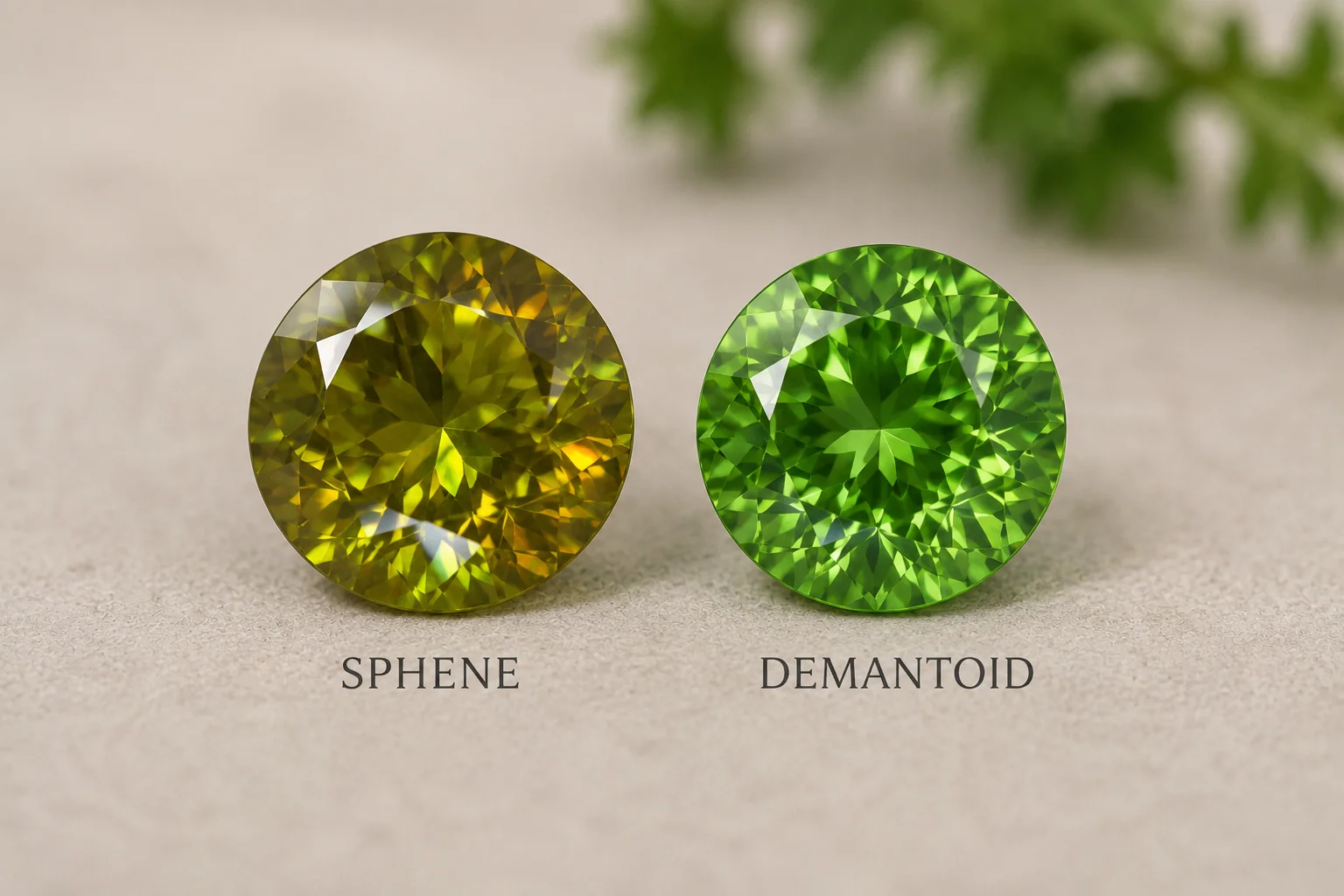
Sphene and Demantoid Garnet are two of the most fiery green gemstones. Both can display yellow-green, olive-green, or vivid green color combined with rainbow flashes strong enough to compete visually with Diamond.
Their similarities are mainly visual. Sphene, also called Titanite, is a calcium titanium silicate with strong double refraction, relatively low hardness, and distinct structural weakness. Demantoid is the green variety of Andradite Garnet. It is singly refractive, harder, denser, and more suitable for jewelry, although it still requires more care than Sapphire or Spinel.
The fastest distinction is often facet doubling. Sphene can show conspicuously doubled rear facet edges because of its exceptionally high birefringence. Demantoid is a cubic Garnet and normally remains singly refractive, so its facet junctions appear as single sharp lines.
Sphene and Demantoid Garnet at a glance
| Property | Sphene | Demantoid Garnet |
|---|---|---|
| Mineral identity | Titanite | Green Andradite Garnet |
| Typical composition | Calcium titanium silicate | Calcium iron silicate |
| Crystal system | Monoclinic | Cubic |
| Optical character | Doubly refractive | Singly refractive |
| Typical color | Yellow, yellow-green, green, orange, brown | Yellowish green to vivid green |
| Refractive index | Very high and variable, broadly about 1.84–2.11 | Very high, commonly around the upper 1.8s |
| Dispersion | Approximately 0.051 | Approximately 0.057 |
| Mohs hardness | About 5–5.5 | About 6.5–7 |
| Specific gravity | Commonly around 3.45–3.55 | Commonly around 3.8–3.9 |
| Cleavage or parting | Structurally vulnerable, with cleavage or parting concerns | No cleavage |
| Toughness | Poor; brittle | Fair to good, but still brittle |
| Main visual clue | Strong facet doubling and intense fire | Single facet edges, adamantine luster, possible horsetail inclusions |
| Best use | Collector gems, pendants, earrings | Protected rings, pendants, earrings, collector jewelry |
Sphene is the gemstone variety of Titanite
Sphene is the traditional gem-trade name for transparent or translucent Titanite. The mineral contains calcium, titanium, silicon, and oxygen, with iron, chromium, rare-earth elements, and other substitutions influencing its color.
Green Sphene can resemble Demantoid most closely, although Sphene also appears yellow, brown, orange, reddish, and nearly colorless. Its broader mineral and gemological profile appears in Sphene: Meaning, Properties & Symbolism.
Sphene’s most memorable feature is its fire. Its dispersion exceeds Diamond’s, so a well-cut stone can separate white light into vivid flashes of red, orange, yellow, green, blue, and violet.
However, strong bodycolor can mask part of that dispersion. A pale yellow-green Sphene may show more visible rainbow fire than a very dark green or brown stone.
Demantoid is green Andradite Garnet
Demantoid belongs to the Andradite species of the Garnet group. Its name comes from a word meaning Diamond-like, reflecting its strong luster and dispersion.
Chromium contributes to desirable green color, while iron commonly introduces yellow or brown components. Fine stones range from yellowish green through rich grass green to deeper green.
The individual material profile appears in Demantoid Garnet: Meaning, Properties & Symbolism. The wider family relationship is explained in Garnet: Meaning, Healing Properties & Uses and Types of Garnet.
Demantoid is one of the most valuable Garnet varieties. Attractive color, brilliance, rarity, origin, size, and certain inclusions can create a substantial premium.
Both gems can show more fire than Diamond
Dispersion measures how strongly a gemstone separates white light into spectral colors.
Demantoid’s dispersion is approximately 0.057, while Sphene is commonly listed near 0.051. Diamond is approximately 0.044.
Those figures do not mean every Sphene or Demantoid will appear more fiery than every Diamond. Visible fire also depends on bodycolor, cut, tone, brilliance, lighting, cleanliness, and stone size.
Demantoid combines high dispersion with strong refractive index and adamantine luster. Sphene combines intense dispersion with double refraction, which can make its internal appearance more complex.
A poorly cut stone of either type may appear dark, windowed, or lifeless despite excellent theoretical optical properties.
Facet doubling strongly suggests Sphene
Sphene has exceptionally high birefringence. Light entering the gemstone divides into two rays that travel at substantially different speeds.
When the stone is examined through a crown facet, rear facet junctions can appear doubled. Lines may look fuzzy, parallel, or split into two visible images.
The effect can be striking in larger, lightly colored stones. It may become harder to see when the gem is very small, dark, heavily included, or cut in an orientation that reduces the visual effect.
Demantoid is cubic and normally singly refractive. Its rear facet edges should remain single rather than producing the same widespread doubling.
Internal strain can cause anomalous reactions in Garnet under crossed polarizers, but it does not create Sphene’s characteristic strong birefringence.
Demantoid often looks sharper
Because Demantoid does not produce double images, its facet pattern can appear sharper and more organized. Fine stones combine crisp junctions with strong brilliance and flashes of spectral color.
Sphene may look slightly softer or busier internally because doubled edges overlap with inclusions and fire.
This does not make one appearance objectively better. Some collectors value Sphene precisely because its visual activity is unusually intense, while buyers seeking a cleaner, more Diamond-like green gem may prefer Demantoid.
Color differences
Sphene frequently leans yellow-green, olive, chartreuse, brownish green, or golden green. Chromium-rich material can reach stronger greens, but much of the market retains a warm yellow component.
Demantoid also commonly contains yellow, yet the most valued stones generally show an attractive green with minimal brown. Rich green Russian material can resemble fine Tsavorite or Emerald while retaining Demantoid’s stronger fire.
Color alone cannot separate them. Both materials can occupy yellowish-green and medium-green territory, especially in photographs.
A neutral background and daylight-equivalent illumination help reveal whether the stone is primarily green, yellow-green, olive, or brownish.
The broader ring-market context for both materials appears in Green Gemstones for Engagement Rings.
Refractive index
Both gems have high refractive indices, but their instrument behavior differs.
Demantoid frequently produces a reading near or above the upper practical limit of a standard gemological refractometer. It provides one principal reading because the gem is singly refractive.
Sphene has multiple refractive indices and extremely strong birefringence. Depending on the stone and instrument, readings may be difficult to obtain because parts of its range exceed ordinary refractometer limits.
Reflectivity meters, microscopy, spectroscopy, and direct observation of facet doubling become useful when standard readings are incomplete.
The combination of very high birefringence and strong doubling is much more characteristic of Sphene than Demantoid.
Density
Demantoid is generally denser than Sphene.
A Demantoid and Sphene with identical dimensions and cutting proportions should not weigh the same. The Demantoid will usually be heavier because Andradite Garnet has a higher specific gravity.
Hand heft is rarely precise enough for small gemstones. Cut depth, girdle thickness, setting metal, and shape can overwhelm the difference.
Hydrostatic specific-gravity measurement provides stronger supporting evidence for loose stones.
Horsetail inclusions favor Demantoid
Certain Demantoids contain radiating bundles of fine fibers or tubes traditionally called horsetail inclusions.
They may curve outward from a central crystal, dark grain, or concentration point and create a delicate sweeping form. The features are associated especially with Demantoid from serpentinite-related deposits.
A well-formed horsetail can increase collector appeal rather than reduce value. However, not every fine Demantoid has one.
Moreover, horsetail-like inclusions do not automatically prove Russian origin. Similar structures occur in Demantoid from other sources, and some Russian stones contain no horsetail.
The inclusion must be interpreted together with chemistry, other internal features, spectroscopy, and provenance.
Sphene inclusions
Natural Sphene can contain mineral crystals, needles, growth structures, fluid features, fractures, and internal strain.
Because the stone is doubly refractive, every inclusion may also appear doubled when viewed through suitable directions. That repeated imaging can help reinforce the Sphene identification.
A clear stone without obvious inclusions can still be natural. Conversely, included glass or synthetic material can contain imperfections that imitate natural growth.
Routine natural-versus-synthetic concern is less prominent for Sphene than for Ruby or Sapphire, but identity should still be confirmed for a significant purchase.
Hardness creates a major durability difference
Sphene ranks only about 5–5.5 on the Mohs scale. Everyday dust commonly contains quartz with hardness 7, so repeated contact can scratch and dull a Sphene surface.
Demantoid generally ranks about 6.5–7. It offers better abrasion resistance but remains softer than Sapphire, Spinel, or Chrysoberyl.
The difference is meaningful in jewelry. Sphene facet junctions can abrade relatively quickly, especially in rings. Demantoid tolerates wear better, although rough daily use can still produce chips and scratches.
The Gemstone Hardness Chart explains their positions on the Mohs scale.
Cleavage, parting, and brittleness
Sphene has structural weaknesses in addition to low hardness. Cleavage, parting, and brittleness can complicate cutting, setting, repair, and wear.
A sharp impact may chip a facet edge or break the stone. Excessive prong pressure can also cause damage during setting.
Demantoid has no cleavage, which gives it an important practical advantage. Nevertheless, Garnets are brittle and can still chip after a concentrated blow.
The role of internal structure is explained in Gemstone Cleavage Explained. The broader distinction between abrasion resistance and impact resistance appears in Gemstone Toughness vs Hardness.
Which is better for rings?
Demantoid is the more practical ring stone, but it is not indestructible.
A protective bezel, halo, low basket, or guarded prong setting can reduce exposure. Rounded shapes such as ovals and cushions are generally easier to protect than sharp pears or marquises.
Sphene is better reserved for pendants, earrings, brooches, and carefully worn collector rings. A Sphene ring should be treated as occasional jewelry rather than a default daily engagement ring.
Neither stone should be worn during exercise, cleaning, gardening, manual work, or activities involving hard surfaces.
Cutting behavior
Sphene challenges cutters because of its softness, brittleness, strong birefringence, and structural weakness. Correct orientation must balance face-up color, fire, clarity, and the visual effect of facet doubling.
A cut that is too deep can make the stone appear dark. A shallow cut may window. Weakly polished facets can abrade further during wear.
Demantoid is also valuable enough that cutters often retain weight. This can produce deep pavilions or outlines influenced by the rough.
A fine Demantoid should return light across the face rather than becoming dark through the center. Horsetail inclusions may also influence orientation because collectors often want them visible beneath the table.
Treatments
Routine treatment is less central to both markets than it is for Ruby, Sapphire, Emerald, or Tanzanite.
Nevertheless, heating, coating, filling, repair, and other modifications may occur in colored gemstones. A seller should disclose any process that affects color, clarity, permanence, durability, or value.
Demantoid heat treatment has been reported in portions of the market, particularly to modify unwanted color components. Detection can be difficult in some stones.
A high-value example should receive independent testing rather than relying on a claim that Garnet is never treated.
The universal distinction among treatment, imitation, and laboratory growth appears in Gemstone Treatments Explained.
Lookalikes
Green Zircon can show strong brilliance and visible facet doubling, making it a possible Sphene lookalike. However, its density, hardness, refractive properties, and inclusion scene differ. The material profile appears in Zircon: Meaning, Properties & Symbolism.
Peridot can overlap with yellow-green stones but has lower refractive index and much weaker dispersion. Its broader identity appears in Peridot: Meaning, Properties & Symbolism.
Green Spessartine-rich Garnet, Grossular, Mali Garnet, Chrysoberyl, Tourmaline, and glass may also enter the comparison.
The broader Garnet purchasing framework appears in the Garnet Buying Guide, while Demantoid-specific priorities belong to the Demantoid Garnet Buying Guide.
Rarity and value
Fine Demantoid is rare, particularly in larger sizes with strong green color, good clarity, and attractive cutting. Stones above one carat can become significantly less common, while large exceptional Russian examples occupy a specialized collector market.
A desirable horsetail may add interest, although an inclusion that reduces transparency or creates structural weakness can still lower value.
Sphene can occur in larger sizes than fine Demantoid, but clean, well-cut, strongly colored material remains collectible. Its price reflects color, transparency, fire, cutting, size, origin, and condition.
The Sphene Price Guide owns Sphene’s value structure. Wider Demantoid and Garnet pricing factors appear in the Garnet Price Guide.
Professional identification
A gemologist can separate the stones through optical character, facet doubling, refractive behavior, spectrum, density, microscopy, and chemical analysis.
Sphene’s strong double refraction is often decisive. Demantoid’s single refraction, Andradite properties, chromium-related spectrum, and possible horsetail inclusions support its identity.
Raman spectroscopy can identify Titanite or Andradite directly. X-ray fluorescence and other chemical methods provide additional confirmation.
The progressive examination process appears in How to Identify Crystals.
Reports and buying safeguards
A report is advisable for a valuable Demantoid, a significant claimed Russian stone, a large clean Sphene, or any purchase whose price depends heavily on origin or treatment.
A report should identify the mineral and note detectable treatment within the laboratory’s service scope. Geographic origin opinions are separate from basic identification and may not be possible for every specimen.
The completed Gemstone Certification Labs Compared explains laboratory selection. Use How to Read a Gem Lab Report to match the report’s weight, dimensions, photograph, identification, and comments to the exact stone.
Before buying from an unfamiliar dealer, follow How to Buy Gemstones Online Without Getting Scammed.
Frequently Asked Questions
1. What is the easiest difference between Sphene and Demantoid?
Sphene is strongly doubly refractive and commonly shows visible facet doubling. Demantoid is singly refractive.
2. Which gemstone has more fire?
Both have exceptional dispersion. Demantoid’s theoretical dispersion is slightly higher, while Sphene’s strong double refraction can make its appearance especially active.
3. Which is harder?
Demantoid is harder at approximately 6.5–7. Sphene is only about 5–5.5.
4. Which stone is better for a ring?
Demantoid is the safer choice, especially in a protective setting. Sphene is better for occasional wear.
5. Is Sphene the same as Titanite?
Yes. Titanite is the mineral name, while Sphene remains widely used in the gemstone trade.
6. Is Demantoid a Garnet?
Yes. It is the green gem variety of Andradite Garnet.
7. Do horsetail inclusions prove Russian origin?
No. They occur in Demantoid from multiple serpentinite-related sources, and some Russian stones do not contain them.
8. Does every Sphene show doubled facets?
Strong doubling is characteristic, but it may be difficult to see in small, dark, included, or specifically oriented stones.
9. Which gemstone is heavier?
Demantoid is generally denser than Sphene and should weigh more at equal dimensions.
10. Can Peridot be confused with either stone?
Yes. Yellow-green Peridot can overlap visually, but it has lower refractive index and weaker dispersion.
11. Are Sphene and Demantoid commonly treated?
Routine treatment is less prevalent than in many major gemstones, but treatment claims should still be verified for valuable material.
12. When should I request a laboratory report?
Testing is worthwhile when the stone is valuable, unusually large, sold with a prestigious origin, or priced according to exceptional treatment status.
Conclusion
Sphene and Demantoid Garnet share green color and extraordinary fire, but their optical and physical behavior separates them clearly.
Sphene is a strongly doubly refractive Titanite gem whose doubled facets, softness, and brittleness make it visually dramatic but difficult for daily jewelry. Demantoid is a singly refractive Andradite Garnet with sharper facet definition, higher hardness, no cleavage, and better ring suitability.
For collectors, Sphene offers an unusually animated optical display. For wearable fine jewelry, Demantoid provides the stronger balance of fire, rarity, and durability.