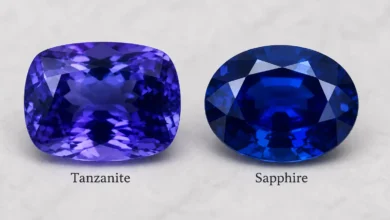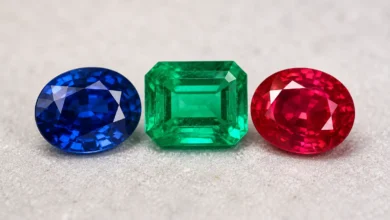

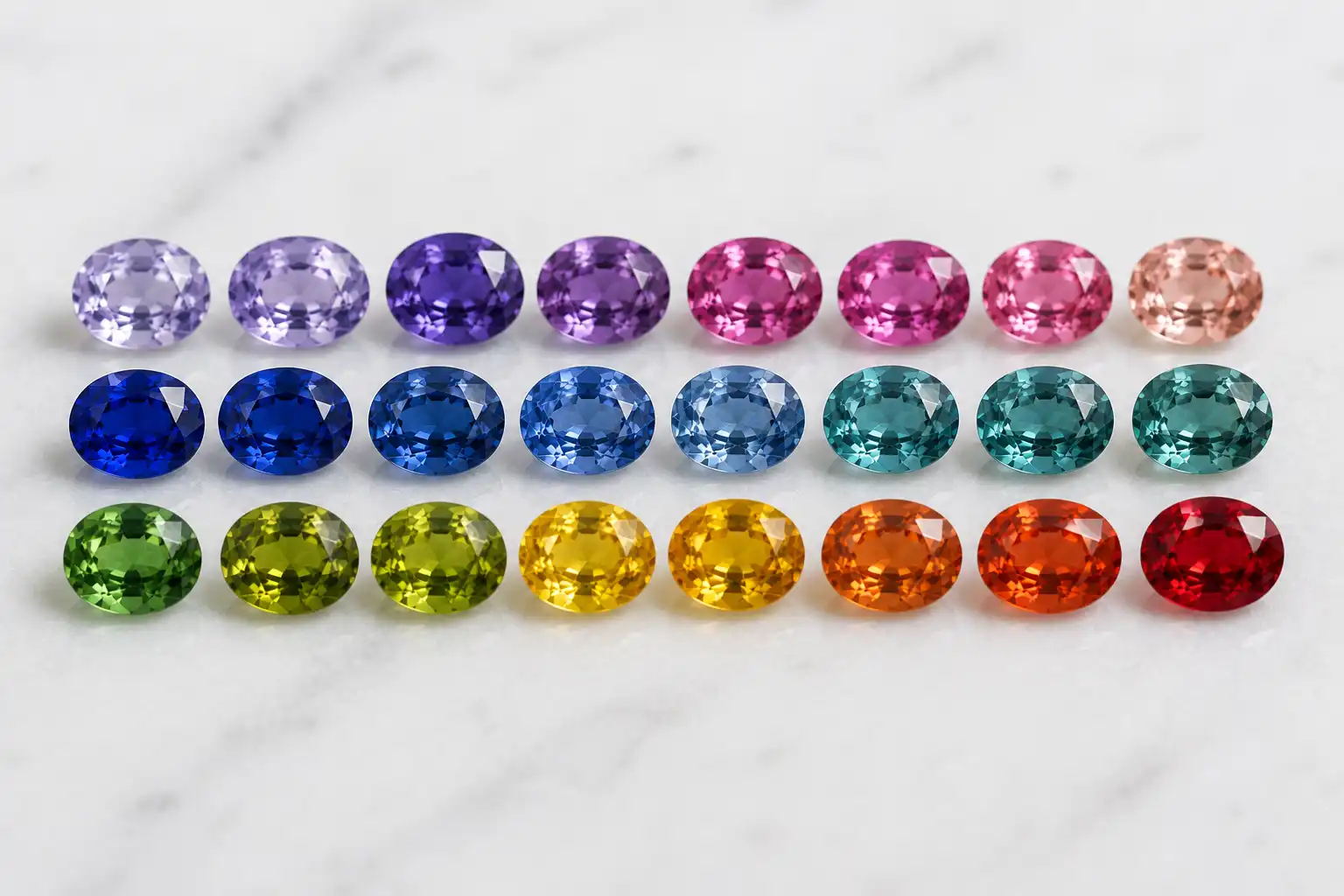

Sapphire’s colors come from trace elements: iron and titanium make blue, chromium makes pink, and iron alone makes yellow and green. Each color also carries its own symbolism — blue for wisdom and truth, pink for love, yellow for prosperity, green for tranquility. The chemistry is fact. The meanings are cultural traditions, not science, and worth enjoying on those terms.
This guide covers sapphire’s colors from both angles. You’ll learn what physically creates each color and what each has traditionally represented. At Gems Lore, we share gem lore honestly.
A quick note first. Crystal traditions described here are belief-based, not medicine, and nothing in this guide is medical advice.
Sapphire Colors at a Glance
- Blue: iron + titanium. Wisdom, truth, loyalty.
- Pink: chromium. Love, compassion.
- Yellow: iron or color centers. Prosperity, confidence.
- Green: iron. Tranquility, growth.
- Padparadscha: delicate balance. Named for the lotus.
Why Sapphire Has So Many Colors
The chemistry is genuinely elegant, and it explains everything below.
Corundum — aluminum oxide — is colorless when pure. Every sapphire color is a trace impurity sitting in that lattice, usually less than 1% of the stone.
What makes sapphire unusual is how many different elements it accepts, and that a single mineral can present as blue, pink, yellow, green, or orange depending on which trace elements got caught during growth. Our types of sapphire guide maps the resulting family.
Crucially, none of this affects durability. Every color is hardness 9 with no cleavage.
Blue Sapphire
The chemistry. Blue comes from iron and titanium together, via a process called intervalence charge transfer — electrons hopping between the two elements absorb red and yellow light, leaving blue. Neither element alone does it; they need each other.
The meaning. Blue sapphire’s symbolism is the deepest in the family, and it’s genuinely ancient rather than recently invented.
The ancient world read its blue as the color of the heavens. Persians reportedly believed the earth rested on a giant sapphire whose reflection colored the sky.
In medieval Europe it became the stone of clergy and kings — bishops wore sapphire rings — symbolizing divine favor, heavenly wisdom, and truth. It was believed to protect against envy and to reveal deception.
Today it’s associated with wisdom, truth, loyalty, and nobility, and its royal link is very much alive through the most famous engagement ring in the world. Our sapphire meaning guide covers the history in full.
Pink Sapphire
The chemistry. Pink comes from chromium — the same element that makes ruby red, just less of it. Push the chromium further and the trade stops calling it sapphire and starts calling it ruby. The boundary is a judgment call, not a chemical line.
The meaning. Pink sapphire is traditionally linked to love, compassion, and emotional healing, following pink’s general symbolism. Because it’s a modern favorite rather than an ancient one, its lore is largely inherited from color association rather than deep history.
It’s become popular as an engagement stone — far cheaper than pink diamond, and vastly tougher.
Yellow Sapphire
The chemistry. Yellow comes from iron, or from color centers — lattice defects that trap electrons and absorb light.
The meaning. Yellow sapphire carries genuinely significant weight in Vedic astrology, where it’s associated with Jupiter and traditionally linked to prosperity, wisdom, and good fortune. It’s among the most commercially important gems in that tradition.
More broadly it’s associated with confidence, optimism, and abundance, following yellow’s general symbolism.
Green Sapphire
The chemistry. Green comes from iron, often with the same iron-titanium interplay that produces blue, just in different proportions. Many green sapphires are really a fine mixture of blue and yellow zones.
The meaning. Green sapphire is linked to tranquility, growth, and integrity, following green’s associations with nature and renewal. Some traditions connect it to the heart.
Historically underrated and still good value.
Teal Sapphire
The chemistry. A blue-green balance, most famously from Montana. The steely, slightly gray character comes from iron content.
The meaning. Teal has no deep traditional lore — it’s a genuinely modern favorite, driven by contemporary taste rather than history. Where meaning is claimed, it borrows from blue’s wisdom and green’s calm.
We’d rather say that plainly than invent a tradition for it.
Padparadscha
The chemistry. A delicate balance of chromium plus iron or color centers, producing pink-orange. The mix is fragile, which is why fine padparadscha is scarce.
The meaning. The name comes from the Sinhalese for lotus blossom, and the lotus carries genuine significance in Buddhist and Hindu traditions as a symbol of purity and spiritual awakening — rising clean from muddy water.
That’s an unusually well-grounded piece of gem lore, since the name itself is the meaning.
Purple and Violet Sapphire
The chemistry. Vanadium, or chromium-iron combinations.
The meaning. Purple’s traditional associations are with spirituality, intuition, and royalty, largely because purple dye was historically extraordinarily expensive, making it literally the color of kings.
Colorless (White) Sapphire
The chemistry. The absence of chemistry — this is nearly pure corundum with no significant trace elements.
The meaning. Associated with clarity, focus, and purity, following white’s symbolism.
The honest note: colorless sapphire has dispersion of just 0.018 against diamond’s 0.044, so it reads soft and glassy rather than fiery. People expecting diamond sparkle are frequently disappointed, as our best diamond alternatives guide explains.
Black and Gray Sapphire
The chemistry. Very high iron, or dense inclusions.
The meaning. Black is associated with protection and grounding, following the general symbolism of black stones. Inexpensive and popular in men’s jewelry.
Star Sapphire
Worth a note here because its “color” is really an effect.
The six-rayed star comes from needle-like rutile inclusions reflecting light. Traditionally, the three crossing bands were said to represent faith, hope, and destiny.
It’s the one case in sapphire where inclusions create value rather than destroying it.
An Honest Note on the Lore
We’ll be direct, because it matters.
There’s no scientific evidence that sapphire, or any crystal, affects wisdom, love, prosperity, tranquility, or health. The chemistry above is fact. The meanings are cultural traditions — some genuinely ancient and historically rich, like blue sapphire’s clerical symbolism and padparadscha’s lotus name; others recently assembled from color association, like teal’s.
That doesn’t make them worthless. A stone worn as a reminder of something matters to the person wearing it, and the history is genuinely interesting. But the meaning comes from you and from culture, not from the trace iron. It should never replace medical or psychological care. Our are crystals worth it guide explores this honestly.
Does Color Affect Value?
Yes, enormously — and not in the order the symbolism might suggest.
Vivid royal and cornflower blue command the most among blues. Padparadscha rivals or exceeds them. Vivid pink and yellow trade strongly. Teal, green, and color-change are collector niches.
Fancy is not a discount category. What actually drops value is dark, inky, grayish, or greenish material, regardless of which color family it sits in. Our sapphire price guide covers the tiers.
Frequently Asked Questions
What causes sapphire’s different colors?
Trace elements in the corundum lattice, usually under 1% of the stone. Iron and titanium together make blue, chromium makes pink, iron or color centers make yellow, and iron makes green. Pure corundum with no trace elements is colorless. None of this affects durability.
What does blue sapphire symbolize?
Wisdom, truth, loyalty, and nobility. Its lore is genuinely ancient: the classical world read its blue as the color of the heavens, and in medieval Europe it was the stone of clergy and kings, symbolizing divine favor. These are cultural traditions, not scientific facts.
Why is pink sapphire not ruby?
Only the intensity of the chromium. Both are corundum colored by chromium; when it pushes the color strongly enough into red, the trade calls it ruby, and anything less is pink sapphire. The boundary is a judgment call, and it matters commercially because ruby costs more.
What does padparadscha mean?
It comes from the Sinhalese for lotus blossom, describing the stone’s delicate pink-orange. It’s unusually well-grounded gem lore, since the lotus carries genuine significance in Buddhist and Hindu traditions as a symbol of purity and spiritual awakening, rising clean from muddy water.
Is yellow sapphire important in astrology?
It carries genuine weight in Vedic astrology, where it’s associated with Jupiter and traditionally linked to prosperity, wisdom, and good fortune, making it one of the most commercially significant gems in that tradition. This is a belief system rather than a scientific claim.
Does sapphire color affect price?
Enormously. Vivid royal and cornflower blue command the most among blues, while padparadscha rivals or exceeds them, and vivid pink and yellow trade strongly. Fancy colors aren’t a discount category. What actually drops value is dark, inky, grayish, or greenish material in any color family.
Where to Go From Here
Sapphire’s colors are a genuinely lovely piece of chemistry: a colorless mineral that becomes blue, pink, yellow, or lotus-orange depending on which stray atoms it caught while growing. Enjoy the symbolism for the history it carries, take the chemistry as fact, and choose the color you actually love.
Map the family in our types of sapphire guide, linked above, learn the stone in our sapphire meaning guide, or explore more in our crystal meanings chart.
Which sapphire color speaks to you? Tell us in the comments.
This guide is for general educational purposes and is not appraisal advice. Crystal traditions described here are belief-based, not scientific fact, and are not medical advice.