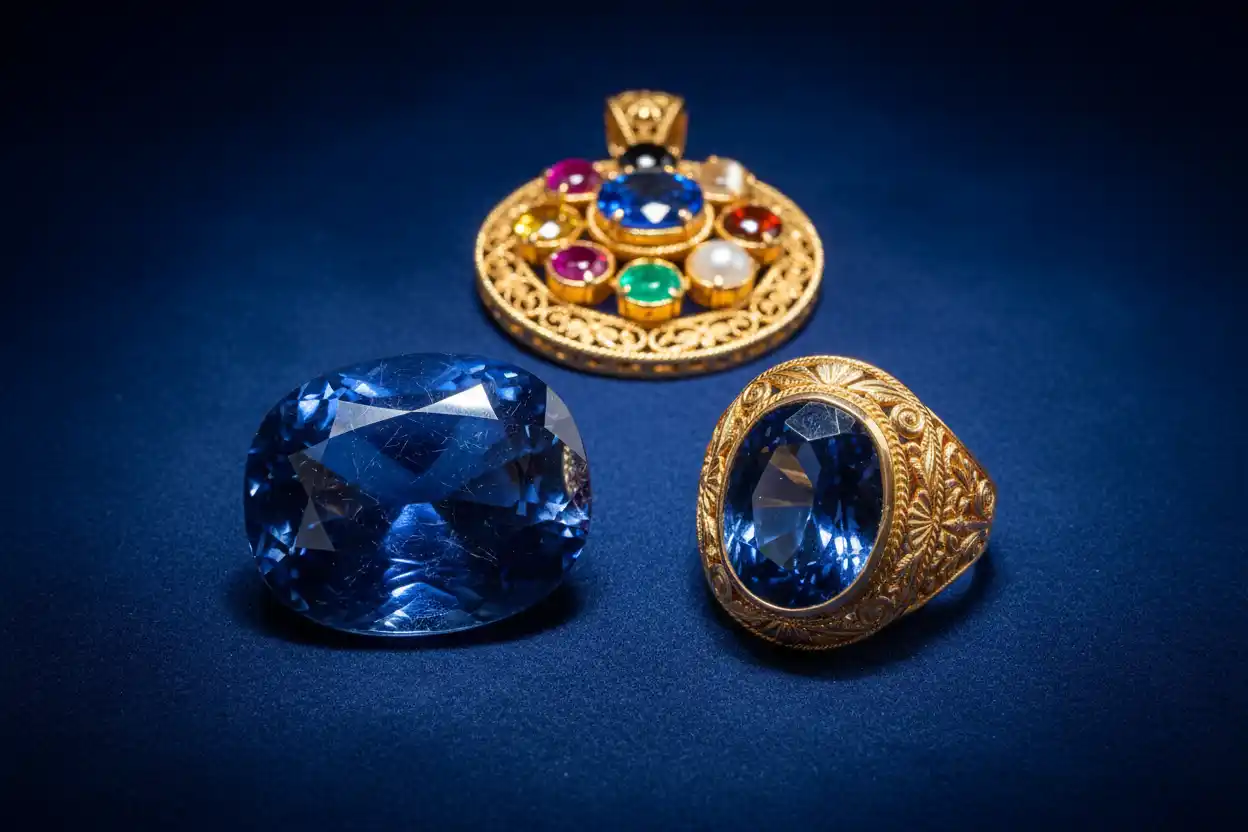
Neelam Blue Sapphire: Vedic Meaning and Buying Guide
Neelam is the South Asian name commonly used for blue Sapphire, especially when the gemstone is discussed within Jyotish, Navagraha and Vedic astrological traditions. It is associated with Shani, the graha corresponding with Saturn, and is often described as one of the most powerful and demanding planetary gemstones.
Gemologically, Neelam is not a separate mineral variety from blue Sapphire. It is blue corundum, an aluminum-oxide crystal whose color commonly develops through interactions involving iron and titanium. Its hardness, inclusions, treatments and geographic origin must be assessed through gemological evidence rather than astrological terminology.
The two frameworks should remain distinct. Astrology interprets Neelam through Saturn-related symbolism involving discipline, responsibility, delay, endurance and consequences. Gemology evaluates the stone through identity, natural or laboratory origin, color, clarity, cut, treatment and durability.
The complete Sapphire gemstone guide owns Sapphire’s broad geology and material profile. This article focuses specifically on Neelam as a Vedic and South Asian cultural gemstone.
Neelam at a Glance
| Feature | Neelam Blue Sapphire |
|---|---|
| Gemological identity | Blue corundum |
| Chemical formula | Al₂O₃ |
| Crystal system | Trigonal |
| Main color contributors | Iron and titanium interactions |
| Typical colors | Violetish blue, pure blue, greenish blue and grayish blue |
| Mohs hardness | 9 |
| Cleavage | None, although parting may occur |
| Toughness | Generally excellent |
| Vedic association | Shani or Saturn |
| Navratna position | Saturn’s gemstone |
| Common treatments | Heat, diffusion, fracture filling and laboratory growth |
| Principal sources | Sri Lanka, Myanmar, Madagascar, Kashmir, Australia and others |
| Traditional themes | Discipline, endurance, accountability, status and delayed results |
| Main buying concern | Treatment, overly dark color, synthetic material and unsupported origin claims |
| Main care concern | Setting damage, filled stones and mixed-gem jewelry |
What Does Neelam Mean?
Neelam, also written nilam or neelam, is a term used across several South Asian languages for a blue gemstone and, in gem commerce, most often blue Sapphire.
The name by itself does not confirm mineral identity. Blue glass, synthetic corundum, Iolite, Spinel, Kyanite and other materials may be sold under vague blue-stone descriptions.
A genuine Neelam sold as blue Sapphire should test as corundum. Its value depends on natural or laboratory origin, treatment, color, transparency, cutting and condition.
The word can carry astrological meaning in one context and ordinary trade meaning in another. Buyers should therefore ask whether a seller means natural blue Sapphire, laboratory-grown Sapphire or simply a blue astrological stone.
Blue Sapphire as Corundum
Sapphire and Ruby belong to the corundum mineral species.
Pure corundum is colorless. Trace elements and structural effects produce its many colors. Red corundum is Ruby, while blue and other non-red colors fall within the Sapphire category.
Blue commonly develops through charge-transfer interactions involving iron and titanium. Variations in concentration, zoning and oxidation conditions produce violetish, pure, greenish and grayish blues.
The Types of Sapphire guide owns the complete color and variety framework.
Neelam usually refers to blue material rather than yellow, pink, white or Padparadscha Sapphire. The corresponding Vedic yellow-Sapphire page is Pukhraj in Vedic Tradition.
Neelam and Shani
Within Jyotish traditions, blue Sapphire represents Shani, the graha associated with Saturn.
Shani symbolism commonly includes time, discipline, duty, labor, limits, patience, justice, maturity and consequences. The gemstone is consequently treated with greater caution than a general fashion accessory in some astrological communities.
These meanings do not arise from measurable radiation emitted by Sapphire. They belong to a symbolic system that connects celestial bodies, colors, metals, days, mantras and gemstones.
A person may wear Neelam as a religious object, family tradition, cultural symbol or reminder of discipline without claiming that corundum changes planetary motion.
Neelam Within Navratna
Neelam is one of the nine standard stones in Navratna jewelry.
In the modern standard arrangement, Ruby represents the Sun, Pearl the Moon, Red Coral Mars, Emerald Mercury, Yellow Sapphire Jupiter, Diamond Venus, Blue Sapphire Saturn, Hessonite Rahu and cat’s-eye Chrysoberyl Ketu.
The complete Navratna set is traditionally interpreted as representing the full group of celestial influences rather than strengthening Saturn alone.
Historical jewels may contain substitutions, irregular cuts or different arrangements. A deviation from a modern diagram does not automatically make an antique piece culturally invalid.
Traditional Meaning of Shani
Shani is often described through themes that can sound severe: delay, restriction, responsibility, hardship and karmic consequence.
However, the symbolism also includes persistence, structure, humility, long-term achievement and learning through experience.
A grounded interpretation of Neelam can therefore use the stone as a reminder to complete difficult obligations, plan realistically and accept the time required for meaningful results.
The gem cannot punish a wearer, shorten a life, cause unemployment or create misfortune through a gemological mechanism.
Claims that one stone produced every positive or negative event after wearing it should be treated as personal interpretation rather than proof of causation.
Claimed Benefits of Neelam
Astrological literature and modern sellers attribute many benefits to Neelam, including career progress, financial stability, protection, authority, concentration and relief from delay.
None of these outcomes has been scientifically established as an effect of blue Sapphire.
A gemstone cannot guarantee employment, promotion, court victory, business income, marriage, protection from fraud or recovery from disease.
The detailed belief-based emotional and chakra claims belong to Sapphire Healing Properties.
Someone who values the symbolism can pair the ring with practical behavior: completing delayed work, reviewing expenses, documenting commitments or creating a realistic timeline.
Who Is Traditionally Advised to Wear Neelam?
Different astrological schools provide different recommendations.
Some practitioners associate Neelam particularly with charts in which Saturn is considered beneficial, strongly placed or functionally supportive. Others base advice on ascendant, Moon sign, planetary periods, houses, aspects and the complete birth chart.
Commercial lists that recommend Neelam to every Capricorn or Aquarius oversimplify a much more complex tradition.
There is no gemological rule restricting Sapphire by zodiac sign, birthday, religion or gender.
Anyone following a specific astrological discipline should consult a trusted practitioner within that tradition rather than treating a generic online list as a personalized chart reading.
Traditional Trial Periods
Some modern Jyotish practitioners suggest testing Neelam for a short period before commissioning a permanent ring.
The practice may involve keeping the stone nearby, wearing it temporarily or observing dreams and life events. Methods and durations vary widely.
A trial period is an astrological custom, not a gemological test. It cannot determine whether a Sapphire is natural, heated, synthetic or suitable for jewelry.
Ordinary coincidences, anxiety and heightened attention can make unrelated events feel connected with the trial.
Material identity must be established through gemological examination, while personal comfort and cultural interpretation remain separate decisions.
Traditional Wearing Customs
Common modern instructions may specify a Saturday, a particular mantra, a middle finger and a setting made from silver, iron, gold or a mixed metal.
Some traditions prefer an open-backed ring so the gemstone touches the skin. Others use pendants or complete Navratna jewelry.
These practices are not universal. Regional, family and practitioner customs differ.
Skin contact does not change corundum’s optical or chemical behavior. An open-backed ring can also collect dirt and expose the stone to more direct impact.
The setting should remain mechanically sound even when ritual preferences influence its design.
Ratti, Carat Weight and Size
Astrological sellers often express Neelam weight in ratti rather than carats.
Ratti standards have varied historically and commercially, so the conversion should be stated explicitly on an invoice. The internationally standardized metric carat equals 0.2 grams.
Some practitioners recommend weight according to body weight or chart interpretation. Those formulas are belief-based and are not gemological quality standards.
A larger stone is not automatically more suitable or valuable. A dark five-carat Sapphire can appear less attractive than a lively two-carat stone with stronger face-up color.
Millimeter dimensions, cut depth and visible color should be considered alongside weight.
Choosing Neelam Color
Color is the most important visual factor in blue Sapphire.
Fine stones commonly show medium to medium-dark blue with strong saturation and enough brightness to remain lively. Violetish blue and balanced blue receive strong demand, while preferences for slightly greenish blue vary.
A stone that is too dark may look black in ordinary indoor light. Strong grayness can make the color appear dull.
The Sapphire Color Meaning guide owns symbolism across Sapphire colors, while gem quality remains a separate issue.
View Neelam under daylight-equivalent illumination, ordinary indoor light and weak light. Concentrated lamps can make a dark stone appear brighter than it will during daily wear.
Color Zoning
Natural blue Sapphire frequently shows color zoning.
The crystal may contain alternating blue and pale or nearly colorless growth areas. A skilled cutter positions the strongest color so it blends face-up.
Uneven zoning can create a dark patch, pale window or split-color appearance.
Color zoning may support natural growth interpretation, but it does not prove that the stone is untreated.
Laboratory-grown Sapphires can also show growth-related color patterns, while heat can alter the appearance of natural zoning.
A face-up video reveals zoning more effectively than one still photograph.
Neelam Clarity and Inclusions
Natural Sapphire may contain rutile silk, mineral crystals, fingerprints, healed fractures, growth zoning and cavities.
Some inclusions help establish natural origin and may support a geographic-origin opinion. Others threaten durability or reduce transparency.
Astrological sellers sometimes promote completely flawless Neelam as ideal. In practice, an unusually clean stone may be natural, synthetic or heavily treated; clarity alone does not determine authenticity.
A surface-reaching fracture near a prong requires more concern than a small internal crystal away from the girdle.
Star-producing rutile belongs to the separate Star Sapphire guide.
Cut and Face-Up Appearance
Blue Sapphire rough is often cut to retain weight and color.
This can produce deep pavilions, uneven outlines or off-center culets. A deep stone may weigh more while appearing smaller than expected.
A broad window weakens color and brilliance. Extinction creates dark areas that remain black through movement.
Oval and cushion cuts are common because they work efficiently with natural crystals. Rounds, pears, emerald cuts and custom forms are also available.
Astrological symbolism does not make poor cutting irrelevant. A well-cut stone presents color more effectively and creates greater practical value.
Kashmir, Sri Lankan and Burmese Neelam
Kashmir Sapphire has a celebrated reputation for velvety blue color and historical scarcity.
Sri Lanka, traditionally called Ceylon in the gem trade, produces a wide range from pale blue to vivid saturated stones. Many Sri Lankan Sapphires have relatively light rough that can respond well to heat treatment.
Myanmar produces important blue Sapphire, while Madagascar has become a major modern source. Australia, Thailand, Cambodia, Montana and other regions also produce blue material.
Origin can influence price, but no country name guarantees beauty or astrological suitability.
A Kashmir, Ceylon or Burma claim should be supported by a respected laboratory when it materially affects price.
Heat Treatment
Heat is the most common Sapphire treatment.
It can improve color, reduce zoning, dissolve rutile silk and alter clarity. Heated natural Sapphire remains natural corundum, but it occupies a different market from a comparable unheated stone.
Some astrological practitioners specify unheated material. That is a religious or traditional preference rather than evidence that heated Sapphire lacks gemological identity.
The Treated Sapphire guide owns heat, diffusion, filling and synthetic-material distinctions.
Known treatment should be stated in writing and reflected in price.
Diffusion and Fracture Filling
Diffusion treatment introduces or redistributes coloring elements near or within the surface.
Beryllium diffusion is associated mainly with fancy colors, while titanium-related diffusion can produce or strengthen blue near the surface.
Fracture filling may use glass or other substances to make cracks less visible.
These treatments can create attractive jewelry at lower prices, but they require clear disclosure. Surface-related color can also complicate repolishing.
A heavily treated Sapphire should not be sold as a premium natural unheated Neelam.
Laboratory-Grown Neelam
Laboratory-grown blue Sapphire has the corundum structure and can possess the same hardness and basic composition as natural Sapphire.
Its origin is manufactured rather than geological.
Flame-fusion, flux and hydrothermal-related methods can produce blue corundum with different growth features.
The Lab Sapphire guide owns the complete synthetic-material profile.
A laboratory-grown Neelam may suit affordable jewelry, but it must not be represented as mined. Astrological traditions differ on whether synthetic gems are acceptable.
Common Neelam Imitations
Blue glass, synthetic Spinel, Iolite, Kyanite, Tanzanite, blue Topaz and doublets can imitate blue Sapphire.
The Real vs Fake Sapphire guide owns the complete diagnostic process.
Color and hardness claims from a seller are not sufficient. Basic thermal Diamond testers do not identify Sapphire reliably.
A gemologist may use refractive index, specific gravity, pleochroism, spectroscopy and microscopy.
Avoid scratch tests, heated needles, acid and attempts to judge identity from one inclusion photograph.
Certification and Origin Reports
A laboratory report can identify natural or laboratory-grown corundum and describe detectable treatment.
Some reports provide geographic-origin opinions when evidence is sufficient. An origin conclusion is an expert interpretation based on inclusions, chemistry and spectroscopy rather than a permanent hallmark inside the stone.
The Gemstone Certification guide explains the difference between identification, grading, origin and appraisal.
A report does not confirm astrological compatibility, planetary strength or future results.
Verify the report number and compare the documented dimensions with the actual stone.
Buying Neelam
The full commercial process belongs to the Sapphire Buying Guide.
Decide first whether the purchase prioritizes Vedic tradition, natural unheated rarity, visual beauty, jewelry durability or budget. These priorities may lead to different stones.
Request neutral-light video, exact measurements, weight, treatment disclosure, natural or laboratory origin, return terms and a laboratory report when price justifies it.
The Sapphire Price Guide owns current market valuation.
Follow How to Buy Gemstones Online Without Getting Scammed when purchasing remotely.
Neelam Jewelry and Durability
Sapphire ranks 9 on the Mohs scale and is appropriate for frequently worn rings.
Hardness does not protect prongs, shanks or open-backed settings from bending. A ring intended for everyday wear needs adequate metal and periodic inspection.
Neelam can also be worn in pendants or Navratna designs. Mixed-gem pieces must follow the care requirements of softer components such as Pearl and Coral.
The September Birthstone guide covers Sapphire’s calendar-birthstone role, which is separate from its Saturn association.
Cleaning and Spiritual Care
Follow How to Clean Sapphire Jewelry Safely.
Warm water, mild soap and a soft brush are appropriate for most sound stones. Filled, coated or assembled material may require stricter care.
Ultrasonic or steam equipment should not be used without understanding treatments and setting condition.
Belief-based rituals, mantras and energetic cleansing belong to How to Cleanse and Charge Sapphire.
Physical cleaning removes oil and dirt. Spiritual cleansing is optional and does not verify authenticity or treatment.
Frequently Asked Questions
1. What is Neelam?
Neelam is the South Asian name commonly used for blue Sapphire, especially in Jyotish and Vedic astrological contexts.
2. Which planet is Neelam associated with?
It is traditionally associated with Shani, corresponding with Saturn.
3. Is Neelam different from blue Sapphire?
Not gemologically. Genuine Neelam is blue corundum; the name adds cultural and astrological context.
4. Is Neelam dangerous to wear?
Blue Sapphire is not physically dangerous when worn in sound jewelry. Claims of rapid bad luck or punishment belong to astrological belief rather than gemological evidence.
5. Who should wear Neelam?
Astrological schools differ and may evaluate the complete birth chart. There is no scientific or gemological restriction by zodiac sign.
6. Must Neelam be unheated?
Some traditions prefer unheated natural stones, but heated Sapphire remains natural corundum. Treatment should be disclosed.
7. Which Neelam color is best?
A lively medium to medium-dark saturated blue is generally desirable. Stones that look black in ordinary light should be evaluated cautiously.
8. Is Ceylon Neelam better than every other origin?
No. Sri Lanka produces excellent stones, but individual color, treatment, cut and clarity matter more than the country name alone.
9. Can laboratory-grown Sapphire be used as Neelam?
It can be used in jewelry when disclosed, although astrological practitioners differ on whether manufactured gems meet traditional requirements.
10. Does Neelam produce immediate results?
No scientifically verified mechanism links Sapphire with rapid financial, career or personal events.
11. Which finger and metal are traditional?
Many modern traditions recommend a middle finger and silver, iron or gold, but customs vary among practitioners and regions.
12. How should Neelam be cleaned?
Use warm water, mild soap and a soft brush unless a report or jeweler identifies filling, coating or another care-sensitive treatment.
Neelam occupies two legitimate but different worlds. Gemology identifies blue corundum and evaluates its color, inclusions, treatment and origin. Jyotish interprets the same stone through Saturn’s themes of time, discipline and consequence. Respecting the tradition does not require confusing symbolic meaning with laboratory evidence; the most responsible purchase understands both.
Neelam’s planetary, protective, medical, career and destiny-related effects are astrological or religious beliefs rather than scientifically established properties of Sapphire. Do not use the gemstone to replace medical care, financial advice, legal guidance or personal-safety decisions.