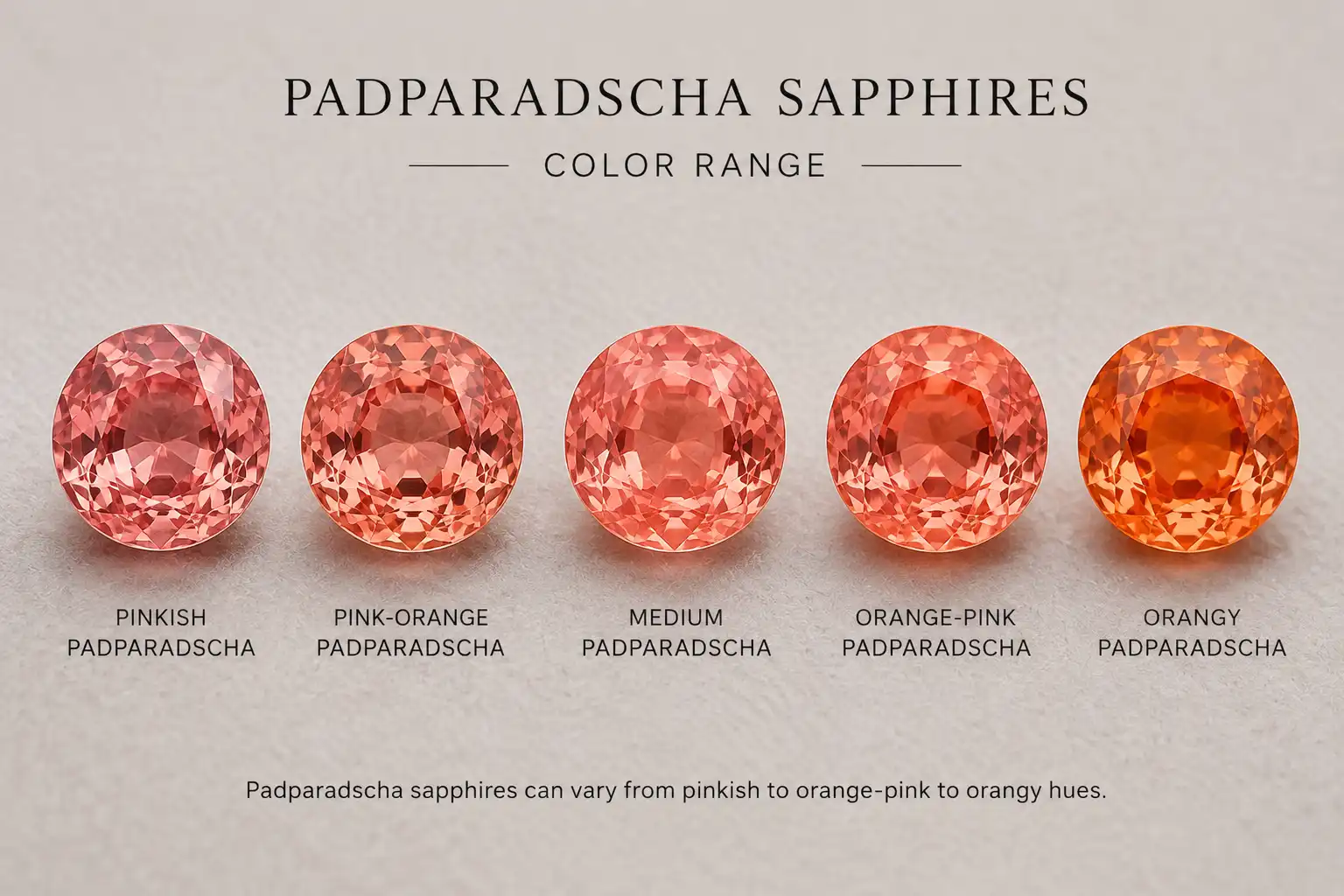
Padparadscha Sapphire Color Meaning and Symbolism
Padparadscha Sapphire is defined by a rare meeting of pink and orange. The color may appear as orangy pink, pinkish orange, salmon, peach or lotus-like coral, but the most respected examples retain a recognizable contribution from both sides of the spectrum.
Its name is associated with the Sinhalese language and the color of a lotus blossom. That origin explains why the stone’s symbolism often combines qualities traditionally assigned to pink—love, compassion and emotional openness—with orange themes involving creativity, warmth and action.
The color name has a technical dimension as well. Not every pink-orange Sapphire receives a Padparadscha description from a gemological laboratory. Tone, saturation, modifiers, distribution, treatment and color stability can all affect the decision.
The broader Padparadscha Sapphire gemstone guide owns the mineral’s formation, properties and sources. This page focuses specifically on color boundaries, cultural symbolism and responsible interpretation.
Padparadscha Color at a Glance
| Color aspect | Typical interpretation |
|---|---|
| Main hue range | Pinkish orange to orangy pink |
| Tone | Commonly light to medium |
| Saturation | Delicate to moderately strong rather than overly dark |
| Desired balance | Both pink and orange visible face-up |
| Common descriptive words | Lotus, salmon, peach, coral and sunset |
| Undesirable modifiers | Strong brown, gray, yellow, purple or red |
| Main value concern | Whether the color qualifies for the Padparadscha description |
| Main visual concern | Even distribution without strong zoning |
| Main treatment concern | Heat, diffusion, irradiation-related color and filling |
| Main stability concern | Orange or yellow color changing after light exposure |
| Main symbolic blend | Compassion joined with creative action |
| Main cultural reference | Lotus-flower color |
What Color Is Padparadscha?
Padparadscha occupies the boundary between pink Sapphire and orange Sapphire.
Some examples appear predominantly pink with an orange warmth. Others appear mainly orange with a clear pink component.
The accepted range is usually lighter and more delicate than vivid orange Sapphire or strongly saturated pink Sapphire.
A stone that looks entirely orange, yellow, red or purple generally belongs to another color category even when a seller uses the Padparadscha name.
Laboratory assessment becomes important because ordinary language such as peach and salmon covers a much broader range than the gemological trade term.
Pinkish Orange vs Orangy Pink
Pinkish orange means orange is the dominant hue with a visible pink modifier.
Orangy pink means pink dominates while orange modifies it.
Both directions can occur within the accepted Padparadscha range.
The exact balance affects personal preference. Some buyers prefer a warmer sunset-like orange, while others seek a cooler lotus-petal pink.
Neither direction should rely on one narrow flash or isolated zone. The face-up impression should carry the mixed color through a meaningful portion of the gemstone.
Tone
Tone describes how light or dark the color appears.
Padparadscha is generally associated with light-to-medium tones. Extremely pale stones may lose the recognizable mixed color, while dark examples can become brownish, red or overly orange.
A lighter tone does not mean low quality automatically. The category is valued partly for its delicate appearance.
However, a stone should still show enough saturation that the pink-orange identity remains visible outside strong jewelry-store lighting.
The setting and background can alter perceived tone, making loose-stone comparison valuable.
Saturation
Saturation describes color intensity.
Many colored gemstones receive their highest praise at strong saturation, but Padparadscha is not simply a contest for maximum intensity. Its appeal often depends on balance and delicacy.
Weak saturation can make a stone look washed out or nearly colorless. Excessive saturation may push it toward vivid orange, pink or red.
The most attractive stone holds enough color to remain clearly pink-orange while preserving brightness and transparency.
Saturation should be evaluated under several lighting conditions rather than one warm spotlight.
Color Distribution
Even color distribution contributes strongly to beauty.
Natural Sapphire can contain pink, orange, yellow and colorless zones. A skilled cutter orients the rough so these areas blend attractively face-up.
Strong zoning can create a stone that looks Padparadscha from one angle and ordinary pink or orange from another.
A small amount of variation may add character, but abrupt divisions weaken the unified lotus-like effect.
Video through movement reveals zoning more effectively than a single photograph.
Brown, Gray and Yellow Modifiers
Brown and gray reduce freshness and brightness.
A brownish stone may still be attractive as peach or autumn-colored Sapphire, but it can fall outside a strict Padparadscha interpretation.
Strong yellow can move the appearance toward yellow-orange Sapphire. Strong red may make the stone resemble orange-red or pink Sapphire.
Purple modifiers cool the color and can reduce the expected orange-pink balance.
These boundaries are not always obvious to an unaided buyer, which is why laboratory descriptions carry weight in the market.
The Lotus Association
Padparadscha is widely connected with the color of a lotus blossom.
Lotus flowers hold important cultural and religious meanings across South and Southeast Asia, including purity, spiritual development, beauty and emergence from difficult conditions.
The gemstone’s name therefore carries more than a commercial color label. It links the pink-orange appearance with a long-established visual symbol.
However, the lotus comparison should not be treated as one exact standardized flower color. Natural lotus petals vary, and gemological laboratories still need defined color criteria.
The association is cultural and descriptive rather than proof of geographic origin.
Pink Symbolism
Pink commonly represents affection, tenderness, compassion and emotional openness in modern color traditions.
Within Padparadscha, pink tempers orange’s activity and warmth. It can symbolize action that remains connected with empathy rather than impulsiveness.
A personal interpretation might use the stone to represent expressing care directly, repairing trust or allowing emotional honesty.
The gemstone cannot create love, guarantee reconciliation or change another person’s consent.
The Pink Gemstones guide provides the broader jewelry-color context, while Pink Crystals owns the wider spiritual list.
Orange Symbolism
Orange is commonly associated with creativity, enthusiasm, sociability and visible action.
Within Padparadscha, orange prevents the color from becoming purely soft or passive. It adds imagery involving warmth, courage and forward movement.
A grounded symbolic use might connect the stone with beginning a creative project or speaking with both confidence and consideration.
The Orange Gemstones guide owns the gemological orange spectrum, while Orange Crystals covers the broader spiritual category.
Orange does not biologically increase energy, fertility or motivation.
The Meaning of Pink and Orange Together
Padparadscha’s strongest symbolism comes from combination.
Pink can represent care, while orange represents action. Together they suggest compassionate initiative—feeling something deeply and responding constructively.
The blend may also symbolize the transition between one stage and another, similar to dawn or sunset. Such imagery makes the gem popular for engagements, anniversaries, personal milestones and creative achievements.
The stone does not guarantee that a transition will succeed. Its role is symbolic and commemorative.
Sunrise and Sunset Symbolism
Pink-orange color frequently evokes sunrise or sunset.
Sunrise suggests beginnings, hope and increasing visibility. Sunset can represent completion, reflection and transition.
Padparadscha can therefore carry different meanings depending on the occasion. An engagement ring may represent a beginning, while an anniversary bracelet may symbolize continuity through changing seasons.
These interpretations are personal rather than fixed gemological definitions.
A seller should not use poetic language to avoid disclosing treatment or actual color quality.
Creativity and Expression
Modern crystal traditions connect Padparadscha with creativity because of its orange component.
The Sapphire Healing Properties guide owns the wider belief-based claims for the corundum family.
A practical creative ritual can place the gemstone near a sketchbook, planning document or instrument as a cue to begin.
The stone cannot produce artistic ability or remove creative blocks through a measurable energy field.
Its color may still offer visual inspiration and emotional significance.
Love and Relationships
Pink-orange Sapphire is often interpreted as balancing affection with passion.
It can symbolize a relationship that combines tenderness, attraction, communication and shared activity.
That makes Padparadscha popular in bridal jewelry, although its color meaning extends beyond romance.
The gemstone cannot attract a specific person, guarantee fidelity or repair an unsafe relationship.
A responsible interpretation connects the stone with mutual action: listening, communicating clearly and respecting boundaries.
Confidence and Warmth
Orange contributes confidence symbolism, while pink softens the meaning toward warmth rather than dominance.
A person might wear Padparadscha before an important conversation as a reminder to speak clearly without becoming dismissive.
Confidence comes from preparation, experience and self-knowledge. Corundum does not create competence by touching the skin.
The color can nevertheless become a useful personal emblem.
Padparadscha vs Pink Sapphire
Pink Sapphire can range from pale blush to vivid magenta and purplish pink.
A stone with only a minor orange warmth may still be classified simply as pink Sapphire rather than Padparadscha.
Padparadscha requires orange to remain visibly important in the overall color.
The broader Sapphire Color Meaning guide explains pink, blue, yellow, white and other corundum colors.
A laboratory report offers more reliable terminology than comparing product photographs online.
Padparadscha vs Orange Sapphire
Orange Sapphire may be yellowish orange, pure orange or reddish orange without a meaningful pink component.
Padparadscha lies closer to the border between the two color families.
Some sellers use the rare name to increase the perceived value of an attractive peach or orange stone. This makes documentation essential.
An orange Sapphire can be beautiful and valuable without qualifying as Padparadscha.
Accurate naming protects both categories.
Padparadscha vs Peach Sapphire
Peach Sapphire is a broad commercial term.
It can include pale pink-orange, beige-pink, yellowish pink, brownish orange and several other warm pastel colors.
Some peach Sapphires meet Padparadscha criteria, but many do not.
Peach describes appearance, while Padparadscha is a narrower prestige category supported by laboratory opinion.
A bracelet or ring may be sold honestly as peach Sapphire without carrying the Padparadscha premium.
Padparadscha vs Morganite
Morganite is pink-to-orange-pink beryl rather than corundum.
Its pale peach and salmon colors can resemble Padparadscha, particularly in rose-gold settings.
Morganite has lower hardness and different refractive properties, density and inclusions.
Padparadscha generally shows stronger brilliance and greater scratch resistance, while Morganite is more available in large sizes.
Color similarity does not imply equal rarity, durability or price.
Lighting and Metal Reflection
Padparadscha can appear different in daylight, warm indoor light and cool white illumination.
Rose gold reflects pink and copper tones into the stone. Yellow gold strengthens warmth, while white metal reveals the bodycolor more independently.
A qualifying stone should not need one specific setting or bulb to appear pink-orange.
View the gem loose when possible and compare it against neutral white, gray and skin backgrounds.
Edited photographs can exaggerate saturation or remove brown and yellow modifiers.
Pleochroism
Sapphire can show different color strengths along different crystallographic directions.
A pink-orange stone may appear pinker or more orange as it moves.
Cut orientation should preserve the most balanced face-up color.
Pleochroism does not automatically create Padparadscha. The primary appearance still needs to fit the accepted range.
A gem that shows pink from one narrow direction and yellow-orange from another may fail to present a unified color face-up.
Heat Treatment
Heating is common and accepted in Sapphire.
It may improve color, clarity or both. Heated Padparadscha-colored Sapphire remains natural corundum.
Comparable unheated material generally receives a premium because it is rarer.
The Treated Sapphire guide owns heat, diffusion, filling, dye and laboratory-grown categories.
Treatment disclosure should accompany symbolism and storytelling rather than being hidden behind them.
Diffusion and Irradiation-Related Color
Diffusion can introduce color-producing elements into Sapphire.
Some processes create color concentrated near the surface, while others penetrate more deeply.
Certain pink, yellow and orange Sapphires can also display color-instability behavior linked with exposure to ultraviolet-containing light and other illumination conditions.
A laboratory may test whether the observed orange component remains stable before assigning a Padparadscha description.
These issues cannot be resolved reliably through ordinary photographs.
Color Stability
Color stability matters because a stone may appear more orange after ultraviolet exposure and less orange after controlled fading.
If the orange component is unstable, the gem’s classification and appearance require careful reporting.
The change does not mean the stone becomes a different mineral. It affects how its color is described under standardized conditions.
Buyers of valuable Padparadscha should ask whether the report includes a color-stability conclusion.
A stone’s appearance under showroom ultraviolet-rich lighting may not represent its stable ground-state color.
Laboratory Reports
GIA and other major laboratories may state whether a Sapphire meets their criteria for Padparadscha.
Definitions and reporting policies can vary slightly, making the issuing laboratory relevant.
The Gemstone Certification guide explains report scope, treatment language and origin opinions.
The Real vs Fake Sapphire guide owns natural, synthetic and imitation identification.
A seller’s verbal claim should not replace an independent report when the color name creates a major premium.
Color and Jewelry Styles
A Padparadscha Sapphire bracelet emphasizes matching several stones.
Padparadscha Sapphire earrings require pair balance, while a Padparadscha Sapphire necklace can present one larger gem.
A Padparadscha Sapphire ring makes the color a central focal point.
Metal affects the presentation, but the stone’s own pink-orange identity should remain visible.
Color and Value
The Padparadscha Sapphire Price Guide owns market valuation.
Color qualification, treatment, origin, clarity, size and cutting all affect price.
A perfectly balanced small stone can command more per carat than a larger brownish or weakly zoned example.
The trade name should not be assigned solely to justify a higher retail price.
The Padparadscha Sapphire Buying Guide provides the complete purchase workflow.
Personal Symbolism
Padparadscha can represent a person who combines warmth with decisiveness.
It may mark a creative career, a compassionate leadership style, a relationship milestone or a period of renewal.
Personal meaning does not require adherence to one chakra or metaphysical system.
A gem becomes symbolically powerful through the event, intention and memory attached to it.
The material remains Sapphire regardless of the interpretation.
Directory Context
Padparadscha appears within Crystals That Start With P and Gemstones That Start With P.
Those directories help readers distinguish it from Painite, Pearl, Peridot, Petalite and other materials sharing the same initial.
Alphabetical grouping is navigational rather than mineralogical.
Padparadscha’s closest identity remains the Sapphire and corundum family.
Frequently Asked Questions
1. What color is Padparadscha Sapphire?
It is generally pinkish orange to orangy pink, usually in light-to-medium tones.
2. Does every peach Sapphire qualify?
No. Peach is a broader commercial term, while Padparadscha follows narrower laboratory criteria.
3. Should Padparadscha be more pink or more orange?
Either color can dominate slightly, provided both remain visibly important and the stone fits the accepted range.
4. Why is it called Padparadscha?
The name is associated with a Sinhalese term and the pink-orange color of a lotus blossom.
5. What does its color symbolize?
Modern interpretations combine pink themes of compassion and love with orange themes of creativity, warmth and action.
6. Is Padparadscha a type of orange Sapphire?
It is a pink-orange Sapphire category, but pure or strongly yellowish orange Sapphire generally does not qualify.
7. Is Padparadscha the same as pink Sapphire?
No. Pink Sapphire may lack a meaningful orange component.
8. Can heat produce Padparadscha color?
Heating can alter Sapphire color. Treatment must be disclosed, and the finished color still needs to meet laboratory criteria.
9. Can Padparadscha color be unstable?
Some pink, yellow and orange Sapphires can gain or lose orange color under different illumination conditions, so laboratories may perform stability testing.
10. Which metal shows the color best?
White metal reveals it most independently, while rose and yellow gold strengthen pink or orange reflections.
11. Does Padparadscha have proven healing properties?
No. Love, creativity and chakra meanings are cultural or personal interpretations rather than scientifically established effects.
12. How can I confirm the color designation?
Obtain a report from a respected gemological laboratory whose Padparadscha criteria and treatment testing are appropriate to the purchase.
Padparadscha’s color is valuable because it resists a simple label. It is neither merely pink nor simply orange, but a controlled visual balance that changes subtly with light while retaining both identities. Its lotus symbolism grows naturally from that balance, although laboratory evidence—not poetry—must support the trade name.
Padparadscha Sapphire meanings involving love, creativity, confidence, chakra balance, healing and spiritual transformation are cultural or personal interpretations rather than scientifically established effects.