Crystals That Start With E: Names and Meanings
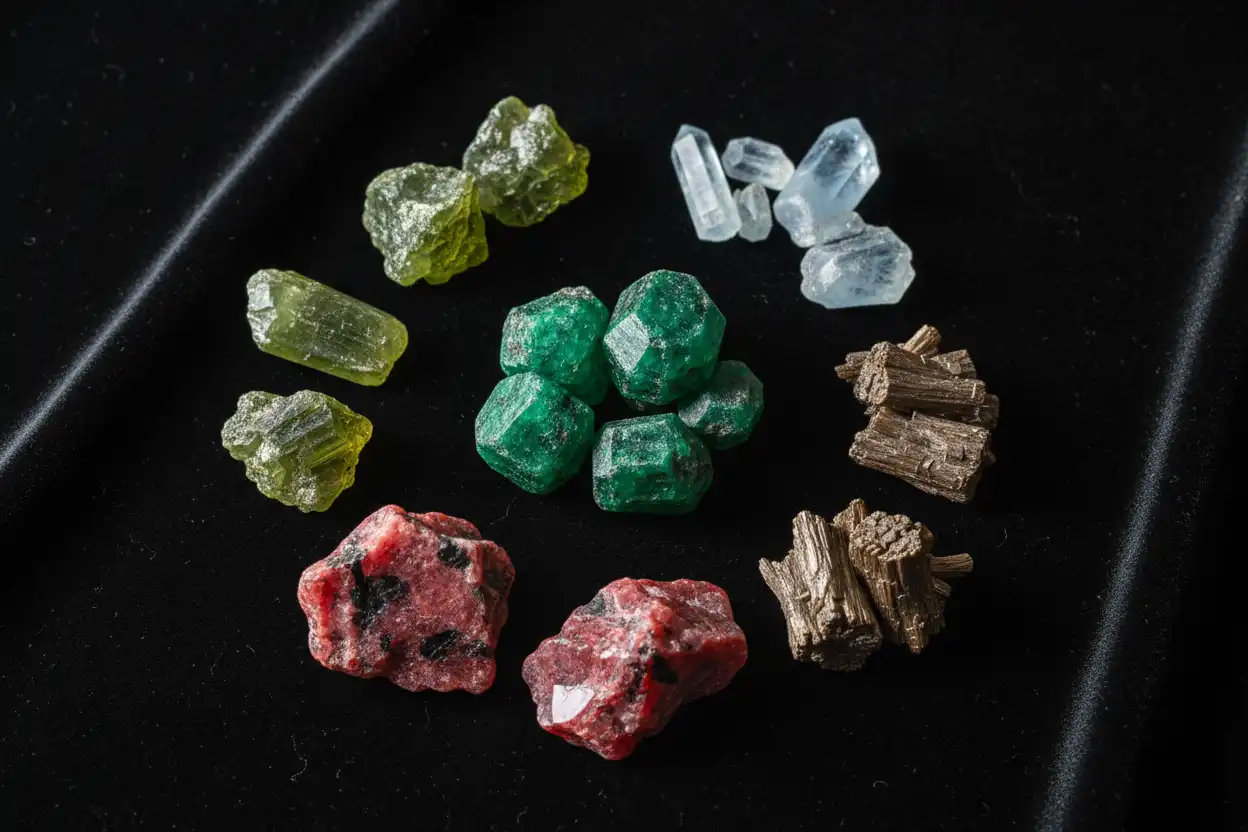
Crystals that start with E include eclogite, elbaite, emerald, enstatite, epidote, erythrite, Ethiopian opal, euclase and eudialyte.
These materials range from familiar green gemstones to rare mineral specimens, multicolored tourmalines and patterned rocks.
Crystal meanings are traditional and spiritual associations rather than scientifically proven medical effects.
Continue from the previous alphabetical guide with Crystals That Start With D.
E Crystals at a Glance
| Crystal or material | Typical appearance | Common symbolic meaning |
|---|---|---|
| Eclogite | Green rock with red garnet crystals | Balance and resilience |
| Elbaite | Pink, green, blue or multicolored tourmaline | Expression and emotional balance |
| Emerald | Rich green transparent beryl | Love, renewal and wisdom |
| Enstatite | Brown, green, gray or bronze mineral | Practical judgment and persistence |
| Epidote | Pistachio-green to dark green crystals | Growth and personal responsibility |
| Erythrite | Pink, crimson or purple mineral coatings | Awareness and transformation |
| Ethiopian Opal | White, transparent or honey-colored play-of-color opal | Creativity and emotional openness |
| Euclase | Colorless, blue, green or pale yellow crystals | Clarity and independent thinking |
| Eudialyte | Red, pink or burgundy mineral in dark matrix | Confidence and self-acceptance |
Eclogite
Eclogite is a metamorphic rock commonly composed of green omphacite and red garnet.
Its contrasting colors often create a distinctive mottled appearance.
Eclogite is traditionally associated with:
- Balance.
- Resilience.
- Adapting under pressure.
- Integrating different strengths.
- Steady personal development.
Because eclogite is a rock made from more than one mineral, individual pieces can differ in hardness, texture and durability.
Some specimens contain prominent garnet crystals, while others display more green pyroxene.
Elbaite
Elbaite is a colorful member of the tourmaline mineral group.
It may occur in:
- Pink.
- Red.
- Green.
- Blue.
- Yellow.
- Colorless.
- Multicolored crystals.
Several familiar tourmaline varieties belong to elbaite, including rubellite, indicolite and watermelon tourmaline.
Elbaite is traditionally associated with:
- Emotional balance.
- Honest expression.
- Creativity.
- Adaptability.
- Appreciating individuality.
Its symbolism often varies by color. Pink material is associated with affection, green with growth and blue with communication.
Explore the wider mineral family in the tourmaline guide.
Emerald
Emerald is the rich green variety of beryl.
Its color comes primarily from chromium, vanadium or a combination of trace elements.
Emerald is traditionally associated with:
- Love.
- Renewal.
- Wisdom.
- Loyalty.
- Emotional growth.
- Prosperity.
Many natural emeralds contain visible internal features known as inclusions. These are common and do not automatically mean the stone is fake.
However, fractures can make emerald vulnerable to impact. Many stones are treated with oil or resin to improve the appearance of surface-reaching fractures.
Use mild cleaning methods and avoid steam or ultrasonic cleaners unless a professional confirms they are appropriate.
Learn about related varieties such as aquamarine, morganite and heliodor in the beryl guide.
Enstatite
Enstatite is a magnesium silicate mineral belonging to the pyroxene group.
It may appear:
- Brown.
- Bronze.
- Gray.
- Green.
- Yellow-green.
- Nearly colorless.
Some polished enstatite displays a silky or metallic-looking sheen.
Its traditional meanings include:
- Practical judgment.
- Persistence.
- Self-control.
- Realistic planning.
- Remaining composed under pressure.
Enstatite is less familiar than many common crystals, making it particularly appealing to mineral collectors.
Gem-quality pieces may be faceted, but cleavage and brittleness require careful handling.
Epidote
Epidote is most commonly recognized by its pistachio-green, yellow-green or dark green color.
It may form:
- Elongated crystals.
- Grainy masses.
- Fibrous aggregates.
- Inclusions within quartz.
- Mixed stones with other minerals.
Epidote is traditionally associated with:
- Growth.
- Personal responsibility.
- Persistence.
- Recognizing opportunities.
- Improving existing strengths.
Some sellers describe epidote as an “attraction stone.” This symbolism is better understood as encouragement to notice and act on opportunities rather than a guarantee of specific outcomes.
Epidote may resemble peridot, green tourmaline or other green minerals, so color alone is not enough for identification.
Erythrite
Erythrite is a cobalt arsenate mineral known for vivid pink, crimson, purple or lavender colors.
It commonly occurs as:
- Thin crystal coatings.
- Radiating sprays.
- Powdery crusts.
- Small prismatic crystals.
Its traditional symbolism includes:
- Awareness.
- Transformation.
- Recognizing warning signs.
- Emotional honesty.
- Reconsidering harmful patterns.
Erythrite has historically been called “cobalt bloom” because its presence can indicate cobalt-bearing mineral deposits.
Because it contains arsenic and cobalt, raw specimens should be handled carefully. Avoid creating dust, wash your hands after handling and keep pieces away from children, pets and food-preparation areas.
Never place erythrite in drinking water.
Ethiopian Opal
Ethiopian opal is known for vivid flashes of color and may appear white, transparent, yellow, orange or honey-colored.
Its play-of-color can include:
- Red.
- Orange.
- Green.
- Blue.
- Violet.
Much Ethiopian opal is hydrophane, meaning its porous structure can absorb water.
When wet, it may temporarily become more transparent or lose some visible play-of-color. Its usual appearance may return as it dries, but repeated soaking can introduce dirt, oils or instability.
Ethiopian opal is traditionally associated with:
- Creativity.
- Emotional openness.
- Imagination.
- Personal expression.
- Accepting change.
Protect it from prolonged water exposure, sudden temperature changes, harsh chemicals and impact.
Explore related varieties and general care guidance in the opal guide.
Euclase
Euclase is a rare mineral that may appear:
- Colorless.
- Pale blue.
- Deep blue.
- Green.
- Pale yellow.
Transparent blue euclase can be especially attractive, but well-formed crystals are often valued more as collector specimens than as jewelry stones.
Euclase is traditionally associated with:
- Clarity.
- Independent thinking.
- Honest self-assessment.
- Making deliberate choices.
- Recognizing personal priorities.
Its name comes from Greek words referring to easy fracture.
Euclase has distinct cleavage and can break if struck, so specimens and jewelry should be handled carefully.
Eudialyte
Eudialyte is a complex mineral commonly found in red, pink, burgundy or reddish-brown patches within a dark matrix.
It may occur with minerals such as:
- Aegirine.
- Nepheline.
- Feldspar.
- Black or gray host rock.
Its traditional meanings include:
- Confidence.
- Self-acceptance.
- Emotional courage.
- Personal direction.
- Expressing individuality.
Eudialyte is often polished into cabochons, beads, palm stones and decorative objects.
Because it commonly occurs as part of a mixed rock, different areas of one specimen may vary in hardness and durability. Avoid acids, harsh chemicals and aggressive cleaning.
E Crystals by Color
Green E Crystals
Notable green examples include:
- Emerald.
- Epidote.
- Green elbaite.
- Some enstatite.
- Green euclase.
Emerald and green elbaite may appear similar, but they belong to different mineral families.
Pink and Red E Crystals
Examples include:
- Erythrite.
- Eudialyte.
- Pink elbaite.
- Red elbaite.
- Some Ethiopian opal.
Erythrite is generally collected as a mineral specimen, while pink and red elbaite may be used in jewelry.
Blue E Crystals
Blue examples include:
- Blue elbaite.
- Euclase.
- Some Ethiopian opal flashes.
Blue elbaite is commonly known as indicolite.
White or Colorless E Crystals
Examples include:
- Colorless elbaite.
- Ethiopian opal.
- Euclase.
- Some enstatite.
Transparency and color alone cannot reliably identify these materials.
Which E Crystals Are Suitable for Jewelry?
Several E stones are used in jewelry, but their durability differs.
More Common Jewelry Choices
- Emerald.
- Elbaite tourmaline.
- Ethiopian opal.
- Enstatite.
- Euclase.
Emerald and elbaite are widely recognized gemstones, while euclase and enstatite are less common.
Better for Occasional Wear
Ethiopian opal and euclase benefit from protective settings and careful wear.
Avoid exposing them to:
- Hard impacts.
- Harsh cleaning products.
- Sudden temperature changes.
- Prolonged soaking.
- Ultrasonic cleaning without professional approval.
Primarily Display Specimens
Erythrite is better suited to protected mineral display because of its softness and chemical composition.
Eclogite and eudialyte are commonly used as polished decorative stones, cabochons or collector pieces.
For a jewelry-centered overview, explore Gemstones That Start With E.
Care and Safety
E crystals have very different care requirements.
- Emerald may contain fractures and treatments that require gentle cleaning.
- Ethiopian opal can absorb water and oils.
- Euclase has strong cleavage and may fracture.
- Erythrite contains arsenic and cobalt.
- Eudialyte may contain several minerals with different durability.
- Eclogite is a multi-mineral rock.
- Elbaite can scratch softer stones.
- Epidote may chip if struck.
Before cleaning an unfamiliar piece, consult How to Identify Crystals.
Also review:
- Which Crystals Can and Cannot Go in Water
- Which Crystals Fade in Sunlight
- Crystals You Should Not Combine
Frequently Asked Questions
What is the most popular crystal that starts with E?
Emerald is the most widely recognized. Epidote, Ethiopian opal, elbaite and eudialyte are also popular among crystal and mineral collectors.
Which green crystals start with E?
Emerald, epidote, green elbaite, some enstatite and green euclase are notable examples.
Which pink crystals start with E?
Pink elbaite, erythrite, eudialyte and some Ethiopian opals may display pink tones.
Is emerald a crystal?
Yes. Emerald is the green variety of the mineral beryl and forms in a crystalline structure.
Is eclogite a crystal?
Eclogite is a metamorphic rock rather than one crystal. It commonly contains visible garnet and green omphacite.
Is Ethiopian opal safe in water?
Brief accidental contact may not immediately ruin every stone, but hydrophane Ethiopian opal can absorb water. Routine soaking is not recommended.
Is erythrite safe to handle?
Erythrite can be collected safely with responsible handling. Avoid dust, wash your hands afterward and keep it away from children, pets and consumable liquids.
Is elbaite the same as tourmaline?
Elbaite is one species within the tourmaline mineral group. Many pink, green, blue and multicolored tourmalines are elbaite.
Which E crystal is the rarest?
Rarity varies by quality and locality, but fine euclase, certain elbaite colors and high-quality collector specimens can be uncommon.
Continue Exploring Crystals and Gemstones
Compare jewelry use, durability and notable gem varieties in Gemstones That Start With E.
Continue alphabetically with Crystals That Start With F, or explore the complete Crystals 101 collection.