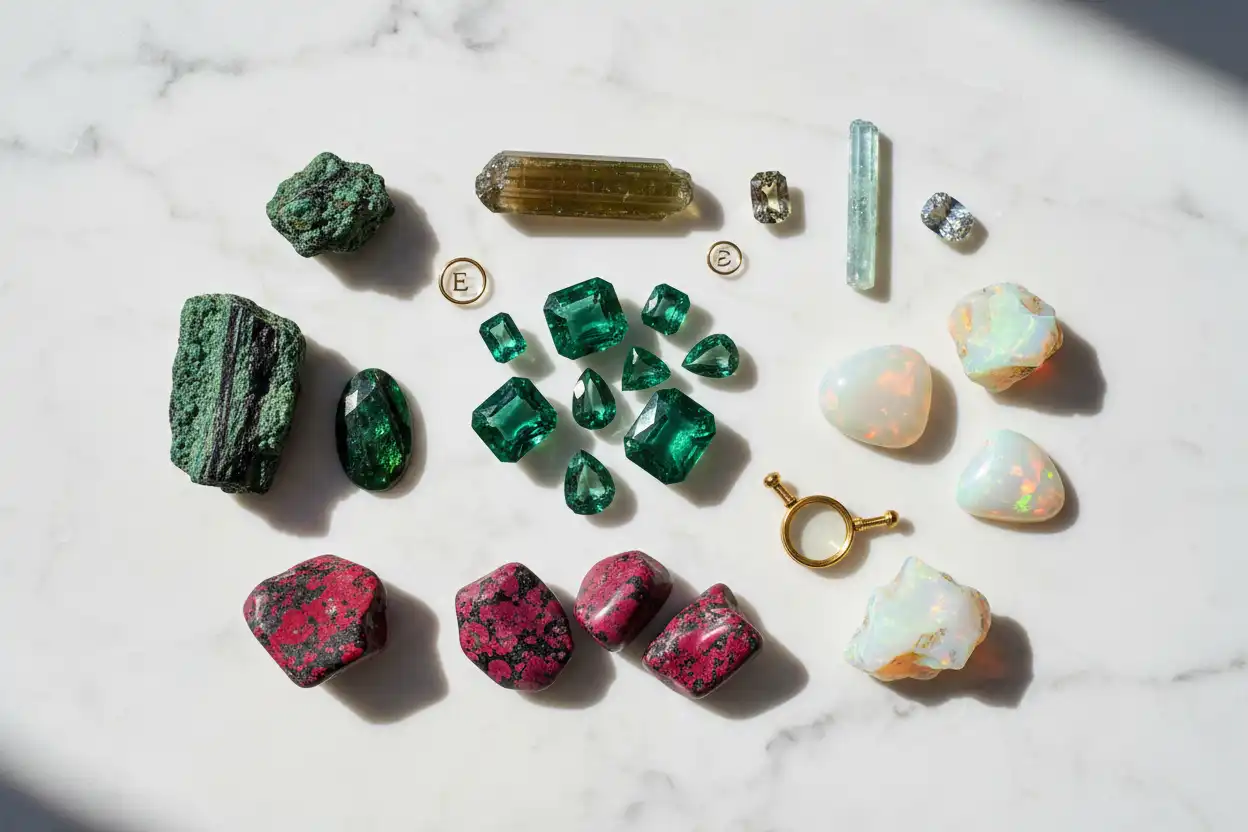
Gemstones That Start With E: A–Z Guide
Gemstones and gem materials that start with E include elbaite, emerald, enstatite, epidote, Ethiopian opal, euclase and eudialyte.
Although E has fewer entries than many other letters, it includes one of the world’s most recognized precious gemstones, a major tourmaline species, hydrophane opal and several rare collector materials.
The meanings below reflect traditional symbolism rather than scientifically proven medical effects.
Continue from Gemstones That Start With D. For additional mineral specimens, explore Crystals That Start With E.
E Gemstones at a Glance
| Gemstone or material | Typical colors | Material type | Common use |
|---|---|---|---|
| Elbaite | Pink, green, blue, red or multicolored | Tourmaline species | Faceted gems and crystal slices |
| Emerald | Green to bluish green | Beryl gemstone | Rings, earrings and necklaces |
| Enstatite | Brown, green, gray or colorless | Pyroxene mineral | Rare faceted and cat’s-eye gems |
| Epidote | Pistachio green, yellow-green or brown | Silicate mineral | Cabochons and collector stones |
| Ethiopian Opal | White, clear, yellow, orange or multicolored | Hydrophane opal | Rings, pendants and earrings |
| Euclase | Colorless, blue, green or pale yellow | Beryllium silicate mineral | Rare faceted collector gems |
| Eudialyte | Red, pink, burgundy or violet in dark matrix | Complex silicate mineral | Cabochons and carvings |
Elbaite
Elbaite is a lithium-rich tourmaline species responsible for many of the mineral group’s best-known gem colors.
Elbaite varieties and color descriptions include:
- Rubellite.
- Indicolite.
- Verdelite.
- Watermelon tourmaline.
- Pink tourmaline.
- Multicolored crystals.
Elbaite is traditionally associated with self-expression, adaptability and emotional balance.
Its complex chemistry can produce strong color zoning within a single crystal.
The wider tourmaline guide explains related species, varieties and color terminology.
Elbaite has good scratch resistance, but elongated or heavily included crystals may fracture under impact or sudden heat.
Emerald
Emerald is the green to bluish-green variety of beryl colored primarily by chromium, vanadium or both.
Its quality is judged using factors such as:
- Color.
- Transparency.
- Clarity.
- Cut.
- Carat weight.
- Treatment.
- Origin documentation.
Emerald is traditionally associated with wisdom, loyalty, prosperity and renewal.
Natural inclusions are common and are often described collectively as jardin. These inclusions can make emerald more vulnerable to impact than cleaner beryl varieties.
Many emeralds are treated with oil or resin to reduce the visibility of surface-reaching fractures. Treatment level and durability can strongly influence the figures in the emerald price guide.
Steam and ultrasonic cleaning are generally inappropriate for fracture-filled stones.
Enstatite
Enstatite is a magnesium-rich pyroxene mineral that occurs in:
- Brown.
- Green.
- Gray.
- Yellow-brown.
- Colorless.
- Nearly black.
Gem-quality enstatite is uncommon. Some polished stones display cat’s-eye or star-like effects.
Enstatite is traditionally associated with resilience, clear priorities and practical decision-making.
Transparent stones may be faceted, while darker material is cut into cabochons.
The mineral has cleavage and can be brittle. Protected settings are preferable to exposed everyday rings.
Green enstatite can resemble diopside, peridot or tourmaline.
Epidote
Epidote is a silicate mineral recognized by pistachio-green, yellow-green, brown and nearly black colors.
It may occur as:
- Prismatic crystals.
- Fibrous aggregates.
- Massive green material.
- Inclusions within quartz.
- A component of rocks such as unakite.
Epidote is traditionally associated with growth, persistence and recognizing opportunities for improvement.
Transparent crystals may be faceted, but most epidote is collected as specimens or used in cabochons.
Its cleavage and dark color in larger stones limit its use in mainstream jewelry.
Ethiopian Opal
Ethiopian opal is strongly associated with deposits in the Wollo region of Ethiopia.
Many examples are hydrophane, meaning they can absorb water and temporarily change:
- Transparency.
- Body color.
- Weight.
- Play-of-color appearance.
Ethiopian opal may have white, clear, yellow, orange, brown or smoky body color with vivid spectral flashes.
It is traditionally associated with creativity, emotional expression and transformation.
Hydrophane behavior requires careful cleaning. Prolonged soaking, oils, dyes, smoke and household chemicals can alter the stone’s appearance.
Pattern, brightness, color range, stability and treatment influence the values discussed in the Ethiopian opal price guide.
Euclase
Euclase is a rare beryllium aluminum silicate hydroxide mineral known for bright luster and attractive transparent colors.
It may appear:
- Colorless.
- Pale blue.
- Vivid blue.
- Blue-green.
- Pale yellow.
- Green.
Euclase is traditionally associated with clarity, independence and precise decision-making.
Although it has good scratch resistance, its name refers to its easy cleavage. A sharp blow can split the stone.
Faceted euclase is mainly a collector gem and is better suited to protected pendants or earrings than everyday rings.
High-value stones should have reliable laboratory identification.
Eudialyte
Eudialyte is a complex zirconium-rich silicate mineral commonly found as red, pink, burgundy or violet areas within dark matrix.
Its appearance may include:
- Raspberry red.
- Deep pink.
- Burgundy.
- Purple-red.
- Black, gray or white associated minerals.
Eudialyte is traditionally associated with individuality, motivation and emotional confidence.
It is usually opaque and cut into cabochons, beads, carvings and decorative objects.
Eudialyte is relatively soft and may contain several associated minerals, causing uneven polishing or durability.
Routine jewelry wear is better limited to protected pieces.
Which E Gemstones Are Best for Jewelry?
The most established jewelry choices are:
- Emerald.
- Elbaite tourmaline.
- Ethiopian opal.
Emerald and elbaite can be used in rings when their inclusions, treatments and settings are appropriate.
Ethiopian opal works well in earrings and pendants but needs protection from liquids, impact and contamination.
Enstatite, epidote and euclase are primarily specialist collector gems. Eudialyte is most common in cabochons and casual decorative jewelry.
Buying and Responsible Sourcing
Important checks include:
- Emerald oil or resin treatment.
- Laboratory-grown emerald.
- Hydrophane Ethiopian opal.
- Smoked, dyed or polymer-treated opal.
- Rare euclase requiring laboratory identification.
- Dark enstatite or epidote confused with other green gems.
- Reconstructed or resin-bound eudialyte material.
- Origin claims that cannot be supported by documentation.
Mining practices, labor conditions and supply-chain transparency also matter. The guide to ethically sourced gemstones outlines practical questions to ask sellers.
Care Guide for E Gemstones
- Keep fracture-filled emerald away from heat, steam and ultrasonic cleaning.
- Protect elbaite crystals with open fractures from sudden temperature changes.
- Avoid impacts along enstatite and euclase cleavage directions.
- Store epidote away from harder jewelry.
- Keep Ethiopian opal away from prolonged water exposure, oils and dyes.
- Use mild hand cleaning when treatments are uncertain.
- Protect eudialyte cabochons from scratches and household chemicals.
- Have valuable stones inspected periodically for loose settings or surface-reaching fractures.
Frequently Asked Questions
What is the most valuable gemstone that starts with E?
Fine emerald is the best-known high-value E gemstone. Exceptional color, transparency, origin and low treatment levels can substantially increase its value.
Which green gemstones start with E?
Emerald, epidote, green elbaite and some enstatite are notable examples.
Is elbaite the same as tourmaline?
Elbaite is one species within the tourmaline mineral group.
Is Ethiopian opal safe in water?
Brief accidental contact may not permanently harm every stone, but routine soaking is not recommended because many Ethiopian opals are hydrophane and absorb liquids.
Is euclase suitable for everyday rings?
Generally, no. Its perfect cleavage makes it vulnerable to splitting after a sharp impact.
Is epidote commonly faceted?
Transparent crystals can be faceted, but most epidote is collected as mineral specimens or cut into cabochons.
Is eudialyte one solid gemstone?
Eudialyte commonly occurs with other minerals in a mixed rock, especially in opaque lapidary material.
Are all emeralds treated?
No, but fracture filling with oil or resin is extremely common. Treatment type and degree should be disclosed.
Continue the Gemstone Alphabet
Continue with Gemstones That Start With F, or browse all alphabetical directories in the Crystals 101 collection.