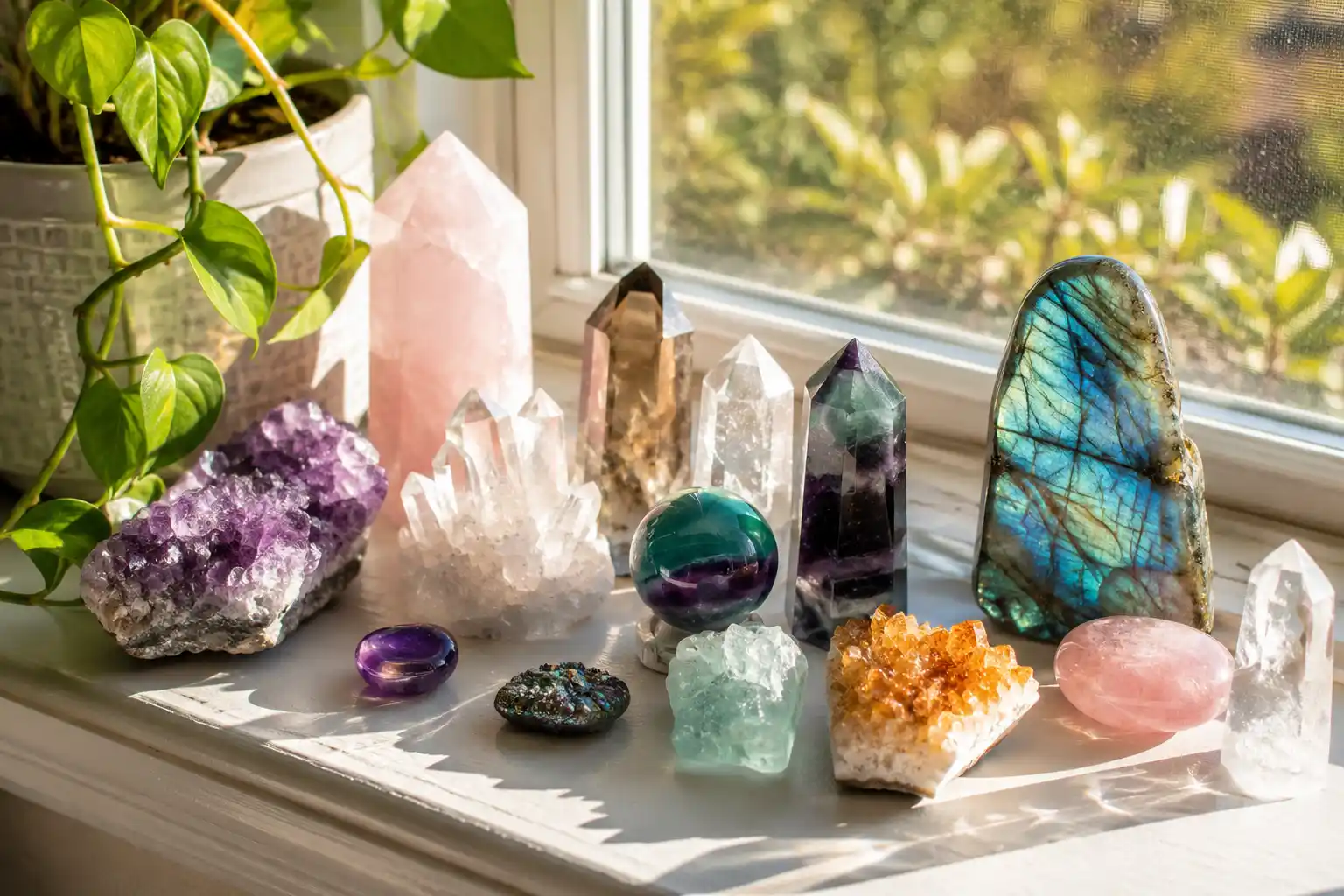
Which Crystals Can and Can’t Go in the Sun?
Some crystals fade, discolor, dry out or become damaged after prolonged exposure to direct sunlight. Amethyst, kunzite, fluorite, rose quartz, smoky quartz and celestite are among the stones that should not remain on sunny windowsills or outdoors for extended periods.
Other materials, including clear quartz, many agates, jasper, carnelian, tiger’s eye and obsidian, are generally more light-stable. However, “sun-safe” does not mean safe under every condition. Heat, thermal shock, treatments, internal fractures and the shape of a polished object can create risks even when the mineral’s color remains stable.
Brief indirect daylight is different from leaving a stone in intense direct sun for hours, days or months.
Sunlight Safety at a Glance
| Category | Examples | Recommended approach |
|---|---|---|
| High fading risk | Amethyst, kunzite and many fluorites | Keep out of prolonged direct sunlight |
| Moderate or variable fading risk | Rose quartz, smoky quartz, citrine and celestite | Use indirect light and shaded storage |
| Heat or drying risk | Opal, turquoise, amber and treated stones | Avoid hot windows, dashboards and outdoor display |
| Generally more light-stable | Clear quartz, carnelian, jasper, tiger’s eye and obsidian | Ordinary indirect display is usually suitable |
| Shape-related fire risk | Clear quartz and glass spheres | Never leave in direct sun where light can focus |
| Unknown or treated material | Dyed agate, coated quartz and assembled stones | Assume caution until treatment is known |
Why Sunlight Damages Some Crystals
Sunlight contains visible light, ultraviolet radiation and infrared energy. These components may affect a stone in different ways.
Ultraviolet exposure can alter color centers or pigments responsible for a mineral’s appearance. Heat may dry porous or hydrated materials, weaken adhesives or expand existing fractures.
A stone may also remain structurally intact while its color gradually becomes paler. Because fading develops slowly, the change may not become obvious until the crystal is compared with an earlier photograph or protected area.
Treatments add another layer of uncertainty. Dyes, coatings, resin fills and adhesives may respond differently from the natural host material.
Sunlight, Heat and Thermal Shock Are Different Risks
A crystal can be color-stable yet still be damaged by heat.
Windowsills, vehicles, patios and enclosed glass displays may become much hotter than the surrounding room. Sudden movement from a hot surface into cold water can create thermal stress.
Fractured, included or assembled stones are especially vulnerable because different areas may expand at different rates.
Therefore, sunlight care should consider four separate questions:
- Will the color fade?
- Can heat dry or alter the material?
- Could temperature changes worsen fractures?
- Is the stone treated, glued or mounted?
Crystals That Commonly Fade in Sunlight
Amethyst
Amethyst is one of the best-known sunlight-sensitive crystals. Prolonged exposure can reduce the intensity of its purple color.
A brief period of ordinary daylight during handling is unlikely to cause immediate visible damage. The main risk comes from repeated or extended direct exposure.
Keep amethyst away from sunny windowsills, dashboards and outdoor charging locations.
Because the exact color response varies between specimens, there is no universal number of safe minutes or hours.
Kunzite
Kunzite is particularly vulnerable to fading. Its pink-to-violet color may weaken after exposure to strong light.
The trade sometimes describes kunzite as an “evening stone” because careful owners often reserve it for lower-light wear.
Store kunzite jewelry in a closed box and avoid permanent display near windows.
Heat and impact also deserve attention because spodumene has pronounced cleavage.
Fluorite
Many fluorites can fade under prolonged sunlight, especially strongly colored purple, blue or green specimens.
Purple fluorite needs protection from both bright light and impact. Fluorite is relatively soft and has perfect cleavage, making a sunny windowsill an especially poor display location.
Keep fluorite in indirect light and use a stable protected stand.
Color stability varies with locality, composition and treatment, so caution is preferable even when one specimen appears unaffected.
Rose Quartz
Rose quartz may become paler after extended exposure to strong sunlight.
A rose-quartz ornament does not need to be kept in total darkness, but long-term direct-window display is unnecessary.
Choose a shaded shelf and rotate displays when one side receives noticeably more light.
Large spheres require extra care because curved transparent or translucent surfaces may redirect sunlight.
Smoky Quartz
Smoky quartz can lose color after prolonged exposure to strong light or heat, particularly when its coloration depends on irradiation-related color centers.
Natural and artificially irradiated material may respond differently, and appearance alone may not reveal the treatment history.
Use indirect room light for display and avoid leaving smoky quartz in vehicles or exposed outdoor arrangements.
A darker specimen is not automatically more sun-resistant.
Citrine
Citrine is usually more stable than amethyst, but prolonged intense exposure may still alter or weaken color in some specimens.
Commercial citrine may be natural, heat-treated amethyst or irradiated quartz. Those histories can influence appearance and stability.
Ordinary indoor use is generally reasonable, while permanent direct-sun display is unnecessary.
Store valuable citrine jewelry away from hot windows and strong light when not in use.
Celestite
Celestite commonly has a delicate pale-blue color that may become less vivid after prolonged sunlight.
The mineral is also relatively soft and brittle. Large celestite clusters can collect dust, chip and become difficult to move safely.
Display celestite on a stable shaded shelf and avoid windows, bathrooms and outdoor locations.
Its gentle color is best preserved through low-light storage.
Stones That Need Heat Caution More Than Fade Caution
Opal
Opal is not primarily known for rapid UV fading. However, heat, drying and sudden temperature changes may contribute to crazing or damage in vulnerable opal.
Avoid hot windowsills, dashboards and prolonged outdoor display.
Opal jewelry should also remain away from strong heat, steam and dehydrating storage conditions.
Turquoise
Turquoise is porous and commonly treated. Heat, oils, cosmetics and environmental exposure may alter its appearance.
Direct sunlight is not its only concern. A hot window or vehicle can affect stabilizers, adhesives and surface treatments.
Keep turquoise in a shaded, dry place and avoid assuming that a stabilized stone has unlimited resistance.
Amber
Amber is an organic gem rather than a mineral crystal.
Heat, prolonged light and oxidation may darken, craze or weaken amber over time. It is also soft and vulnerable to chemicals.
Store amber away from sunny windows and hot display cases.
Pearl
Pearl is another organic gem. Heat and drying may affect its nacre, while perfume and cosmetics create additional risks.
Pearls should not be used for prolonged sunlight charging or kept on hot windowsills.
Wear them normally, then store them in a suitable environment away from intense heat.
Crystals Generally More Stable in Ordinary Sunlight
Some crystals are less likely to fade during ordinary exposure:
- Clear quartz
- Carnelian and many natural agates
- Jasper
- Tiger’s eye
- Black obsidian
- Many garnets
- Jadeite and nephrite
- Pyrite
- Hematite
This group still requires caution. Treatments, dyes, inclusions and repairs may respond differently from the natural stone.
“Generally stable” means the mineral is not well known for rapid color fading under ordinary light. It does not justify permanent outdoor exposure, extreme heat or storage in a vehicle.
Clear Quartz and Sunlight Fire Risk
Clear quartz is generally light-stable, but polished spheres and curved transparent objects create a separate hazard.
A sphere can focus sunlight onto curtains, wood, paper, bedding or dried plants. Magnifying glass–like heating may scorch or ignite nearby material.
Keep quartz spheres, crystal balls and glass ornaments away from direct sunlight. Use a stable stand on a shaded surface.
Points and clusters are less efficient lenses, but they still should not sit where concentrated or reflected light creates heat.
Sun resistance does not equal fire safety.
Are Garnets Safe in Sunlight?
Most garnets are comparatively light-stable during ordinary wear and indoor display.
However, heat, treatments, inclusions and jewelry settings still matter. Avoid extreme temperature changes and prolonged hot-window exposure.
The dedicated guide to whether garnet is safe in water and sunlight examines the material in greater detail.
A garnet specimen containing matrix or another mineral may require different care from a clean faceted stone.
Is Selenite Safe in Sunlight?
Selenite does not have the same famous fading problem as amethyst or kunzite. Nevertheless, it remains soft, brittle and sensitive to moisture.
Extended heat and outdoor exposure are unnecessary, while sunny windows may also expose it to condensation and accidental falls.
The specific guide to selenite care in water and sunlight explains its risks.
A dry shaded shelf is safer than a windowsill.
Dyed, Coated and Treated Crystals
Artificial color may fade even when the underlying mineral is stable.
Dyed agate, aura-coated quartz, resin-filled stones and glued decorative pieces should remain away from prolonged direct sunlight.
Heat can weaken coatings and adhesives. UV exposure may also change plastics and resins.
When treatment is unknown, assume the crystal needs indirect light.
A seller should disclose significant treatments, but old or secondhand pieces may have incomplete histories.
Can Sunlight Cleanse or Charge Crystals?
Sunlight is a popular symbolic cleansing and charging method, but it is not required.
The completed guide to cleansing crystals safely includes lower-risk alternatives such as sound, visualization and careful dry placement.
A brief period of indirect morning light may be suitable for many durable stones. However, direct midday sun adds little practical value and creates more fading, heat and fire risk.
The intention can be completed indoors without exposing a valuable specimen to damage.
How Long Can Crystals Stay in the Sun?
There is no universal safe duration.
Risk depends on the stone, color mechanism, treatment, season, latitude, window glass, temperature, specimen thickness and previous exposure.
Visible fading may develop gradually rather than after one predictable period.
For sensitive crystals, avoid intentional direct-sun exposure entirely. For more stable stones, use brief ordinary handling and shaded indoor display rather than testing their limits.
Sunlight Through a Window
Window glass reduces some ultraviolet wavelengths but does not remove all light and heat exposure.
A sunny windowsill may become extremely hot, particularly behind closed glass. One side of a crystal can also receive years of repeated light.
Therefore, glass does not make a window display automatically safe.
Use a shaded shelf, sheer curtain or cabinet positioned away from the direct beam.
Sunlight and Crystal Jewelry
Normal daylight wear is different from permanent display.
A kunzite pendant worn for an evening event may receive limited exposure, while the same piece left beside a sunny window every day may fade noticeably.
Apply perfume, cosmetics and sunscreen before putting on jewelry. Remove pieces during swimming, sports and high-heat activities.
Store light-sensitive stones in a closed jewelry box after wear.
Outdoor Crystal Displays
Permanent outdoor displays expose crystals to sun, rain, frost, pollution and theft.
Even stable quartz can accumulate cracks, residue or surface damage. Stands, adhesives and wire may fail under weather exposure.
Keep personal mineral specimens indoors. Use materials designed for outdoor landscaping when decorating a garden.
Crystals do not need to remain outside to retain symbolic meaning.
A Sunlight-Safety Decision Guide
Before placing a crystal in direct sun, ask:
- Is the exact mineral known?
- Is the stone naturally colored, dyed, coated or irradiated?
- Does it contain fractures, glue or a setting?
- Is it a sphere or curved transparent object?
- Will the location become hot?
- Is direct sunlight necessary?
When any answer is uncertain, choose indirect light.
Conclusion
Crystals that should not remain in prolonged direct sunlight include amethyst, kunzite, fluorite, rose quartz, smoky quartz, citrine and celestite. Opal, turquoise, amber and pearl need additional caution because heat and drying may cause damage even when fading is not the primary concern.
Clear quartz, carnelian, jasper, tiger’s eye and obsidian are generally more light-stable, but treatment, heat and shape still matter. No crystal benefits from being tested on a hot windowsill, and transparent spheres require strict fire-safety precautions.
Frequently Asked Questions
1. Which crystals fade fastest in sunlight?
Kunzite, many fluorites and amethyst are among the most widely recognized sunlight-sensitive stones.
2. Can amethyst go in the sun?
Brief ordinary exposure is unlikely to cause immediate damage, but prolonged direct sunlight may fade amethyst.
3. Can rose quartz go in sunlight?
Rose quartz can tolerate ordinary room light, but long-term direct sunlight may gradually reduce its color.
4. Can citrine go in the sun?
Citrine is often more stable than amethyst, but prolonged intense sunlight and heat remain unnecessary, especially when treatment history is unknown.
5. Can clear quartz go in sunlight?
The material is generally light-stable, but clear quartz spheres can focus sunlight and create a fire hazard.
6. Can smoky quartz fade in sunlight?
Yes. Prolonged strong light or heat may weaken smoky coloration in some specimens.
7. Can fluorite go in the sun?
Fluorite should remain out of prolonged direct sunlight because many colored specimens can fade.
8. Can selenite go in sunlight?
Selenite is not famous for rapid fading, but it remains soft, brittle and better suited to a dry shaded shelf.
9. Does window glass protect crystals from fading?
Window glass reduces some UV exposure but does not eliminate light, heat or long-term fading risk.
10. How long should crystals be charged in sunlight?
There is no required charging time. Sensitive stones should avoid direct sun, while symbolic charging can use indirect light or another method.
11. Are black crystals safe in sunlight?
Many black stones are comparatively light-stable, but heat, treatments and matrix material still require consideration.
12. Can faded crystal color be restored?
Usually not. Once light has altered a stone’s color, home treatments cannot reliably restore the original appearance.
Disclaimer: Sunlight tolerance varies with mineral identity, color mechanism, treatment, fractures and temperature. Avoid prolonged direct exposure when uncertain. Never leave quartz or glass spheres where they can focus sunlight onto combustible material, and keep all crystals away from extreme heat and rapid temperature changes.