London Blue Topaz: Meaning, Properties & Symbolism
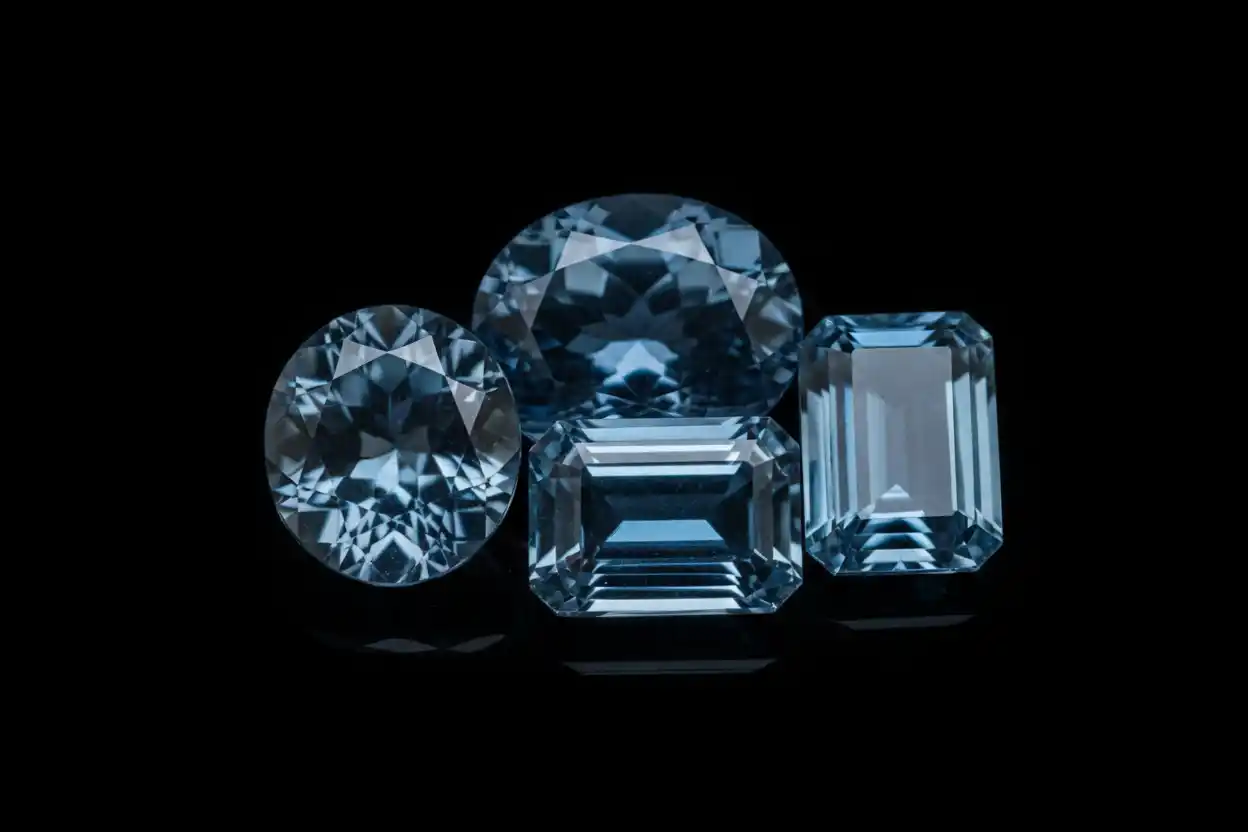
London Blue Topaz is the darkest established commercial blue-topaz color, usually showing a deep ink blue, grayish blue or slightly greenish blue appearance. Nearly all material on the market began as colorless or pale natural topaz and received irradiation followed by controlled heating to create and stabilize the blue color.
London Blue Topaz at a Glance
| Property | London Blue Topaz Characteristics |
|---|---|
| Material type | Deep-blue treated variety of natural topaz |
| Composition | Aluminum fluorosilicate, Al₂SiO₄(F,OH)₂ |
| Colors | Deep blue, grayish blue, ink blue, teal blue and blue green |
| Crystal system | Orthorhombic |
| Habit or texture | Faceted from prismatic natural topaz rough; also used for carvings and cabochons |
| Luster | Vitreous |
| Transparency | Transparent |
| Mohs hardness | 8 |
| Cleavage | Perfect basal cleavage |
| Tenacity | Brittle with poor toughness |
| Common uses | Rings, earrings, pendants, necklaces, bracelets and large statement gems |
| Main care concern | Cleavage, treatment disclosure, excessive darkness, sudden temperature change and ultrasonic or steam cleaning |
What Is London Blue Topaz?
London Blue is a trade color within the topaz family.
The material remains natural topaz at the crystal level. Its blue color, however, is normally created through treatment rather than through the conditions under which the crystal originally formed.
The name describes a deep blue appearance rather than a mine, laboratory process or protected grading standard.
One seller may reserve London Blue for dark grayish blue, while another may include greener or more saturated navy-blue stones.
Accordingly, buyers should judge the actual hue, tone and saturation rather than relying on the name alone.
The types of topaz page owns the full family comparison. This guide remains focused on the London Blue treatment, appearance and buyer concerns.
Is London Blue Topaz Natural?
The topaz crystal is usually natural, but the commercial blue color is treated.
Topaz most commonly occurs colorless or pale in nature. Strong naturally blue topaz exists, yet it is rare and generally much lighter than the mass-market London Blue color.
Manufacturers expose suitable colorless rough to ionizing radiation. The radiation changes defects within the crystal lattice and creates color centers.
Subsequent heating modifies or removes unstable components of the irradiation color and produces the intended blue.
Therefore, “natural London Blue Topaz” can be misleading when it implies untreated color. A clearer description is natural topaz with irradiated-and-heated blue color.
The dedicated treated-topaz guide should own detailed process detection and disclosure rather than repeating every treatment pathway here.
What Creates the Dark Blue Color?
Topaz color depends on trace elements and defects within its crystal structure.
Irradiation displaces electrons and changes the charge states of defect centers. Those centers absorb selected wavelengths, leaving blue visible to the eye.
Heating adjusts the color after irradiation. It can remove unwanted brown, gray or inky components and shift the final appearance.
Different starting materials and treatment protocols create different shades.
A light clean blue is usually marketed as Sky Blue. A brighter, more saturated medium blue is commonly called Swiss Blue. The darkest grayish or greenish blue normally enters the market as London Blue.
These boundaries remain commercial rather than laboratory-defined. No universal instrument reading decides where Swiss Blue ends and London Blue begins.
London Blue vs Sky Blue Topaz
Sky Blue is the palest major commercial blue-topaz category.
It resembles a clear light-blue sky and often shows less saturation than aquamarine. Because the color is light, the stone may appear nearly colorless in shallow cuts or weak lighting.
London Blue has greater tone and saturation. It looks darker, more dramatic and commonly contains a gray or green modifier.
The two remain the same mineral and receive related treatment processes. Their market difference comes mainly from color appearance.
A buyer choosing between them should compare face-up brightness. A London Blue stone cut too deeply can become almost black, while a well-cut Sky Blue gem may look more lively despite its weaker saturation.
London Blue vs Swiss Blue Topaz
Swiss Blue generally occupies the middle-to-bright end of the commercial blue range.
It often shows a vivid electric or tropical blue without London Blue’s darker gray component.
London Blue appears deeper and more restrained. In some lighting, it may lean teal, navy or steel blue.
The topaz color meaning page covers the wider symbolism and color taxonomy. Here, the key purchasing distinction is tone.
A medium-dark London Blue should retain visible blue and internal brightness. If the stone closes into black across most of the face, its depth or orientation may be working against the color.
London Blue Topaz vs Aquamarine
Aquamarine is blue-to-greenish-blue beryl.
Natural aquamarine commonly shows softer blue, greater lightness and less gray than London Blue Topaz. However, dark heated aquamarine and pale topaz can overlap visually.
Topaz has higher density and stronger brilliance. Aquamarine is slightly harder in many references and lacks topaz’s perfect basal cleavage.
London Blue also tends to show unusually uniform saturated color because the treatment works well in clean topaz rough.
The aquamarine versus blue topaz guide owns the detailed identification, price and durability comparison.
Topaz Structure and Cleavage
Topaz is an aluminum fluorosilicate with the formula Al₂SiO₄(F,OH)₂.
It crystallizes in the orthorhombic system and commonly forms elongated prismatic crystals with well-developed terminations.
The crystal structure contains a plane of perfect basal cleavage. A blow or concentrated pressure in the wrong direction can split the stone cleanly.
This weakness shapes every stage of production. Cutters orient the rough to reduce the risk of cleavage during faceting, while setters avoid excessive prong pressure.
London Blue Topaz may rank 8 on the gemstone hardness chart, yet hardness measures resistance to scratching rather than resistance to splitting.
The gemstone cleavage guide and gemstone toughness-versus-hardness guide explain why topaz needs more care than its Mohs number suggests.
Sources of the Original Topaz
Brazil supplies a large proportion of the colorless topaz used for blue treatment.
Minas Gerais contains major pegmatite and hydrothermal deposits capable of producing clean crystals in large sizes.
Nigeria, Namibia, Sri Lanka, Madagascar, Myanmar, Mexico and several other countries also produce colorless or pale topaz.
The place where the crystal was mined may differ from the country where it was irradiated, heated, cut and mounted.
Consequently, a Brazilian origin does not mean the London Blue color developed naturally in Brazil.
For most commercial blue topaz, precise mine origin has little effect on value. Color, cut, clarity and size matter more.
Is Irradiated Blue Topaz Radioactive?
Some irradiation methods can temporarily activate trace elements inside topaz.
For that reason, regulated facilities hold treated stones until residual radioactivity decays below legal release limits. Licensed distributors also survey applicable material before it enters the market.
Legally released London Blue Topaz is considered safe for normal jewelry use.
The fact that irradiation can create temporary radioactivity does not mean every treated stone remains radioactive indefinitely. It also does not mean that the wearer receives ongoing treatment radiation from compliant jewelry.
Consumers cannot establish regulatory compliance by looking at the color. Reputable supply chains and lawful import or distribution provide the appropriate protection.
A seller should disclose irradiation treatment without using unnecessary fear or falsely claiming that the color is untreated.
Color Stability
The blue color produced by irradiation and heat is generally stable during ordinary wear.
It does not sit on the surface and cannot peel away like the coating on Mystic Topaz.
Nevertheless, high heat and sudden temperature changes can damage topaz structurally. Excessive heating during repair may also alter color centers.
Long-term normal indoor light is not a major concern for commercial blue topaz. However, every gemstone benefits from avoiding prolonged exposure to extreme display heat.
Surface coatings occasionally applied to topaz require different care because abrasion can remove them. A report or seller disclosure should distinguish ordinary irradiated London Blue from coated material.
Clarity and Inclusions
London Blue Topaz is usually eye clean.
The treatment industry selects transparent colorless rough with few fractures because abundant clean material is available.
Typical natural inclusions include fluid cavities, healed fissures, two-phase inclusions, growth tubes and mineral crystals.
A visible inclusion does not make the stone fake. However, severe cleavage-reaching fractures reduce durability and should affect value.
Exceptional clarity alone does not justify a high rarity premium. Eye-clean blue topaz is normal rather than extraordinary.
The real-versus-fake topaz guide should own the full separation from glass, synthetic spinel, quartz and assembled stones.
Cutting London Blue Topaz
London Blue Topaz appears in ovals, cushions, pears, rounds, emerald cuts and fantasy designs.
Elongated shapes fit the natural prismatic rough and preserve weight. Mixed cuts can strengthen brightness while maintaining dark blue saturation.
A deep pavilion concentrates color but may produce extinction. Conversely, a cut that is too shallow creates a transparent window through the center.
The best result balances depth and light return. The stone should remain clearly blue without turning black around the center or edges.
Large rough is available, so skilled cutters use topaz for sculptural gems and intricate fantasy cuts. In such pieces, workmanship can be worth far more than the raw material.
Jewelry Suitability
London Blue Topaz works well in earrings, pendants and necklaces because these pieces experience relatively little impact.
The topaz-necklace guide covers chain length, pendant structure and setting choices without duplicating them here.
Rings can also be practical when the gem sits low and receives protection around the girdle. The topaz-ring guide should own detailed style and setting advice.
Bezel, halo and substantial prong settings reduce edge exposure. Thin high-set cocktail rings remain vulnerable to knocks.
Bracelets require more caution because they strike desks, doorframes and hard surfaces frequently.
Topaz itself can scratch many softer gems, so mixed jewelry should keep it away from opal, pearl and fluorite during storage.
Treatments and Imitations
Irradiation and heat are expected for London Blue color.
Possible additional treatments include fracture filling, surface coating, backing and assembly. These processes are less characteristic but still require disclosure.
Blue glass, synthetic spinel, blue quartz and coated colorless stones can imitate the appearance.
Glass may show round bubbles and curved flow lines. Quartz has lower refractive index and density, while synthetic spinel is singly refractive.
A standard gemological test can identify topaz, but it may not determine the exact irradiation method.
The broader gemstone treatments guide explains why expected treatment should still be disclosed rather than hidden.
London Blue Topaz Price and Value
London Blue Topaz is affordable because colorless rough is abundant and treatment produces large volumes of consistent material.
| London Blue Topaz Product | Broad Current Asking Range |
|---|---|
| Small calibrated gem below 2 ct | Approximately $5–$25 per stone |
| Commercial 2–10 ct loose stone | Approximately $5–$20 per carat |
| Large clean standard-cut stone | Approximately $50–$200 per stone |
| Precision or fantasy-cut gem | Approximately $20–$75+ per carat |
| Sterling-silver jewelry | Commonly $40–$300 |
| Gold jewelry | Commonly $300–$2,000+, depending mainly on metal and design |
| Major artisan carving | Determined principally by cutting skill and size |
These ranges should remain subordinate to the dedicated topaz price guide, which owns current market comparisons.
London Blue does not receive the scarcity premiums associated with natural imperial, red or fine pink topaz.
Value comes from attractive tone, brightness, cut precision, clarity and jewelry workmanship.
Buying London Blue Topaz
The topaz buying guide should own the complete purchase checklist.
For London Blue specifically, confirm that the seller discloses irradiation and heat treatment. A claim of untreated dark blue deserves independent laboratory support.
View the exact stone under neutral light and in motion. Still photographs can hide black extinction, gray modifiers and central windows.
Compare measurements rather than carat weight alone because topaz is dense and can carry hidden depth.
A laboratory report may be worthwhile for an expensive designer gem, unusual untreated-color claim or stone represented as having special treatment history. Routine calibrated London Blue normally does not require costly certification.
Cleaning and Storage
Use lukewarm water, mild soap and a soft brush.
The dedicated topaz cleaning guide provides the complete procedure for settings and repairs.
Avoid steam and ultrasonic cleaning. Heat, vibration and sudden temperature changes can exploit the perfect cleavage.
Store London Blue Topaz separately in a padded compartment. Diamond, sapphire and other topaz can scratch it, while it can scratch many softer gems.
A jeweler should know that the stone is topaz before resizing or repairing the setting because torch heat and prong pressure require special care.
London Blue Topaz Meaning and Symbolism
London Blue Topaz has no separate ancient tradition because the dark color depends mainly on modern irradiation technology.
Its symbolism therefore combines the broader history of topaz with contemporary responses to its deep blue appearance.
Modern associations include measured communication, responsibility, composure and confidence that does not require constant display.
The darker tone can represent reflection and depth, while the treatment history introduces another material-specific theme: controlled intervention can reveal an appearance that the original colorless crystal did not show.
These meanings remain personal or cultural interpretations. Scientific evidence does not show that London Blue Topaz improves communication, changes mood or produces measurable healing energy.
The blue gemstones and blue crystals pages provide broader color symbolism.
Topaz also remains a traditional November birthstone, regardless of whether the chosen color is natural or treated.
Frequently Asked Questions About London Blue Topaz
Is London Blue Topaz real topaz?
Yes. It is normally natural topaz whose blue color was created through irradiation and heat.
Is London Blue Topaz naturally blue?
Naturally blue topaz exists, but the deep commercial London Blue color is almost always treated.
What color is London Blue Topaz?
It ranges from deep grayish blue and ink blue to dark teal or slightly greenish blue.
How is London Blue Topaz made?
Colorless or pale topaz is irradiated to create color centers and then heated to develop the intended blue.
Is irradiated London Blue Topaz radioactive?
Regulated stones are held and tested until any residual radioactivity falls below legal release limits.
How does London Blue differ from Swiss and Sky Blue?
Sky Blue is pale, Swiss Blue is brighter and medium saturated, while London Blue is darker and commonly grayer or greener.
Does London Blue Topaz fade?
Its treated blue is generally stable during normal wear, although extreme heat should be avoided.
How hard is London Blue Topaz?
It ranks 8 on the Mohs scale but has poor toughness because of perfect cleavage.
Is London Blue Topaz suitable for a ring?
Yes, provided the stone has a protective setting and the wearer avoids hard impacts.
Can it go in an ultrasonic cleaner?
No. Warm soapy water is safer because vibration can exploit cleavage or fractures.
Is London Blue Topaz expensive?
It is generally affordable. Cut quality, size, jewelry metal and workmanship influence price more than rarity.
Does London Blue Topaz need a laboratory report?
Routine commercial stones usually do not, but a report is appropriate for costly designer gems or claims of untreated natural blue color.
London Blue Topaz belongs in both Crystals That Start With L and Gemstones That Start With L directories.