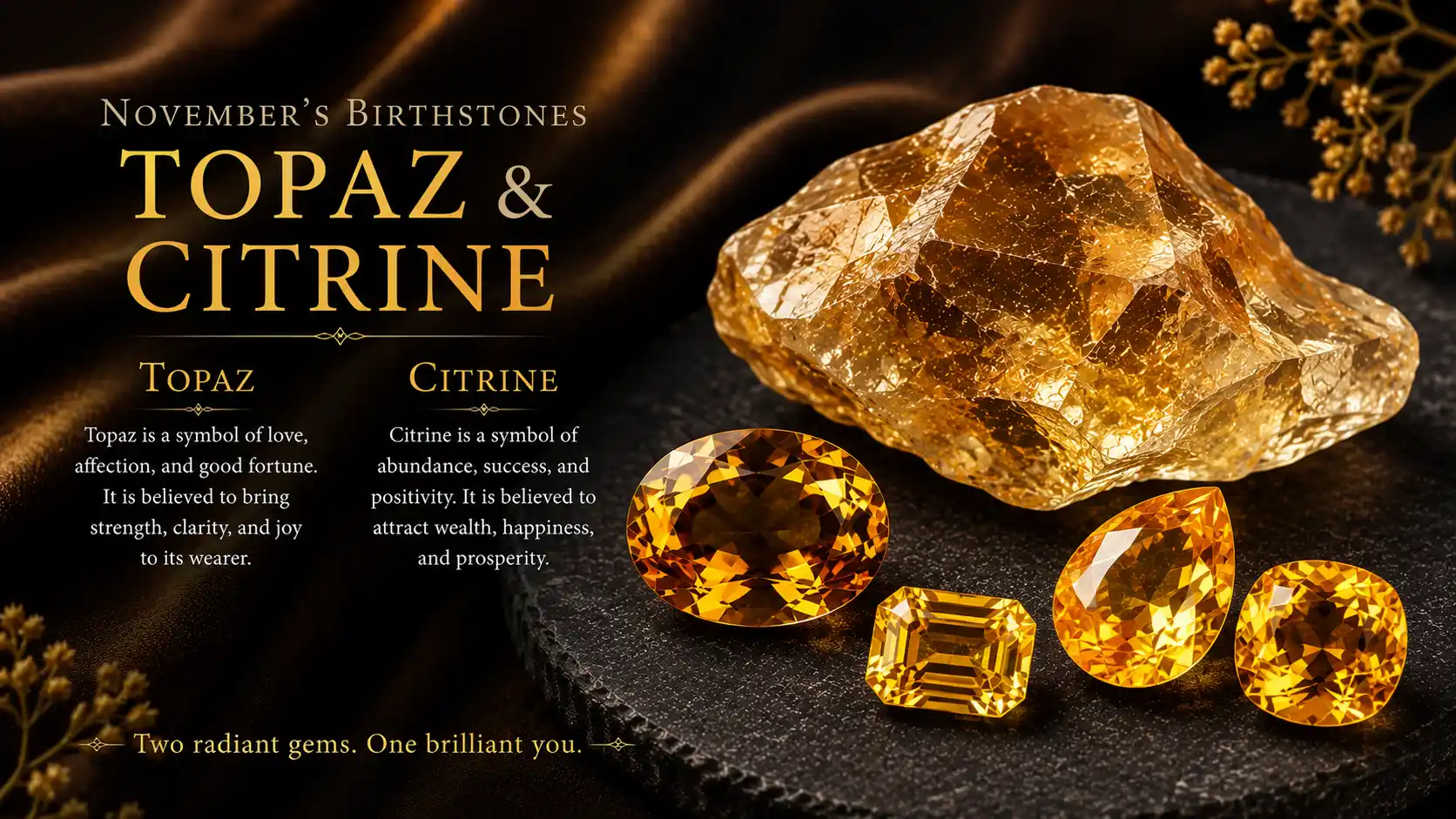
November Birthstone: Topaz & Citrine
November has two recognized birthstones: Topaz and Citrine. Their best-known colors occupy a similar yellow-to-orange range, which caused the materials to be confused for centuries before modern gemology separated them.
They are unrelated minerals. Topaz is a fluorine- and hydroxyl-bearing aluminum silicate with Mohs hardness 8 and perfect cleavage. Citrine is yellow-to-brownish-orange Quartz with Mohs hardness 7, no cleavage and generally good toughness.
The choice between them involves more than color. Topaz offers a wider natural and treated color range, greater hardness and prestigious Imperial varieties, but its cleavage requires protection from sharp blows. Citrine provides good toughness, broad size availability and accessible prices, although most material in the modern market is heat-treated Amethyst.
The companion November Birthstone Jewelry Gift Guide owns recipient, metal and finished-jewelry choices. This article focuses on the stones themselves, including their history, properties, symbolism and differences.
November Birthstones at a Glance
| Feature | Topaz | Citrine |
|---|---|---|
| Mineral identity | Topaz | Yellow-to-orange Quartz |
| General formula | Al₂SiO₄(F,OH)₂ | SiO₂ |
| Crystal system | Orthorhombic | Trigonal |
| Typical November colors | Yellow, golden, orange and pink-orange | Pale yellow, golden yellow, orange and reddish orange |
| Wider color range | Colorless, blue, green, yellow, orange, pink, red, purple and brown | Yellow through brownish or reddish orange |
| Mohs hardness | 8 | 7 |
| Toughness | Poor because of cleavage | Good |
| Cleavage | Perfect basal cleavage | None |
| Common treatments | Irradiation, heat and surface coating | Heat treatment of Amethyst or Smoky Quartz |
| Typical price position | Commercial blue and colorless material affordable; fine Imperial Topaz costly | Generally affordable |
| Main care concern | Sharp impact, steam, ultrasound and thermal shock | Scratching, thermal shock and prolonged intense light |
| Anniversary association | Blue Topaz for fourth; Imperial Topaz for twenty-third | Thirteenth anniversary |
Why November Has Two Birthstones
Birthstone traditions developed gradually rather than from one ancient universal chart.
Older religious, cultural and commercial lists assigned different stones to months, zodiac signs and symbolic groups. In the United States, the jewelry trade standardized a birthstone list in 1912 and later revisions expanded several months to include alternatives.
The Birthstones by Month guide owns the full calendar and list history.
Topaz has the longer traditional connection with November. Citrine became a widely recognized modern alternative because its warm color suited the established theme while offering greater affordability and availability.
Both are legitimate November birthstones. A person does not need to choose the more expensive stone for the tradition to be meaningful.
What Is Topaz?
Topaz is a distinct mineral containing aluminum, silicon, oxygen, fluorine and hydroxyl.
It commonly forms in fluorine-rich igneous environments, including granitic pegmatites, rhyolitic cavities and related deposits.
Topaz crystals can become exceptionally large and transparent. Colorless material is abundant, while fine natural pink, red and Imperial orange-pink colors are much less common.
The mineral is pleochroic, meaning color can differ according to viewing direction. Cut orientation therefore matters in strongly colored stones.
The Types of Topaz guide owns the complete color and variety framework.
What Is Citrine?
Citrine is the transparent yellow-to-brownish-orange variety of Quartz.
Iron-related color centers produce its yellow and orange appearance. Natural Citrine is relatively uncommon.
Much of the Citrine sold today begins as purple Amethyst that is heated until it becomes yellow, orange or reddish brown. Heated material remains natural Quartz, but the treatment should be understood.
Citrine commonly occurs in large clean sizes and can be cut into calibrated stones, bold pendants, cocktail rings and carvings.
The Types of Citrine guide owns natural, heated and color-based commercial categories.
Why Topaz and Citrine Were Confused
Before refractive index, density and modern mineral classification became available, yellow transparent gemstones were frequently grouped by appearance.
The word Topaz was applied historically to several yellow stones that would now be identified as Quartz, Peridot or other minerals.
Citrine’s yellow-to-orange color closely overlaps golden and yellow Topaz. Both can also be transparent and relatively clean.
Modern gemology separates them easily through crystal structure, refractive index, density, optical character and cleavage.
The direct Citrine vs Yellow Topaz guide owns the complete identification comparison.
November Topaz Colors
Topaz is not limited to yellow.
Natural and treated material can appear colorless, blue, yellow, brown, orange, pink, red, green or purple. However, warm yellow, orange and pink-orange varieties retain the strongest traditional November association.
Yellow Topaz ranges from pale yellow to golden and brownish yellow.
Imperial Topaz is a valued trade category generally associated with rich yellow-orange, orange-pink, pinkish orange and related warm hues. Definitions vary, and the name should not be applied to every yellow stone.
Blue Topaz is extremely popular but is also listed as a December birthstone in some modern systems.
November Citrine Colors
Citrine ranges from very pale yellow to golden yellow, orange, brownish orange and reddish orange.
Deep reddish-orange and Madeira-like colors attract strong demand, although stones that appear overly brown or nearly black may lose brightness.
Color should remain reasonably even across the face. Strong zoning can indicate heated Amethyst when the darker color concentrates near the original crystal tips.
Marketing names such as Madeira, lemon and golden Citrine are descriptive rather than standardized grades.
The color categories do not establish whether a stone formed naturally as Citrine or changed through heat.
Topaz Hardness and Cleavage
Topaz ranks 8 on the Mohs scale, providing strong resistance to everyday scratching.
However, it has perfect basal cleavage. A sharp blow in an unfortunate direction can split the stone cleanly.
This makes Topaz a clear example of why hardness is not the same as toughness. The Gemstone Hardness Chart supplies numerical context, but setting protection remains essential.
Earrings and pendants are safer than exposed rings and bracelets. Rings should use protected corners and avoid very high settings.
Topaz should not be cleaned with ultrasonic or steam equipment.
Citrine Hardness and Toughness
Citrine ranks 7 on the Mohs scale.
It can be scratched by Topaz, Sapphire, Diamond and other harder materials but has no cleavage and generally offers good toughness.
This makes Citrine practical for rings, earrings, necklaces and bracelets when normal precautions are followed.
Quartz-bearing dust can scratch the surface over time because the dust may be equal in hardness to the gemstone.
Abrupt temperature changes can cause fractures, and prolonged intense light or heat may fade some colors.
Citrine should be stored separately from harder jewelry.
Topaz Treatments
Colorless Topaz is commonly irradiated and heated to produce blue.
The process can create pale Sky Blue, brighter Swiss Blue and darker London Blue colors. Properly processed stones are safe for ordinary jewelry use after required regulatory controls and decay periods.
Mystic Topaz receives a thin surface coating that creates iridescent color. The coating can scratch and may be removed by repolishing.
Heat may alter selected natural colors, while diffusion-related treatments have also been investigated or used in the trade.
The Treated Topaz guide owns the complete enhancement boundary.
Citrine Treatments
Most commercial Citrine is produced by heating Amethyst.
The treatment can create yellow, orange and reddish-brown colors, depending on the original material and heating conditions.
Heated Amethyst remains natural Quartz. It should not be described as naturally colored Citrine when that distinction materially affects value or collector interest.
Some Quartz is irradiated and heated through more complex color-production processes.
The Treated Citrine guide owns heat, irradiation, synthetic Quartz and coating concerns.
A very dark burnt-orange cluster with white or purple at its base is commonly heated Amethyst rather than naturally formed Citrine crystal.
Natural Citrine
Natural Citrine is comparatively rare.
Its color often appears lighter, smoky, golden or champagne-like rather than the vivid burnt orange associated with heavily heated Amethyst.
Natural color alone cannot be confirmed from a photograph. Some heat-treated stones look pale, while some natural stones display zoning.
Origin, inclusions, spectroscopy and crystal morphology may help a laboratory reach a conclusion, but identifying treatment in Quartz can remain difficult.
The Real vs Fake Citrine guide owns the complete owner-diagnostic workflow.
Natural and Laboratory-Grown Topaz
Natural Topaz is widely available, so laboratory-grown Topaz is less prominent in ordinary jewelry than synthetic Sapphire or Quartz.
Glass, Cubic Zirconia, synthetic Spinel and Quartz may imitate Topaz’s colors.
The Real vs Fake Topaz guide owns material identification.
A stone described as created Topaz should not be assumed to have the Topaz structure unless documentation confirms it. Some sellers use created loosely for an imitation or treated color.
Sources of Topaz
Brazil is one of the best-known Topaz-producing countries and is especially important for Imperial Topaz from the Ouro Preto region.
Pakistan, Russia, Sri Lanka, Nigeria, Namibia, Madagascar, Mexico and the United States have also produced material.
Large colorless crystals occur in several pegmatite regions.
Origin can add interest but does not guarantee a particular color or quality. Imperial terminology and Brazilian-origin claims should be supported when they produce a major premium.
The Topaz Buying Guide owns color, cut, treatment and provenance evaluation.
Sources of Citrine
Brazil is a major source of Quartz used in the Citrine market, including material heated from Amethyst.
Bolivia is known for Quartz deposits that produce Citrine and Ametrine. Zambia, Namibia, Madagascar, the Democratic Republic of Congo and other countries also supply yellow-to-orange Quartz.
A source claim does not prove natural color.
The Citrine Buying Guide owns purchasing and seller-disclosure questions.
Large size is widely available, so color, clarity and cutting generally matter more than carat weight alone.
Topaz Meaning and History
Topaz has been associated historically with strength, protection, intelligence, warmth and prosperity.
Some ancient references using the word Topaz probably described other yellow stones because early classification relied heavily on color.
Warm golden stones became linked with sunlight and wealth, while blue Topaz later acquired associations with calm and communication.
These meanings are cultural rather than measurable properties.
A November Topaz can symbolize resilience because the material combines considerable hardness with a need for protection against directional impact.
Citrine Meaning and History
Citrine is commonly associated with optimism, warmth, success and abundance.
Its yellow and orange colors inspired solar and commercial symbolism, while its availability made it popular in large decorative jewelry.
Victorian Scottish jewelry used yellow Quartz and related stones extensively.
Citrine is sometimes called the merchant’s stone in modern crystal culture. The name does not mean the gem produces revenue or guarantees business success.
Its symbolism can be attached to practical habits such as budgeting, completing work and recognizing progress.
Topaz and Citrine Prices
Commercial Citrine is generally affordable, including relatively large clean stones. The Citrine Price Guide owns current ranges and natural-versus-treated distinctions.
Topaz pricing varies much more by color. Colorless and treated blue material are accessible, while fine Imperial, natural pink and red Topaz can command substantial prices.
The Topaz Price Guide owns those market differences.
Carat weight should not be compared directly across the two minerals. Density, cut depth, rarity and color demand differ.
November Zodiac Connections
November birthdays commonly fall under Scorpio or Sagittarius in the Western tropical zodiac.
The Scorpio Birthstones guide owns the earlier-November zodiac framework, while Sagittarius Birthstones covers later November.
A monthly birthstone and zodiac stone belong to separate traditions.
Someone born in November can choose Topaz or Citrine regardless of sign, chart or personal belief.
Anniversary Associations
Citrine is widely associated with the thirteenth wedding anniversary.
Blue Topaz is commonly linked with the fourth anniversary, while Imperial Topaz is associated with the twenty-third.
These are modern jewelry traditions rather than geological properties.
The Anniversary Gemstones by Year guide places them within the complete sequence.
A gift should still be selected for the recipient’s color preference and wearing habits rather than the anniversary list alone.
Choosing Between Topaz and Citrine
Choose Topaz when the recipient wants a wider range of colors, greater scratch resistance or the prestige of fine Imperial material.
Choose Citrine when affordability, good toughness, large sizes and yellow-to-orange color are the priorities.
A ring wearer who frequently strikes hard surfaces may find Citrine’s lack of cleavage reassuring, although Citrine scratches more readily.
A pendant or pair of earrings can protect fine Topaz and allow its richer colors to be worn safely.
Neither is universally better. Their differences create two useful November options.
Cleaning and Care
Follow How to Clean Topaz Jewelry Safely for Topaz and How to Clean Citrine Jewelry Safely for Citrine.
Warm water, mild soap and a soft brush are the safest routine methods.
Do not steam or ultrasonically clean Topaz. Heat and vibration can exploit its cleavage.
Protect Citrine from sudden temperature changes and prolonged intense heat or sunlight.
Coated Mystic Topaz requires especially gentle handling because abrasion can damage its surface layer.
Frequently Asked Questions
1. What are the November birthstones?
Topaz and Citrine are the two recognized November birthstones.
2. Which is the traditional November birthstone?
Topaz has the older traditional association, while Citrine is widely recognized on modern lists.
3. Are Topaz and Citrine the same mineral?
No. Topaz is an aluminum silicate containing fluorine and hydroxyl; Citrine is yellow-to-orange Quartz.
4. Why were they historically confused?
Both can be transparent yellow or orange, and early gemstone names were often based on color rather than mineral testing.
5. Is Citrine usually natural yellow Quartz?
Much commercial Citrine is heat-treated Amethyst. Naturally colored Citrine is less common.
6. Is blue Topaz a November birthstone?
Topaz as a mineral is recognized for November, although blue Topaz also appears as a December stone in some modern charts.
7. Which November birthstone is harder?
Topaz is harder at Mohs 8. Citrine ranks 7.
8. Which is tougher?
Citrine generally has better toughness because Topaz has perfect cleavage.
9. What is Imperial Topaz?
It is a valuable warm-color Topaz category usually associated with rich yellow-orange, orange-pink or pinkish-orange hues.
10. Which November birthstone is more expensive?
Commercial Citrine and blue Topaz are affordable. Fine Imperial, pink or red Topaz can be substantially more expensive.
11. Which stone is better for a daily ring?
Citrine has no cleavage but scratches more readily. Topaz resists scratches better but needs protection from sharp blows.
12. How should November birthstones be cleaned?
Use warm soapy water and a soft brush. Avoid steam and ultrasonics for Topaz and protect both gems from thermal shock.
Topaz and Citrine share November through color and history, not mineral identity. One is a hard but cleavage-prone silicate available in nearly every color; the other is durable yellow-to-orange Quartz whose modern market depends heavily on heated Amethyst. Their differences give November-born wearers a genuine choice rather than two names for the same stone.
Historical protective, prosperity and calming meanings associated with Topaz and Citrine are cultural traditions rather than scientifically established medical or financial effects.