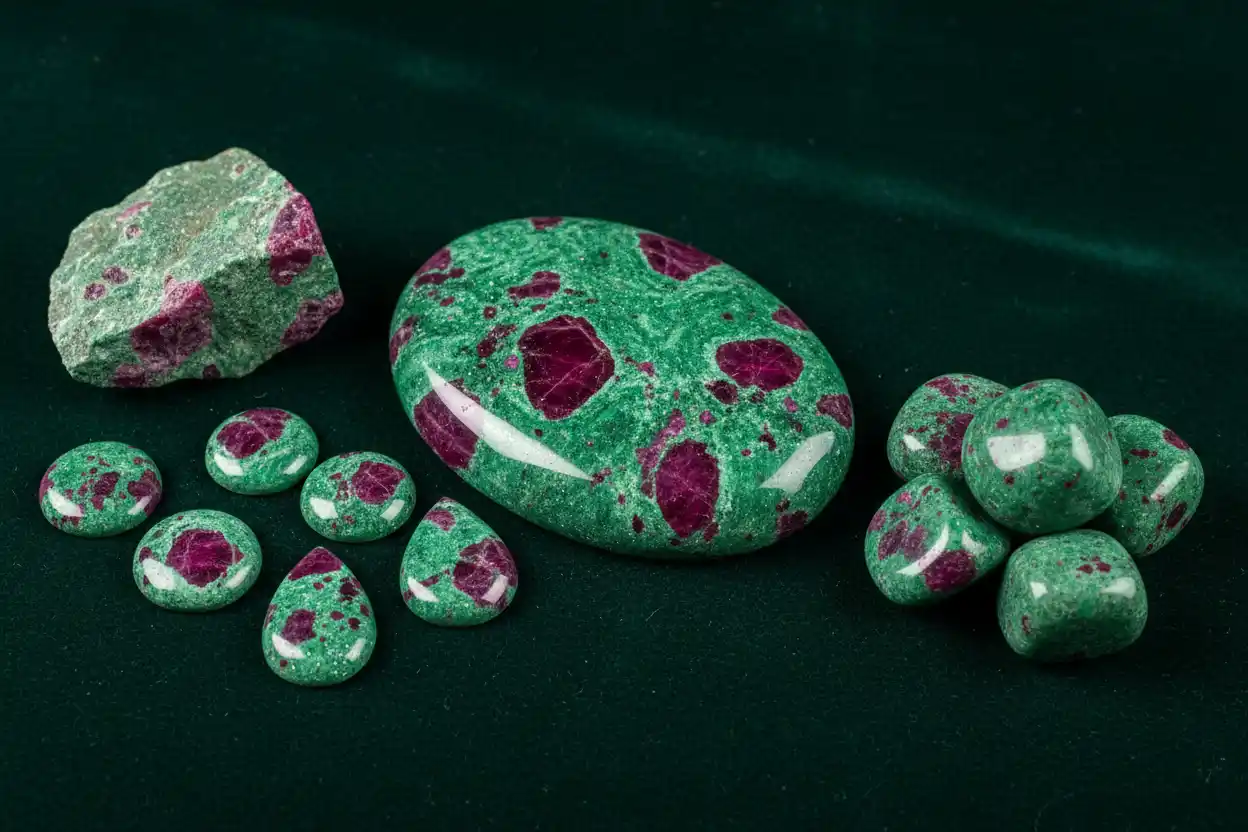
Ruby in Fuchsite Meaning, Properties, Identification & Value
Ruby in Fuchsite is a metamorphic mineral aggregate containing red corundum crystals embedded in green chromium-bearing muscovite mica. Its visual appeal comes from the contrast between hard crimson Ruby and soft sparkling Fuchsite, sometimes separated by pale blue, blue-green, or white reaction rims containing Kyanite and related minerals.
It is not one mineral species and does not have one hardness value. A polished piece can contain Ruby near Mohs 9 beside Fuchsite near 2–3, creating substantial differences in cutting behavior, scratch resistance, and long-term wear.
Ruby in Fuchsite at a Glance
| Property | Ruby in Fuchsite |
|---|---|
| Material type | Metamorphic rock or mineral aggregate containing Ruby and Fuchsite |
| Principal components | Ruby corundum, Al₂O₃, and chromium-rich muscovite mica |
| Possible associated minerals | Kyanite, quartz, rutile, margarite, chlorite, feldspar, diaspore, and additional metamorphic phases |
| Common colors | Red, purplish red, pink-red, light green, emerald green, silver green, blue-green, white, and occasional black or brown |
| Crystal system | No single system applies to the complete rock |
| Ruby system | Trigonal |
| Fuchsite system | Monoclinic |
| Typical texture | Mica-rich, foliated, granular, schistose, mottled, porphyroblastic, or slab-like |
| Luster | Vitreous over Ruby; pearly, silky, or sparkling over Fuchsite |
| Transparency | Opaque to locally translucent |
| Mohs hardness | Highly variable: Ruby about 9; Fuchsite commonly about 2–3 along mica surfaces; associated Kyanite about 4.5–7 depending on direction |
| Cleavage | Perfect basal cleavage in Fuchsite; variable in associated minerals |
| Tenacity | Brittle and locally flaky |
| Common uses | Cabochons, slabs, pendants, beads, spheres, carvings, palm stones, display specimens, and decorative objects |
| Main care concern | Extreme hardness contrast, mica cleavage, undercutting, fractures, resin, dye, misidentification as Ruby in Zoisite, and mixed-mineral dust |
The Ruby Component
Ruby is the red variety of corundum.
Its ideal composition is aluminum oxide, Al₂O₃, while chromium substituting for aluminum produces the red color.
The parent Ruby guide owns Ruby’s broader mineralogy, value, history, treatments, and transparent gem market.
Within Ruby in Fuchsite, the corundum commonly occurs as opaque to translucent crystals rather than clean facet-grade gemstones.
Cut surfaces may reveal six-sided outlines, irregular red masses, rounded crystals, or flattened grains.
Some crystals fluoresce strongly red beneath ultraviolet light because chromium absorbs higher-energy radiation and re-emits visible red light.
A fluorescent red area supports Ruby identification but does not prove that the green host is Fuchsite.
The Fuchsite Component
Fuchsite is the chromium-rich green variety of muscovite mica.
Its layered crystal structure allows it to split into very thin sheets with perfect basal cleavage.
Chromium substituting for aluminum creates pale mint, silver green, apple green, and deep emerald-green colors.
Numerous mica flakes reflect light, giving the rock a pearly or sparkling appearance.
The shimmer is structural rather than a surface glitter treatment.
Because Fuchsite is much softer than Ruby, it commonly wears or undercuts around the harder red crystals.
This contrast creates both the material’s distinctive appearance and its greatest durability problem.
Is Ruby in Fuchsite a Gemstone?
Ruby in Fuchsite is used as an ornamental gem material, but the complete object is a rock or mineral aggregate rather than one uniform gemstone species.
Lapidaries cut it into cabochons, tablets, pendants, beads, spheres, carvings, and display slabs.
The Ruby portions may be gem minerals, but the value of the finished product depends mainly on pattern and craftsmanship rather than the market price of transparent faceted Ruby.
A large opaque red patch inside soft mica should not be valued as though every carat were loose fine Ruby.
Its appropriate position is closer to ornamental carving rocks than to conventional transparent corundum.
The wider category is discussed in the best gemstones and rocks for carving.
How Ruby and Fuchsite Form Together
Corundum-Fuchsite rocks form in unusual chromium-rich, aluminum-rich metamorphic environments.
The starting rocks may include altered ultramafic material, chromium-bearing sediments, hydrothermal alteration zones, or chemically unusual layers within greenstone belts.
Metamorphism reorganizes aluminum, chromium, potassium, silica, oxygen, and other elements into new minerals.
Corundum develops where aluminum is abundant but silica activity is low enough to prevent all aluminum from entering silicate minerals.
Fuchsite forms when chromium-rich fluids or reactions produce green muscovite.
Later deformation can align the mica into a schistose fabric while larger Ruby crystals remain as porphyroblasts.
The resulting rock records a complex interaction among original composition, fluid movement, pressure, temperature, and chemical alteration.
Blue Kyanite Reaction Rims
Some Ruby crystals in Fuchsite are surrounded by pale blue, turquoise, blue-green, or white rims.
These zones can contain Kyanite, margarite, quartz, and related metamorphic minerals.
A reaction rim develops when the Ruby and surrounding mica are no longer chemically stable against one another under changing pressure, temperature, or fluid conditions.
New minerals form at their boundary, producing a corona around the corundum crystal.
The rim is not automatically dye or glue. Natural coronas can follow the Ruby outline closely and continue through the cut stone.
However, blue pigment may also be used commercially to imitate such contrast.
Laboratory testing is necessary before naming the rim’s exact minerals.
Important Sources
Southern India, especially Karnataka and the broader Mysore corundum districts, is a major source of Ruby-bearing Fuchsite schist.
Material commonly displays red corundum crystals in sparkling pale-to-deep-green mica, sometimes with blue Kyanite-rich coronas.
Ethiopia supplies polished Ruby in Fuchsite sold through the contemporary gem market.
Corundum-Fuchsite rocks also occur in chromium-rich metamorphic belts of southern Africa, including parts of Zimbabwe and South Africa.
Additional occurrences are reported from Brazil, Russia, Pakistan, and other metamorphic terrains.
Commercial origin descriptions remain inconsistent. India may refer to mining, cutting, or both, while Ethiopia-labeled pieces may show patterns similar to Indian material.
Mine-level provenance should depend on supplier records rather than color.
Ruby in Fuchsite versus Ruby in Zoisite
Ruby in Zoisite contains Ruby in green Zoisite, commonly with black amphibole.
The Fuchsite host is micaceous, sparkling, foliated, and relatively soft.
Green Zoisite is more granular, denser, and generally harder, with a waxy-to-vitreous polish rather than a flaky mica sparkle.
Ruby in Fuchsite may display blue Kyanite rims around individual Ruby crystals.
Ruby in Zoisite more often contains black or dark-green amphibole spots and irregular granular green matrix.
The two trade materials are frequently confused, particularly in online listings.
Viewing the green host under magnification usually provides more useful evidence than examining the Ruby alone.
Ruby in Fuchsite versus Green Aventurine
Green Aventurine is quartz-rich material commonly colored and made aventurescent by Fuchsite flakes.
Both materials can therefore show green mica sparkle.
Aventurine is dominated by quartz and generally approaches Mohs 7 throughout most of the stone.
Ruby in Fuchsite has softer mica-rich zones and visible corundum crystals.
Small red iron stains inside Aventurine should not be called Ruby.
Raman spectroscopy and hardness mapping can distinguish quartz-rich Aventurine from Fuchsite schist containing genuine corundum.
Color and Pattern
The most recognizable pieces combine vivid red or purplish-red Ruby with medium-to-deep green Fuchsite.
Silver-green mica creates a softer appearance, while saturated emerald-green material gives stronger contrast.
Blue Kyanite-rich borders can create three-color patterns.
White quartz, feldspar, or mica bands may frame the Ruby or cross the green matrix.
Dark areas can represent rutile, iron oxides, amphibole, or another associated mineral.
Pattern varies from evenly distributed small Rubies to one large central crystal.
Cutters decide whether to center a single hexagonal Ruby or preserve a more abstract distribution.
Ruby Fluorescence
Ruby commonly fluoresces red beneath long-wave ultraviolet light.
The response depends on chromium concentration, iron content, transparency, and interfering minerals.
Low-iron Ruby generally fluoresces more strongly than iron-rich corundum.
Opaque Ruby in Fuchsite may show bright red patches even when the crystal looks dark in daylight.
Fuchsite itself can remain weak or inert, making the red areas stand out.
Fluorescence supports the presence of chromium-bearing corundum but does not determine treatment, origin, or value.
Dyed resin and some artificial materials can also glow.
How to Identify Ruby in Fuchsite
Begin with the green host.
Under magnification, Fuchsite should show platy mica grains, pearly reflections, basal cleavage, and a layered or foliated texture.
The red areas should occur within the rock rather than only as surface paint.
Ruby commonly preserves hexagonal outlines and may show red fluorescence.
Hardness differs sharply across the surface. The Ruby resists scratching, while Fuchsite can be marked by much softer materials.
Destructive scratch testing is unsuitable because it damages the polish and mica.
Raman spectroscopy can identify corundum, muscovite, Kyanite, quartz, and other exposed phases.
X-ray diffraction and petrographic microscopy provide a broader view of the complete rock.
The general testing sequence appears in how to identify crystals.
Common Imitations and Mislabeling
Ruby in Zoisite is the most frequent natural misidentification.
Dyed Fuchsite or pale mica can be combined with red resin, glass, Garnet, synthetic corundum, or painted mineral fragments.
A composite can place genuine Ruby chips into a resin-rich green matrix.
Repeated identical red shapes, glue around the crystals, surface-only color, round bubbles, and mold seams provide warning signs.
Some products sold as Ruby in Fuchsite contain little or no Ruby, with red spots consisting of iron oxides or Jasper.
Conversely, genuine corundum may be present without reaching a red color strong enough for the Ruby name.
Detailed Ruby-substitution checks appear in real versus fake Ruby.
Treatments and Stabilization
Solid Ruby in Fuchsite may receive only cutting and polishing.
However, the soft micaceous matrix can flake or separate during lapidary work.
Clear resin impregnation stabilizes loose mica, fills fractures, and helps the surface accept a more even polish.
Wax or oil can deepen green color and improve luster temporarily.
Dye may intensify the Fuchsite or create artificial blue-green reaction rims.
Filler can conceal cracks around Ruby crystals.
Backing may support a thin slice used in a pendant or ring.
Heat treatment is not a defining process for the complete rock, although a Ruby component could theoretically carry a separate treatment history.
Treatment disclosure matters because resin and dye affect cleaning, repair, and value.
Lapidary Cutting
Ruby in Fuchsite is normally cut as a cabochon, flat tablet, slice, bead, sphere, carving, or freeform.
Faceting the mixed rock is impractical because of its opacity and extreme hardness contrast.
A diamond cutting wheel removes soft Fuchsite much faster than Ruby.
If pressure remains constant, the mica undercuts and leaves the Ruby protruding above the surface.
Polishing compounds can collect around crystal boundaries and inside cleavage openings.
A skilled cutter uses controlled pressure, suitable backing, and repeated inspection to maintain a level surface.
Flat slices preserve hexagonal Ruby outlines effectively, while moderate cabochon domes emphasize color contrast.
Durability and Jewelry Suitability
Ruby itself has a hardness of 9, but the complete material is not Ruby hard.
Fuchsite can scratch, peel, and lose polish readily.
Its mixed position should be interpreted through the gemstone hardness chart rather than assigning the whole cabochon the Ruby value.
Mica cleavage and mineral boundaries create structural weakness.
The difference between hardness and practical toughness appears in gemstone toughness versus hardness.
Pendants, earrings, brooches, and protected bolo stones are safer than rings and bracelets.
A ring should use a low bezel and remain occasional-wear jewelry.
Beads can chip or abrade around holes, especially when Ruby crystals cross the drilled channel.
Large spheres and carvings should rest on padded stands.
Current Ruby in Fuchsite Asking Prices
Ruby in Fuchsite is generally an affordable ornamental material rather than a fine-Ruby market.
| Ruby in Fuchsite product | Broad July 2026 retail asking range |
|---|---|
| Small tumbled stone | About $3–$15 |
| Palm stone | About $10–$40 |
| Standard cabochon or polished slice | About $20–$100 |
| Ruby-rich or strongly patterned designer cabochon | About $75–$250 |
| Bead strand | About $15–$75 |
| Small sphere or carving | About $25–$125 |
| Large sphere, tower, or carving | About $100–$600 |
| Sterling-silver jewelry | About $50–$300 |
| Fine mineral specimen with distinct Ruby crystals | About $75–$500 or more |
| Large decorative artwork | Individually priced according to material, treatment, and craftsmanship |
These are broad asking ranges rather than appraisals or guaranteed resale values.
Current loose marquise slices weighing roughly 3–13 carats commonly list from the low $20s to around $100.
The price reflects pattern, polish, size, and manufacture—not the per-carat market for transparent Ruby.
What Gives Ruby in Fuchsite Value?
Color contrast is the principal factor.
Vivid red Ruby should remain visible against attractive green mica.
Distinct hexagonal crystal outlines generally attract more interest than indistinct red smears.
Blue Kyanite-rich coronas can add visual and geological interest when natural.
The Fuchsite should show appealing sparkle without appearing crumbly or heavily resin coated.
Pattern placement matters. A well-centered Ruby can become the focal point of a cabochon, while a balanced distribution suits spheres and carvings.
Structural stability, polish, Ruby fluorescence, treatment disclosure, locality, and craftsmanship complete the valuation.
Buying Ruby in Fuchsite
Confirm that the green host is Fuchsite rather than Zoisite, Aventurine, dyed quartzite, or resin.
Request magnified photographs showing mica flakes and the boundaries around the Ruby.
A rotating video can reveal whether the green sparkle originates throughout the stone.
Ask whether blue rims have been identified as Kyanite or merely described visually.
Check for resin, filler, dye, backing, loose mica, and open fractures.
A product should be priced as an ornamental aggregate rather than by multiplying its full weight by a transparent-Ruby price.
Ruby variety context appears in types of Ruby.
Ruby in Fuchsite is listed in the red-crystal directory and green-crystal directory.
It also appears in the crystals beginning with R directory and gemstones beginning with R directory.
Cleaning and Storage
Wipe Ruby in Fuchsite with a soft dry or slightly damp cloth.
When necessary, use a small amount of mild soap and lukewarm water, then rinse briefly and dry immediately.
Avoid soaking because water can enter mica cleavage, fractures, glue, resin, or porous associated minerals.
The wider context appears in which crystals can and cannot go in water.
Do not use ultrasonic or steam cleaning.
Avoid acids, bleach, ammonia, abrasive powders, stiff brushes, and solvent cleaners.
Store the material separately from Quartz, Topaz, sapphire, Ruby, and diamond.
The broader distinction between preserving natural matrix and polished surfaces appears in raw versus polished crystals.
Ruby in Fuchsite Meaning and Symbolism
Ruby and green mica acquired separate cultural and modern symbolic associations before the combined material became widely traded.
Contemporary crystal traditions associate Ruby in Fuchsite with balancing enthusiasm and restraint, maintaining affection without ignoring practical limits, and combining confidence with thoughtful communication.
The hardness contrast provides a direct natural metaphor: visibly different components can remain together while responding very differently to pressure.
Green Fuchsite’s layered sparkle inspires themes of adaptability, while red Ruby represents commitment, energy, and focused intention.
Blue Kyanite-rich coronas can symbolize boundaries created through interaction rather than separation.
These meanings remain personal, artistic, cultural, or spiritual interpretations. Scientific evidence does not show that Ruby in Fuchsite treats illness, strengthens relationships, increases vitality, or guarantees emotional balance.
Frequently Asked Questions
Is Ruby in Fuchsite a mineral?
No. It is a metamorphic rock or mineral aggregate containing Ruby corundum and green Fuchsite mica.
Is the red material real Ruby?
In genuine material, the red crystals are chromium-bearing corundum. Testing may be needed because Garnet, glass, resin, and iron-rich minerals can imitate them.
What is Fuchsite?
Fuchsite is the chromium-rich green variety of muscovite mica.
Why does Ruby in Fuchsite sparkle?
Flat mica flakes reflect light from their cleavage surfaces, producing a pearly or glittering green appearance.
What are the blue rims around some Rubies?
They can be natural reaction zones containing Kyanite, margarite, quartz, or related minerals.
Where is Ruby in Fuchsite found?
Important commercial material comes from southern India and Ethiopia, while corundum-Fuchsite rocks also occur in southern Africa and other metamorphic regions.
How does Ruby in Fuchsite differ from Ruby in Zoisite?
Fuchsite is soft, flaky, and sparkling. Zoisite is harder, granular, and commonly accompanied by black amphibole.
Does Ruby in Fuchsite fluoresce?
The Ruby portions often fluoresce red under ultraviolet light, while the Fuchsite host may remain weak or inert.
How hard is Ruby in Fuchsite?
The Ruby is Mohs 9, but Fuchsite is commonly near 2–3. Therefore, the complete stone has highly uneven durability.
Is Ruby in Fuchsite suitable for rings?
Only for protected occasional wear. Pendants and earrings expose the soft mica to less abrasion and impact.
Can Ruby in Fuchsite go in water?
Brief damp cleaning may suit stable untreated material, but soaking is not recommended.
What makes Ruby in Fuchsite valuable?
Ruby visibility, green color, mica sparkle, natural reaction rims, pattern, fluorescence, structural stability, polish, treatment disclosure, locality, and craftsmanship determine value.
Ruby in Fuchsite should be evaluated as an interaction among several minerals rather than as inexpensive large Ruby. Its green mica, red corundum, and occasional blue reaction rims preserve a metamorphic relationship that becomes clearest when the complete rock remains accurately identified.
Cutting or grinding Ruby in Fuchsite can release corundum, mica, Kyanite, quartz, and other mixed-mineral dust. Use wet methods, effective local extraction, eye protection, protective clothing, and suitable respiratory protection. Do not ingest powdered material or use it in drinking-water preparations.