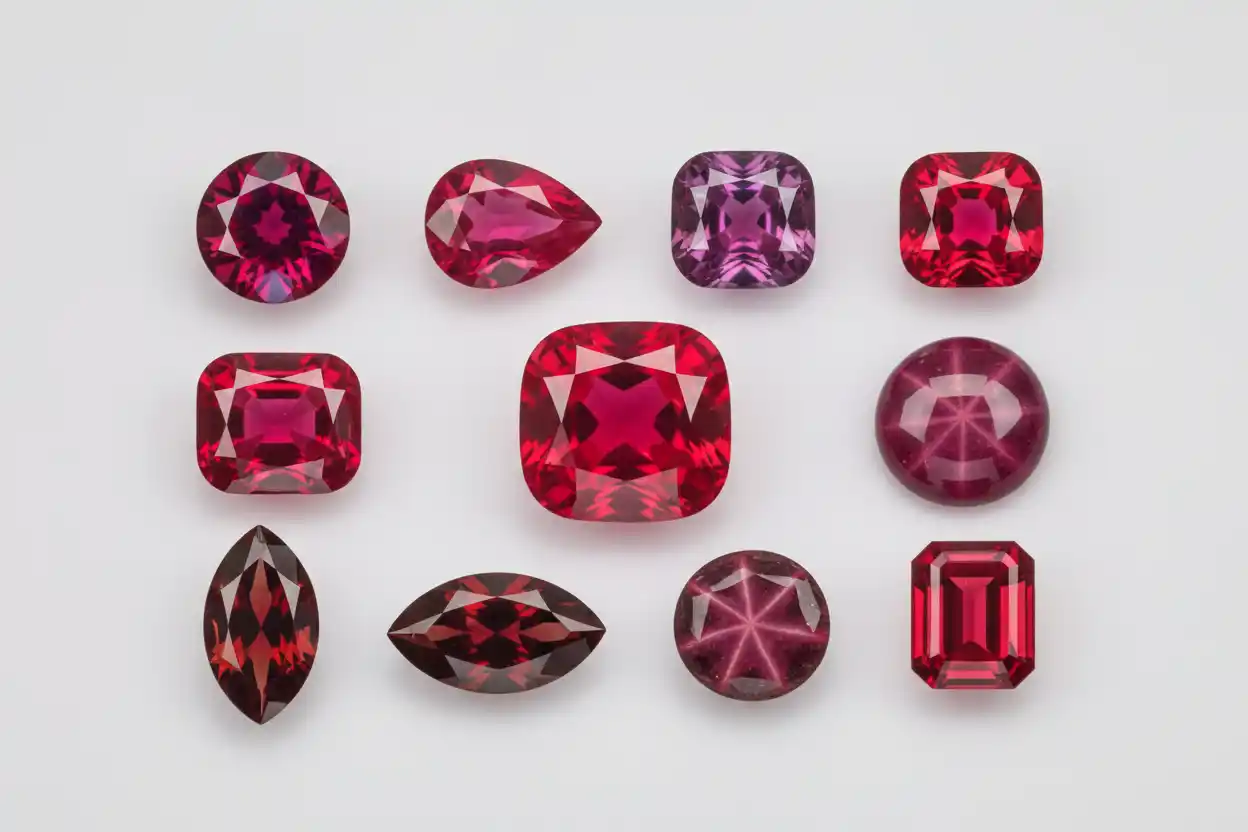
Types of Ruby: Colors and Varieties Explained
Ruby is the red variety of corundum, an aluminum oxide mineral whose color comes primarily from chromium. Its recognized “types” are not separate mineral species; instead, they reflect differences in hue, saturation, tone, origin, inclusions, optical effects, transparency, treatment, and natural or laboratory growth.
A vivid untreated Mogok ruby, a darker iron-rich Thai stone, a translucent six-rayed star ruby, and a lead-glass-filled commercial gem can all be corundum. Their rarity, appearance, durability, and value differ profoundly. The parent ruby meaning and properties guide covers ruby broadly, while this page owns color and variety classification.
Ruby at a Glance
| Property | Ruby |
|---|---|
| Composition | Aluminum oxide, Al₂O₃, colored primarily by chromium |
| Mineral group | Corundum |
| Main colors | Red, vivid red, pinkish red, purplish red, orangy red, brownish red, and dark red |
| Crystal system | Trigonal |
| Typical habit | Barrel-shaped, prismatic, tabular, bipyramidal, rounded water-worn crystals, massive material, and cabochons |
| Luster | Vitreous to subadamantine |
| Transparency | Transparent to opaque |
| Mohs hardness | 9 |
| Cleavage | No true cleavage; basal and rhombohedral parting may occur |
| Tenacity | Brittle, though generally durable in sound stones |
| Common uses | Faceted jewelry, cabochons, star stones, carvings, beads, watch bearings, lasers, and industrial components |
| Main care concern | Fractures, glass filling, cavity filling, diffusion treatment, heat-sensitive inclusions, and misleading origin or color terms |
Ruby Within the Corundum Family
Ruby and sapphire are the same mineral species.
Red corundum is ruby. Corundum in blue, yellow, green, orange, purple, colorless, and most pink colors is sapphire.
The boundary between very pink ruby and pink sapphire is not governed by one universal color measurement accepted across every laboratory and market. Different traditions may classify borderline material differently.
Consequently, a report from a respected laboratory is important when the name ruby rather than pink sapphire materially affects price.
The broader types of gemstones guide explains why mineral species and commercial varieties must be separated.
What Causes Ruby’s Red Color?
Chromium substitutes for a small proportion of aluminum within the corundum lattice.
Chromium absorbs parts of visible light while allowing red wavelengths to dominate. It also creates strong red fluorescence in many rubies, particularly those with lower iron content.
Iron can suppress fluorescence and darken the color. Rubies from iron-rich basalt-related deposits may therefore appear deeper, browner, or less fluorescent than marble-hosted stones.
Trace chemistry does not operate independently from cut and lighting. A shallow stone may look washed out, while an overly deep stone can appear blackish in the center.
Vivid Red Ruby
Vivid red ruby shows strong saturation without excessive darkness.
Fine examples appear red under neutral light and produce bright internal reflections. Minor pink, purple, or orange modifiers may be present, but red remains dominant.
This broad visual category includes stones from Myanmar, Mozambique, Vietnam, Tanzania, Madagascar, and other deposits.
Vivid color alone does not establish origin, treatment, or a prestigious trade name. Transparency, evenness, fluorescence, cut, and treatment must also be considered.
Pigeon-Blood Ruby
Pigeon blood is a prestigious trade color term applied to a narrow range of vivid red ruby.
No universal scientific definition governs the term across every laboratory. Major laboratories use internal master stones and additional requirements involving saturation, tone, treatment, transparency, zoning, fluorescence, and visual quality.
Some laboratories restrict the term to untreated rubies. Others may use different criteria or wording.
A retailer’s unsupported pigeon-blood claim should not carry the same weight as a recognized laboratory assessment.
The term describes color quality rather than one mine. Fine rubies from Myanmar, Mozambique, Vietnam, and other origins may potentially meet a laboratory’s criteria.
Pinkish-Red Ruby
Pinkish-red ruby has a visible pink modifier while remaining red enough to qualify as ruby under the chosen laboratory or trade standard.
Lighter tone can create exceptional brightness, especially when chromium fluorescence is strong. However, material that becomes predominantly pink may be classified as pink sapphire.
Online images often shift color through white-balance and saturation editing. A laboratory description provides a more consistent starting point for an expensive borderline stone.
Pinkish ruby should not be valued solely by darkness. A lively medium-tone gem may appear finer than a deeper red stone with weak transparency.
Purplish-Red Ruby
Purplish-red ruby displays a blue-red or violet-red modifier.
This appearance is common in rubies from several deposits and may become more visible under cool lighting. Heat treatment can reduce some blue or purple components in suitable material.
A mild purple modifier can be attractive, while strong purple usually reduces demand compared with balanced red.
Cutters may orient pleochroic rough to emphasize red and minimize less desirable directional color.
Orangy-Red Ruby
Orangy-red ruby contains a warm orange modifier.
Iron, chromium concentration, inclusions, and cutting can all influence the appearance. Some East African and Southeast Asian material shows this warmer red.
Strongly orange corundum may cross into orange or padparadscha-type sapphire rather than ruby. Laboratory classification becomes important near that boundary.
Dark and Brownish-Red Ruby
Dark ruby may appear burgundy, wine red, blackish red, or brown-red.
High iron content, dense color, inclusions, or excessive cutting depth can cause darkness. Thai and Cambodian basalt-related rubies are often associated with deeper iron-rich colors, although individual stones vary.
Dark material can be attractive in cabochons and men’s jewelry, but reduced brilliance usually lowers its value compared with a lively medium-to-medium-dark red.
Thin sections and backlighting may reveal stronger red than the mounted stone shows face-up.
Untreated Ruby
Untreated ruby shows no detectable evidence of heat or clarity modification.
Because heating is widespread, fine untreated material carries a substantial premium when independent testing confirms its condition.
Untreated status does not automatically make a stone beautiful. A dark, opaque, heavily included unheated ruby may be less valuable than a bright transparent heated gem.
The largest premiums occur when natural color, transparency, size, cut, and respected origin combine with no evidence of treatment.
Heated Ruby
Heat treatment is the most accepted and widespread ruby enhancement.
Controlled heating can improve color, reduce blue or purple modifiers, dissolve rutile silk, heal certain fissures, and increase transparency.
The effect depends on temperature, atmosphere, fluxes, and the ruby’s original inclusions. Some heating leaves subtle evidence, while high-temperature processing can create obvious altered inclusions.
Heated ruby remains natural corundum, but the treatment should be disclosed. Fine conventionally heated stones occupy a stronger market tier than heavily filled or diffusion-treated material.
The dedicated treated ruby guide owns the complete treatment hierarchy and detection intent.
Flux-Healed Ruby
During high-temperature treatment, a fluxing agent may enter surface-reaching fissures and help partially heal them with newly crystallized material.
Residues can remain inside healed areas. Laboratories may describe this treatment according to the amount of residue and the nature of the fissure healing.
Flux healing differs from filling a fracture with a large volume of glass. However, treatment terminology can be technical, so buyers should read the report comments rather than relying on the word heated alone.
Lead-Glass-Filled Ruby
Lead-glass-filled ruby begins as heavily fractured, low-transparency corundum.
A glass with a refractive index closer to ruby fills the fractures and improves apparent clarity. The filler can occupy a substantial proportion of the finished stone.
This material may look attractive at low cost, but it requires careful handling. Heat from jewelry repair, acids, ultrasonic cleaning, and some chemicals can damage or remove the glass.
Lead-glass-filled ruby should not be priced or described like conventionally heated ruby. The invoice should state the treatment clearly and prominently.
Diffusion-Treated Ruby
Diffusion treatment uses high temperature and added chemicals to introduce color-producing elements into the surface or near-surface region.
Beryllium and other elements have been used in corundum treatment. The resulting color may extend to varying depth.
Repolishing or recutting can alter shallow diffused color. Laboratory analysis is required because visual inspection may not determine treatment depth reliably.
Burmese and Mogok Ruby
Myanmar has produced ruby from several regions, with the Mogok Stone Tract holding the strongest historic prestige.
Mogok rubies commonly form in marble-related deposits. Lower iron can allow strong red fluorescence, while chromium produces vivid red to pinkish-red color.
Fine Mogok stones may show soft internal silk, bright color, and a glowing appearance. However, origin does not guarantee quality, and not every Burmese ruby comes from Mogok.
A credible Burmese or Mogok origin claim requires laboratory evidence. Historic mine names should never be assigned solely from color.
Mong Hsu Ruby
Mong Hsu in Myanmar became a major ruby source during the late twentieth century.
Rough commonly contains dark blue or violet cores and fractures. Heat treatment can reduce the blue component and improve transparency.
Flux-assisted heating is especially associated with some Mong Hsu material. Consequently, treatment disclosure is central to valuation.
Fine heated Mong Hsu ruby can be attractive, but it occupies a different market position from elite untreated Mogok material.
Mozambique Ruby
Mozambique has become one of the world’s most important modern ruby sources.
Deposits in the Montepuez region produce a broad range, from opaque carving material to transparent vivid red gems.
Fine Mozambique rubies can show strong saturation and excellent size. Some stones are relatively clean, while others contain amphibole crystals, rutile, fractures, and iron-related features.
Both heated and untreated material enters the market. Exceptional untreated Mozambique stones can achieve premium prices comparable with historic sources when color and clarity are outstanding.
Thai and Cambodian Ruby
Thailand and Cambodia produce ruby from basalt-related deposits, particularly around Chanthaburi, Trat, and Pailin.
These rubies commonly contain more iron than marble-hosted material. As a result, they may be darker, browner, less fluorescent, or more orangy red.
Heat treatment has long been central to the regional gem industry. Thai cutting and treatment expertise also processes ruby rough imported from many countries.
A stone cut in Thailand is not necessarily Thai-origin ruby.
Sri Lankan Ruby
Sri Lanka produces ruby, pink sapphire, star corundum, and many fancy sapphires from alluvial deposits.
Sri Lankan rubies are often lighter in tone and may lean pinkish red or purplish red. Highly saturated red examples are less common than pink sapphire.
The boundary between ruby and pink sapphire becomes especially important for pale Sri Lankan material.
Vietnamese Ruby
Vietnam has produced important marble-hosted rubies from Luc Yen and Quy Chau.
Fine stones may show vivid red, pinkish red, strong fluorescence, and attractive silk. Star and trapiche-like structures also occur.
Material ranges from transparent faceting rough to ruby in marble or spinel-bearing matrix.
Tanzanian and East African Ruby
Tanzania has produced rubies from Longido, Winza, Mahenge, and other areas.
Longido is strongly associated with opaque ruby in green zoisite or other metamorphic matrix. Winza produced transparent red crystals, while other deposits supply included and star material.
Madagascar, Kenya, Malawi, Greenland, Afghanistan, Tajikistan, and additional regions also produce ruby with distinctive inclusion and trace-element characteristics.
Origin should be treated as a laboratory-supported conclusion rather than a visual guess.
Star Ruby
Star ruby displays asterism: a star that moves across the surface under a single point light source.
Oriented rutile needles, commonly called silk, reflect light along intersecting directions. A six-rayed star is most familiar, although twelve-rayed or unusual multiple stars can occur when more than one inclusion system contributes.
The rough must be cut as a cabochon with the dome correctly aligned to the crystal axis. Faceting would scatter the effect.
Fine star ruby combines attractive red color, a sharp centered star, straight rays, useful transparency, and strong movement. Synthetic star ruby also exists.
Trapiche Ruby
Trapiche ruby contains a fixed six-rayed or wheel-like growth pattern divided by dark arms.
The structure develops during crystal growth rather than moving across the surface like asterism. Dark sectors can contain graphite, mineral inclusions, or growth-related material.
Trapiche ruby is rare and differs from a star ruby. One displays a stationary internal pattern; the other shows a moving reflected star.
A cross-section perpendicular to the crystal’s length usually reveals the trapiche structure most clearly.
Cat’s-Eye Ruby
Rare ruby can display a single moving band rather than a complete star when inclusions align predominantly in one direction or the cabochon is oriented differently.
A sharp centered eye with strong body color has collector appeal. However, cat’s-eye ruby remains far less common in the market than star ruby.
Cabochon and Opaque Ruby
Not every ruby is transparent enough for faceting.
Translucent and opaque ruby can produce attractive cabochons, beads, carvings, and substantial jewelry at lower prices. Color evenness, polish, fractures, and any star effect determine quality.
Opaque material may contain abundant rutile, mica, amphibole, feldspar, or other minerals. Dye and fracture filling are possible in low-cost goods.
Ruby in Zoisite and Ruby in Fuchsite
Ruby in zoisite is a multi-mineral rock containing red corundum within green zoisite and commonly black amphibole.
Ruby in fuchsite contains ruby within green chromium-bearing mica.
These materials are not color varieties of transparent gem ruby. They are ornamental rocks valued through pattern, polish, mineral contrast, and carving suitability.
Laboratory-Grown Ruby
Lab ruby has the same corundum composition and chromium-related red color as natural ruby but grows through an artificial process.
Common methods include flame fusion, flux growth, hydrothermal growth, Czochralski pulling, and related techniques.
Flame-fusion ruby is abundant and inexpensive. It may show curved growth lines, gas bubbles, and strong fluorescence.
Flux-grown ruby can contain veil-like flux residues and natural-looking inclusions. Advanced testing may be necessary because high-quality synthetics can imitate natural material convincingly.
Ruby Inclusions
Natural ruby commonly contains rutile silk, mineral crystals, negative crystals, healed fissures, fingerprints, growth zoning, cavities, and color bands.
Inclusions can support natural origin and sometimes indicate geological source. However, no single inclusion proves a country of origin.
Fine silk can scatter light and soften color attractively. Dense inclusions reduce transparency, while surface-reaching fractures threaten durability.
An apparently flawless ruby deserves careful testing because natural stones without any internal features are exceptionally unusual.
Ruby Identification and Lookalikes
Ruby can resemble red spinel, garnet, tourmaline, topaz, glass, synthetic corundum, and assembled stones.
The dedicated ruby versus spinel guide explains why spinel’s single refraction and different spectrum matter. The broader ruby, garnet, and spinel comparison covers darker red lookalikes.
The real versus fake ruby guide owns consumer-level warning signs.
Refractive index, birefringence, pleochroism, fluorescence, spectroscopy, microscopy, and trace-element analysis provide stronger identification than color or scratch tests.
Cutting Behavior
Ruby rough is commonly irregular, tabular, barrel-shaped, or water-worn.
Cutters balance color orientation, weight retention, zoning, inclusions, windowing, and extinction. Ovals and cushions often preserve more weight than rounds.
Dark rough may receive a shallower pavilion to avoid black extinction. Pale material may be cut deeper to intensify color.
Silk can improve apparent color but reduce transparency. Heating may alter the silk before cutting, changing the stone’s optical character.
Star rough requires a cabochon aligned with the rutile network. Trapiche crystals require cross-sectional orientation to reveal their pattern.
Durability and Jewelry Suitability
Ruby has Mohs hardness 9 and excellent resistance to ordinary scratching. The gemstone hardness chart places only diamond and a few specialized materials above it.
Corundum lacks true cleavage, but parting and brittle fractures can cause chips. The gemstone cleavage guide clarifies this distinction.
Untreated and conventionally heated rubies are suitable for daily-wear rings, earrings, necklaces, and bracelets when structurally sound.
Glass-filled, cavity-filled, heavily fractured, and composite stones require much greater caution. The relationship between hardness and overall durability appears in gemstone toughness versus hardness.
Ruby Prices in 2026
Ruby prices span several market tiers.
Opaque and heavily included cabochon ruby may sell for approximately $20–$300 per carat. Star effect, good color, and attractive cutting can raise the range.
Commercial heated faceted ruby commonly falls near $300–$2,000 per carat. Better transparent heated stones with strong red color may range from approximately $2,000–$10,000 per carat.
Fine vivid heated ruby, especially above one carat, can reach $10,000–$30,000 per carat. Untreated material of comparable beauty carries a substantial premium.
Exceptional untreated Burmese, Mozambique, Vietnamese, or other top-origin rubies may exceed $50,000–$100,000 per carat, particularly at larger sizes. Elite stones with prestigious color and origin reports can achieve auction prices far beyond those broad retail ranges.
Lead-glass-filled ruby may cost only a few dollars to a few hundred dollars per carat because a significant part of its appearance depends on filler.
Laboratory-grown ruby is far less expensive than comparable natural material, although branded jewelry and precision cutting can add significant cost.
The dedicated ruby price guide should retain detailed market tables and future updates.
Buying Guidance
Color, transparency, treatment, size, cut, and report quality should be considered together.
Assume that a ruby may have been heated unless a respected laboratory reports no evidence of heat. Untreated claims should not rest on a seller’s verbal assurance.
Read the treatment comments carefully. Heated, flux-healed, diffusion-treated, cavity-filled, and lead-glass-filled stones occupy different value and care categories.
Origin matters most when the gem already has exceptional quality. A dull Burmese ruby does not become elite through country name alone.
The complete transaction process belongs in the ruby buying guide. Independent-report considerations appear in gemstone certification.
Ruby Jewelry
A ruby engagement ring can be durable enough for daily use when the stone is sound and appropriately treated.
Ruby rings commonly use ovals, cushions, halos, three-stone settings, and protective bezels.
Ruby earrings place less impact stress on the stone and suit matched pairs, drops, studs, and clusters.
A ruby necklace can feature transparent gems, star cabochons, beads, or carved material, while ruby bracelets need secure settings because the wrist experiences frequent contact.
Cleaning and Storage
Warm soapy water is generally safe for untreated and conventionally heated ruby.
Ultrasonic and steam cleaning may be suitable for many sound untreated or heated stones, but not for glass-filled, cavity-filled, dyed, composite, or heavily fractured material.
A glass-filled ruby should receive only gentle cleaning with a damp cloth unless a qualified jeweler confirms a safer method.
The complete care process belongs in how to clean ruby jewelry.
Store ruby separately from diamond, sapphire, and other corundum pieces that can scratch or chip it.
Meaning and Symbolism
Ruby has represented vitality, authority, love, protection, courage, status, and prosperity in different cultural traditions.
Vivid red stones are often associated with passion and confidence, while star ruby may symbolize guidance or purpose.
Ruby is the traditional subject of the July birthstone guide.
The dedicated ruby healing properties guide owns the wider metaphysical intent.
These interpretations belong to culture, history, and personal belief. They are not scientifically demonstrated effects of chromium-bearing corundum.
Frequently Asked Questions
1. What are the main types of ruby?
Ruby may be classified by color, origin, treatment, transparency, optical effect, inclusion pattern, and natural or laboratory growth.
2. Is pink sapphire the same as ruby?
Both are corundum, but ruby must be sufficiently red. Borderline pinkish-red material may receive different classifications depending on the laboratory or market standard.
3. What is pigeon-blood ruby?
It is a prestigious trade term for a narrow range of vivid red ruby meeting a laboratory’s specific color and quality criteria. It is not one universally standardized color.
4. Which origin produces the best ruby?
Myanmar’s Mogok region has the strongest historic prestige, while Mozambique, Vietnam, Tanzania, and other sources produce exceptional stones. Individual quality matters more than origin alone.
5. Is heated ruby real?
Yes. Heated ruby is natural corundum whose color or clarity has been improved by controlled heating.
6. Is lead-glass-filled ruby durable?
It is less stable than untreated or conventionally heated ruby. Heat, acids, repair work, and some cleaning methods can damage the filler.
7. What creates a star in ruby?
Oriented rutile needles reflect light into a moving star when the stone is correctly cut as a cabochon.
8. What is trapiche ruby?
Trapiche ruby has a fixed six-rayed growth structure divided by dark arms. It differs from the moving reflected star of star ruby.
9. Is ruby in zoisite a ruby variety?
It is a multi-mineral ornamental rock containing ruby within zoisite and other minerals, not a transparent ruby color variety.
10. Can natural ruby be flawless?
Completely inclusion-free natural ruby is exceptionally unusual. Fine stones normally contain at least minor internal features.
11. Is lab-grown ruby chemically real ruby?
Yes. It is chromium-bearing corundum with the same basic composition as natural ruby, but it formed through an artificial growth process.
12. Which ruby type is most valuable?
Large, transparent, vivid-red, untreated natural ruby with excellent cut and respected origin documentation occupies the highest market tier.
Ruby’s types reflect the interaction of chromium, iron, geology, inclusions, heat, cutting, and commercial terminology. A fluorescent Mogok ruby, large Mozambique stone, iron-rich Thai gem, six-rayed star cabochon, fixed-pattern trapiche crystal, and flame-fusion synthetic may share corundum chemistry, yet they belong to very different value and disclosure categories. Related R entries appear in the crystals that start with R directory and the gemstones that start with R guide.