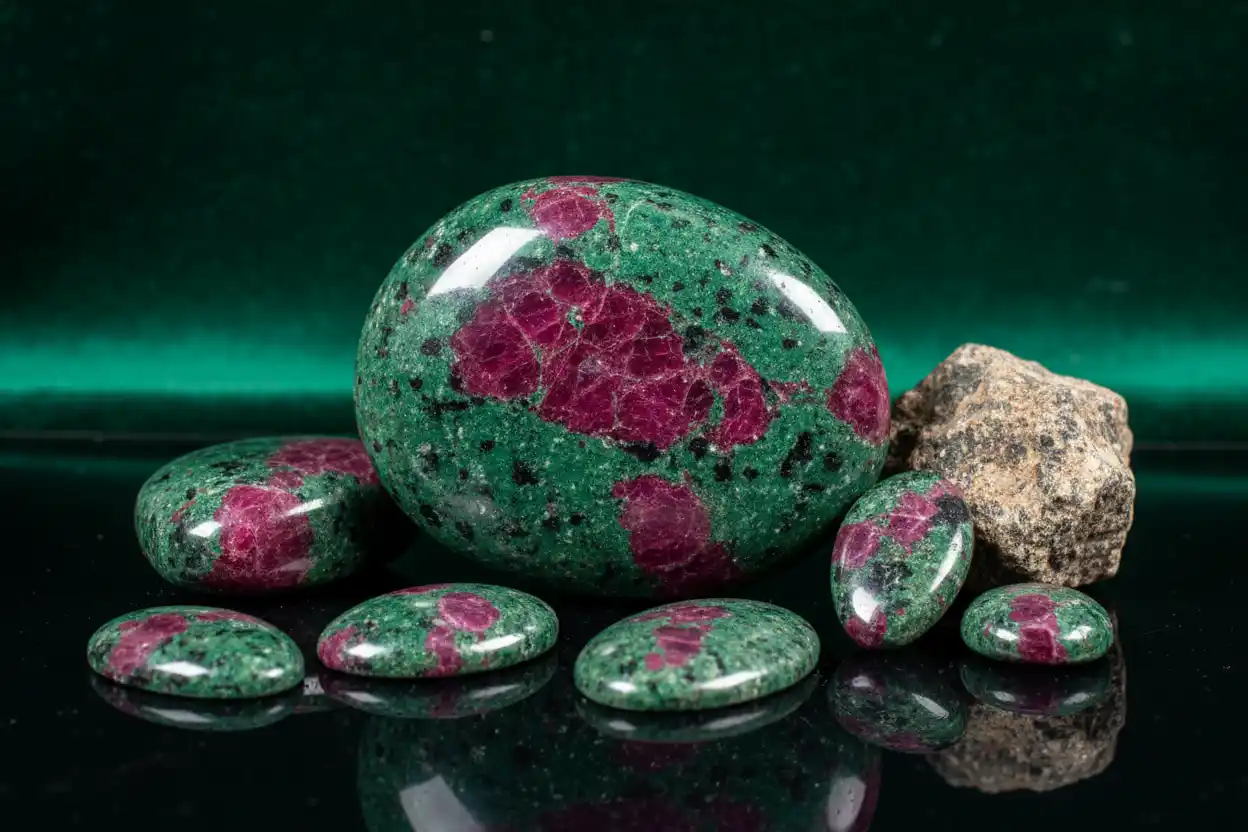
Ruby in Zoisite Meaning, Properties, Anyolite & Value
Ruby in Zoisite is a multicolored metamorphic rock composed principally of red Ruby crystals, green chromium-bearing Zoisite, and dark-green-to-black amphibole. The material is also called Anyolite, a trade and rock name associated most strongly with the Longido district of northern Tanzania.
Its striking red, green, and black pattern is used for cabochons, carvings, beads, spheres, tablets, and decorative objects. Although the Ruby portions can reach Mohs hardness 9, the complete rock has variable durability controlled by softer Zoisite, amphibole, fractures, cleavage, and mineral boundaries.
Ruby in Zoisite at a Glance
| Property | Ruby in Zoisite |
|---|---|
| Material type | Metamorphic rock or mineral aggregate |
| Common trade name | Anyolite |
| Principal components | Ruby corundum, green Zoisite, and dark amphibole |
| Possible amphiboles | Tschermakite, pargasite, hornblende-group material, and compositionally related amphiboles |
| Common colors | Crimson, red, purplish red, vivid green, yellow-green, dark green, black, gray, and occasional white |
| Crystal system | No single system applies to the complete rock |
| Ruby system | Trigonal |
| Zoisite system | Orthorhombic |
| Typical texture | Granular, massive, spotted, porphyroblastic, foliated, mottled, and locally veined |
| Luster | Vitreous over Ruby and Zoisite; vitreous to dull over amphibole |
| Transparency | Usually opaque, with locally translucent Ruby or Zoisite |
| Mohs hardness | Variable: Ruby 9; Zoisite commonly 6–6.5; amphibole commonly about 5–6 |
| Cleavage | Zoisite has prominent cleavage; amphibole has two cleavage directions; Ruby lacks practical cleavage |
| Tenacity | Brittle |
| Common uses | Cabochons, carvings, beads, pendants, spheres, eggs, slabs, decorative objects, and mineral specimens |
| Main care concern | Mixed hardness, Zoisite and amphibole cleavage, undercutting, fractures, resin, dye, and confusion with Ruby in Fuchsite |
What Anyolite Means
Anyolite is the established trade name for Ruby-bearing green Zoisite rock.
The name is commonly linked with a Maasai word referring to green.
It is not an approved mineral species and does not have one chemical formula.
Some references use Ruby Zoisite, Ruby-in-Zoisite, Tanganyika art stone, or Zoisite rock.
Anyolite should refer to the complete multicolored rock rather than the red Ruby grains alone.
A seller who describes one opaque carving as a 500-carat Ruby is ignoring the green Zoisite and black amphibole that make up most of the object.
The Ruby Component
Ruby is chromium-bearing corundum, Al₂O₃.
The crystals inside Anyolite can be irregular, rounded, tabular, barrel-like, or six-sided in cross-section.
Most are opaque to translucent and deeply colored.
Some contain enough clean material for cabochons, and the Longido district has occasionally produced facet-grade Ruby separate from or within the Zoisite-bearing deposit.
The parent Ruby guide owns transparent-gem quality factors, treatments, history, and high-value jewelry use.
Within Anyolite, the Ruby is valued mainly for its color contrast, distribution, crystal shape, and fluorescence.
The Zoisite Component
Zoisite is a calcium aluminum silicate with the formula Ca₂Al₃(SiO₄)(Si₂O₇)O(OH).
It crystallizes in the orthorhombic system and commonly forms in metamorphic rocks.
Chromium contributes to the green color in Anyolite.
The host can range from pale yellow-green to vivid grass green and deep forest green.
Massive Zoisite takes a useful polish but has cleavage and can fracture along internal boundaries.
The green material should not be confused with jade, Serpentine, Fuchsite, or dyed quartzite.
The Black Amphibole Component
Dark spots and bands in Ruby in Zoisite commonly belong to the amphibole group.
Tschermakite is frequently named, although pargasite, hornblende-group amphibole, or compositionally related phases may occur depending on the specimen.
The areas can appear black, dark green, gray-black, or brown-black.
Amphibole contributes visual contrast but can complicate cutting because it has two strong cleavage directions.
A polished black patch should not be called Tschermakite solely from its color.
Raman spectroscopy, chemical analysis, and X-ray diffraction are needed when the exact amphibole species matters.
Geological Formation
Ruby in Zoisite formed in a metamorphic environment where aluminum-, calcium-, chromium-, silica-, magnesium-, and iron-bearing components reacted under elevated pressure and temperature.
Ruby developed where aluminum and chromium were available under conditions suitable for corundum.
Zoisite formed within calcium- and aluminum-rich metamorphic assemblages.
Amphibole crystallized from magnesium-, calcium-, aluminum-, iron-, and silica-bearing reactions.
Fluids likely played an important role by transporting elements and promoting reactions along grain boundaries.
The exact sequence and source of the Longido assemblage continue to attract geological study.
A single polished slab can preserve several reaction stages, including Ruby partly surrounded by green Zoisite and crossed by later dark amphibole.
Longido, Tanzania
The Longido district of northern Tanzania is the classic source of Ruby in Zoisite.
It is among Africa’s longest-known Ruby-producing regions.
The deposit is famous for large red corundum crystals within green Zoisite matrix, commonly accompanied by black amphibole.
Most production is suitable for carving, cabochons, beads, and decorative objects.
Occasional zones yield cabochon- or facet-grade Ruby with deep red color.
Mundarara and related mining areas near Longido are closely associated with the Anyolite trade.
Tanzania should remain the expected source for classic material, although similar Ruby-Zoisite assemblages and Zoisite-bearing rocks can occur elsewhere.
A country label should still be supported through supplier records rather than assumed from color alone.
Anyolite Discovery History
Commercial accounts commonly state that Anyolite was discovered near Longido in 1954.
Ruby had been known in the broader district for decades before the multicolored carving material entered international trade.
The bright contrast made it useful for sculpture, animal carvings, beads, decorative bowls, and jewelry.
Its introduction also created persistent naming problems.
Some sellers called the complete rock Ruby, green Ruby, Zoisite Ruby, or African jade.
None of those names describes the mineral mixture accurately.
Anyolite or Ruby in Zoisite remains the clearest familiar wording.
Color and Pattern
High-quality material displays strong red Ruby against saturated green Zoisite.
Black amphibole can frame the red areas, produce spotted patterns, or dominate large sections.
A balanced three-color composition generally receives more demand than muddy green rock with tiny indistinct red grains.
Some pieces contain broad Ruby crystals with visible six-sided outlines.
Others show irregular red streaks or scattered grains.
White areas may contain feldspar, quartz, calcite, or pale Zoisite.
Purple-red Ruby creates a cooler palette, while orange-red crystals produce warmer contrast.
Cutting orientation determines whether one large Ruby becomes centered or several smaller crystals create a distributed pattern.
Ruby Fluorescence
Ruby in Zoisite frequently shows red fluorescence in the corundum areas.
Under long-wave ultraviolet light, the red patches may glow strongly against an inert or weaker green-and-black matrix.
The intensity depends on chromium, iron, transparency, and the thickness of the Ruby.
A strong reaction can help map corundum distribution inside a carving or cabochon.
However, fluorescence does not establish whether the host is Zoisite or Fuchsite.
It also cannot prove origin or rule out synthetic Ruby fragments embedded in an artificial matrix.
Ruby in Zoisite versus Ruby in Fuchsite
Ruby in Fuchsite contains red corundum in chromium-rich green muscovite mica.
Its host commonly sparkles, splits into thin layers, and has a softer micaceous texture.
Ruby in Zoisite has a granular, waxy-to-vitreous green host and commonly contains black amphibole.
Fuchsite material can display blue Kyanite reaction rims around the Ruby.
Anyolite generally lacks the pronounced silver-green mica shimmer.
The two are easy to separate when the matrix texture remains visible, yet polished low-resolution photographs often conceal that distinction.
Ruby in Zoisite versus Tanzanite
Tanzanite is the blue-to-violet gem variety of Zoisite.
It is typically transparent and faceted, while Anyolite is an opaque multicolored rock.
Tanzanite’s color arises from vanadium and is routinely modified by heat to reduce brown components.
The green Zoisite in Anyolite is chromium bearing and occurs with Ruby and amphibole.
A carving containing a blue patch should not be described as Tanzanite without laboratory identification.
Both materials share the Zoisite mineral species but occupy very different markets.
Ruby in Zoisite versus Thulite
Thulite is pink-to-red manganese-bearing Zoisite.
It commonly forms a more uniformly pink or mottled ornamental rock.
Ruby in Zoisite contains distinct corundum crystals rather than relying on manganese within the Zoisite to create the red color.
A Thulite object may include white or black minerals, but its red areas generally do not fluoresce like Ruby.
Raman spectroscopy and microscopic texture provide clear separation.
Ruby in Zoisite versus Ruby
A polished Anyolite object can contain real Ruby without being valued as a transparent Ruby gemstone.
The green and black portions contribute most of its weight.
Opaque Ruby crystals may be fractured, included, or chemically intergrown with the matrix.
A seller should not quote the Ruby price and apply it to the entire carving.
The ornamental-rock market values color contrast, pattern, polish, carving quality, and size.
Exceptional facet-grade Longido Ruby is a separate product requiring individual identification and treatment assessment.
How to Identify Ruby in Zoisite
Begin with the three-part visual structure: red corundum, green granular Zoisite, and dark amphibole.
Magnification should show mineral boundaries continuing through the polished surface.
The red areas may retain hexagonal outlines and should resist scratches much more strongly than the matrix.
The green host commonly has a hardness near 6–6.5 and a less flaky texture than Fuchsite.
Ultraviolet light may reveal red Ruby fluorescence.
Raman spectroscopy can identify corundum and Zoisite at separate points.
Chemical analysis can establish chromium-bearing Zoisite and classify amphibole.
Petrographic microscopy provides the strongest overview of the complete rock.
The general testing sequence appears in how to identify crystals.
Common Imitations
Dyed Zoisite, dyed Serpentine, green marble, quartzite, resin, and ceramic can imitate the host.
Red spots may consist of Garnet, Jasper, synthetic corundum, glass, or pigmented resin.
A composite product can place genuine Ruby fragments into a reconstructed green matrix.
Repeated identical red crystals, round bubbles, mold seams, glue lines, and surface-only color deserve scrutiny.
Ruby in Fuchsite is also frequently mislabeled as Ruby in Zoisite.
Detailed corundum-substitution checks appear in real versus fake Ruby.
Treatments and Stabilization
Most solid Anyolite is sold after cutting and polishing without routine color enhancement.
Nevertheless, open fractures and weak mineral boundaries can receive resin or clear filler.
Wax and oil can deepen the green-and-black contrast temporarily.
Dye may strengthen green Zoisite or add red to weak corundum areas.
Backing can reinforce thin slabs.
Coatings can add gloss but may scratch or yellow.
Individual Ruby crystals might have a separate heat history, although heating the complete mixed rock is not a standard treatment because the minerals respond differently.
The broader treatment categories appear in gemstone treatments explained.
Cutting and Carving
Ruby in Zoisite is primarily a carving material.
Lapidaries use it for animal figures, masks, eggs, spheres, hearts, bowls, cameos, cabochons, beads, and decorative slabs.
Its color distribution allows the cutter to use red Ruby for an eye, flower, crest, or focal detail within a green carving.
However, the hardness contrast creates technical challenges.
The cutting wheel removes Zoisite and amphibole faster than Ruby.
Ruby areas can protrude, while cleavage-rich black zones may chip or undercut.
Fine carving therefore requires continuous adjustment rather than one uniform pressure and abrasive sequence.
Durability and Jewelry Suitability
The complete rock should not receive Ruby’s hardness rating.
Zoisite commonly measures about 6–6.5, while amphibole commonly falls near 5–6.
Ruby reaches 9 but occupies only part of the object.
The range is placed in context by the gemstone hardness chart.
Zoisite and amphibole possess cleavage, and all components can separate along their boundaries.
The distinction between hardness and structural toughness appears in gemstone toughness versus hardness.
Pendants, earrings, brooches, and protected cabochons provide practical use.
Rings and bracelets receive more impact and abrasion, so they should be worn occasionally.
Large carvings need stable padded bases because a fall can split the stone through a cleavage or mineral boundary.
Current Ruby in Zoisite Asking Prices
Ruby in Zoisite is widely available as an ornamental material.
| Ruby in Zoisite product | Broad July 2026 retail asking range |
|---|---|
| Small tumbled stone | About $3–$12 |
| Standard commercial cabochon | About $15–$60 |
| Large or strongly Ruby-rich cabochon | About $50–$200 |
| Bead strand | About $10–$60 |
| Palm stone or small egg | About $15–$60 |
| Small sphere or carving | About $25–$125 |
| Large sphere or detailed carving | About $100–$750 |
| Sterling-silver jewelry | About $40–$250 |
| Fine collector specimen with prominent crystals | About $100–$1,000 or more |
| Separate facet-grade Longido Ruby | Valued independently as Ruby rather than by the Anyolite market |
These are broad asking ranges rather than appraisals or guaranteed resale values.
Current loose commercial cabochons and carvings commonly list from approximately $19 to $300 depending on size, Ruby coverage, shape, and workmanship.
Large weight alone does not create high value because much of the stone consists of green and black matrix.
What Gives Ruby in Zoisite Value?
Color contrast is the leading factor.
Bright red Ruby should remain visible against saturated green Zoisite.
Black amphibole can strengthen the composition when it frames rather than overwhelms the other colors.
Ruby coverage matters, but too much dark opaque corundum can reduce the visual balance.
Recognizable crystal outlines, strong fluorescence, unusual mineral relationships, and Tanzanian provenance add interest.
Cutting should position the pattern deliberately.
The polish must remain reasonably even despite the hardness contrast.
Open cracks, filler, dye, chips, and unstable cleavage reduce quality.
Carving skill, size, treatment disclosure, and provenance complete the valuation.
Buying Ruby in Zoisite
Confirm that the host is granular Zoisite rather than sparkling Fuchsite.
Request photographs of the front, back, edges, and mineral boundaries.
Ask whether the dark phase has been analyzed or is being called amphibole only from appearance.
Use ultraviolet light as supporting evidence for Ruby, not as the only test.
Check for resin, dye, backing, surface paint, and loose cleavage.
Do not pay transparent-Ruby prices for the complete matrix stone.
Variety context is available in types of Ruby, while treatment-specific corundum issues belong on treated and synthetic Ruby identification.
Ruby in Zoisite appears in the red-gemstone directory and green-gemstone directory.
It is also indexed through the crystals beginning with R directory and gemstones beginning with R directory.
Cleaning and Storage
Clean stable Ruby in Zoisite with lukewarm water, mild soap, and a soft cloth or brush.
Rinse briefly and dry it thoroughly.
Avoid soaking when fractures, filler, dye, glue, or porous matrix are present.
Do not use ultrasonic or steam cleaning.
Vibration and heat can affect cleavage, repairs, and mineral boundaries.
Avoid acids, bleach, abrasive powders, and strong household chemicals.
Store the stone separately from sapphire, Ruby, Topaz, and diamond.
Jewelry care principles should follow the softer matrix rather than the Ruby component. The separate Ruby jewelry cleaning guide applies only after accounting for the Zoisite and amphibole.
Ruby in Zoisite Meaning and Symbolism
Anyolite’s modern symbolism comes largely from its contrasting colors and intergrown minerals.
Contemporary crystal traditions associate it with combining enthusiasm and patience, pursuing growth without abandoning practical judgment, and coordinating different strengths within one project.
Red Ruby represents commitment, warmth, and decisive effort.
Green Zoisite contributes themes of development, adaptation, and reconsidering an established plan.
Black amphibole can symbolize structure, boundaries, and the less visible material supporting a larger pattern.
The natural hardness differences provide another metaphor: elements can belong to one object without responding identically to pressure.
These meanings remain personal, artistic, cultural, or spiritual interpretations. Scientific evidence does not show that Ruby in Zoisite treats illness, increases vitality, strengthens fertility, or guarantees emotional transformation.
Frequently Asked Questions
Is Ruby in Zoisite a mineral?
No. It is a metamorphic rock or mineral aggregate containing Ruby, green Zoisite, and commonly dark amphibole.
Is Anyolite the same as Ruby in Zoisite?
Yes. Anyolite is the established trade name for this red, green, and black ornamental material.
Is the red material genuine Ruby?
In authentic Anyolite, the red crystals are chromium-bearing corundum. Testing may be needed to exclude substitutes or composites.
What creates the green color?
Chromium-bearing Zoisite produces the characteristic green matrix.
What are the black spots?
They commonly belong to the amphibole group and may include Tschermakite, pargasite, hornblende-group material, or related compositions.
Where is Ruby in Zoisite found?
The classic and principal commercial source is the Longido district of northern Tanzania.
Does Ruby in Zoisite fluoresce?
The Ruby portions commonly fluoresce red under ultraviolet light, while the matrix may respond weakly or remain inert.
How does Ruby in Zoisite differ from Ruby in Fuchsite?
Zoisite is granular and moderately hard, commonly with black amphibole. Fuchsite is soft, flaky, sparkling mica and may show blue Kyanite rims.
Is Ruby in Zoisite the same as Tanzanite?
No. Tanzanite is transparent blue-to-violet Zoisite, while Ruby in Zoisite is an opaque green-and-red ornamental rock.
Is Ruby in Zoisite suitable for rings?
It can be used in a protected occasional-wear ring, but pendants and earrings expose its cleavage and mixed hardness to less impact.
Can Ruby in Zoisite go in water?
Brief gentle washing is usually suitable for sound untreated material. Avoid soaking filled, dyed, glued, or fractured pieces.
What makes Ruby in Zoisite valuable?
Color contrast, Ruby coverage, recognizable crystals, fluorescence, pattern, polish, structural condition, Tanzanian provenance, treatment disclosure, size, and craftsmanship determine value.
Ruby in Zoisite is most accurately appreciated as a three-component Tanzanian metamorphic rock rather than an oversized inexpensive Ruby. Its red corundum, green Zoisite, and black amphibole preserve a mineral relationship that becomes part of both its geological identity and lapidary design.
Cutting or grinding Ruby in Zoisite can generate corundum, Zoisite, amphibole, and other mixed-mineral dust. Use wet methods, effective local extraction, eye protection, protective clothing, and appropriately selected respiratory protection. Do not ingest the material or use it in drinking-water preparations.