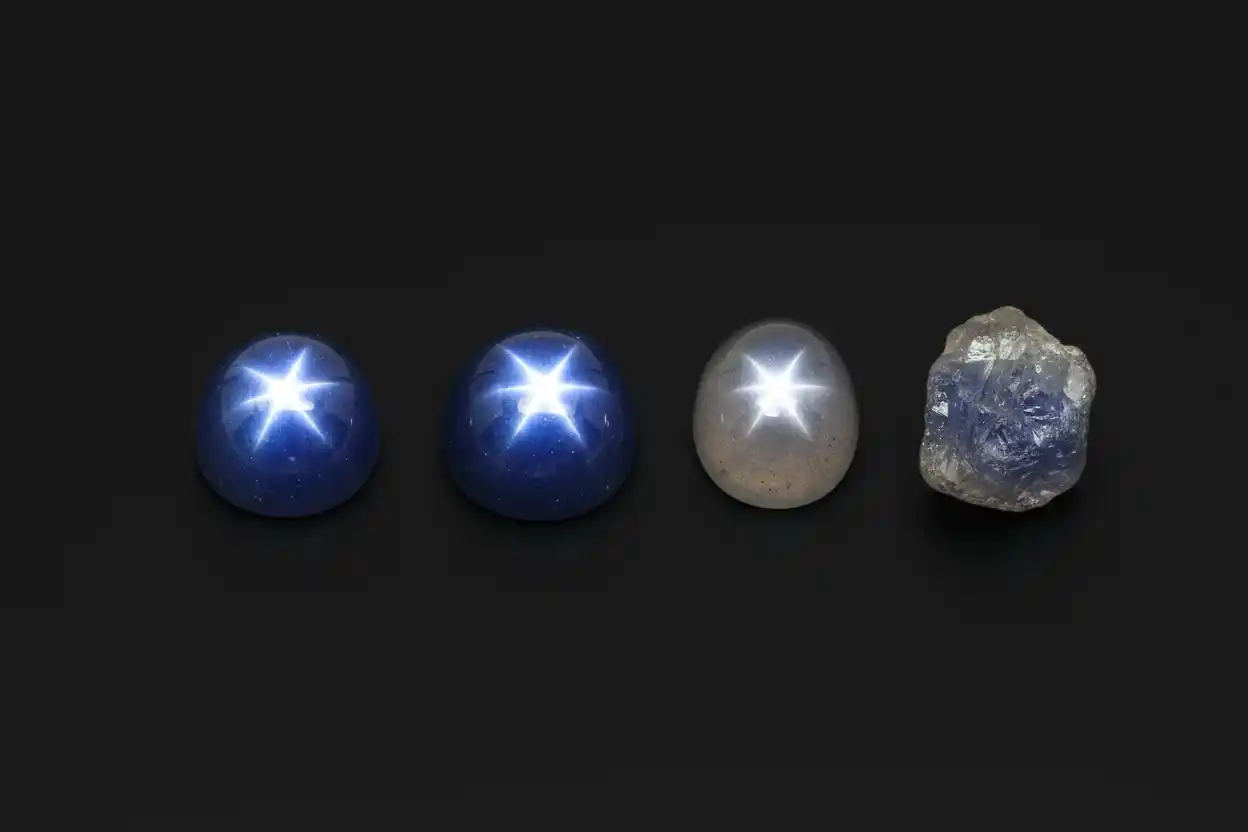
Star Sapphire: Meaning, Properties & Symbolism
Star Sapphire is phenomenal corundum whose oriented microscopic inclusions reflect light as a star across a polished cabochon. Blue is the best-known color, although natural star-forming sapphire also occurs in grey, black, purple, pink, yellow, white, greenish, and brownish shades.
The effect is called asterism. Most stones show six rays, while less common inclusion arrangements can produce four or twelve rays.
Star Sapphire at a Glance
| Property | Star Sapphire |
|---|---|
| Composition | Aluminum oxide, Al₂O₃, with iron, titanium, chromium, vanadium, or other trace elements |
| Group or type | Asteriated sapphire; phenomenal corundum |
| Color | Blue, grey, black, white, purple, pink, yellow, greenish, brown, orange |
| Crystal system or texture | Trigonal |
| Habit | Barrel-shaped, tabular, bipyramidal, massive, or waterworn; fashioned as cabochons |
| Luster | Vitreous to adamantine when polished |
| Transparency | Transparent to opaque, commonly translucent |
| Mohs hardness | 9 |
| Cleavage | None, though parting can occur |
| Tenacity | Brittle but generally durable when not heavily fractured |
| Common uses | Cabochon rings, pendants, earrings, brooches, birthstone jewelry, collector gems |
| Primary care concern | Fractures, parting, diffusion treatment, filling, synthetic material, and exposed cabochon domes |
What Is Star Sapphire?
Star Sapphire is a variety of sapphire, the name given to gem-quality corundum in every color except the red classified as ruby. Asteriated red corundum belongs on the separate Star Ruby page.
The mineral consists primarily of aluminum and oxygen. Small amounts of iron, titanium, chromium, vanadium, magnesium, and other elements influence body color, fluorescence, inclusion growth, and treatment response.
A sapphire becomes a Star Sapphire only when its inclusions have the correct orientation and concentration to produce a visible star after cabochon cutting. A silky sapphire without an organized star remains ordinary sapphire, while a laboratory-grown stone must be identified as synthetic Star Sapphire.
Star Sapphire occupies a distinct place within the types of sapphire because its value depends on an optical phenomenon as well as color, size, treatment, and origin.
It is also included in the crystals that start with S and gemstones that start with S directories.
How Asterism Forms
Most six-rayed Star Sapphires contain three sets of microscopic inclusions aligned with the trigonal structure of corundum. When light strikes these inclusions, each set reflects a narrow luminous band.
The three bands intersect at approximately 60-degree angles, forming six apparent rays. A curved cabochon dome focuses the reflections into a visible star.
Fine needles of rutile commonly cause white or silvery stars in blue and fancy-color sapphire. Hematite or ilmenite platelets and needles can create golden, bronze, or pale rays, especially in black Star Sapphire.
The inclusions must have appropriate dimensions and alignment. If they are too sparse, the rays remain weak. Conversely, dense coarse silk may create a bright star while making the body excessively opaque or grey.
Asterism is directional. The star appears most clearly beneath a single small light source and can become faint under broad, diffuse illumination.
Four-Ray, Six-Ray, and Twelve-Ray Stars
Six rays are standard because corundum commonly contains three oriented inclusion systems. Each system creates one luminous line across the cabochon.
Four-rayed stars can occur when only two inclusion directions contribute visibly. Some stones marketed as four-ray Star Sapphire may also have two weak rays that appear only under strong light.
Twelve-rayed stars form when two separate six-ray systems overlap. Rutile may create a silver-white star, while hematite or ilmenite produces a second yellow, gold, or bronze star rotated relative to the first.
A genuine twelve-ray effect should remain organized as the stone and light move. Random reflections, scratches, polished-base effects, and secondary glare do not constitute double asterism.
The quality of a star matters more than the number of rays. A sharp, centered six-ray star generally has greater visual appeal than a twelve-ray pattern with broken or indistinct arms.
How to Judge Star Quality
A high-quality star should have narrow, straight, continuous rays. Broad fuzzy bands indicate coarse inclusions, weak focus, or an unsuitable cabochon profile.
The rays should meet near the top center of the dome when the stone rests face-up. An off-center star usually reflects imperfect orientation, asymmetric cutting, or a deliberate attempt to preserve weight.
Each ray should extend toward the girdle without disappearing abruptly. Balanced length and brightness create a more symmetrical appearance.
Mobility is also important. Under a moving point light, the star should travel smoothly across the dome instead of remaining stuck near one edge.
The best viewing angle should not be impossibly narrow. A star visible only when the stone is tilted dramatically offers less practical appeal in jewelry.
Finally, body color and star quality must work together. A brilliant star cannot fully compensate for an unattractive grey, overly dark, or patchy body, while intense blue color loses phenomenal value if the star remains weak.
Star Sapphire Colors
Blue Star Sapphire ranges from pale blue-grey through cornflower, violet-blue, medium blue, inky blue, and nearly black. Iron and titanium contribute to blue coloration.
Grey material may show silver, blue, or white stars. Some stones have a cool steel appearance, while others carry brown, green, or violet modifiers.
Black Star Sapphire usually contains dense dark inclusions. Its rays may appear white, silver, bronze, or gold, and some examples display twelve-ray effects.
Purple Star Sapphire gains color from combinations of chromium, iron, vanadium, and related absorption mechanisms. Fine stones may show plum, violet, grape, or reddish-purple tones.
Pink star-forming corundum falls near the commercial boundary between pink sapphire and ruby. Laboratories and dealers may classify the reddest stones as Star Ruby, so the name should match the report rather than a seller’s preference.
Yellow, orange, white, and greenish Star Sapphires are less familiar but occur naturally. Their identity still depends on corundum properties and asterism, not simply on unusual color.
These materials may appear within guides to blue gemstones and black gemstones, but a color directory cannot replace phenomenal-stone evaluation.
How Star Sapphire Forms
Corundum forms in aluminum-rich rocks where silica activity remains low. If abundant silica were present, aluminum would enter feldspar or other silicate minerals instead.
Metamorphic Star Sapphires can develop in marble, gneiss, granulite, amphibolite, and rocks altered by high-temperature fluids. Magmatic sapphires occur in alkali basalts, syenitic rocks, and related igneous environments.
Titanium may enter corundum during crystal growth. As the sapphire cools, some titanium can separate from the host and form oriented rutile needles.
Other iron-titanium oxide inclusions may grow directly or exsolve along structurally controlled directions. These inclusion systems later create the star.
Weathering releases durable corundum from its host rock. Rivers concentrate the heavy crystals in alluvial gravels, where they may become rounded before mining.
The broader processes involved are explained in how gemstones are formed, while Star Sapphire remains focused on inclusion orientation and asterism.
Important Sources
Sri Lanka is one of the best-known sources of blue, grey, white, purple, pink, and fancy-color Star Sapphires. Its gem gravels can produce relatively translucent stones with mobile stars.
Myanmar, especially the Mogok region, has yielded blue, grey, and other star-forming corundum. Fine Burmese material may combine strong color with a prominent star, although opaque commercial stones also occur.
Madagascar supplies substantial quantities of blue, black, grey, and fancy-color Star Sapphire. The country is an important source of affordable commercial cabochons as well as better translucent stones.
Thailand and Cambodia produce dark blue and black star material, including stones with gold or twelve-rayed effects associated with iron-titanium inclusions.
Australia is known particularly for dark blue, greenish, grey, and black sapphire. High iron content commonly produces deep colors.
India, Vietnam, Tanzania, Kenya, Nigeria, Rwanda, Laos, China, Pakistan, Afghanistan, and the United States have also yielded star-forming sapphire.
Geographic origin cannot be established from color or star shape alone. A qualified laboratory may provide an origin opinion for some stones, but the result can remain inconclusive.
Inclusions in Star Sapphire
Rutile silk appears as fine parallel needles, reflective clouds, or intersecting networks under magnification. When dense, it creates a softly translucent or milky body.
Hematite and ilmenite can form platelets, needles, or oriented particles. They are particularly important in black, gold-starred, and twelve-ray sapphires.
Other natural inclusions may include zircon, apatite, spinel, mica, feldspar, calcite, graphite, sulfides, fluid inclusions, healed fractures, and negative crystals.
Angular growth zoning and color bands can follow corundum’s crystal symmetry. These patterns help gemologists interpret natural growth and treatment.
Parting planes may resemble cleavage even though corundum has no true cleavage. Fractures can intersect the surface and collect foreign filling material.
A visible inclusion scene does not by itself prove natural origin. Synthetic star corundum can contain rutile needles, gas bubbles, curved growth features, and manufactured structural patterns.
How to Identify Star Sapphire
The first observation should use a single small light. A genuine star should move across the cabochon as the light or stone changes position.
Sapphire has a Mohs hardness of 9, specific gravity near 4.00, and refractive indices around 1.76–1.77. A spot refractive-index reading can support corundum identification.
Pleochroism may be visible in more translucent stones. Blue sapphires commonly show two blue-to-greenish or violet-blue directions, although dense inclusions can obscure the effect.
A spectroscope may reveal iron- or chromium-related absorption. Ultraviolet fluorescence varies according to trace chemistry, origin, and treatment.
Magnification is essential. Natural silk, angular zoning, mineral inclusions, curved synthetic growth lines, gas bubbles, filled fractures, and diffusion-related features can all affect identification.
The dedicated real vs fake sapphire guide owns broader authenticity intent. Valuable Star Sapphire should receive a report from an independent laboratory.
Common Lookalikes
Star garnet may display four or six rays over a dark red, purple, or black body. Garnet is singly refractive and has different density, hardness, spectra, and inclusions.
Star diopside commonly shows four rays across a black or dark green body. It is much softer than corundum and has prominent cleavage.
Star rose quartz usually has a pale pink cloudy body with a softer, less sharply focused six-ray effect. Quartz has lower hardness, density, and refractive index.
Star spinel can overlap in grey, blue, purple, pink, or red colors. Spinel is cubic and singly refractive, while sapphire is trigonal and doubly refractive.
Kyanite can resemble blue sapphire in body color, but it does not normally produce the same corundum asterism and has highly directional hardness.
Fiber-optic glass, molded glass, engraved cabochons, and foil-backed stones can imitate a star. Their rays may remain fixed, appear too geometrically perfect, or reveal bubbles and assembly lines.
Heat Treatment
Conventional high-temperature heating often dissolves rutile silk. As the needles disappear into the corundum lattice, transparency may improve while the star weakens or vanishes.
Lower-temperature heating can alter color, inclusions, and fracture appearance without completely removing asterism. Treatment effects depend on temperature, atmosphere, duration, original chemistry, and cooling conditions.
A visible star therefore does not prove that a sapphire is unheated. Conversely, weak silk does not establish treatment because natural inclusion density varies.
Heated Star Sapphire can remain attractive and durable. Its value should still reflect disclosure, laboratory evidence, color, and star quality.
Treatment-specific identification belongs on the treated sapphire page.
Diffusion, Filling, and Coatings
Titanium diffusion can create or strengthen asterism near the surface of natural or synthetic corundum. The star may depend on a shallow treated layer rather than inclusions extending throughout the stone.
Repolishing a diffusion-treated cabochon can weaken or remove the effect if the treated surface layer is disturbed.
Fracture filling with glass, resin, oil, or other substances is possible, particularly in low-quality or damaged material. Bubbles, flow structures, colored flashes, and differences in surface relief can reveal filling.
Backing can improve apparent darkness or saturation in a thin cabochon. Foil or reflective material may also exaggerate the star.
Surface coatings can alter color or add metallic reflection. Wear at the girdle, scratches through the coating, and concentrated color along surface features provide warning signs.
General disclosure terminology appears in gemstone treatments explained.
Synthetic Star Sapphire
Laboratory-grown Star Sapphire has been produced commercially for many decades. Flame-fusion material is particularly common.
During production, manufacturers add titanium to synthetic corundum. Controlled heat treatment then causes fine oriented rutile needles to precipitate and create a star.
Synthetic stones may show curved growth striae, curved color bands, gas bubbles, Plato lines, exceptionally uniform color, and highly regular needle patterns.
Some synthetic stars appear unusually sharp and symmetrical across an evenly colored body. Nevertheless, appearance alone cannot prove laboratory origin because fine natural stones can also have strong stars.
Older Linde-type and other vintage synthetic Star Sapphires can have legitimate jewelry and collector value when correctly labeled. They should not receive natural-sapphire pricing.
The dedicated lab sapphire page explains the material, while lab-grown vs natural gemstones covers disclosure and identification principles.
Cabochon Cutting and Orientation
Star Sapphire must be fashioned as a cabochon because a curved surface focuses reflections from the inclusions into visible rays.
The cutter locates the corundum c-axis and places the center of the dome over the correct orientation. A mistake can move the star toward the edge or prevent it from forming.
Dome height affects focus. A shallow cabochon may show broad rays, while an excessively high dome can distort the star and retain unnecessary hidden weight.
The base should remain flat enough for stable setting. Deep uneven bases are sometimes left to preserve carat weight.
Cutters also balance color and inclusions. Removing a cloudy zone may improve body color but weaken the star, while retaining too much silk can create an opaque stone.
Recutting an existing cabochon carries risk. The process can shift the star, expose fractures, reduce weight, or remove a diffusion-treated layer.
Durability and Jewelry Suitability
Star Sapphire has excellent scratch resistance because corundum ranks 9 on the Mohs scale. It performs much better in jewelry than most phenomenal gems.
However, hardness does not prevent impact damage. Parting, fractures, cavities, and filler can weaken an individual stone.
Cabochon rings are practical when the sapphire is structurally sound and protected by a low bezel or substantial prongs. The raised dome should not sit unnecessarily high above the setting.
Pendants and earrings receive fewer direct blows. Bracelets expose the cabochon to more frequent contact with desks, walls, and neighboring stones.
Glass-filled, diffusion-treated, coated, or heavily fractured stones need additional care. The seller or laboratory report should identify these conditions before the gem is mounted or repaired.
Star Sapphire Value and July 2026 Asking Prices
The dedicated sapphire price page owns detailed valuation. Star Sapphire pricing nevertheless requires separate context because the market ranges from inexpensive opaque lots to fine, laboratory-documented gems.
As of July 2026, commercial opaque blue, grey, or black cabochons commonly carry asking prices around $5–$40 per carat. Treated black star material may appear around $30–$100 per carat, depending on the star and finish.
Better translucent stones with stronger blue, purple, white, or fancy color and a centered mobile star often ask approximately $50–$500 per carat.
Fine unheated stones with attractive saturation, strong translucency, complete rays, respected laboratory reports, and credible origin may range around $500–$2,000 per carat.
Exceptional material can exceed $2,000–$3,000 per carat, particularly when color, origin, size, and star quality align. However, a large opaque stone with a weak star can remain inexpensive despite substantial weight.
Current dealer examples illustrate the range: inexpensive opaque mixed lots can average only a few dollars per carat, while individual untreated Sri Lankan or Burmese stones may be offered from roughly $100 to $900 per carat.
Buying Star Sapphire
The sapphire buying guide owns detailed transactional intent. For Star Sapphire, begin with a rotating video beneath one point light.
The seller should show the star moving across the dome rather than only presenting the best still photograph. Ask to see ordinary indoor lighting as well as a focused light source.
Evaluate body color without allowing the bright star to dominate the decision. Grey patches, dead areas, color zoning, and overly dark sections remain visible when the point light moves away.
Request weight, dimensions, dome height, treatment disclosure, origin claim, and photographs of the base and girdle. These views expose deep hidden weight, fractures, backing, filling, and poor symmetry.
For any expensive stone, obtain an independent laboratory report confirming natural or synthetic origin and detectable treatments. A seller-issued card is not equivalent to laboratory testing.
September buyers may also consult the September birthstone guide, but birthstone symbolism should not override treatment and quality evaluation.
Cleaning and Storage
Detailed setting-specific instructions belong on the how to clean sapphire jewelry page.
For routine care, use lukewarm water, mild soap, and a soft brush. Rinse briefly and dry the stone with a lint-free cloth.
Hand cleaning is the safest default when treatment status remains unknown. Avoid harsh acids, bleach, abrasive cleaners, and sudden temperature changes.
Untreated and conventionally heated sapphire may sometimes tolerate ultrasonic or steam cleaning, but fractures, fillings, coatings, backing, and weak settings can make those methods unsafe.
Provide the jeweler with the laboratory report before resizing, retipping prongs, or repairing the mounting. Torch heat can damage fillers and some treatments.
Store Star Sapphire separately from diamond and other corundum. A padded individual box protects the raised dome and keeps the gem’s documentation with it.
Star Sapphire Meaning and Symbolism
Sapphire has long carried symbolism involving wisdom, loyalty, truth, protection, authority, and spiritual devotion. Star Sapphire adds a visible point of convergence to those broader associations.
The intersecting rays are sometimes interpreted as faith, hope, purpose, balance, or several paths meeting at one center. Different traditions assign different meanings, so no one interpretation applies universally.
Because the star becomes visible under focused light, it may serve as a personal metaphor for abilities or knowledge revealed under the right conditions.
Blue Star Sapphire is often associated symbolically with thoughtful communication and steady judgment. Black material may represent boundaries and endurance, while purple examples can symbolize reflection or imagination.
These interpretations belong to cultural, spiritual, and personal belief systems. Scientific evidence does not show that Star Sapphire cures disease, predicts events, protects against physical danger, or guarantees mental clarity.
Frequently Asked Questions
1. What causes the star in Star Sapphire?
Oriented microscopic inclusions—commonly rutile and sometimes hematite or ilmenite—reflect light as intersecting bands across a cabochon.
2. Why is Star Sapphire cut as a cabochon?
A curved dome focuses the inclusion reflections into rays; a flat faceted surface usually cannot display a well-formed star.
3. Does every Star Sapphire have six rays?
No. Six rays are most common, but four-ray and rare twelve-ray stones also occur.
4. What causes a gold star in black sapphire?
Oriented hematite or ilmenite inclusions commonly produce golden, bronze, or yellowish rays.
5. Can a natural Star Sapphire be pink?
Yes. Pink star-forming corundum exists, although strongly red stones may be classified as Star Ruby.
6. Does a visible star prove the sapphire is unheated?
No. Heat can alter, weaken, remove, or sometimes contribute to asterism depending on the process.
7. Can Star Sapphire be diffusion treated?
Yes. Titanium diffusion can create or strengthen a star near the stone’s surface.
8. Are synthetic Star Sapphires common?
Yes. Flame-fusion synthetic star corundum has been sold commercially for decades.
9. Why does the star disappear in diffuse lighting?
Asterism requires directional reflection, so a single concentrated light shows the rays better than broad ambient light.
10. Is Star Sapphire suitable for an engagement ring?
A sound natural or conventionally heated stone can perform well in a protective setting, although fractures and fillings reduce durability.
11. Why are some very large Star Sapphires inexpensive?
Large commercial stones may be opaque, grey, weakly starred, poorly cut, treated, synthetic, or unsupported by reliable identification.
12. What should a Star Sapphire report disclose?
It should identify natural or laboratory-grown corundum and describe detectable heat, diffusion, filling, coating, and origin when determinable.
The strongest Star Sapphire combines more than a bright star. Attractive body color, useful translucency, accurate orientation, sound structure, and dependable treatment disclosure determine whether the phenomenon remains impressive beyond one carefully staged photograph.