
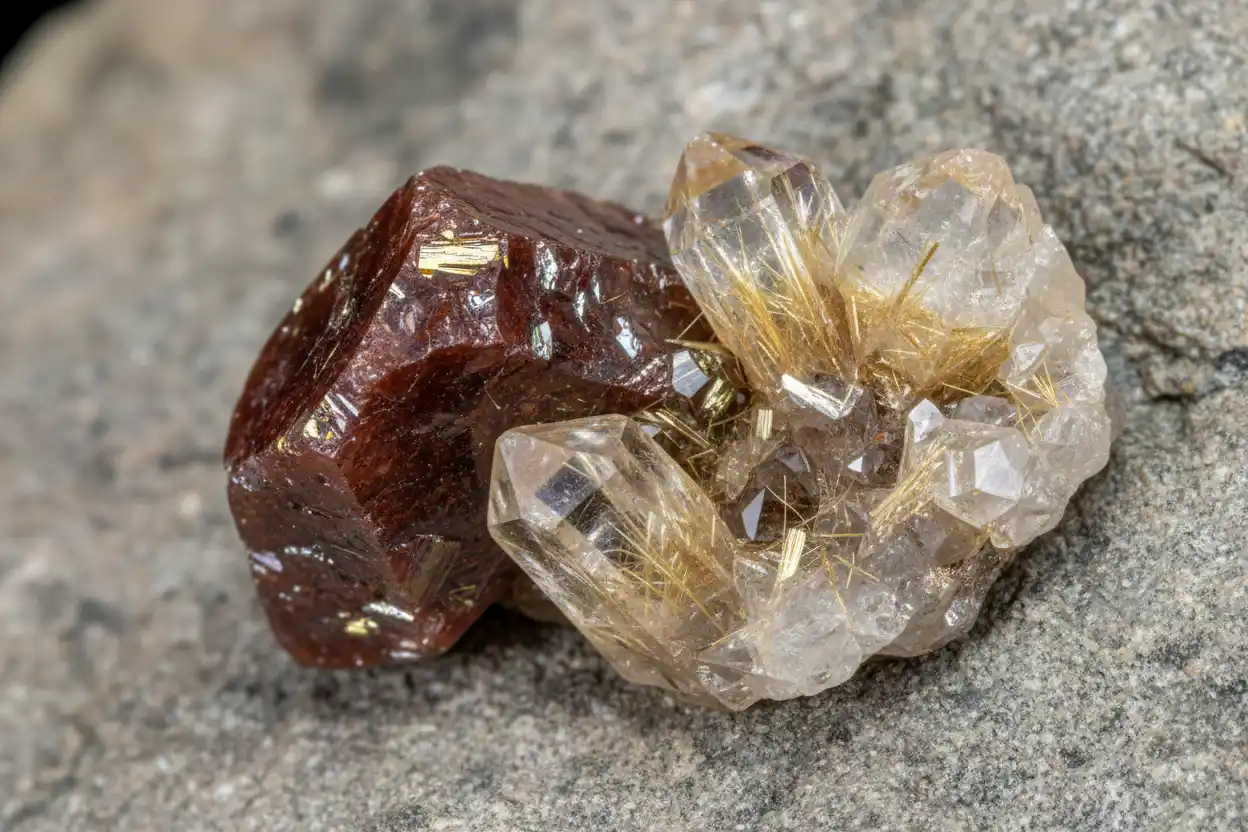

Rutile is a titanium dioxide mineral recognized by its unusually high refractive index, adamantine luster, and slender prismatic or needle-like crystals. Although many people encounter it as golden threads inside quartz, rutile also forms independent red-brown, black, yellow, and occasionally transparent crystals with distinctive twinning.
The mineral belongs among the scientifically important yet comparatively uncommon collector gems covered in broader guides to the types of gemstones. Its strong optical properties can create exceptional brilliance, but its dark body color, brittleness, and cleavage limit its use in mainstream jewelry.
Rutile at a Glance
| Property | Rutile |
|---|---|
| Composition | Titanium dioxide, TiO₂ |
| Group or type | Rutile group oxide mineral |
| Color | Red-brown, reddish black, black, golden yellow, orange, dark brown; rarely colorless or transparent red |
| Crystal system or texture | Tetragonal |
| Habit | Prismatic, acicular, needle-like, granular, massive; knee and elbow twins are common |
| Luster | Adamantine to submetallic or metallic |
| Transparency | Transparent to opaque |
| Mohs hardness | 6–6.5 |
| Cleavage | Good to distinct in prismatic directions |
| Tenacity | Brittle |
| Common uses | Titanium ore, mineral specimens, rare faceted collector gems, source of inclusions in quartz and corundum |
| Primary care concern | Cleavage, brittleness, fractures, and delicate matrix associations |
What Is Rutile?
Rutile is the most stable naturally occurring form of titanium dioxide under many geological conditions. It shares its chemical composition with anatase and brookite, but each mineral arranges titanium and oxygen atoms in a different crystal structure.
That structural difference matters. Rutile crystallizes in the tetragonal system and usually develops elongated prisms, fine needles, striated crystals, or compact granular masses. Well-formed specimens may show sharply angled knee twins, heart-like intergrowths, or radiating clusters.
The name comes from the Latin rutilus, meaning reddish or glowing red. Early mineralogists chose it because thin crystals commonly appear deep red when light passes through their edges, even when the specimen looks nearly black in ordinary illumination.
Rutile appears in both the crystals that start with R and gemstones that start with R directories. Nevertheless, most rutile enters industrial supply chains rather than jewelry workshops.
Composition and Crystal Structure
Pure rutile consists of one titanium atom bonded with two oxygen atoms. Natural crystals rarely remain chemically pure, however. Iron, niobium, tantalum, chromium, vanadium, tin, and other elements can substitute into the lattice in small quantities.
Iron commonly produces dark brown, reddish black, or black material. Chromium or vanadium may contribute red or greenish nuances in unusual crystals, while niobium- and tantalum-rich compositions tend to occur in specialized pegmatitic or metamorphic environments.
Rutile has one of the highest refractive indices found among naturally occurring minerals. Transparent material can therefore display intense brilliance, strong double refraction, and pronounced spectral dispersion. These effects may look dramatic in a carefully cut stone, although dark color and internal strain frequently conceal them.
Its relatively high specific gravity, around 4.2, also separates rutile from many visually similar dark minerals. A small crystal often feels noticeably heavy for its size.
How Rutile Forms
Rutile develops across a wide range of geological environments. High-pressure and high-temperature metamorphic rocks, including eclogite, granulite, gneiss, schist, and amphibolite, commonly contain microscopic or visible rutile.
During metamorphism, titanium released from other minerals can recrystallize as rutile. Because the mineral remains stable under demanding pressure and temperature conditions, geologists study its chemistry and inclusions to reconstruct the history of deeply buried rocks.
Rutile also occurs in igneous rocks, granitic pegmatites, carbonatites, hydrothermal veins, and skarns. Crystals from Alpine-type fissures may grow with quartz, hematite, chlorite, or feldspar, while pegmatitic examples can form thicker prisms associated with niobium- and tantalum-bearing minerals.
Weathering frees resistant rutile grains from their host rocks. Rivers and waves then concentrate the dense grains with ilmenite, zircon, monazite, and garnet in heavy-mineral sands. Many commercial titanium deposits occur in ancient or modern coastal dunes, beaches, and alluvial systems.
Rutile Colors and Their Causes
Red-brown remains the mineral’s classic color. Thin crystals may transmit ruby-red or orange-red light, while thicker crystals look opaque black because the dense body absorbs most visible light.
Golden and yellow rutile usually contains fewer darkening impurities or occurs as very fine needles that reflect light strongly. These needles create the bright threads seen in rutilated quartz, although the host and inclusion remain separate minerals.
Brown rutile belongs naturally within broader comparisons of brown gemstones. Dark opaque pieces may also resemble materials grouped as black gemstones, whereas transparent reddish specimens occasionally overlap visually with rare red gemstones.
Color zoning can occur within a single crystal. Furthermore, surface oxidation, adhering iron oxides, or included hematite may make a specimen appear more orange, rusty, or metallic than its interior.
Crystal Habits, Twins, and Inclusions
Needle-like rutile is its most recognizable habit, but the mineral can also form blocky prisms, fibrous aggregates, granular masses, and radiating sprays. Fine striations often run parallel to the length of a prismatic crystal.
Knee twins form when two crystals meet at a characteristic angle. Repeated twinning can produce cyclic clusters, open stars, hearts, or lattice-like groups prized by mineral collectors.
Independent rutile crystals may contain hematite, ilmenite, quartz, fluid inclusions, or small oxide grains. Conversely, rutile commonly acts as the inclusion inside another gemstone.
Parallel rutile needles can scatter light into a narrow moving band. In corundum, intersecting sets of oriented needles produce the stars seen in star ruby and star sapphire. Similar inclusions can create silk, haze, chatoyancy, or reflective golden strands in other minerals.
Rutile Versus Rutilated Quartz
Rutile and rutilated quartz should not be treated as interchangeable names. Rutile is the titanium dioxide mineral itself, while rutilated quartz is quartz that encloses visible rutile needles.
A loose rutile crystal typically has greater density, stronger luster, a much higher refractive index, and a red-brown streak. Rutilated quartz behaves mainly like its quartz host, so it has a hardness near 7, lower density, conchoidal fracture, and no cleavage.
Market values also follow different criteria. Collectors judge independent rutile specimens by crystal form, twinning, locality, matrix, damage, and rarity. Buyers assess rutilated quartz mainly by the clarity of the quartz, needle arrangement, color contrast, cut, and overall visual design.
Important Rutile Localities
Brazil has produced abundant rutile in quartz, hematite-rutile epitaxy, and independent crystals, particularly from Minas Gerais and Bahia. Fine specimens range from golden acicular inclusions to thick lustrous red-brown prisms.
Graves Mountain in Georgia, United States, is historically known for rutile crystals associated with lazulite, kyanite, pyrophyllite, and iron minerals. Magnet Cove in Arkansas and several Californian localities have also yielded notable material.
The European Alps produce sharp crystals from fissures in Switzerland, Austria, France, and Italy. Norway is known for rutile-bearing metamorphic rocks and coarse crystals, while Pakistan and Afghanistan supply alpine and pegmatitic specimens.
Madagascar, Sri Lanka, India, Mozambique, Sierra Leone, South Africa, and Australia contribute rutile through mineral specimens, metamorphic deposits, or heavy-mineral sands. A locality should accompany serious collector material because provenance can strongly affect value.
How to Identify Rutile
Visual identification begins with habit, luster, density, streak, and twinning. A tetragonal prism with strong vertical striations, adamantine surfaces, a reddish-brown streak, and substantial heft provides a useful preliminary match.
Thin edges may glow red-brown under transmitted light. Opaque surfaces often look submetallic, while fresh crystal faces can reflect light almost like polished metal.
Rutile can scratch materials below approximately 6 on the Mohs scale, although testing a finished specimen risks permanent damage. Cleavage and brittleness make indiscriminate scratch testing especially unwise.
A refractometer may not measure rutile with standard contact liquids because its refractive index exceeds their range. Gemologists can instead use microscopy, specific-gravity testing, spectroscopy, Raman analysis, or X-ray diffraction. The broader how to identify crystals guide explains why a combination of observations offers more confidence than a single home test.
Rutile Lookalikes
Cassiterite can resemble dark brown or black rutile because both have tetragonal crystals and adamantine luster. Cassiterite has much greater density, commonly displays different twinning, and generally lacks rutile’s characteristic red-brown streak.
Ilmenite and hematite may look similar in opaque metallic specimens. Ilmenite often has a black to brownish-black streak and different crystal forms, whereas hematite produces a red to reddish-brown streak but belongs to the trigonal system.
Anatase and brookite share rutile’s TiO₂ chemistry but develop different habits and crystal symmetry. Anatase commonly forms steep dipyramids, while brookite develops orthorhombic plates or tabular crystals.
Dark titanite, also called sphene, can display high luster and strong dispersion. However, sphene usually has wedge-shaped monoclinic crystals, lower hardness, lower density, and noticeably different cleavage.
Treatments, Synthetic Rutile, and Imitations
Collectors and gem dealers usually sell natural rutile crystals without treatment. Cleaning, trimming, stabilization of a matrix, or repair of a detached crystal may occur, so sellers should disclose restoration and preparation work.
Gem treatments applied to a rutile-bearing host do not necessarily treat the rutile itself. For example, heat treatment of ruby or sapphire can dissolve, alter, or redistribute rutile silk. The gemstone treatments explained guide covers why inclusion changes can help laboratories interpret a stone’s treatment history.
Manufacturers produce synthetic rutile for pigments, ceramics, optical applications, and research. Transparent synthetic rutile was also used historically as a diamond simulant because of its exceptional brilliance and dispersion.
Synthetic rutile differs clearly from diamond. It is much softer, strongly doubly refractive, denser, and prone to visible facet doubling. Modern diamond simulants have largely replaced it in ordinary jewelry.
Glass, coated materials, metallic needles embedded in resin, and manufactured quartz composites can imitate the appearance of rutile or rutilated quartz. Magnification may reveal bubbles, mold marks, surface coatings, or unnatural needle arrangements.
Cutting Behavior and Faceted Rutile
Transparent natural rutile is scarce enough that most faceted examples appeal primarily to specialist collectors. A cutter must work around dark color, cleavage, internal stress, fractures, and frequent inclusions.
Proper orientation can expose reddish or golden transmitted color while controlling the strong doubling visible through the stone. Shallow or poorly aligned cuts may appear dark, whereas careful faceting can produce exceptional fire.
Polishing can prove difficult because rutile’s cleavage and brittle edges may chip. Heat and pressure during cutting must remain controlled, particularly when the rough contains healed fractures or attached matrix.
Cabochons are uncommon unless the material has an interesting pattern, surface, or inclusion scene. Mineral specimens usually retain more value in natural form than they would after cutting.
Durability and Jewelry Suitability
A hardness of 6–6.5 gives rutile moderate scratch resistance, but hardness does not prevent cleavage or impact damage. The mineral can chip along facet junctions and break when struck.
Faceted rutile works best in pendants, earrings, collector brooches, or carefully protected rings worn occasionally. Low-profile bezels and substantial protective shoulders reduce exposure, although no setting can eliminate cleavage risk.
Rutile crystals on matrix require even gentler handling. Thin needles, twin junctions, and contact points can break from vibration, pressure, or a small fall.
Daily-wear rings generally benefit from tougher materials. Anyone choosing rutile for jewelry should accept that preservation may take priority over unrestricted wear.
Rutile Value and July 2026 Asking Prices
Rutile does not have one standardized per-carat market. Independent crystals, matrix specimens, twinned groups, inclusion material, and transparent faceted stones each trade through different collector channels.
As of July 2026, common thumbnail crystals and small matrix specimens often carry asking prices around $20–$100. Attractive twins, radiating groups, sharp crystals on contrasting matrix, and stronger locality pieces commonly appear around $100–$600.
Exceptional classic-locality specimens, damage-free starbursts, museum-scale groups, unusual epitaxial associations, and rare gem-quality crystals may reach several hundred to several thousand dollars. Natural faceted rutile also occupies a thin collector market, so price depends heavily on transparency, color, cut quality, size, documentation, and the availability of a comparable stone.
Rarity alone does not guarantee high value. A dark, fractured, poorly terminated crystal may sell modestly, while a smaller but sharp and aesthetically balanced twin can command more.
Rutile occasionally appears in discussions of the rarest gemstones in the world because clean facetable crystals are scarce. Still, ordinary rutile grains and industrial concentrations are not geologically rare.
Buying Rutile
Start by deciding whether the target is an independent mineral specimen, a faceted collector stone, or rutile enclosed in another mineral. Each category requires different photographs, measurements, and disclosure.
For a specimen, request images from several angles and inspect every termination, twin junction, repaired area, and matrix contact. A seller should state the locality, specimen dimensions, crystal size, stabilization, restoration, and whether any crystals were reattached.
For a faceted stone, ask for carat weight, measurements, transparency, treatment disclosure, origin claims, and a clear video in neutral lighting. Strong facet doubling can support a rutile identification, but a laboratory report offers greater confidence for expensive material.
The how to buy gemstones online guide provides a broader framework for reviewing return policies, lighting, measurements, seller language, and independent testing.
How to Clean and Store Rutile
Clean a solid, unfractured rutile crystal with lukewarm water, mild soap, and a very soft brush. Rinse briefly and dry it with a lint-free cloth.
Avoid household acids, bleach, abrasive powders, harsh jewelry dips, and sudden temperature changes. These methods may damage associated matrix minerals even when the rutile itself remains chemically resistant.
Do not place matrix specimens, fractured crystals, twins, or inclusion-rich faceted stones in steam or ultrasonic equipment. Guidance on gemstones in ultrasonic cleaners explains why vibration can expand hidden fractures and detach delicate crystals.
Store rutile separately in a padded box. Soft wrapping protects polished stones from harder gems, while a fitted specimen box prevents natural crystals from moving against their matrix.
Rutile Meaning and Symbolism
Rutile’s historical identity comes primarily from its reddish appearance, metallic brilliance, and connection with titanium rather than from one continuous ancient spiritual tradition. Modern collectors may also associate needle-like rutile with direction, movement, or the idea of finding a path through complexity.
Contemporary crystal traditions often describe rutile as a symbol of focus, determination, clarity, personal momentum, and resilience. Golden needles are sometimes interpreted as signs of illumination or creative energy, while dark rutile may symbolize grounding and endurance.
These interpretations belong to cultural and personal belief systems. Mineralogical evidence does not show that rutile treats illness, changes bodily processes, or produces guaranteed emotional effects.
Some people use a specimen as a meditation object, keepsake, artistic reference, or reminder of a chosen intention. Others value it entirely for its crystallography, geological history, optical properties, and natural form.
Frequently Asked Questions
1. Is rutile the same as rutilated quartz?
No. Rutile is TiO₂, while rutilated quartz is quartz containing visible rutile needles.
2. Why does rutile often grow as needles?
Its tetragonal crystal structure favors elongation along one crystallographic direction, producing slender prisms and acicular crystals.
3. Can natural rutile be transparent?
Yes, but transparent gem-quality crystals are rare. Most rutile appears translucent at thin edges or completely opaque.
4. What makes rutile red-brown or black?
Iron and other trace-element substitutions commonly darken the crystal, while crystal thickness and light absorption affect its apparent color.
5. Does rutile cause stars in rubies and sapphires?
Oriented rutile needles can reflect light as asterism when a corundum crystal is cut into a properly aligned cabochon.
6. How can rutile be separated from cassiterite?
Cassiterite has substantially greater density and different typical twinning, while rutile commonly shows a reddish-brown streak and characteristic knee twins.
7. Is rutile magnetic?
Most rutile is not strongly magnetic, although iron-rich material or attached magnetic minerals may produce a weak response.
8. Is rutile suitable for an everyday ring?
Usually not. Its cleavage, brittleness, and moderate hardness make pendants, earrings, protected occasional-wear rings, or collector pieces safer choices.
9. Why is faceted natural rutile uncommon?
Transparent rough is scarce, often dark, internally strained, fractured, or too included to cut attractively.
10. Is synthetic rutile chemically similar to natural rutile?
Yes. Both consist mainly of TiO₂, but laboratory growth conditions, inclusions, trace chemistry, and commercial purpose differ.
11. Can rutile be washed in water?
Brief cleaning with lukewarm water is normally suitable for a stable single crystal. Matrix specimens require caution because associated minerals may react differently.
12. What information should accompany a collectible rutile specimen?
A useful label records the mineral name, precise locality, specimen and crystal dimensions, acquisition source, and any repair, stabilization, or restoration.
A careful buyer’s next decision is therefore not simply whether a piece contains rutile, but which form of rutile offers the strongest combination of natural structure, condition, provenance, and visual character.