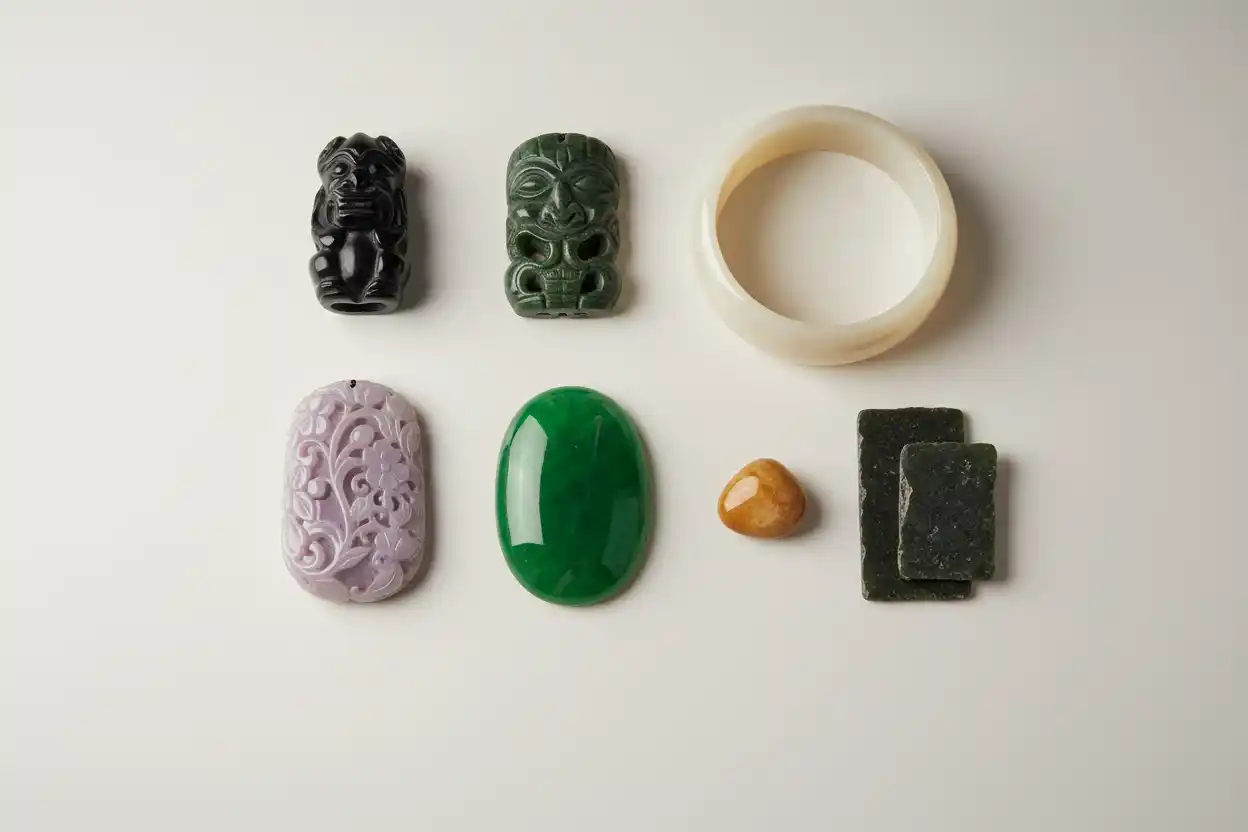
Types of Jade: Colors and Varieties Explained
Jade is not one mineral with a single composition. The traditional gem name primarily covers two exceptionally tough materials: jadeite-rich jade and nephrite jade. Under carefully defined gemological conditions, some green omphacite-rich rocks may also qualify for a jade identification.
Within those mineral categories, jade appears in green, white, lavender, yellow, orange, red, gray, blue-green, brown, and black. Trade names also classify it by origin, texture, treatment, transparency, and cultural tradition. The main jade meaning and properties guide covers jade’s broader identity, while this article separates its principal material and color types.
Jade at a Glance
| Property | Jadeite Jade | Nephrite Jade |
|---|---|---|
| Composition | Mainly jadeite, NaAlSi₂O₆, commonly with other pyroxenes and minor minerals | Dense intergrowth of tremolite-actinolite amphibole, approximately Ca₂(Mg,Fe)₅Si₈O₂₂(OH)₂ |
| Mineral group | Pyroxene | Amphibole |
| Main colors | Green, white, lavender, blue-green, yellow, orange, red, brown, gray, and black | White, cream, yellow, brown, gray, black, pale green, spinach green, and dark green |
| Crystal system | Monoclinic mineral grains in a tough interlocking aggregate | Monoclinic fibers in a dense interlocking aggregate |
| Typical texture | Granular, compact, interlocking crystalline rock | Fibrous, felted, compact aggregate |
| Luster | Vitreous to waxy; fine material may appear glassy | Waxy to greasy |
| Transparency | Transparent at thin edges to opaque | Translucent at thin edges to opaque |
| Mohs hardness | Approximately 6.5–7 | Approximately 6–6.5 |
| Cleavage | Individual grains possess cleavage, but aggregate texture reduces visible splitting | Individual fibers possess cleavage, but felted aggregate is exceptionally resistant to breaking |
| Tenacity | Very tough | Exceptionally tough |
| Common uses | Cabochons, bangles, beads, rings, earrings, pendants, carvings, seals, and objets d’art | Bangles, beads, carvings, tools, ceremonial objects, pendants, and cabochons |
| Main care concern | Hidden bleaching, polymer impregnation, dye, fracture filling, heat, and impact to thin sections | Surface treatments, dye, wax, internal flaws, heat, and impact to thin carvings or drilled areas |
What Materials Qualify as Jade?
The word jade has been used loosely for centuries, but modern gemology applies it more narrowly.
Jadeite jade is a rock composed primarily of jadeite or related pyroxenes. Nephrite jade consists of tightly interwoven tremolite-actinolite fibers.
GIA also recognizes that certain green omphacite-rich materials may fall within jade terminology when their mineral composition and appearance meet defined criteria. However, commercial labels remain inconsistent, so laboratory reports may use more precise wording than a retailer.
Serpentine, bowenite, quartz, aventurine, soapstone, calcite, prehnite, glass, and dyed materials are frequently sold with jade-like trade names. They may be attractive stones, but they are not automatically jade.
The focused jadeite versus nephrite guide owns the detailed two-material comparison.
Jadeite Jade
Jadeite is the rarer and generally more valuable jade mineral. It belongs to the pyroxene group and forms under high-pressure, relatively low-temperature metamorphic conditions commonly linked with subduction zones.
Gem jadeite is not usually one visible crystal. Instead, it is a compact rock made from interlocking microscopic to fine-grained pyroxenes and accessory minerals.
Color, transparency, and texture dominate value. Fine jadeite has an even, intense color, high translucency, and a smooth compact texture without distracting fractures or coarse grains.
Myanmar has produced most of the commercial material associated with elite imperial-green jadeite. Guatemala and Japan also have culturally and geologically important jadeite deposits.
The dedicated jadeite guide covers the mineral-rich material without duplicating the entire jade family.
Nephrite Jade
Nephrite consists of extremely fine, interlocking tremolite-actinolite amphibole fibers.
That felted microstructure gives nephrite extraordinary toughness. Before modern metals, people fashioned it into axes, blades, adzes, ornaments, ritual objects, and durable tools.
Nephrite is generally more abundant and less expensive than fine jadeite. Nevertheless, exceptional white, spinach-green, black, yellow, and historically important nephrite can command substantial prices.
Major sources include China, Russia, Canada, New Zealand, Taiwan, the United States, Australia, South Korea, and several Central Asian regions.
The dedicated nephrite guide retains the material-specific geology, symbolism, and care intent.
Omphacite Jade
Omphacite is a sodium-calcium pyroxene related to jadeite. Some green jade rocks contain substantial omphacite, jadeite, kosmochlor, or mixed pyroxene compositions.
Under older trade practice, certain dark or mottled green materials might simply be called jadeite. Modern analytical methods can reveal a more complex composition.
An authoritative laboratory may identify qualifying material as omphacite jade, omphacite-jadeite jade, or another compositionally precise term.
Color alone cannot separate omphacite-rich jade from jadeite-rich jade. Raman spectroscopy, infrared spectroscopy, chemical analysis, and microscopic structure may be required.
Imperial Green Jadeite
Imperial jade is the highest-profile jadeite color grade.
Fine imperial material displays vivid, evenly distributed, moderately dark green with excellent translucency and a fine texture. Chromium is the principal cause of the intense green.
The best stones appear saturated without becoming black or opaque. Light should penetrate the material and create a glowing, almost liquid appearance.
“Imperial” is not a species or a universally enforced laboratory grade. Sellers sometimes use it loosely for any bright green jadeite. A valuable imperial claim should therefore be supported by an independent report confirming natural jadeite and treatment status.
Fine imperial-green cabochons, beads, and bangles can reach extraordinary prices because large, evenly colored, translucent sections of rough are exceptionally scarce.
Apple-Green Jadeite
Apple-green jadeite is lighter and usually more yellowish than imperial green.
The best examples show fresh, lively color with enough translucency to avoid a chalky appearance. Commercial material may contain white clouds, mottling, darker spots, or uneven saturation.
Apple green can be attractive and valuable without meeting imperial criteria. Its price depends heavily on whether the color is natural, dyed, or concentrated by treatment.
Moss-in-Snow and Mottled Green Jadeite
Moss-in-snow jadeite has vivid green patches, veins, or speckles distributed through a white or near-colorless background.
The pattern may resemble moss, floating clouds, or leafy inclusions. Fine material balances the green and white areas in a visually pleasing composition.
Mottled jadeite can be less valuable than evenly colored imperial material, but exceptional patterns suit carvings because a skilled artist can incorporate color boundaries into the design.
Texture remains crucial. Coarse, dry, fractured material does not become elite jade simply because part of it is green.
Lavender Jadeite
Lavender jadeite ranges from pale lilac and gray-lavender to pinkish violet and stronger purple.
Manganese-related components contribute to the color. Fine lavender material should have attractive saturation, translucency, and a compact texture.
Many pale lavender pieces appear gray under weak lighting. Conversely, dyed material may show unnaturally concentrated purple in cracks and grain boundaries.
Lavender jadeite has a significant collector market and can command high prices when the color is natural and evenly distributed.
The term lavender jade should not be applied automatically to purple quartz, chalcedony, glass, dyed marble, or unrelated carving stone.
White Jadeite
White jadeite ranges from translucent icy material to opaque porcelain-white rock.
Near-colorless highly translucent jadeite is sometimes called icy jade. The finest pieces show strong light penetration and a fine, even texture without obvious green, gray, or brown components.
More opaque white material is common in carvings, beads, and bangles. Brightness, texture, absence of staining, and structural integrity determine quality.
The broader white jade guide covers pale jade symbolism while distinguishing jadeite from white nephrite.
Icy Jadeite
“Icy” is a trade description for highly translucent colorless, white, pale green, or pale lavender jadeite.
The material does not contain ice. Instead, its fine grain and transparency create a cool, watery appearance.
Icy jadeite may contain subtle cotton-like clouds, faint color zones, or crystalline texture. Clean pieces with excellent translucency can be highly valuable even without vivid imperial color.
Glass and transparent resin can imitate the appearance, making laboratory confirmation important for expensive stones.
Yellow, Orange, and Red Jadeite
Yellow and orange jadeite commonly obtain color from iron-bearing alteration near the surface of rough boulders.
Colors range from pale cream-yellow and honey to orange, rust, and reddish brown. Strong natural orange-red is uncommon.
These weathered outer colors can form attractive skins around white or green interiors. Carvers may use the contrast deliberately in figures, animals, landscapes, and symbolic objects.
Dyed yellow, orange, and red jade also exist. Surface-concentrated color or unusually uniform saturation should prompt treatment testing.
Blue and Blue-Green Jadeite
Blue jadeite ranges from gray-blue and blue-green to muted teal.
Guatemala is known for blue-green and mottled jadeite used historically by Mesoamerican cultures. Japan has also produced blue jadeite from geologically important deposits.
Strong pure blue is rare. Much material contains green, gray, black, or white components.
“Blue jade” is also used commercially for dyed quartz, serpentine, calcite, and other materials. Origin and identity should therefore be confirmed rather than assumed from a trade name.
Black Jadeite and Chloromelanite
Black jadeite may appear opaque black but transmit dark green at thin edges.
Some material contains substantial dark pyroxenes, including omphacite, kosmochlor, aegirine-rich components, or chloromelanite-type mixtures.
Chloromelanite is an older descriptive term for dark green-to-black jadeite-rich material rather than a simple modern species name.
Fine black jade should have a smooth compact texture, good polish, and minimal surface-reaching fractures. Dyed pale jade and black glass are common imitations.
White Nephrite and Mutton-Fat Jade
White nephrite ranges from gray-white and cream to warm ivory-like shades.
The celebrated term mutton-fat jade describes exceptionally fine, dense, even-textured white nephrite with a warm, soft, greasy luster. It does not mean the material contains animal fat.
Historically important white nephrite is strongly associated with the Kunlun and Hetian regions of western China, particularly river-worn pebbles and boulders.
The term is frequently overused. Ordinary opaque white nephrite should not be marketed as top mutton-fat quality without the fine texture, luster, even color, and provenance expected by specialist collectors.
Hetian Jade
Hetian jade is a historic and commercial name associated primarily with nephrite from the Xinjiang region of China.
Traditional material occurs as mountain rough and river-worn pebbles. White, cream, yellow, greenish, brown-skinned, and darker varieties exist.
The weathered outer rind of river pebbles may show yellow, red-brown, or dark skin. Skilled carvers sometimes preserve the skin as a deliberate part of the design.
Modern market use can be broad, and some material from other regions is sold as Hetian-style jade. A strong locality claim requires credible documentation.
Spinach-Green Nephrite
Spinach jade describes medium-to-dark green nephrite with black, dark green, or cloudy inclusions resembling cooked spinach leaves.
Iron-rich actinolite components contribute to the green color. Fine examples have an attractive even ground with a lively fibrous or speckled texture.
Spinach nephrite occurs in China, Russia, Canada, and other regions. The name describes appearance rather than one deposit.
It is usually more opaque than top imperial jadeite but can be exceptionally tough and attractive in bangles, beads, and carvings.
Siberian and Russian Nephrite
Russian nephrite occurs in several regions, including Siberia.
Material ranges from pale green and apple green to dark spinach green, black-spotted green, white, and yellowish tones.
Fine Russian nephrite can display rich color, translucency at thin edges, and a dense polish. Large blocks have supplied carvings and architectural objects as well as jewelry.
“Russian jade” should not automatically be interpreted as nephrite because unrelated green stones can also receive geographic marketing labels.
Canadian Nephrite
British Columbia is one of the world’s major sources of nephrite.
Canadian material commonly appears medium to dark green, spinach green, gray-green, or blackish green. Large boulders can supply carvings, tiles, beads, cabochons, and ornamental objects.
Mining often involves heavy equipment because sound nephrite boulders are dense and exceptionally tough. Sawing and transport can cost more than the initial extraction.
Commercial Canadian nephrite is widely available, but premium translucent, evenly colored material remains more valuable than dark fractured carving grade.
New Zealand Pounamu
Pounamu is the Māori name applied to treasured greenstone materials from New Zealand, primarily nephrite, bowenite, and certain serpentinite-related stones within established cultural categories.
Nephrite varieties include kawakawa, īnanga, kahurangi, and other traditionally recognized appearances. These names carry cultural, genealogical, geographical, and legal significance beyond ordinary gem color descriptions.
Authentic pounamu is tied to New Zealand sourcing and Māori guardianship. Buyers should respect provenance and avoid using the name generically for imported green nephrite.
A commercial article should not reduce pounamu to a color grade because its cultural meaning is inseparable from place and community.
Black Nephrite
Black nephrite contains abundant iron-rich amphibole components, graphite, magnetite, or other dark material.
Some pieces appear solid black, while thin edges reveal green or gray. A high polish can create an attractive deep luster.
Black nephrite is used for pendants, beads, bangles, carvings, and contemporary jewelry. It may be confused with black jadeite, serpentine, onyx, obsidian, or dyed stone.
Yellow and Brown Nephrite
Yellow nephrite ranges from cream and butter yellow to honey, mustard, brown-yellow, and russet.
Iron-bearing compounds, weathering, and associated minerals contribute to color. River pebbles may have a brown or reddish skin around a lighter core.
Warm natural colors can be desirable for carvings, especially when several layers occur in one piece. Dye and artificial staining remain possible, so important material should be tested.
Maw-Sit-Sit and Related Green Rocks
Maw-sit-sit is a vivid green and black metamorphic rock from Myanmar containing kosmochlor, chromian jadeite, albite, amphiboles, and other minerals.
It is associated geologically and commercially with jade, but it is not simply a color variety of pure jadeite.
The material can be attractive and durable, yet it should be labeled maw-sit-sit rather than sold as top imperial jadeite.
Other mixed pyroxene rocks may also receive jade-like names. Mineralogical accuracy matters because composition influences rarity, treatment response, and value.
Type A, B, C, and B+C Jadeite
The A, B, and C system principally describes jadeite treatment rather than color or mineral variety.
Type A jadeite is natural or has received only traditional surface waxing and polishing. It is the preferred category for buyers seeking untreated structure and natural color.
Type B jadeite has been bleached with acid to remove stains and then impregnated with polymer. The process improves transparency and appearance but alters the material’s structure and long-term stability.
Type C jadeite has been dyed. Type B+C has received both bleaching-polymer impregnation and dye.
Some sellers use Type D for assembled or composite jade, although the term is not applied consistently.
The dedicated treated jade guide owns the complete detection discussion. Treatment should be disclosed in writing regardless of whether the finished piece remains attractive.
Jade Formation and Geology
Jadeite forms in high-pressure, relatively low-temperature environments associated with subduction, serpentinized mantle rocks, and fluid-driven metasomatism.
Jadeite-rich veins and blocks can occur within serpentinite mélanges. Geological uplift and erosion later release boulders into river systems, where weathered skins may conceal valuable interiors.
Nephrite commonly forms when calcium-rich and magnesium-rich rocks react during metamorphism or hydrothermal alteration. Serpentinite-related and dolomite-related nephrite deposits follow somewhat different geological pathways.
The interlocking texture develops through recrystallization rather than from one large crystal. That texture explains jade’s exceptional toughness.
Major Jade Localities
Myanmar remains the defining source of fine commercial jadeite. Guatemala supplied jadeite to ancient Olmec, Maya, and other Mesoamerican cultures and continues to produce green, blue-green, black, and mottled material.
Japan’s Itoigawa region has important prehistoric and modern jadeite history. Additional jadeite occurrences exist in Russia, Kazakhstan, the United States, Italy, and other regions.
China’s Xinjiang region is historically important for nephrite. Russia, British Columbia, New Zealand, Taiwan, Australia, South Korea, Wyoming, and Alaska also produce notable nephrite.
Locality cannot be proved from color alone. An independent laboratory may identify the material and treatment but may not always determine geographic origin conclusively.
Jade Texture, Inclusions, and Transparency
Jade value depends heavily on texture because the material is an aggregate of many small grains or fibers.
Fine jadeite has a compact, smooth texture that permits strong translucency and a bright polish. Coarse grains scatter light and create a dry or granular appearance.
Nephrite’s fibrous structure may produce silky, greasy, felted, cloudy, or cat’s-eye-like visual effects. Some aligned-fiber nephrite can show weak chatoyancy.
White clouds, dark mineral grains, oxidized fractures, grain boundaries, healed cracks, and weathered skins are common natural features. Their effect on value depends on placement and whether they threaten durability.
How Jade Is Identified
Jade identification begins by establishing whether the material is jadeite, nephrite, omphacite jade, another rock, or an imitation.
Jadeite and nephrite have different refractive indices, specific gravities, spectra, microscopic textures, and chemical compositions. Infrared spectroscopy is especially useful for detecting polymer impregnation in jadeite.
A handheld light can reveal texture and transparency, but it cannot prove treatment status. Sound tests, scratch tests, and cold-touch claims are unreliable.
The dedicated real versus fake jade guide owns consumer-level warning signs. The jade versus jadeite guide clarifies why “jade” is the umbrella term rather than a third competing mineral.
Jade Lookalikes
Serpentine is one of the most common jade substitutes. It can be green, waxy, carvable, and inexpensive, but it is generally softer and has different optical properties. The parent serpentine guide covers that mineral family.
Aventurine quartz may resemble granular green jade. The aventurine versus jade guide explains why sparkle, quartz hardness, and granular structure matter.
Other lookalikes include dyed quartzite, prehnite, calcite, marble, soapstone, glass, resin, amazonite, chrysoprase, hydrogrossular garnet, and green feldspar.
No single home test safely separates every material. Important purchases should rely on laboratory analysis rather than destructive scratching or heating.
Cutting and Carving Behavior
Jade is usually cut as cabochons, beads, bangles, tablets, hoops, seals, pendants, and carvings rather than transparent faceted gems.
The interlocking aggregate resists splitting, but hidden fractures and grain boundaries still influence cutting. A bangle requires a large sound section of rough, which is why fine untreated bangles can be exceptionally valuable.
Carvers plan around color zones, weathered skins, white clouds, fractures, and inclusions. A brown rind may become an animal’s fur, a green streak may become foliage, and a white area may define a figure or cloud.
Jadeite’s granular texture and nephrite’s fibrous texture polish differently. Excessive heat can damage wax, polymer impregnation, dye, adhesive, and delicate sections.
Durability and Jewelry Suitability
Jade’s reputation for durability comes from toughness rather than exceptional hardness.
Jadeite is approximately 6.5–7 on the Mohs scale, while nephrite is approximately 6–6.5. The gemstone hardness chart shows that both can be scratched by harder gems.
Their interlocking structures resist impact better than many visibly crystalline stones. The gemstone toughness versus hardness guide explains why nephrite can survive heavy use despite modest scratch resistance.
Bangles, rings, beads, necklaces, and earrings can all be worn regularly when the material is structurally sound. Thin carved areas, drill holes, existing fractures, and Type B polymer-treated jadeite require extra care.
Jade Prices in 2026
Jade prices span one of the widest ranges in the gem market because “jade” covers different minerals, colors, treatments, textures, objects, and cultural markets.
Commercial nephrite cabochons and small carvings may cost approximately $10–$100. Better translucent green, white, yellow, or black nephrite pieces often range from $100 to several thousand dollars, depending on size, origin, artistry, and quality.
Commercial natural jadeite beads or cabochons may sell for approximately $20–$300 per piece. Better Type A green, lavender, icy, or multicolored jadeite commonly enters the hundreds to several-thousand-dollar range.
Fine untreated jadeite bangles, bead strands, cabochons, and carved objects can cost $10,000 to several hundred thousand dollars. Exceptional imperial-green pieces, matched beads, historic carvings, and high-jewelry objects can reach millions.
Type B and Type C material usually sells for much less than comparable-looking Type A jadeite because treatment changes rarity, structure, and long-term value.
Jade is often valued per object rather than per carat. A bangle’s diameter, thickness, color continuity, translucency, and absence of fractures matter more than simple weight.
The dedicated jade price guide retains detailed valuation intent, while the general gemstone pricing guide explains nonlinear rarity and finished-jewelry costs.
Buying Guidance
Begin by asking whether the piece is jadeite, nephrite, omphacite jade, maw-sit-sit, or another material.
Treatment disclosure is essential. For valuable jadeite, request an independent report confirming identity and whether polymer impregnation or dye was detected.
Judge jadeite through color, transparency, texture, cut, and structural integrity. Nephrite quality depends on color, evenness, texture, translucency, polish, origin, and workmanship.
Inspect bangles under transmitted light for fractures, filled cavities, color concentrations, and uneven texture. Examine carvings from every angle because cracks may be hidden on the back or incorporated into the design.
The dedicated jade buying guide owns the full purchase checklist. Laboratory documentation principles appear in gemstone certification.
Jade Jewelry Types
Jade’s toughness makes it especially suitable for pieces carved from one continuous section of material.
A jade bracelet may consist of beads, links, or a solid bangle. Bangles require careful sizing because forcing one over the hand can cause injury or breakage.
Jade earrings place less mechanical stress on the stone and work well for cabochons, hoops, drops, and carved motifs.
A jade necklace may use matched beads, carved pendants, plaques, or donut-shaped bi forms. Thread and knots need periodic inspection.
Jade rings can use cabochons or saddle-shaped designs. Protective settings help prevent edge impacts even though jade itself is tough.
Cleaning Jade
Warm water, mild soap, and a soft cloth or brush provide the safest general cleaning method.
Untreated jade can sometimes tolerate ultrasonic or steam cleaning, but unknown dye, polymer, wax, adhesive, filling, or repair changes the risk. For that reason, conservative hand cleaning is preferable unless treatment status is documented.
Avoid acids, bleach, solvents, abrasive powders, and prolonged soaking. Strong heat may damage polymer-treated jadeite and adhesives.
The complete material-specific process appears in how to clean jade jewelry.
Storage and Long-Term Care
Store jade separately from diamond, sapphire, topaz, and other harder stones that can scratch its polish.
Do not stack bangles or allow them to strike tile, stone, or metal surfaces. A padded box with individual compartments reduces impact damage.
Type B and dyed material should be kept away from heat, strong ultraviolet exposure, chemicals, and harsh cleaning equipment. Surface wax may eventually require professional renewal.
Ordinary room conditions are suitable for sound untreated jade. There is no need to oil or soak it routinely.
Meaning and Symbolism
Jade holds deep cultural significance in China, New Zealand, Mesoamerica, and many other regions. It has represented status, ancestry, protection, continuity, virtue, authority, beauty, and connection with land or community.
Modern spiritual traditions commonly associate green jade with harmony and prosperity, white jade with clarity, lavender jade with reflection, yellow jade with optimism, and black jade with steadiness or protection.
The detailed symbolic distinctions belong in the jade color meaning guide, while claimed wellness practices remain within the dedicated jade healing properties guide.
These interpretations belong to cultural, spiritual, and personal traditions. They are not scientifically demonstrated medical effects of jadeite or nephrite.
Frequently Asked Questions
1. What are the two main types of real jade?
The two principal jade materials are jadeite jade and nephrite jade. Certain qualifying omphacite-rich materials may also receive a jade identification under modern gemological criteria.
2. Which type of jade is most valuable?
Fine untreated imperial-green jadeite usually occupies the highest market tier. Exceptional lavender, icy, red, white, or multicolored Type A jadeite can also be extremely valuable.
3. Is nephrite real jade?
Yes. Nephrite is one of the two historically and gemologically accepted principal jade materials.
4. Is jadeite always green?
No. Jadeite occurs in white, colorless, lavender, blue-green, yellow, orange, red-brown, gray, black, and multicolored forms as well as green.
5. What is Type A jade?
Type A generally means natural jadeite that has received no structural treatment beyond traditional waxing and polishing.
6. What is Type B jade?
Type B jadeite has been acid bleached and impregnated with polymer to improve appearance and transparency.
7. Is imperial jade a separate mineral?
No. Imperial jade is the finest vivid-green translucent jadeite color and quality category, not a separate species.
8. What is mutton-fat jade?
Mutton-fat jade is a premium traditional term for exceptionally fine, warm white nephrite with a dense texture and soft greasy luster.
9. Is pounamu the same as any green jade?
No. Pounamu is a culturally and geographically specific Māori term for treasured New Zealand greenstone materials, including nephrite and related stones.
10. Is black jade always jadeite?
No. Black jade may be jadeite-rich, omphacite-rich, nephrite, or a mislabeled imitation. Laboratory testing establishes composition.
11. Why is jade so tough?
Jade consists of tightly interlocking grains or fibers. This aggregate texture resists crack propagation and gives jadeite and especially nephrite exceptional toughness.
12. Does jade need a laboratory report?
A report is strongly advisable for expensive jadeite, imperial or lavender claims, bangles, important carvings, and any piece whose value depends on natural color or Type A treatment status.
Jade’s varieties cannot be understood through color alone. Mineral composition separates jadeite from nephrite, texture controls translucency and toughness, treatment determines long-term stability, and locality adds cultural and historical meaning. A vivid imperial cabochon, warm white Hetian carving, Canadian spinach bangle, Guatemalan blue-green pendant, and New Zealand pounamu heirloom may all be called jade, but each belongs to a distinct material and cultural context. Related entries appear in the crystals that start with J directory and the gemstones that start with J guide.