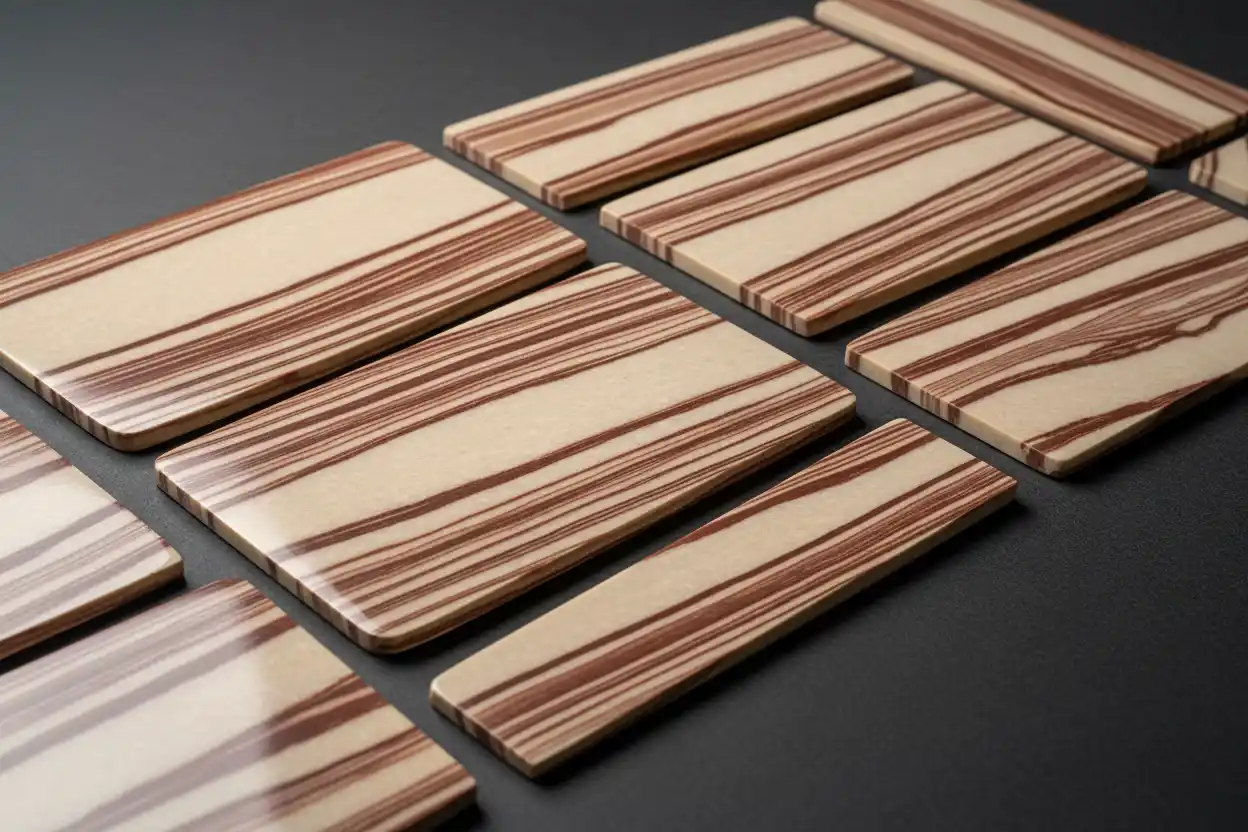
Australian Zebra Rock: Formation, Properties & Uses
Australian Zebra Rock is a distinctive cream-and-reddish-brown patterned sedimentary rock from the East Kimberley region of Western Australia. Its stripes formed when iron-rich fluids moved through an ancient clay-rich siltstone and deposited rhythmic hematite-rich bands.
The material is also sold as Zebra Stone, Kimberley Zebra Rock and Australian Zebra Stone. It is neither a mineral species nor a form of Zebra Jasper, and the geographic description matters because many unrelated striped rocks share similar trade names.
Australian Zebra Rock at a Glance
| Property | Australian Zebra Rock |
|---|---|
| Material type | Patterned sedimentary rock |
| Geographic origin | East Kimberley, Western Australia |
| Host rock | Fine-grained, clay-rich siltstone |
| Geological age | Ediacaran, commonly described as roughly 600–670 million years old |
| Principal light-band materials | Fine quartz and clay minerals |
| Principal dark pigment | Hematite and other iron-rich material |
| Additional reported minerals | Kaolinite, dickite, pyrophyllite, alunite and related clay or sulfate minerals |
| Typical colors | Cream, off-white, pale gray, reddish brown, maroon and dark brown |
| Pattern | Rhythmic stripes, spots, rings, waves and irregular iron-rich bands |
| Crystal system | None for the rock as a whole |
| Luster | Dull when rough; matte to waxy after polishing |
| Transparency | Opaque |
| Hardness | Variable; generally a relatively soft ornamental rock |
| Cleavage | None as a whole rock, though individual minerals have their own structures |
| Tenacity | Brittle; thin sections can chip or break |
| Common use | Slabs, carvings, beads, cabochons, spheres, inlay and display pieces |
| Main care concern | Soft clay-rich texture, variable porosity, undercutting and misleading trade names |
What Is Australian Zebra Rock?
Australian Zebra Rock is an ornamental siltstone transformed by rhythmic iron-oxide patterning.
The pale host consists of extremely fine sediment, including quartz and clay minerals.
The reddish-brown bands contain greater concentrations of hematite and related iron-rich material.
Although the polished pattern can resemble jasper, Zebra Rock is not primarily microcrystalline chalcedony.
The underlying material belongs among the rocks and lapidary substances within Types of Gemstones rather than among single-crystal minerals.
A precise title should retain Australian or East Kimberley to distinguish it from Zebra Calcite, Zebra Jasper, zebra marble and generic striped decorative rock.
Zebra Rock, Zebra Stone and Zebra Jasper
The names Zebra Rock and Zebra Stone are commonly used for the East Kimberley material.
Zebra Jasper is a separate commercial category that usually refers to silica-rich black-and-white or brown-and-cream patterned material.
Some retailers use all three names interchangeably, which creates direct keyword and buyer confusion.
This page uses Australian Zebra Rock as the primary name because it communicates both the geological material and its restricted regional identity.
The dedicated Zebra Jasper guide retains the quartz-rich jasper intent.
Zebra Stone without an origin should be treated cautiously because sellers apply the term to several unrelated rocks.
Where Is Australian Zebra Rock Found?
Authentic material comes from the East Kimberley region of northern Western Australia.
Classic occurrences lie near the Ord River and Lake Argyle, south of Kununurra.
The patterned layers occur within fine sedimentary units associated with the Ranford Formation, including the Johnny Cake Shale Member in widely used geological descriptions.
Much original low-lying material was submerged after the construction of Lake Argyle.
Remaining commercial rough comes from deposits and stockpiles in the surrounding Kimberley region.
A product mined elsewhere may still be an attractive striped rock, but it should not be sold as East Kimberley Zebra Rock without evidence.
How Old Is Zebra Rock?
The host sediment formed during the Ediacaran Period near the end of Precambrian time.
Commercial and geological references commonly cite ages around 600–670 million years.
The original fine sediment accumulated long before the modern Australian landscape developed.
Later fluid movement, weathering and iron redistribution created the famous pattern.
Therefore, the age of the host rock and the timing of the stripes are related but not necessarily identical events.
Scientific work focuses not only on when the sediment formed but also on how and when the iron-rich pattern developed.
What Creates Zebra Rock’s Stripes?
Modern mineralogical research supports a self-organized chemical pattern driven by iron-rich acidic fluid entering oxidizing sediment.
Iron was transported primarily in a reduced, soluble state.
As the fluid encountered more oxidizing conditions, iron precipitated as hematite-rich material.
The reaction did not occur uniformly. Instead, chemical feedback produced regularly spaced bands and spots through a process comparable with Liesegang pattern formation.
The result resembles rings and stripes formed in laboratory gels when dissolved chemicals react and precipitate at rhythmic intervals.
Changes in permeability, fluid direction, sediment texture and oxidation created the wide variety of patterns visible today.
The stripes are therefore mineral reaction fronts rather than painted layers or ordinary bedding alone.
The Acidic-Fluid Formation Model
The patterned siltstone contains minerals consistent with acidic alteration, including kaolinite, dickite, pyrophyllite and alunite.
These minerals indicate that the original sediment interacted with chemically aggressive fluids.
Some evidence can support heated hydrothermal fluid, while other textures point toward near-surface acid-sulfate soil and weathering processes.
A recent detailed study concluded that the exact origin and temperature of the fluid could not be determined with absolute certainty.
However, it proposed that Liesegang-style hematite banding developed as iron-rich acidic fluid infiltrated oxidizing sediment.
This explanation accounts for the rhythmic patterns, iron distribution and altered clay mineralogy without requiring the bands to be biological structures.
Was Zebra Rock Formed by Microbial Mats?
An older proposal interpreted some patterns as possible traces of cyanobacterial mats or microbial structures.
The idea attracted attention because Zebra Rock formed during a period when microbial life dominated many environments.
However, pattern resemblance alone cannot prove biological origin.
Modern geochemical and mineralogical evidence favors a chemical self-organization model involving iron transport, oxidation and precipitation.
Commercial descriptions sometimes continue to call every Zebra Rock piece a microbialite or fossil.
That wording should remain cautious unless a particular specimen has stronger paleontological evidence than the general patterned rock.
The rock’s established value does not depend on it being a fossil.
Zebra Rock Patterns
Parallel Bands
Some slabs show closely spaced, nearly parallel reddish-brown lines across cream sediment.
The bands may curve gradually or change thickness across the slab.
Zebra Stripes
High-contrast alternating dark and light bands create the pattern that inspired the name.
A cut perpendicular to the patterned layer often displays the clearest stripes.
Spots and Blotches
Rounded hematite-rich spots can form isolated circles or clustered patches.
Some pieces combine spots with broad flowing bands.
Liesegang Rings
Concentric or nested brown rings record outward-moving chemical reaction fronts.
These patterns resemble bull’s-eyes and can create valuable cabochon designs.
Okapi Pattern
The trade uses Okapi for broader irregular cream-and-brown patches rather than narrow zebra stripes.
The term is descriptive, not a separate mineral or scientifically defined variety.
Picture Patterns
Some slabs resemble landscapes, wood grain, animals or abstract paintings.
The visual category overlaps the appeal of Picture Jasper without making the material jasper.
Mineral Composition
The host is a fine-grained siltstone rich in quartz and clay minerals.
Sericite, a fine-grained white mica term, appears in traditional descriptions of the pale matrix.
Modern analyses identify minerals such as kaolinite, dickite, pyrophyllite and alunite in different altered zones.
Hematite creates much of the reddish-brown pigmentation.
Individual deposits and bands do not contain identical proportions.
Because Zebra Rock is heterogeneous, it does not have one fixed refractive index, hardness or chemical formula.
The composition should be described as a rock assemblage rather than as pure quartz, hematite or mica.
Australian Zebra Rock Versus Zebra Jasper
Zebra Jasper is generally a quartz- or chalcedony-rich ornamental material.
It is usually harder and takes a more glass-like polish.
Australian Zebra Rock is a clay-rich siltstone with iron-oxide reaction bands.
Its surface can be softer, more porous and more prone to undercutting.
The two can show similar cream-and-brown stripes when polished, so country and geological description matter.
A generic Zebra Jasper product from India, Africa or China should not be relabeled as Kimberley Zebra Rock.
Australian Zebra Rock Versus Zebra Calcite
Zebra Calcite is banded calcium-carbonate material.
Calcite areas measure hardness 3 and react quickly with dilute acid.
Australian Zebra Rock contains quartz, clay minerals and hematite rather than being calcite-dominant.
Zebra Calcite commonly displays peach, black, white and translucent carbonate bands.
Australian material more often shows opaque red-brown iron patterns across a cream siltstone.
Australian Zebra Rock Versus Wonderstone
Wonderstone is a trade name commonly applied to patterned rhyolitic tuff from Utah and Nevada.
Wonderstone formed from volcanic ash and glass-rich material.
Australian Zebra Rock formed from fine sedimentary siltstone later altered by iron-rich fluids.
Both can display Liesegang-style rings and bands.
Their pattern-forming chemistry may be conceptually similar, but the host rocks, geographic sources and mineral assemblages differ.
Australian Zebra Rock Versus Rhyolite
Rhyolite is a silica-rich volcanic rock.
It can display flow banding, orbicular patterns and altered zones.
Zebra Rock is sedimentary siltstone rather than volcanic lava or ash.
A rhyolite sold under the broad Zebra Stone name may be a legitimate ornamental rock, but it should not receive the Australian locality identity.
Australian Zebra Rock Versus Marble
Striped marble contains recrystallized calcite or dolomite.
It is acid-reactive and commonly shows crystalline grain boundaries.
Zebra Rock lacks marble’s carbonate-dominated metamorphic structure.
The reddish-brown bands are iron-rich chemical patterns within siltstone rather than folded calcite veins.
Internal Texture
Rough Zebra Rock generally feels fine-grained rather than visibly sandy.
The pale matrix may appear chalky or matte.
Dark hematite-rich bands can be denser and may polish differently from the light areas.
Tiny pores and dissolution voids occur within some layers.
Microfractures can follow band boundaries.
Clay-rich areas may absorb water or polishing compounds more readily.
A strong surface finish requires balancing these textural differences rather than treating the rock like homogeneous agate.
How to Identify Australian Zebra Rock
Begin with geographic documentation.
Authentic material should trace to the East Kimberley region of Western Australia.
Under magnification, the stone should show extremely fine sedimentary texture instead of clear calcite cleavage or a uniform chalcedony structure.
The reddish-brown pattern should penetrate the rock rather than appear as surface paint.
Raman spectroscopy can identify hematite and individual clay minerals.
X-ray diffraction characterizes quartz, mica-like minerals, kaolinite, dickite, pyrophyllite and alunite.
Petrographic microscopy provides the strongest picture of grain texture and band relationships.
The complete process builds on How to Identify Crystals while recognizing that a rock requires multi-mineral analysis.
Treatments and Stabilization
Dense Zebra Rock may be sold untreated.
Softer or porous material can be stabilized with resin before cutting.
Polymer strengthens weak clay-rich areas and reduces undercutting.
Wax and oil deepen the reddish-brown bands and create a richer temporary appearance.
Clear coating can improve gloss on carvings that would otherwise remain matte.
Dye could be added to pale porous rock, although artificial color is less common than misidentification.
Composite pieces may join thin Zebra Rock slices to backing material.
Treatments should be disclosed under the framework in Gemstone Treatments Explained.
Cutting and Polishing
Zebra Rock is primarily a pattern stone.
The cutter studies rough edges to determine how the hematite bands continue inside the block.
Cutting perpendicular to the band direction can reveal stripes and rings.
Cutting parallel to the pattern may produce broad brown patches instead.
Slabs allow the pattern to remain large enough for display.
Cabochons are often free-form because standard ovals can crop important lines.
Clay-rich pale bands may undercut, while hematite-rich areas remain slightly raised.
Resin stabilization and careful progressive sanding can improve the final surface.
The material suits many uses in Best Gemstones for Carving and Cabochons, but very thin projections break easily.
Tumbling Zebra Rock
Small dense pieces can be tumbled.
However, the material should not be mixed with hard agate or jasper without testing.
Hard companions can bruise the softer bands and round away the pattern.
Porous areas may trap grit and polish.
A short test run determines whether one batch can reach a gloss or will remain satin-matte.
The process in Rock Tumbling for Beginners should be modified for softer sedimentary material.
Finished pebbles belong among tumbled stones, but they should retain their Australian identity rather than being sold as generic Zebra Jasper.
Durability and Jewelry Suitability
Australian Zebra Rock is softer and less uniform than conventional quartz-rich jasper.
It can scratch, chip and separate along weak layers.
A universal Mohs number is misleading because the rock contains several minerals and differently altered bands.
The general principles in the gemstone hardness chart apply only after considering the complete rock texture.
The distinction explained in Gemstone Toughness vs Hardness is especially important for thin layered material.
Pendants, brooches and earrings are safer than rings.
Thick cabochons in protective bezels can tolerate occasional wear.
Large slabs, carvings and display pieces remain the material’s strongest uses.
Australian Zebra Rock Prices in 2026
Small tumbled stones commonly retail for approximately $5–$20.
Current individual polished tumbles are offered around $13.
Small polished hearts, animals and cabochons generally range from $15–$50.
A current 1.7-inch polished piece is listed near $25, with bulk discounts lowering the per-piece price.
Slabs and selected rough commonly range from approximately $20–$100, depending on size and pattern.
Large bookmatched slabs, spheres and detailed carvings may sell for $100–$500 or more.
Exceptional old-stock pieces with bold undamaged patterns can command stronger prices because access to classic material is limited.
Most value comes from pattern, origin and lapidary workmanship rather than from mineral rarity in the conventional gem sense.
What Determines Value?
Authentic East Kimberley provenance is the first important factor.
Pattern quality follows closely.
High-contrast reddish-brown bands should form balanced stripes, rings or picture-like compositions.
Large uninterrupted patterns command more than fragmented or muddy material.
Fine-grained dense rock accepts a better polish and is less likely to crumble.
Cutting orientation determines whether the pattern looks intentional.
Cracks, soft patches and resin reduce value when they are not disclosed.
Old collection labels and stock from deposits now inaccessible beneath Lake Argyle can add collector interest.
Buying Guidance
Look for the words East Kimberley, Kununurra, Lake Argyle or Ord River alongside a credible seller history.
Ask whether the material is Australian Zebra Rock or an unrelated product sold as Zebra Stone.
Request dry photographs under neutral lighting.
Water and oil can intensify the brown bands and conceal a matte surface.
Ask about resin stabilization, wax and backing.
Inspect thin slabs for cracks following band boundaries.
Compare pattern and dimensions rather than weight alone.
Do not accept microbialite or fossil claims as established fact without specific supporting evidence.
A seller can describe the rock accurately without relying on unresolved biological interpretations.
Cleaning, Water and Storage
Wipe polished Zebra Rock with a damp soft cloth, then dry it promptly.
Avoid prolonged soaking because clay-rich and porous areas can absorb water.
The guidance in Which Crystals Can and Cannot Go in Water should be applied conservatively.
Do not use ultrasonic or steam cleaning.
Avoid acids, bleach and aggressive household cleaners.
Natural hematite pigmentation is stable under ordinary indoor light.
However, resin, wax and adhesive can deteriorate under prolonged heat or direct sunlight, as discussed in Crystals That Fade in Sunlight.
Store thin slabs flat with padding between them.
For symbolic cleansing, use dry contact-free methods rather than saltwater soaking.
Meaning and Symbolism
Australian Zebra Rock has limited ancient gemstone lore under its modern trade name.
Contemporary symbolism often focuses on balance, patience, pattern recognition and the relationship between contrasting forces.
Its rhythmic bands encourage interpretations involving gradual change and natural systems organizing themselves over time.
The restricted East Kimberley origin can represent connection with place and the importance of preserving geological context.
Some people use the stone as a reminder that striking results can emerge from repeated small chemical changes rather than one dramatic event.
These meanings are cultural, spiritual or personal rather than scientifically demonstrated effects.
Frequently Asked Questions
1. Is Australian Zebra Rock a mineral?
No. It is a patterned sedimentary rock containing quartz, clay minerals, hematite and other components.
2. Where is authentic Zebra Rock found?
It comes from the East Kimberley region of Western Australia, especially areas near the Ord River, Lake Argyle and Kununurra.
3. How old is Zebra Rock?
The host siltstone is Ediacaran in age and is commonly described as roughly 600–670 million years old.
4. What creates the reddish-brown stripes?
Hematite-rich bands formed when iron-bearing acidic fluid entered oxidizing sediment and precipitated in rhythmic reaction fronts.
5. Is Zebra Rock a fossil?
A microbial origin has been proposed historically, but modern geochemical work favors chemical Liesegang-style banding. It should not automatically be sold as a fossil.
6. Is Australian Zebra Rock the same as Zebra Jasper?
No. Zebra Jasper is normally a harder silica-rich material, while Australian Zebra Rock is a clay-rich patterned siltstone.
7. Is Zebra Rock the same as Zebra Calcite?
No. Zebra Calcite is calcium-carbonate material, whereas Australian Zebra Rock contains quartz, clay minerals and iron oxides.
8. Can Zebra Rock be polished?
Yes. Dense material can take an attractive satin-to-waxy polish, although softer bands may undercut.
9. Is Australian Zebra Rock treated?
Some material is untreated, while porous pieces may be resin-stabilized, waxed or coated.
10. Can Zebra Rock go in water?
Brief wiping is generally acceptable, but prolonged soaking should be avoided because clay-rich and stabilized areas may absorb water.
11. How much is Australian Zebra Rock worth?
Small polished pieces commonly cost $10–$50, while large slabs, spheres and carvings can range from approximately $100 to several hundred dollars.
12. Does Australian Zebra Rock have scientifically proven healing properties?
No. Its symbolism may hold personal meaning, but scientific evidence does not establish healing effects.
Australian Zebra Rock is most meaningful when its striking pattern remains attached to its East Kimberley geology. The brown bands are not generic decoration: they preserve a self-organized iron reaction within an ancient Ediacaran siltstone found in one restricted part of Western Australia.
Australian Zebra Rock appears in Crystals That Start With Z and Gemstones That Start With Z.
Safety disclaimer: Australian Zebra Rock contains fine quartz and clay-rich material. Cutting, grinding or polishing can create respirable mineral dust. Use wet lapidary methods, local extraction, eye protection and appropriate respiratory protection.