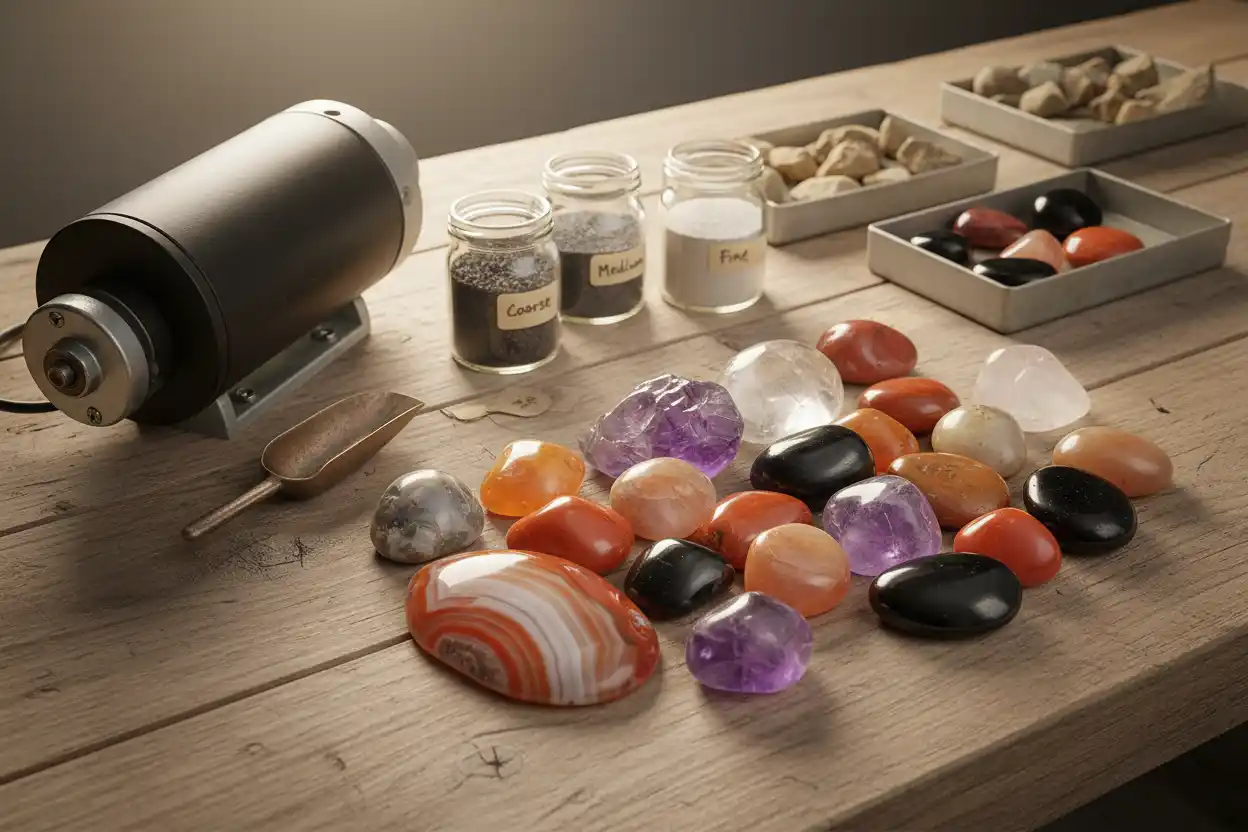
Tumbled Stones: A Beginner’s Guide
Tumbled stones are pieces of rock, mineral or gem material that have been rounded, smoothed and polished by controlled abrasion. Their curved shapes come from repeated movement with grit and water rather than from natural river wear alone.
Commercial tumbled stones are widely used in collections, wire-wrapped jewelry, mosaics, crafts, meditation practices and decorative arrangements. They also provide an accessible way for beginners to study color, pattern, luster and mineral durability without purchasing faceted gemstones.
Not every stone should be tumbled, however. Successful batches depend on compatible hardness, sound material, correct barrel loading, fresh abrasive, careful cleaning between stages and realistic safety precautions.
Tumbled Stones at a Glance
| Feature | Beginner Guidance |
|---|---|
| Basic definition | Stone rounded and polished through controlled abrasion |
| Common equipment | Rotary or vibratory rock tumbler |
| Beginner materials | Agate, Jasper, Chalcedony and sound Quartz |
| Typical hardness range | About Mohs 6.5–7 for mixed beginner batches |
| Common abrasive | Silicon carbide grinding grit |
| Common polish | Aluminum oxide or another material-specific polish |
| Standard stages | Coarse grind, medium grind, pre-polish and polish |
| Typical barrel loading | Approximately two-thirds to three-quarters full |
| Main quality factor | Smooth surface without pits, cracks or undercutting |
| Main batch risk | Mixing incompatible hardness or fragile material |
| Main health concern | Mineral dust, contaminated slurry and hazardous rough |
| Main disposal concern | Never pour rock slurry into household drains |
What Is a Tumbled Stone?
A tumbled stone has been placed in a rotating or vibrating barrel with abrasive material.
The abrasive gradually removes sharp edges, weathered surfaces and high points. Finer stages then reduce scratches until the stone can accept a reflective polish.
The final shape depends on the original rough. A blocky fragment becomes rounded but may retain a broad flat side. A naturally oval pebble may finish with only modest reshaping.
Tumbling does not change the mineral’s identity. A tumbled piece of Amethyst remains Quartz, while a polished piece of Obsidian remains natural volcanic glass.
Natural Pebbles Versus Machine-Tumbled Stones
River and beach pebbles can become naturally rounded through movement against sediment and other stones.
Their surfaces may feel smooth without showing a high polish.
Machine-tumbled stones undergo a more controlled sequence. Coarse grit shapes the rough, while pre-polish and polish create a brighter surface.
Some commercial sellers call any rounded stone “tumbled,” including naturally worn pebbles that received only surface polishing.
Neither type is automatically better. The description should explain whether the shape is natural, machine tumbled or partly hand finished.
How a Rotary Rock Tumbler Works
A rotary tumbler slowly turns a barrel containing rough stones, water and abrasive grit.
The stones climb the barrel wall and slide or cascade back through the mixture. Repeated contact rounds the material while the abrasive cuts its surface.
The barrel must contain enough material to create a controlled rolling action. An underfilled barrel allows stones to fall farther and strike each other, leading to bruising and chips.
An overfilled barrel may prevent proper movement.
For many machines, filling the barrel approximately two-thirds to three-quarters full provides a useful starting point. The equipment manual should take priority because barrel design and load limits differ.
Rotary Versus Vibratory Tumblers
A rotary tumbler rounds stones aggressively.
It is the usual beginner choice for converting angular rough into smooth pebbles. The process removes significant material and can take several weeks.
A vibratory tumbler moves stones through a rapid rubbing action. It preserves more of the original shape and usually completes fine grinding and polishing faster.
Vibratory equipment is less suitable for aggressively rounding very angular rough. Some lapidaries use a rotary tumbler for coarse shaping and transfer the stones to a vibratory machine for later stages.
The two machines require different loading, abrasive quantities and monitoring. Instructions should not be transferred automatically from one system to the other.
The Four Main Tumbling Stages
| Stage | Main Purpose | Common Abrasive |
|---|---|---|
| Coarse grind | Round edges and remove pits or weathered surfaces | Coarse silicon carbide |
| Medium grind | Remove coarse scratches and refine shape | Medium silicon carbide |
| Pre-polish | Prepare an even satin-smooth surface | Fine silicon carbide or pre-polish compound |
| Polish | Create reflective luster | Aluminum oxide or material-specific polish |
Each stage must remove the scratches left by the previous one.
Polish cannot conceal deep pits or coarse-grind marks. A stone should advance only when its surface is ready.
Coarse Grinding
The coarse stage determines the final shape and quality.
Angular stones may need more than one coarse cycle. After each run, rinse and inspect every piece.
Stones with deep pits, unstable cracks or areas that continue shedding grains should be removed, trimmed professionally or returned to coarse grinding.
Do not rush this stage to preserve weight. A pit that remains after coarse grinding will usually trap finer grit and interfere with polishing.
Coarse grinding may last approximately one to two weeks per cycle in many rotary systems, but the actual duration depends on material, grit, load and desired shape.
Medium Grinding
Medium grit removes the scratches created by the coarse stage.
The stones should already have acceptable shapes before entering this cycle. Medium grit refines rather than performs major correction.
Check the barrel, lid and stones for trapped coarse abrasive before loading.
One grain of coarse grit can create new scratches in a later stage.
After the cycle, the stones should feel uniformly smooth without sharp edges or obvious rough spots.
Pre-Polish
Pre-polish creates a very fine, even surface.
The stones may develop a soft satin luster but should not yet look fully reflective.
Cleanliness becomes increasingly important. Use a dedicated or thoroughly scrubbed barrel when possible.
Inspect cracks and pits again. A cavity can retain earlier grit even after the surface appears ready.
Stones that fail to improve should be removed rather than allowing them to contaminate the complete batch.
Polishing
Polish uses a much finer compound than grinding grit.
Aluminum oxide is common for Quartz-rich material, although the best polish depends on the stone and equipment.
The load should contain only compatible, well-prepared stones.
Adding extra polish does not correct poor pre-polish. It can instead create thick slurry and inefficient movement.
A completed stone should show an even luster under diffuse light, not only when wet.
Burnishing
Burnishing is an optional cleaning cycle performed after polishing.
Polished stones are tumbled briefly with clean water and a small amount of suitable soap to remove polish residue.
Burnishing does not create a true polish on an inadequately prepared surface.
Use a simple, appropriate soap rather than detergents containing bleach, grit, oils or moisturizers.
The machine manufacturer’s instructions should guide quantities and duration.
Choosing Beginner Rough
Quartz-rich materials provide the most forgiving starting point.
Agate, Jasper, Chalcedony and many sound varieties of Quartz share similar hardness and can finish well together.
The completed types-of-Agate guide and types-of-Jasper guide show how broad these commercial families can be.
Choose rough without deep fractures, crumbly matrix or thin projections.
A batch containing several sizes usually moves more efficiently because smaller pieces fill spaces between larger stones.
Agate
Agate is one of the best beginner tumbling materials.
Its Chalcedony structure is hard, tough and capable of taking a bright polish.
Banding, moss-like inclusions and color zones often become clearer after weathered surfaces are removed.
Natural pits can remain in some nodules. These need to be ground away or accepted as part of the finished appearance.
Avoid mixing hard Agate with soft Calcite, Fluorite or Turquoise.
Jasper
Jasper is another reliable beginner material.
It is generally opaque, Quartz-rich and available in many patterns.
Sound Jasper takes a durable polish, but fractured or brecciated pieces may shed fragments during coarse grinding.
Some commercial “Jaspers” are trade-name rocks with variable composition. Test a few pieces before committing an entire valuable batch.
Red, picture, ocean and other names describe appearance or locality rather than one universal tumbling behavior.
Clear and Rose Quartz
Clear Quartz and Rose Quartz can be tumbled successfully.
Transparent Quartz reveals bruising more readily than opaque Jasper. Hard impacts create white internal fractures along the edges.
Maintain a properly filled barrel and use smaller cushioning material to reduce collision.
Fractured Quartz may never become optically clear, even after excellent polishing.
The finished appearance depends heavily on the original clarity and internal structure.
Amethyst
Amethyst is purple Quartz and can be processed with other sound Quartz varieties.
Pale zones, white Quartz and natural internal fractures may remain visible after tumbling.
Color concentrated only near the surface of a rough piece can diminish if significant material is removed.
Strong prolonged light may fade some Amethyst, so finished stones should not be stored permanently in intense sun.
The polish should be evaluated dry because wet Amethyst can temporarily conceal fine scratches.
Aventurine
Aventurine is Quartz-rich material containing reflective mineral platelets.
Green Aventurine commonly contains Fuchsite, while other colors can contain different inclusions.
It generally tumbles well with Quartz-rich material, although heavily fractured pieces may bruise.
A successful polish reveals a subtle sparkling effect called aventurescence.
Dyed Quartzite and glass are sometimes sold under the Aventurine name, so identification still matters.
Carnelian
Carnelian is orange-to-red Chalcedony.
It is an excellent tumbling material when structurally sound.
Color may be uneven or concentrated in bands. Heat treatment is common in the market and does not prevent successful polishing.
A bright dry polish should remain visible without oil or wax.
The material should not be confused with soft orange Calcite.
Obsidian
Obsidian is volcanic glass rather than crystalline Quartz.
It can take a high polish, but it is softer and more prone to bruising and chipping than Agate or Jasper.
Tumble Obsidian separately or with compatible cushioning material. Avoid mixing it casually with hard, angular Quartz.
Shorter stages and careful barrel loading may be required.
Broken Obsidian can create razor-sharp edges. Wear eye protection and gloves when sorting damaged rough.
Hematite and “Hematine”
Hematite can be tumbled, but its density and variable texture make it a more specialized choice.
Heavy pieces may damage lighter stones in a mixed batch.
Natural Hematite can polish to a metallic or submetallic surface. However, many highly magnetic metallic beads sold as Hematite are manufactured “hematine” products rather than natural stone.
Do not assume every metallic gray tumbled piece has the same composition or tumbling behavior.
Stones That Need Specialized Batches
Fluorite ranks about 4 and has perfect cleavage.
Calcite ranks about 3 and reacts with acids.
Lapis Lazuli, Sodalite and Turquoise are softer and may be porous or treated.
Malachite is soft and generates copper-bearing dust or slurry during cutting.
These materials should not be added to a standard Quartz batch. Experienced lapidaries may polish some of them through specialized methods, but they require separate abrasives, shorter cycles or hand finishing.
Matching Hardness
A mixed batch should contain stones with similar hardness and durability.
Hard stones grind softer pieces rapidly. The soft material may become undersized, pitted or completely consumed before the harder stones are ready.
Hardness difference is not the only factor. Toughness, cleavage, porosity, density and grain structure also matter.
The completed gemstone toughness-versus-hardness guide explains why two stones with similar Mohs numbers can behave differently.
For a first batch, use one clearly identified Quartz-rich material rather than an assorted bag of unknown crystals.
Using Ceramic or Plastic Media
Media fill empty spaces and improve rolling action.
Ceramic cylinders are durable and can move through several grinding stages when cleaned carefully.
Plastic pellets provide softer cushioning but may retain grit. They should not be transferred casually into later stages.
Media should be compatible with the stone and machine.
The goal is not merely to fill volume. The complete load must still move freely rather than forming a solid mass.
Water Level
Water carries abrasive, controls slurry consistency and helps reduce airborne dust.
Many rotary-tumbler instructions recommend adding water to near the lower portion of the top stone layer rather than completely submerging the load.
Too much water can reduce grinding action. Too little can produce excessively thick slurry or poor movement.
Exact amounts vary with barrel size, material porosity and grit.
Check the machine manual rather than using one universal formula.
Cleaning Between Stages
Cross-contamination is one of the most common reasons a batch fails to polish.
Remove the stones, media, lid and barrel liner and wash them thoroughly.
Use a small brush around the barrel rim, gasket and recessed areas.
Examine pits and cracks in every stone because old grit can remain trapped inside.
A dedicated polish barrel reduces risk when the equipment budget allows.
Never assume a barrel is clean merely because no grit is visible from a distance.
Slurry Disposal
Rock-tumbling slurry should never be poured into a household sink, toilet or storm drain.
The fine mineral solids can settle and harden inside plumbing.
Allow the slurry to remain wet while handling it. Depending on local rules, it may be poured into a designated container, allowed to settle, and disposed of with solid waste after the water has been managed appropriately.
Do not dump contaminated slurry into gardens or waterways.
Material containing metals or hazardous minerals may require specialized disposal.
Dust Safety
Dry mineral dust can damage the lungs.
Quartz, Agate, Jasper and many common tumbling materials contain crystalline silica. Grinding residue should therefore remain wet.
Do not dry-sweep spilled grit or dried slurry. Use wet cleanup methods and follow appropriate local occupational guidance.
Home rock tumbling is not a substitute for a properly controlled lapidary workshop when stones need sawing, drilling or dry grinding.
The completed toxic-crystals safety list identifies materials that need additional caution.
Stones Not to Tumble Casually
Do not tumble unidentified ore, fibrous amphibole minerals, radioactive specimens or materials containing mercury, arsenic or lead.
Cinnabar, Realgar, Galena and fibrous Tremolite are unsuitable hobby experiments.
Copper minerals such as Malachite and Azurite also create contaminated slurry when abraded.
A polished finished specimen may be handled differently from a barrel that is actively grinding the material into fine particles.
When identity is uncertain, keep the specimen intact and consult a qualified mineralogist or lapidary professional.
Opening and Monitoring the Barrel
Inspect the machine regularly for leaks, belt wear and unusual noise.
A barrel may develop pressure from trapped air, heat or reactions involving contaminated material. Open it away from the face and follow the manufacturer’s procedure.
Keep long hair, loose clothing, children and pets away from rotating machinery.
The tumbler should sit on a stable surface with ventilation and spill containment.
Do not operate damaged electrical equipment near water.
Buying Finished Tumbled Stones
Examine the stones when dry.
Water and oil can temporarily hide scratches and dull patches.
A good tumbled stone has an even surface appropriate to the material. Natural patterns and inclusions may remain, but the polish should not depend on thick wax or resin unless treatment is disclosed.
Inspect pits, cracks and chipped edges. A low-priced stone can still be attractive, but it should not be represented as premium polish if the surface remains unfinished.
The completed how-to-identify-crystals guide provides a broader buying framework.
Dyed and Coated Tumbled Stones
Agate, Quartzite, Howlite and other porous stones are frequently dyed.
Color may concentrate in cracks or around pits. Strong neon pink, blue or purple can indicate enhancement.
Titanium-coated Quartz and similar products receive thin metallic films that create iridescence.
Treatment does not automatically make a stone undesirable. It should be disclosed because it affects care and value.
Avoid solvents, abrasive polishing and prolonged sunlight when dye or coating is present.
Glass and Resin Imitations
Glass can be tumbled into smooth pebble shapes.
Bubbles, flow lines, mold marks and unusually uniform color may provide clues.
Resin may contain glitter, flowers, pigments or crushed mineral particles. It can imitate natural stone while remaining much lighter and softer.
Neither material should be sold as a natural crystal.
The absence of sharp edges does not prove that a piece was geologically formed.
Tumbled Stones for Jewelry
Tumbled stones can be wire wrapped, drilled, caged or incorporated into macramé.
Choose pieces with sound edges and enough thickness around the intended attachment point.
Drilling requires water-cooled equipment and appropriate dust controls. Do not dry-drill Quartz or unknown minerals indoors.
A wire cage avoids drilling and allows the stone to be removed.
The planned crystal-shapes guide explains how tumbled forms differ from points, spheres and towers.
Tumbled Stones for Collections
A beginner collection can focus on mineral families rather than random colors.
One tray might compare Agate, Jasper, Clear Quartz, Rose Quartz, Amethyst, Aventurine and Carnelian.
Label every stone with its accepted identity, locality when known and treatment.
Avoid relying on metaphysical trade names as mineral identification.
Photograph the pieces in neutral light and record where they were purchased. Good records make later comparison and correction easier.
Spiritual and Decorative Use
Many people use tumbled stones in meditation, symbolic arrangements, pockets or decorative bowls.
These practices can provide personal meaning and visual enjoyment.
Crystal meanings belong to cultural and spiritual traditions rather than established medical treatment.
The completed crystal-pairings guide discusses symbolic combinations, while the completed how-to-cleanse-crystals guide covers non-abrasive ritual methods.
Do not place loose stones where children or pets can swallow them.
Water and Sunlight Care
A rounded surface does not make every mineral water safe.
Porous, soft, soluble, treated and composite stones may be damaged by soaking.
The planned crystals-that-can-go-in-water guide separates water-tolerant materials from unsuitable choices.
Likewise, some dyes and natural colors can fade in prolonged sunlight. The planned crystals-that-fade-in-sunlight guide provides material-specific guidance.
Identify the stone before choosing a cleaning or display method.
Troubleshooting a Dull Polish
A dull batch usually reflects an earlier-stage problem.
Possible causes include mixed hardness, incomplete coarse grinding, contaminated barrels, incorrect polish, poor load movement or stones that naturally undercut.
Return scratched stones to the appropriate earlier stage rather than adding more polish.
Inspect whether one crumbly specimen has released particles into the load.
Test the process with a known material such as Agate before blaming the machine.
Consistent preparation produces polish more reliably than secret additives.
Frequently Asked Questions
1. What are tumbled stones?
They are pieces of rock or mineral rounded and polished through controlled abrasion in a rotating or vibrating tumbler.
2. Which stones are easiest for beginners?
Agate, Jasper, Chalcedony and sound Quartz varieties are generally the most forgiving.
3. How long does rock tumbling take?
A rotary batch commonly takes several weeks, especially when more than one coarse-grind cycle is needed.
4. Can different stones be tumbled together?
Only when their hardness, toughness, density and grain structure are reasonably compatible.
5. How full should a rotary tumbler barrel be?
Many machines work well when loaded approximately two-thirds to three-quarters full, but the manufacturer’s instructions should take priority.
6. Why did my stones become chipped?
The barrel may have been underfilled, the batch may have contained incompatible materials, or fragile stones may have struck harder pieces.
7. Why will my stones not polish?
Common causes include deep scratches, trapped grit, mixed hardness, poor pre-polish, unsuitable material or barrel contamination.
8. Can tumbling slurry go down the sink?
No. Fine mineral solids can settle and harden inside plumbing.
9. Is rock-tumbling dust dangerous?
Dry dust from Quartz-rich and other minerals can be hazardous. Keep slurry wet and avoid dry grinding or sweeping.
10. Can Fluorite and Quartz be tumbled together?
No. Quartz is much harder and will damage Fluorite.
11. Are brightly colored tumbled stones natural?
Some are, but neon or unusually uniform colors may result from dye, coating, glass or resin.
12. Do tumbled stones have healing properties?
Healing meanings are spiritual beliefs rather than scientifically established medical effects.
Rock tumbling creates fine mineral particles. Keep grit and slurry wet, never dry-grind unknown rough, and do not tumble toxic, fibrous, radioactive or metal-bearing minerals without professional controls. Crystal practices do not replace medical care.