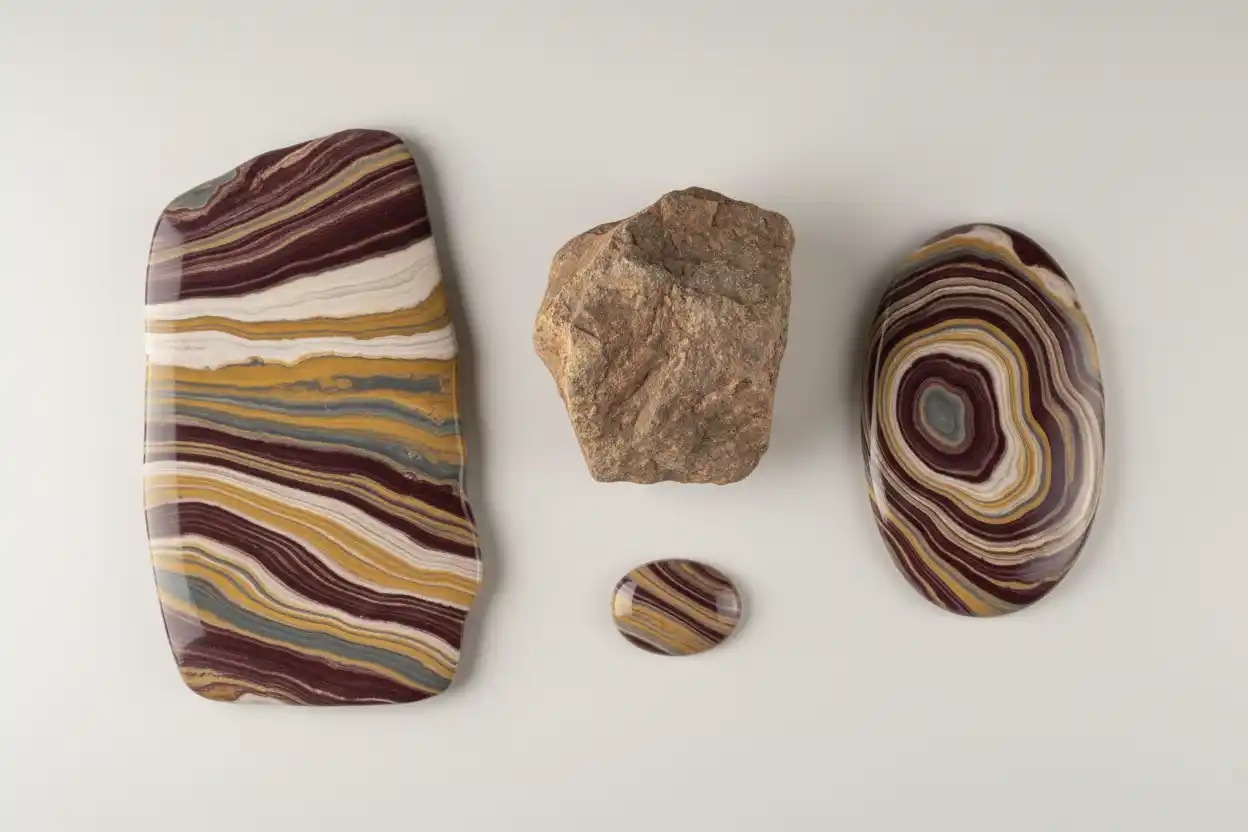
Wonderstone Meaning, Properties, Identification and Uses
Wonderstone is a trade name applied to attractively banded volcanic rock, especially rhyolitic tuff from Utah and Nevada. Its curved maroon, cream, yellow, brown and gray patterns formed through volcanic deposition, welding and later alteration rather than through the crystallization of one mineral species.
Although sellers sometimes call it Wonderstone Jasper, the best-documented Utah material is a welded, glass-rich tuff of rhyolitic composition. Its exact hardness, porosity and polishing behavior can therefore vary more than those of dense true jasper.
Wonderstone at a Glance
| Property | Wonderstone |
|---|---|
| Material type | Banded volcanic rock sold under a trade name |
| Classic Utah material | Welded-vitric tuff of rhyolitic composition |
| Nevada material | Commonly rhyolitic ash-fall or welded tuff |
| Main constituents | Altered volcanic glass, silica, feldspar and fine volcanic fragments |
| Coloring materials | Iron oxides, iron hydroxides and locally manganese-rich minerals |
| Typical colors | Maroon, red-brown, yellow, cream, tan, gray, white, pink and black |
| Structure | Fine-grained to glassy volcanic rock; no single crystal system |
| Common patterns | Concentric rings, flowing bands, bull’s-eyes, waves and picture-like scenes |
| Luster | Dull or earthy when rough; matte, waxy or vitreous when polished |
| Transparency | Opaque |
| Specific gravity | Variable, commonly approximately 2.3–2.7 |
| Mohs hardness | Variable, commonly about 5–6.5 depending on silicification and alteration |
| Cleavage | None as a rock; fracture behavior varies by texture |
| Tenacity | Brittle, with durability depending on porosity and internal layering |
| Common use | Slabs, cabochons, tumbles, carvings, bookends and display rough |
| Main care concern | Variable softness, porosity, weak layers and inconsistent polish |
What Is Wonderstone?
Wonderstone is not a formally defined mineral species. Instead, it is a lapidary and rock-collecting name for volcanic material whose contrasting bands create decorative patterns.
The classic Vernon Hills Wonderstone of Utah is a welded-vitric tuff with rhyolitic composition. A tuff forms from volcanic ash and fragments deposited during an eruption.
Vitric means that volcanic glass makes up a significant part of the original rock. Welding occurred while the hot deposit remained soft enough for glass particles and ash fragments to compact and fuse together.
Later groundwater moved through the rock and altered its components. Iron oxides produced the familiar maroon, red and yellow-brown bands.
The parent rhyolite guide covers rhyolitic volcanic rocks broadly, while this page owns the Wonderstone trade name, banding, locality and lapidary intent.
Is Wonderstone a Mineral, Rock or Gemstone?
Wonderstone is a rock because it contains several mineral and glassy components rather than one uniform crystalline substance.
It can function as an ornamental gemstone after cutting and polishing. However, that lapidary use does not turn it into a mineral species.
The distinction is important when applying the classifications in the types of gemstones guide. Wonderstone belongs among ornamental rocks and composite lapidary materials rather than transparent single-crystal gems.
A seller should describe the underlying rock whenever possible. “Utah welded rhyolitic tuff” provides more useful information than the trade name alone.
Wonderstone Versus Wonder Stone
Wonderstone and Wonder Stone are spelling variations used in the commercial market.
Neither spelling guarantees a specific locality or composition. The joined spelling is common for Utah and Nevada banded volcanic rock, while the separated phrase may appear on other ornamental materials.
Some sellers use the name for banded sandstone, jasper, rhyolite or unrelated patterned rock. Therefore, the buyer should request locality and composition rather than relying on spelling.
This page uses Wonderstone as the canonical spelling while recognizing that the term remains commercially flexible.
How Wonderstone Forms
Wonderstone begins with an explosive volcanic eruption that produces silica-rich ash, glass shards and rock fragments.
Hot material settles across the landscape. In welded tuff, the weight and heat of the deposit flatten and fuse glass fragments together.
Cooling creates fractures and microscopic pathways. Groundwater then circulates through the rock, carrying dissolved minerals and chemically altering the volcanic glass.
Iron changes oxidation state as water and oxygen conditions vary. Hematite, goethite and related iron materials create red, maroon, yellow and brown colors.
Different areas of the rock react at different rates. Consequently, alteration fronts spread outward from fractures, pores, clasts and fluid pathways.
These fronts produce rings, waves and intersecting bands. The patterns are therefore chemical records of groundwater movement rather than annual layers or tree rings.
What Causes Wonderstone’s Bands?
The bands reflect differences in iron oxidation, mineral alteration, porosity and groundwater flow.
Maroon and red zones commonly contain hematite or related oxidized iron material.
Yellow and yellow-brown areas may contain hydrated iron oxides such as goethite.
Cream, gray and white bands tend to contain less intense iron staining or more strongly altered pale volcanic material.
Water can move outward from one fracture or central point. Repeated alteration fronts then create concentric bull’s-eye patterns.
Other bands follow the original flow, compaction or depositional texture of the tuff. As a result, one slab can display both volcanic structure and later chemical alteration.
Utah Wonderstone
The Vernon Hills locality in Tooele County is the best-documented Utah Wonderstone source.
Its material is a welded-vitric tuff of rhyolitic composition containing volcanic glass particles fused by heat and compaction.
Groundwater alteration created maroon and yellow-brown banding, while iron oxides supplied the principal colors.
Utah Wonderstone commonly shows broad cream, gray, brown and red zones. Some rough contains sharply defined concentric circles known commercially as bull’s-eye Wonderstone.
Not every piece from the locality polishes equally well. More strongly silicified sections can take a brighter surface, whereas porous or heavily altered areas may remain matte.
Collecting rules can change, and access does not imply permission to excavate without restriction. Rockhounds should check current land-management guidance before visiting.
Nevada Wonderstone
Nevada Wonderstone is associated with several rhyolitic volcanic deposits, including tuff in the Lahontan Mountains region.
Nevada material can show red, yellow, tan, cream, gray, pink and nearly black flowing patterns.
Its texture ranges from fine and relatively dense to porous and ash-rich. Consequently, polishing results vary among localities and even within one boulder.
The term Nevada Wonderstone does not identify one single mine or formation. Precise locality adds more value than the state name alone.
Some commercial Nevada material is mislabeled as jasper because it has attractive banding and accepts a polish. A silica-rich rhyolitic tuff can resemble jasper face-up without sharing jasper’s uniform microcrystalline quartz composition.
Wonderstone Patterns
Bull’s-Eye Wonderstone
Bull’s-eye material contains nested rings or rounded alteration fronts.
A cutter must slice through the pattern at the correct angle to reveal complete circles. An off-center cut produces arcs rather than symmetrical eyes.
Flow-Banded Wonderstone
Flowing stripes may reflect both volcanic movement and later iron alteration.
The bands curve, fold and cross one another, creating designs that resemble topographic maps or desert landscapes.
Picture Wonderstone
Picture-like slabs contain scenes that resemble mountains, clouds, dunes or abstract paintings.
The appearance overlaps picture jasper, but similarity of pattern does not make the rock jasper.
Brecciated Wonderstone
Some material contains angular fragments surrounded by contrasting seams.
Fracturing may have occurred during cooling, tectonic movement or later weathering. Silica and iron minerals subsequently filled or highlighted the breaks.
Lace and Wave Patterns
Fine repeated bands can produce lace-like or wave-like designs. These patterns are particularly effective in elongated cabochons and bookmatched slabs.
Wonderstone Versus Jasper
True jasper consists mainly of opaque microcrystalline quartz or chalcedony.
Dense jasper usually measures close to 6.5–7 on the Mohs scale and accepts a durable glassy polish.
Wonderstone is commonly an altered rhyolitic tuff containing volcanic glass, feldspar, silica and fine ash fragments. Its hardness can vary between bands.
Some Wonderstone becomes strongly silicified and behaves much like jasper during cutting. Other material remains softer, porous and prone to undercutting.
The classification differences within types of jasper should therefore not be extended automatically to every commercial Wonderstone.
Wonderstone Versus Noreena Jasper
Noreena Jasper is an Australian silica-rich lapidary material known for angular red, yellow and cream patterns.
Its network generally appears more fractured or geometric, while Wonderstone often shows flowing rings and alteration fronts.
Both names are commercial and require geological context. Pattern alone cannot prove origin or composition.
Wonderstone Versus Obsidian
Obsidian is volcanic glass produced when silica-rich lava cools quickly.
Wonderstone can contain altered volcanic glass, but it is usually a tuff made from ash and fragments rather than one homogeneous mass of glass.
Obsidian commonly shows conchoidal fracture and a glassy luster. Rough Wonderstone tends to look fine-grained, matte or earthy.
Weathered obsidian can become pale or patterned, so laboratory or petrographic examination may be necessary for ambiguous rough.
Wonderstone Versus Banded Sandstone
Banded sandstone consists of compacted sand grains cemented together.
Under magnification, sandstone can reveal visible grains and gritty texture. Wonderstone’s classic material is much finer and volcanic.
Some rocks sold under broad Wonder Stone labels may genuinely be sedimentary. This inconsistency is why locality and mineralogical description matter.
A seller should not present every banded sedimentary rock as classic Utah Wonderstone.
Identifying Wonderstone
Identification begins with the recognition that Wonderstone is a rock rather than one mineral.
A fresh surface may show fine volcanic texture, flattened fragments, glass-rich zones and iron-stained alteration bands.
Petrographic microscopy can identify glass shards, feldspar, quartz and altered volcanic components.
X-ray diffraction helps determine crystalline minerals but may not detect original glass precisely after extensive alteration.
Raman spectroscopy and chemical analysis can characterize individual components.
Hardness testing one band does not establish the entire rock because differently altered areas can respond differently.
The general approach in how to identify crystals should therefore be expanded to include rock texture, locality and petrographic evidence.
Treatments and Stabilization
Dense Wonderstone is often sold untreated.
Porous or weak material may be stabilized with resin before cutting. Polymer enters fractures and pore spaces, reducing crumbling and improving polish.
Clear sealants, wax and oil can deepen color or make a matte surface appear temporarily glossy.
Dye is possible in pale porous material, although it is less common than resin stabilization.
Filled sections may show bubbles, different ultraviolet response or glossy patches inside cracks.
A stabilized stone remains natural rock, but treatment should be disclosed because it changes care, value and polishing behavior.
The broad terminology appears in gemstone treatments explained.
Cutting and Polishing
Wonderstone is popular for slabs and cabochons because cutting reveals patterns hidden inside plain-looking rough.
The lapidary first studies visible bands and chooses a cutting direction. Cross-cutting a rounded alteration feature creates bull’s-eyes, while cutting parallel to it creates long stripes.
Dense material can accept a bright polish with standard diamond or oxide compounds.
Softer bands may undercut, leaving a wavy surface. Resin stabilization can reduce this difference.
Porous rough may absorb oil and polishing compound, creating dark patches that require further cleaning.
The material also suits the designs discussed in best gemstones for carving and cabochons, although delicate projections should be avoided.
Tumbling Wonderstone
Wonderstone can be tumbled, but results depend heavily on hardness and porosity.
Dense pieces may become smooth and glossy. Softer tuff can lose edges, develop pits or remain matte after the polishing stage.
Test a small piece before adding a valuable batch to the tumbler.
Keep it with materials of similar hardness. Hard quartz or agate can bruise softer Wonderstone.
The process in rock tumbling for beginners should therefore be adjusted according to the individual batch.
Finished material can join collections of tumbled stones, but a matte final surface is not always evidence of poor technique.
Hardness and Durability
Wonderstone does not have one universal Mohs hardness because it is a heterogeneous rock.
Dense, silica-rich sections may approach hardness 6–6.5. Heavily altered or clay-rich areas can be much softer.
The variability makes a single number on the gemstone hardness chart less useful than direct examination of the whole piece.
Internal bands can separate under impact even when the surface resists scratching.
The distinction explained in gemstone toughness versus hardness applies particularly well to layered and fractured material.
Pendants, earrings and brooches are safer than thin rings. Thick cabochons in protective bezels can tolerate occasional wear when the rock is dense and stabilized if necessary.
Wonderstone Prices in 2026
Wonderstone is usually sold by weight or piece rather than by carat.
Bulk ordinary rough commonly sells for approximately $3–$10 per pound, particularly in larger lots.
Selected patterned rough and individual display pieces often range from $10–$40 per pound.
Current Utah rough listings include large lots near approximately $7 per pound, while selected smaller pieces can cost much more after shipping and retail markup.
Slabs generally sell for approximately $10–$40 each, depending on size and pattern.
Commercial cabochons commonly range from $10–$50, while large designer cuts and matched pairs may reach $50–$150.
Spheres, polished free forms, carvings and bookmatched display slabs may cost $50–$300 or more, with most of the premium reflecting labor and pattern selection.
Wonderstone is not intrinsically rare enough to justify fine-gem pricing. Exceptional pattern, lapidary skill and documented locality create the meaningful premiums.
What Determines Value?
Pattern is the leading factor. Complete bull’s-eyes, flowing multicolored bands and convincing picture scenes receive the strongest demand.
Color contrast matters. Maroon, cream and yellow bands should remain distinct rather than blending into muddy brown.
Dense material that takes a smooth polish generally commands more than porous rock requiring extensive stabilization.
Size adds value when a slab preserves a balanced pattern without major fractures.
Cutting orientation can transform ordinary rough into an exceptional cabochon or destroy the visual design.
Documented Vernon Hills or Nevada locality can support collector interest, especially when the piece includes original labels or collecting history.
Buying Guidance
Ask where the material originated and what the seller believes the underlying rock to be.
Inspect both wet and dry photographs. Water can intensify color and hide a naturally matte surface.
Request disclosure of resin stabilization, sealant, wax and dye.
Check the edges for crumbly layers, open pores and fractures crossing the central pattern.
Do not pay a jasper premium solely because the listing says Wonderstone Jasper.
For rough, ask whether the seller has test-polished material from the same batch. One boulder may contain both polishable and weak sections.
Cleaning, Water and Storage
Clean dense polished Wonderstone with a damp cloth and mild soap, then dry it promptly.
Avoid prolonged soaking, particularly when the material is porous or resin-treated.
Water can enter pore spaces, temporarily darken bands or alter the apparent contrast until the rock dries.
The broad guidance in which crystals can and cannot go in water should be applied conservatively because Wonderstone composition varies.
Avoid steam and ultrasonic cleaners. Vibration can exploit weak bands, while heat can affect resin and sealants.
Natural iron-oxide colors are generally stable under ordinary indoor lighting. However, prolonged heat or sunlight can degrade coatings and adhesives, as discussed in crystals that fade in sunlight.
For personal cleansing practices, use gentle dry options from how to cleanse crystals.
Meaning and Symbolism
Wonderstone has limited ancient gemstone lore because its name is a modern regional and lapidary term.
Contemporary traditions associate it with curiosity, perspective, creativity and recognizing patterns within complicated situations.
Its concentric alteration bands encourage symbolism involving change spreading gradually from one point.
Flowing lines may also represent adaptability and the way a single event can leave several visible stages of influence.
These meanings are cultural, spiritual or personal rather than scientifically proven effects of the rock.
Frequently Asked Questions
1. Is Wonderstone a mineral?
No. It is a trade name for patterned rock, commonly rhyolitic volcanic tuff containing several minerals and altered glass.
2. Is Wonderstone a type of jasper?
Classic Utah Wonderstone is welded rhyolitic tuff rather than true microcrystalline-quartz jasper. Some strongly silicified material can behave similarly during polishing.
3. What causes Wonderstone’s bands?
Groundwater alteration and iron oxidation create red, maroon, yellow and brown fronts within the volcanic rock.
4. What is bull’s-eye Wonderstone?
It is material whose concentric alteration fronts create rounded rings when cut at the correct angle.
5. Is Utah Wonderstone the same as Nevada Wonderstone?
Both are banded volcanic lapidary materials, but they come from different deposits and can have different textures and formation details.
6. How hard is Wonderstone?
Hardness varies, commonly from about 5 to 6.5. Silica-rich sections are harder than porous or heavily altered bands.
7. Does Wonderstone take a good polish?
Dense material can polish brightly. Softer or porous pieces may remain matte or require resin stabilization.
8. Can Wonderstone be tumbled?
Yes, but a small test batch is recommended because softer material can pit, lose edges or fail to reach a gloss.
9. Is Wonderstone treated?
Much rough is untreated, although porous pieces may be resin-stabilized, sealed, waxed or oiled.
10. Can Wonderstone go in water?
Brief cleaning is generally acceptable for dense untreated material. Avoid prolonged soaking because porosity and treatment vary.
11. How much is Wonderstone worth?
Bulk rough commonly costs a few dollars per pound, while selected cabochons, slabs and carvings can range from tens to several hundred dollars.
12. Does Wonderstone have scientifically proven healing properties?
No. Its symbolism can carry personal meaning, but scientific evidence does not establish healing effects.
Wonderstone is most valuable when its trade name is supported by geology. The maroon and cream pattern is attractive on its own, yet understanding the rock as welded volcanic ash altered by groundwater gives each ring and flowing band a more precise story.
Wonderstone appears in Crystals That Start With W and Gemstones That Start With W.
Safety disclaimer: Cutting, grinding or polishing Wonderstone can release fine silica-bearing rock dust. Use wet lapidary methods, local ventilation, eye protection and appropriate respiratory protection.