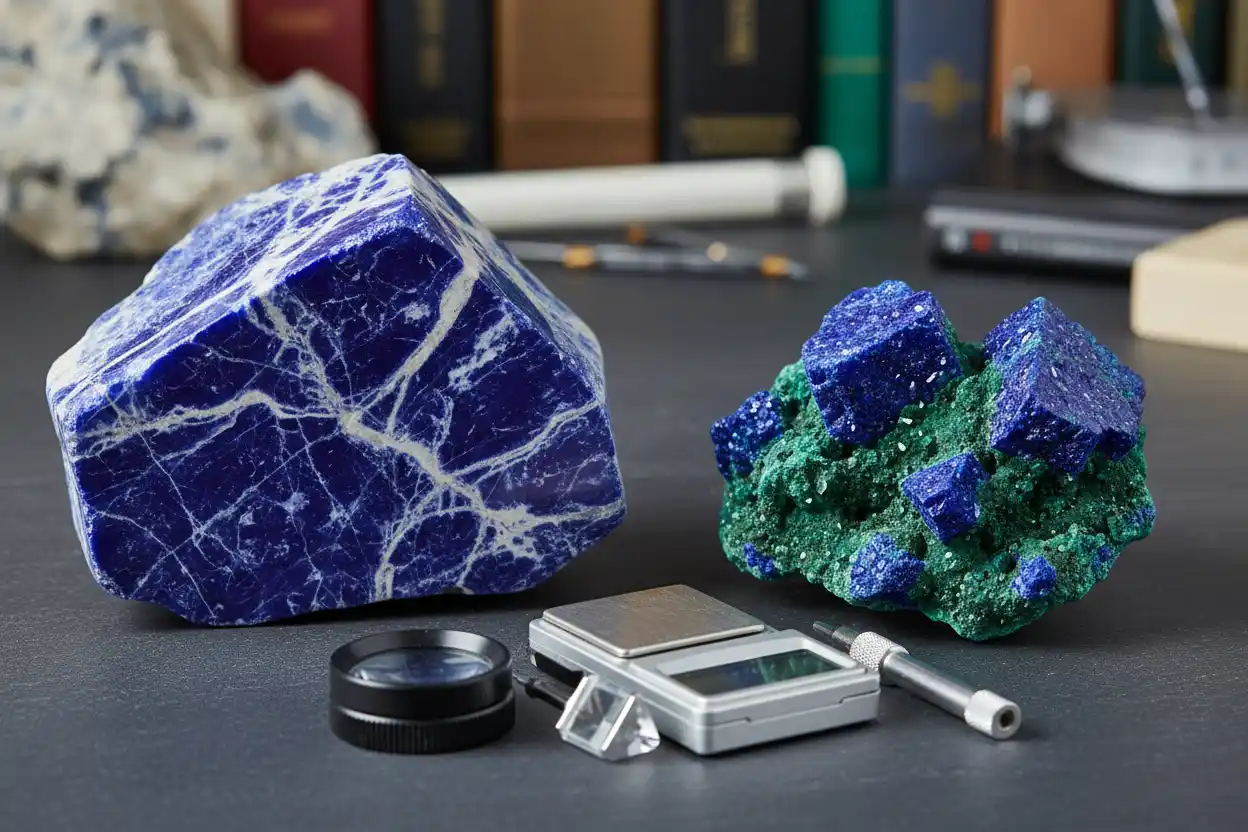
Sodalite vs Azurite: How to Tell Them Apart
Sodalite and Azurite are blue minerals whose names and colors can create confusion in polished stones, beads, carvings, and rough specimens. Their chemistry, structure, density, hardness, and geological origins are entirely different.
Sodalite is a sodium-rich aluminosilicate feldspathoid. It commonly appears as royal blue, violet-blue, gray-blue, or blue-and-white massive material.
Azurite is a copper carbonate hydroxide mineral. It normally displays a richer azure, electric blue, dark navy, or blue-black appearance and frequently occurs with green Malachite or other copper minerals.
The quickest practical distinctions are texture, weight, and hardness. Sodalite is usually lighter, harder, and marked by white Calcite. Azurite is substantially denser, softer, more brittle, and more likely to show vivid crystal faces or green copper-mineral associations.
Sodalite and Azurite at a glance
| Property | Sodalite | Azurite |
|---|---|---|
| Mineral class | Feldspathoid aluminosilicate | Carbonate |
| Approximate composition | Na₈(Al₆Si₆O₂₄)Cl₂ | Cu₃(CO₃)₂(OH)₂ |
| Crystal system | Cubic | Monoclinic |
| Common color | Royal blue, violet-blue, gray-blue | Azure blue, electric blue, deep navy, blue-black |
| Typical associated material | White or gray Calcite | Green Malachite, Chrysocolla, Limonite, host rock |
| Transparency | Usually opaque to translucent | Transparent crystals to opaque massive material |
| Mohs hardness | About 5.5–6 | About 3.5–4 |
| Specific gravity | Roughly 2.1–2.4 | Roughly 3.7–3.9 |
| Optical character | Singly refractive | Doubly refractive |
| Refractive index | Approximately 1.48 | Approximately 1.73–1.84 |
| Streak | White | Light blue |
| Main care risk | Scratching, fractures, associated Calcite | Softness, cleavage, acid sensitivity, heat, copper-bearing dust |
| Common use | Beads, carvings, cabochons, spheres | Collector crystals, carvings, cabochons, pigment history |
Different mineral families
Sodalite belongs to the feldspathoid group. Feldspathoids form in silica-poor igneous rocks where free quartz is absent or limited.
Its structure contains sodium, aluminum, silicon, chlorine, and oxygen. Variations in sulfur chemistry can produce blue color, fluorescence, or reversible color change in Hackmanite.
The broader material profile appears in Sodalite: Meaning, Healing Properties & Uses.
Azurite forms in the oxidized zones of copper deposits. Copper produces its intense blue color, while changing chemical conditions can create Malachite and other secondary copper minerals nearby.
The complete copper-carbonate profile appears in Azurite: Meaning, Properties & Symbolism.
Color differences
Sodalite commonly has a slightly violet, indigo, royal-blue, or denim-blue appearance. White or gray areas can interrupt the color, creating a mottled stone.
Azurite generally shows a more intense mineral blue. Fine crystals may appear electric azure, deep blue, navy, or nearly black in thick sections.
Color alone remains unreliable. Dark Sodalite can resemble massive Azurite, while pale or finely divided Azurite may appear softer and lighter.
Photography also changes the comparison. Digital saturation can turn Sodalite into electric blue, while strong reflected light can make Azurite look violet.
The identity should be supported by associated minerals, weight, hardness, structure, and measured properties.
White veins favor Sodalite
Commercial Sodalite often contains irregular white or gray Calcite veins and patches.
The pale material may form broad clouds, thin lines, broken networks, or granular areas. It usually appears naturally integrated rather than painted onto the surface.
White Calcite is not required for Sodalite, but its presence strongly supports the ordinary massive ornamental material.
Azurite can also occur with Calcite. Therefore, one white patch does not settle the identification. The complete stone needs to show whether the dominant blue material behaves like a lightweight feldspathoid or a dense copper carbonate.
The Sodalite authenticity workflow appears in Real vs Fake Sodalite.
Green areas favor Azurite-Malachite
Azurite commonly forms beside Malachite because both develop through alteration of copper-bearing minerals.
A specimen may show blue Azurite crystals over green Malachite, irregular blue-and-green layers, or areas where Malachite has replaced the original Azurite structure.
This natural combination is often called Azurmalachite in the ornamental trade.
Green areas therefore do not indicate that an Azurite specimen is fake. They may provide strong geological evidence for a copper-mineral association.
The dedicated Malachite vs Azurite page owns the direct two-carbonate comparison. The separate green mineral appears in Malachite: Meaning, Healing Properties & Uses.
Artificial blue-green resin and reconstructed stone can imitate the pattern, so mineral association should still be examined under magnification.
Crystal habit
Sodalite usually reaches the retail market as massive rock. Individual crystals exist but are less common in ordinary jewelry and décor.
Massive Sodalite may be cut into spheres, towers, cabochons, beads, eggs, and carvings. A pointed polished tower does not represent a natural crystal termination.
Azurite frequently forms distinct crystals. Habits include tabular, prismatic, bladed, wedge-shaped, rosette-like, radiating, and clustered forms.
Fine Azurite crystals can have bright vitreous faces and intense blue transparency around thin edges. Massive and earthy Azurite also occurs, so a lack of visible crystal faces does not exclude it.
Sodalite is much lighter
Density provides one of the strongest physical distinctions.
Sodalite has specific gravity roughly in the low 2s. Azurite commonly falls near 3.7–3.9 because of its copper-rich composition.
Two loose objects with similar dimensions should therefore feel markedly different. Azurite should feel unusually heavy compared with Sodalite.
The comparison must use similar shapes and sizes. A thick Sodalite carving can outweigh a thin Azurite cabochon, while matrix and associated minerals alter the result.
Hydrostatic specific-gravity measurement gives a much stronger answer than hand heft.
Sodalite is harder
Sodalite generally ranks around 5.5–6 on the Mohs scale. Azurite is softer at approximately 3.5–4.
This means Azurite scratches and abrades more easily. Raised crystal edges can become damaged through ordinary handling, while polished surfaces may lose luster in jewelry.
The Gemstone Hardness Chart shows the substantial difference.
Do not scratch a finished object. The test causes permanent damage, and a mixed rock can contain minerals with several hardness levels.
A professional may use hardness only on an inconspicuous area of expendable rough material and as one part of a larger examination.
Cleavage and brittleness
Azurite has pronounced cleavage and is brittle. Sharp crystals can chip, split, or crumble under impact or setting pressure.
Sodalite is also brittle but does not have the same prominent cleavage behavior. Massive material is generally more suitable for beads and carvings, although cracks and associated Calcite can weaken individual pieces.
The distinction between scratch resistance and structural breaking appears in Gemstone Toughness vs Hardness and Gemstone Cleavage Explained.
Neither material is ideal for an exposed daily-wear ring. Azurite requires substantially greater protection.
Luster and surface texture
Polished Sodalite commonly has a vitreous-to-greasy appearance. Different mineral areas may polish unevenly, especially where soft Calcite crosses the harder blue body.
Azurite crystals can have a bright vitreous luster, while massive or earthy material may appear duller. Polished Azurite may show an intense blue surface but can abrade quickly.
A highly uniform plastic-like polish on either material may indicate resin, coating, reconstruction, or glass imitation.
Existing chips are informative. Sodalite tends to reveal a granular or uneven mineral interior, while Azurite may show a richer blue powdery or crystalline break.
Streak
Sodalite normally leaves a white streak. Azurite leaves a pale or light-blue streak.
This difference can identify ordinary rough specimens, but a streak test grinds away mineral and should not be performed on jewelry, polished objects, collector crystals, or valuable pieces.
The color may also be affected by associated Calcite, Malachite, host rock, or surface treatment.
A light-blue streak strongly supports Azurite, but professional optical or spectroscopic tests are safer.
Optical properties
Sodalite crystallizes in the cubic system and is normally singly refractive. Its refractive index is comparatively low, near 1.48.
Azurite is monoclinic and doubly refractive, with much higher refractive indices and strong birefringence.
This creates a decisive gemological separation. A refractometer reading from a suitable polished surface can distinguish them immediately.
A polariscope also helps. Sodalite generally remains dark under crossed polarizers unless internal strain or mixed minerals create anomalous reactions. Azurite should show doubly refractive behavior.
Massive aggregates, rough surfaces, and mixed rocks can complicate both tests.
Ultraviolet response and Hackmanite
Some Sodalite-group material fluoresces orange, yellow, pink, white, or red. Hackmanite may show tenebrescence, changing color after ultraviolet exposure and fading afterward.
That behavior can strongly support a Sodalite-group identity.
Ordinary Sodalite does not always fluoresce strongly or change color, so a weak response does not disprove it.
Azurite is not identified through a comparable tenebrescent reaction. Associated Calcite, coatings, resin, or adhesives may fluoresce, making ultraviolet light a supporting tool rather than a final answer.
Azurite can change to Malachite
Azurite is less stable than Malachite under some near-surface environmental conditions. Over time, a specimen may alter partly or completely into the green carbonate.
Pseudomorphs can preserve the original Azurite crystal shape while the material becomes Malachite.
This process explains why blue and green often occur together and why an Azurite specimen can develop complex replacement textures.
It should not be confused with applied green dye. Natural alteration follows mineral boundaries and crystal structure rather than collecting only on the surface.
The broad authenticity concerns for artificial green-black banding are covered in Real vs Fake Malachite.
Sodalite versus Lapis Lazuli
Lapis Lazuli is a rock, not one mineral. Its important blue component, Lazurite, belongs to the Sodalite group.
This relationship explains why Sodalite and Lapis can resemble one another more closely than either resembles Azurite.
Pyrite and the complete rock texture often support Lapis, while ordinary Sodalite commonly has simpler blue-and-white Calcite patterning.
The direct comparison appears in Lapis Lazuli vs Sodalite. The rock itself appears in Lapis Lazuli: Meaning, Healing Properties & Uses.
The broad imitation issues involving glass, dye, Sodalite, and reconstructed blue rock belong to Real vs Fake Lapis Lazuli.
Glass, resin, and dyed imitations
Cobalt glass can imitate Azurite’s intense blue or Sodalite’s royal-blue body. Manufacturers may add white swirls or green areas to copy associated minerals.
Glass may show round bubbles, curved flow lines, conchoidal chips, or mold seams. Bubble-free glass still exists.
Resin can reproduce blue-and-white or blue-green patterns with mineral powder and pigment. Signs include low weight, round bubbles, mold seams, surface dents, and transparent binder between particles.
Dyed Calcite, Howlite, Magnesite, and quartzite can imitate Sodalite. Blue pigment or coating over ordinary rock can imitate massive Azurite.
The general screening framework appears in How to Spot Fake Crystals and Glass vs. Crystal.
Treatment and reconstruction
Natural Sodalite may be dyed, coated, stabilized, or reconstructed. Detailed boundaries belong to How to Spot Treated or Synthetic Sodalite.
Azurite can be stabilized with resin because fragile crystals and porous massive material are vulnerable. It may also be backed, repaired, coated, or incorporated into composites.
Stabilization does not change the underlying mineral identity, but it affects care and collector value.
A reconstructed blue material containing Azurite or Sodalite powder should be described as composite rather than one natural crystal or solid stone.
Jewelry suitability
Sodalite works best in pendants, earrings, beads, brooches, and protected cabochons. It can scratch and chip, but it generally tolerates ordinary ornamental use better than Azurite.
Azurite is primarily a collector mineral. Durable jewelry examples usually involve compact massive material, stabilization, protective settings, or combinations with harder matrix.
Rings expose both stones to impact and abrasion. Azurite is especially unsuitable for rough daily wear because of its softness, cleavage, and sensitivity to chemicals and heat.
Both should be cleaned gently with a dry or barely damp soft cloth after treatment status is known. Do not use ultrasonic or steam equipment.
Traditional nonwater cleansing approaches appear in How to Cleanse and Charge Sodalite and How to Cleanse and Charge Azurite.
Buying and collector value
Sodalite is relatively available in large ornamental pieces. Value depends on blue saturation, attractive pattern, polish, size, carving quality, unusual crystal form, Hackmanite behavior, and locality.
The planned Where to Buy Real Sodalite owns seller selection and reconstruction risks.
Azurite value depends more strongly on crystal quality, luster, color, size, damage, association, locality, and specimen aesthetics. Fine undamaged crystals from important localities can be highly collectible.
The planned Where to Buy Real Azurite will own specimen sourcing, repairs, stabilization, and fraudulent locality claims.
Professional identification
A gemologist or mineralogist can separate the materials through refractive index, optical character, specific gravity, microscopy, and spectroscopy.
Raman spectroscopy identifies the aluminosilicate framework of Sodalite or the copper carbonate structure of Azurite. X-ray diffraction can resolve mixed rocks and altered specimens.
X-ray fluorescence or related chemical testing quickly reveals sodium-aluminum-silicon-rich Sodalite versus copper-rich Azurite.
The general sequence appears in How to Identify Crystals: A Beginner’s Guide.
Frequently Asked Questions
1. What is the main difference between Sodalite and Azurite?
Sodalite is a sodium-rich aluminosilicate feldspathoid, while Azurite is a copper carbonate hydroxide mineral.
2. Which stone is usually darker blue?
Azurite often shows a more intense azure, navy, or electric blue, although dark Sodalite can overlap.
3. Which stone commonly has white veins?
Sodalite commonly contains white or gray Calcite veins.
4. Which stone commonly occurs with green Malachite?
Azurite frequently forms with Malachite in oxidized copper deposits.
5. Which stone is harder?
Sodalite is harder at approximately 5.5–6, while Azurite ranks about 3.5–4.
6. Which stone is heavier?
Azurite is substantially denser because of its copper-rich composition.
7. Can ultraviolet light identify Sodalite?
Fluorescence or Hackmanite-like tenebrescence can support the identification, but not every Sodalite reacts strongly.
8. Does blue streak prove Azurite?
A light-blue streak supports Azurite, but streak testing damages the specimen and should not be used on finished pieces.
9. Can Sodalite contain green areas?
It can contain associated minerals or staining, but a natural blue-and-green copper-mineral combination more strongly suggests Azurite with Malachite.
10. Can glass imitate both stones?
Yes. Glass can reproduce royal blue, electric blue, white swirls, and green patterns.
11. Which stone is better for jewelry?
Sodalite is generally more practical. Azurite is softer, denser, cleavable, and better suited to protected pieces or collections.
12. When is laboratory testing necessary?
Testing is useful for valuable crystals, mixed blue-green rocks, reconstructed material, unusual transparent stones, and disputed locality or treatment claims.
Conclusion
Sodalite and Azurite share a blue palette but little else. Sodalite is a relatively lightweight feldspathoid commonly associated with white Calcite. Azurite is a dense, soft copper carbonate often associated with green Malachite.
A royal-blue stone with white veins and moderate hardness is more likely Sodalite. An unusually heavy, vivid-blue specimen with green copper minerals, low hardness, or distinct crystal faces is more likely Azurite.
Color provides the first clue. Density, hardness, associated minerals, optical character, and spectroscopy provide the dependable separation.
Safety note: Do not grind, sand, acid-test, or deliberately powder Azurite. It is a copper-bearing mineral, and dust or chemical reaction products should not be inhaled or ingested.