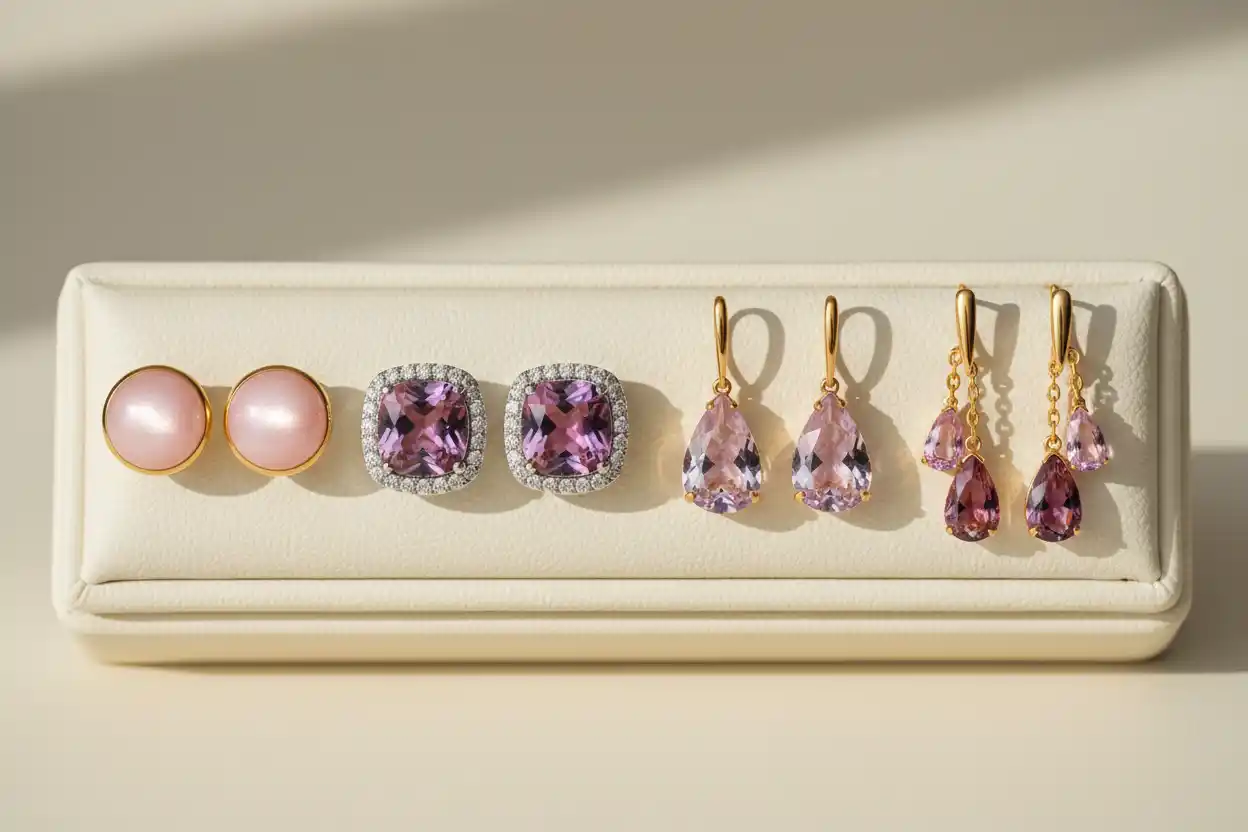
Kunzite Earrings: Styles, Matching and Buying Guide
Kunzite earrings place the gem’s pink-to-violet color near the face while keeping it away from most of the impacts that threaten rings and bracelets. That makes earrings one of the most practical jewelry forms for kunzite, particularly when the stones sit in low, well-supported settings.
The buying challenge lies in matching. Kunzite is strongly pleochroic, and its best color appears along a particular crystal direction. Two stones can have similar carat weights and still look mismatched because they were cut with different orientations, depths, or color concentrations.
The general kunzite guide covers mineral identity, formation, properties, and symbolism. This article focuses on earring styles, pair matching, setting pressure, comfort, treatments, light stability, and purchase decisions.
Why Earrings Suit Kunzite
Kunzite ranks approximately 6.5–7 on the Mohs scale, but it has perfect cleavage in two directions and poor toughness. A sharp blow can split the gemstone even when its polished surface remains relatively resistant to ordinary scratches.
Earrings encounter fewer desks, tools, doors, and hard surfaces than hand jewelry. Studs and short drops are particularly protected. Long dangles still face snagging and collision risks, but they generally remain safer than an exposed kunzite bracelet or ring.
The gemstone hardness chart explains kunzite’s scratch resistance, while gemstone toughness versus hardness explains why cleavage remains the decisive durability issue.
Main Kunzite Earring Styles
| Earring style | Visual effect | Practical advantage | Main concern |
|---|---|---|---|
| Solitaire studs | Clean face-up color | Low movement and low impact | Prong pressure and pair matching |
| Halo studs | Greater visual spread | Halo can shield the center stone | Hard accent stones must remain separated |
| Bezel studs | Modern, protected outline | Strong girdle protection | Uneven bezel pressure |
| Drop earrings | Visible movement and pleochroism | Larger stones can hang safely | Connector and bail strength |
| Dangle earrings | Dramatic length and color | Displays multiple stones | Snagging, weight and stone collision |
| Chandelier earrings | Formal statement design | Uses many small stones | Numerous joints and maintenance points |
| Hoop earrings with charms | Contemporary movement | Removable or interchangeable drops | Charm impact and hinge wear |
| Cluster earrings | Broad field of pink color | Works with smaller stones | Many prongs and matching requirements |
| Carved kunzite earrings | Artistic surface and shape | Uses large clean material | Cleavage and thin carved areas |
| Vintage-style earrings | Decorative metalwork | Character and historical styling | Repairs, glue and uncertain treatment |
Kunzite Stud Earrings
Studs offer the safest everyday format. The gemstone sits close to the ear, receives little leverage, and does not swing against the neck or clothing.
A pair of solitaire studs places strong emphasis on color, cut, and matching. Ovals, cushions, rounds, and emerald-style cuts are common. Rounded stones are generally easier to protect, while rectangular cuts need secure corners and enough metal beneath the pavilion.
A low four- or six-prong basket can work when the stones are sound. Bezel-set studs provide greater perimeter protection, although the jeweler must avoid excessive setting pressure.
The posts should connect securely to the baskets rather than relying on a thin solder point. Larger kunzite studs also need substantial backs to prevent the earrings from tilting forward.
Halo Kunzite Earrings
A diamond, sapphire, spinel, zircon, or moissanite halo can make a moderate kunzite look larger and brighter. A low halo may also protect the center stone from side impact.
However, the accent stones are harder than kunzite. Their girdles and prongs should not press against its edge. Examine the underside to confirm that the halo and center setting form one stable structure rather than several flexible parts rubbing together.
A white halo can emphasize lilac tones, while rose-gold or pink-sapphire accents can strengthen the warm pink appearance. The design should still allow the kunzite to remain the dominant color.
Drop and Dangle Earrings
Drops reveal kunzite’s pleochroism as they move. A pear or oval stone may alternate among pink, violet, pale lilac, and nearly colorless directions during wear.
This movement is attractive when both earrings change in a similar way. A poorly matched pair may show one stone remaining vivid while the other repeatedly washes out.
The connection above the stone should articulate freely without grinding the bail against a fragile girdle. Jump rings must close completely, and drilled or capped stones require inspection for glue and fractures.
Long dangles should not contain kunzite elements that strike one another. Small metal separators can preserve movement while preventing direct stone-to-stone contact.
Chandelier and Cluster Earrings
Chandelier earrings use multiple stones, articulated sections, and decorative metalwork. Kunzite can create a soft formal palette, particularly with diamonds, pearls, or pale sapphires.
Yet each setting introduces pressure points and each hinge introduces wear. The design should remain flexible without twisting the stones against one another.
Cluster earrings can use several small kunzites or combine one center gem with pink and colorless accents. Matching many kunzites becomes difficult because small differences in orientation become visible across the cluster.
A visually successful cluster should look intentionally graduated or balanced rather than assembled from random pale stones.
Matching a Pair of Kunzites
Matching kunzite involves more than finding equal carat weights.
Compare both stones under the same neutral lighting for:
- Hue
- Tone
- Saturation
- Pleochroic change
- Shape
- Millimeter dimensions
- Pavilion depth
- Facet arrangement
- Transparency
- Extinction and windowing
Then rotate both earrings together. The pair should change color in a coordinated way.
One stone may be slightly deeper or more included, but the difference should not make one earring visibly darker, larger, or grayer when worn.
Matching is especially challenging in larger stones because cutters orient each piece of rough to retain the strongest color. A carefully matched pair can therefore cost more than two unrelated kunzites of similar total weight.
Color Near the Face
Pale pink kunzite can look delicate against the skin but may disappear from normal viewing distance. Medium-light to medium pink-violet generally provides stronger presence in earrings.
White metals make cool lilac and violet tones more visible. Rose gold can intensify pink, while yellow gold provides warmer contrast.
The directories of pink gemstones and purple gemstones compare kunzite with alternatives in the same color families.
Morganite often appears peachier and warmer, with less dramatic pleochroic variation. The direct kunzite-versus-morganite guide explains why the two gems should not be identified by color alone. Buyers comparing finished styles can also consider morganite earrings.
Clarity
Faceted kunzite is commonly expected to look clean to the unaided eye. Inclusions that reduce transparency or create visible fractures can have a stronger effect on value than they would in a gem where inclusions are routine.
An enclosed crystal or fine needle may be acceptable. A bright feather reaching the surface beneath a prong is more concerning because setting pressure can enlarge it.
Inspect both stones from the side and back. Earrings are sometimes photographed only from the front, allowing thick pavilions, cavities, glue, and fractures to remain hidden.
Cut and Orientation
Kunzite’s strongest color is normally concentrated along the length of the crystal. Cutters must balance that orientation with two perfect cleavage directions.
Step cuts can showcase clean material, while brilliant and mixed cuts create more sparkle. Deep cutting may strengthen color but can cause the stones to project far behind the earlobe or hide weight below the setting.
A good pair should show similar face-up dimensions. Two earrings with equal carat weights may look mismatched when one stone is much deeper.
Windowing appears as a broad transparent area through the center. Extinction produces large dark zones. Some variation is acceptable, but neither should dominate the pair.
Earring Weight and Comfort
Large kunzite gems are available, which makes dramatic earrings possible. Nevertheless, the total weight includes stone, metal, accents, backs, and decorative components.
Request the weight per earring rather than only the pair’s combined weight. One heavy earring can pull differently if the stones or settings are not matched.
Large studs benefit from supportive disk backs. Heavy drops may need leverbacks or substantial hinged findings rather than thin hooks.
The guide to gemstones and metals for sensitive skin explains why post alloy, solder, plating, backs, and hooks must be considered independently from the kunzite.
Posts, Backs and Closures
Friction backs are common for studs, but they need enough tension to support the stone without pinching the ear. Screw backs offer security, although some wearers find them slower or less comfortable.
Leverbacks work well for drops because they close completely. Fishhook wires should use silicone stoppers when loss is a concern.
Inspect hinges for side-to-side movement and verify that posts are straight. A beautiful kunzite provides little value when a lightweight finding bends or opens easily.
Treatments and Seller Disclosure
Kunzite may be irradiated and then heated to improve its color. The resulting pink or violet can fade with intense light and heat, but natural color can also fade.
Treatment should be disclosed when known. The gemstone treatments guide explains why enhancement, synthetic origin, imitation, and repair are separate issues.
Laboratory-grown kunzite is not a routine mainstream jewelry product, but glass and other pink stones can imitate it. A seller should identify the material clearly rather than relying on the words genuine, created, or kunzite color.
The guide to lab-grown versus natural gemstones explains those terminology boundaries.
Light Exposure
Earrings are often worn in daylight, but brief ordinary use is different from prolonged intense exposure. The greatest risks come from storage in sunlit displays, hot vehicles, windows, ultraviolet lamps, and strong retail lighting.
Keep kunzite earrings in a closed box between uses. Do not leave them on a dressing table directly beside a sunny window.
The broader guide to crystals that fade in sunlight explains why some colored stones need shaded storage even when they tolerate normal occasional wear.
Price and Buying Priorities
The kunzite price guide addresses value by color, clarity, cut, size, treatment, and market position.
In earrings, pair matching adds a separate premium. Two stones must coordinate in color, orientation, dimensions, depth, and cut. The metal, accent stones, post system, backs, and workmanship may also represent a substantial portion of the retail price.
The Kunzite Buying Guide provides the loose-stone quality framework. For finished earrings, examine construction as closely as the gems.
Buying Online
Follow the protections in How to Buy Gemstones Online Without Getting Scammed.
Request:
| Buying detail | What to verify |
|---|---|
| Identity | Natural kunzite rather than glass, quartz, another spodumene color, or imitation |
| Treatment | Irradiation, heat, coating, filling, repair, or assembly |
| Pair matching | Color, orientation, cut, dimensions, clarity, and movement |
| Stone size | Millimeters and carat weight for each stone |
| Earring weight | Grams per earring |
| Metal | Alloy, hallmark, post material, backs, and plating |
| Setting | Prongs, bezel, halo, glue, bail, or drilled construction |
| Condition | Chips, fractures, abrasions, repairs, and loose components |
| Lighting | Continuous neutral-light video of both earrings moving together |
| Returns | Sufficient time for inspection and comfort testing |
For unusually valuable stones, a report may clarify identity and treatment. The guide to gemstone certification laboratories explains what such a report can and cannot establish.
Styling Kunzite Earrings
Kunzite studs work well with professional and understated clothing because the color remains close to the face. Drops suit evening and formal wear, where controlled indoor lighting also reduces prolonged light exposure.
Avoid tight scarves, over-ear headphones, helmets, and clothing that catches long earrings. Apply perfume and hairspray before putting the earrings on.
The guide to best gemstones for everyday wear compares kunzite with tougher alternatives. Earrings remain one of the better formats when the wearer wants kunzite’s color without exposing it to hand-level impact.
For a coordinated set, a kunzite necklace can repeat the color close to the earrings. A kunzite ring requires a more protective setting and stricter wear habits.
Cleaning and Storage
Warm soapy water and a soft brush or cloth provide the safest cleaning method. Avoid ultrasonic and steam equipment.
Follow the complete procedure in How to Clean Kunzite Jewelry Safely.
Hold earrings over a padded surface while cleaning. Small studs and backs can slip easily, while long drops can strike a hard sink or countertop.
Store each earring in a separate soft compartment so the stones and posts do not scratch one another. The Gemstones That Start With K directory places kunzite among other K-named gems without altering these care requirements.
Repair and Maintenance
Inspect prongs, posts, hinges, jump rings, bails, and backs regularly. Stop wearing an earring when the stone moves, the post bends, or a connector begins opening.
Tell the jeweler that the gemstone is kunzite. Heat, pressure, vibration, and rapid temperature change can cause damage.
A chipped matched stone presents a difficult repair problem because recutting can alter its size and color orientation. Replacing both stones may sometimes produce a better visual match than replacing one.
Frequently Asked Questions
1. Are kunzite earrings suitable for everyday wear?
Studs and short drops can be worn regularly with care because earrings receive limited impact. Remove them for sleep, exercise, swimming, showering, and hair styling.
2. Are kunzite studs safer than dangle earrings?
Generally, yes. Studs move less, snag less, and keep the stone close to the ear.
3. Why do my kunzite earrings look mismatched in some lighting?
The stones may have different pleochroic orientations, depths, or color concentrations. Lighting and viewing angle can make those differences more visible.
4. What color kunzite is best for earrings?
Medium-light to medium pink-violet usually remains visible near the face. Very pale stones can look nearly colorless from normal distance.
5. Can kunzite earrings fade?
Yes. Natural and enhanced color can fade through prolonged intense light or heat. Store the earrings in a closed box.
6. Are kunzite halo earrings durable?
A low halo can protect the center stone, but the harder accent stones must not rub against the kunzite. Setting workmanship remains critical.
7. Is rose gold a good metal for kunzite?
Yes. Rose gold complements pink material, while white metals emphasize lilac and violet tones. Structural strength and alloy disclosure matter as much as color.
8. Can large kunzite earrings be uncomfortable?
Yes. Kunzite occurs in large sizes, but total stone and metal weight can pull on the ears. Check the weight per earring before buying.
9. Can kunzite earrings be cleaned in an ultrasonic machine?
No. Vibration can worsen fractures and trigger cleavage-related breakage.
10. Are treated kunzite earrings less durable?
The gemstone’s cleavage remains the principal structural concern. Color-enhanced stones also share kunzite’s light and heat sensitivity.
11. Do kunzite earrings need laboratory reports?
Most commercial pairs do not. Reports become more useful for unusually expensive, large, disputed, or misrepresented stones.
12. What should I do if one earring becomes chipped?
Stop wearing the pair and have both stones evaluated. Recutting one may change its size and color orientation, making matching difficult.
Kunzite earrings work best when the pair has been matched in motion rather than only face-up on a tray. Coordinated pleochroism, low settings, suitable weight, secure findings, and shaded storage preserve the visual softness that makes the gem appealing while respecting its cleavage and light sensitivity.