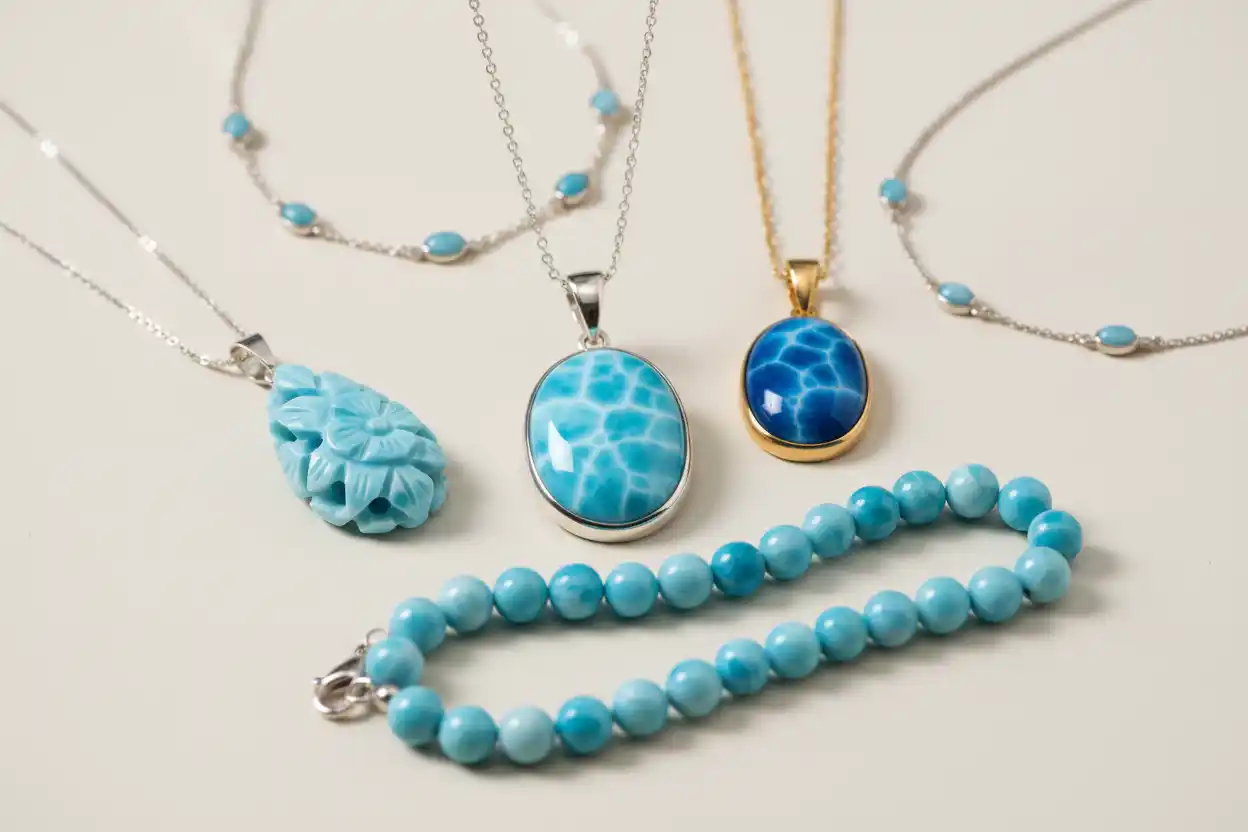
Larimar Necklaces and Pendants: Complete Buying Guide
Larimar necklaces display the stone’s blue-and-white patterns in one of its safest jewelry positions. A pendant can accommodate a broad cabochon, carved motif or polished tablet without exposing the material to the repeated desk and doorframe impacts faced by rings and bracelets.
That protection does not remove the need for careful construction. Larimar is compact blue pectolite with moderate-to-low scratch resistance, pronounced cleavage and natural variations that may include white fibrous zones, calcite, cavities, matrix and surface-reaching fractures. The pendant’s bail, backing, setting, chain and balance must all support the stone rather than merely frame its color.
The broader Larimar gemstone guide owns its mineral identity, Dominican geology, history and symbolism. This page focuses specifically on necklace design, pendant construction, chain selection, treatment disclosure, authenticity, wear and repair.
Larimar Necklaces at a Glance
| Feature | What to assess |
|---|---|
| Gem material | Blue massive pectolite associated with the Dominican Republic |
| Typical appearance | White to deep blue with cloudlike, cellular or streaked patterns |
| Mohs hardness | Approximately 4.5–5 |
| Structural concern | Cleavage, thin areas, cavities and open fractures |
| Strongest pendant setting | Low full bezel with adequate back support |
| Common necklace forms | Solitaires, carvings, tablets, beads, stations and inlay |
| Main quality factor | Attractive blue coverage balanced with natural pattern |
| Main mechanical concern | Bail, jump ring, chain, clasp and drill-hole strength |
| Possible alterations | Resin, dye, coating, backing, wax, oil, glue or filling |
| Safest cleaning | Brief hand cleaning with lukewarm water and mild soap |
Why Larimar Works Better in Necklaces Than Rings
A pendant hangs on the chest rather than the hand. Consequently, it experiences fewer hard knocks, less pressure and less frequent contact with household chemicals.
This makes a necklace a practical choice for a large Larimar cabochon that would be excessively exposed in a ring. Earrings provide similar protection, while a Larimar bracelet remains more vulnerable because it repeatedly touches desks and other jewelry.
Larimar should still be treated as a careful-wear gem. Its approximate position on the gemstone hardness chart means quartz-bearing dust and many common gemstones can scratch it. Moreover, the difference between scratching and breaking is important, as explained in Gemstone Toughness vs Hardness.
A long pendant can swing into furniture, while a loosely supported stone can crack if the setting twists. Necklace position reduces risk, but design and wearing habits determine how much protection the material actually receives.
Main Larimar Necklace Styles
| Necklace style | Main advantage | Main concern |
|---|---|---|
| Solitaire cabochon | Gives one stone complete visual focus | Bail balance and stone support |
| Full-bezel pendant | Protects most of the perimeter | Closed backs may hide treatment or thin construction |
| Partial-bezel pendant | Shows more of the pattern | Exposed edges remain vulnerable |
| Prong-set pendant | Creates an open, light appearance | Setting pressure and exposed girdle |
| Carved pendant | Uses the pattern artistically | Thin details and drilled loops |
| Tablet pendant | Displays a broad graphic surface | Corners and backing |
| Inlay pendant | Produces smooth geometric designs | Adhesive and thin stone |
| Bead necklace | Shows many colors and patterns | Drill holes, cord and bead abrasion |
| Station necklace | Lightweight and contemporary | Flipping stones and connector wear |
| Multi-stone pendant | Combines varied patterns | Matching and stone-to-stone contact |
Solitaire Larimar Pendants
A solitaire places one cabochon at the center of the design. Ovals, cushions, rounds, pears, rectangles and natural freeforms are common.
The strongest stone should remain attractive while hanging vertically. Product photographs sometimes show a cabochon flat beneath concentrated lighting, which can conceal a poorly balanced setting or an unattractive reverse.
Ask to see the pendant suspended from its bail. The face should remain approximately forward rather than turning continuously toward the body.
The side profile should also be examined. An unusually deep cabochon may carry hidden weight, while an excessively thin tablet may depend on metal backing for stability.
Neither construction is automatically wrong. The seller should simply disclose whether the visible Larimar is a solid cabochon, backed slab, doublet, inlay section or resin-supported component.
Full-Bezel Pendants
A full bezel usually provides the strongest perimeter protection.
The metal surrounds the Larimar’s edge, reducing the chance that a direct lateral impact reaches the pectolite. It also creates a smooth outline that catches less easily on clothing.
The bezel should follow the cabochon evenly. Gaps, roughly folded metal, visible adhesive and uneven pressure suggest poor setting work.
White lines deserve special attention near the bezel. Some are ordinary Larimar patterning, while others may be fractures or cleavage-related planes. A setter should not press metal directly over a structurally weak line.
A closed back can reinforce a thin stone. However, it can also conceal filler, backing, glue, matrix, cracks or a replacement material. High-value pendants should receive clear written construction disclosure.
Partial Bezels and Prongs
A partial bezel covers selected sides while leaving more of the cabochon visible. It can work well when the protected sections correspond with the stone’s most vulnerable edges.
Prongs expose still more of the stone, but they concentrate pressure at a small number of points. Rounded cabochons generally tolerate this arrangement better than sharp pears, marquises or rectangular tablets.
The stone should rest inside a supportive basket rather than hang only between prong tips. One prong must not press over an open crack, cavity or weak white seam.
An open setting may show more pattern, yet the slight visual gain should be weighed against reduced protection.
Larimar Carved Pendants
Carving allows the lapidary to use Larimar’s pattern as part of the design. Waves, turtles, dolphins, leaves, hearts, flowers and abstract forms are common.
The most vulnerable areas are narrow projections, pierced sections and drilled loops. A thin fin, leaf tip or openwork bridge can break even when the main body remains sound.
Metal caps can reinforce carved pendants, although they may also hide glue or a repaired drill hole. Ask for close photographs around the attachment point.
A carving should feel smooth against clothing. Sharp exposed matrix and unfinished edges can catch fabric or produce small chips.
Larimar’s modern Caribbean identity makes marine motifs visually appropriate, but the design should not be marketed as proof of ancient cultural symbolism unless reliable provenance supports that claim.
Larimar Tablet and Inlay Pendants
Flat tablets create a broad blue-and-white surface. Their geometric simplicity can suit modern silver or gold settings, but thin corners need metal protection.
Inlay uses smaller sections fitted into channels or mosaics. The finished surface should feel level, without raised edges, gaps or cloudy adhesive.
Because inlay pieces are thin, the metal and bonding material carry much of the structural load. Such pendants should never be soaked, steamed or placed in an ultrasonic cleaner.
An intensely uniform blue inlay may be natural Larimar, dyed substitute, reconstructed material or resin. Material disclosure matters more than the visual style.
Larimar Bead Necklaces
Bead strands reveal a broad range of natural color and texture. Round, oval, barrel-shaped and graduated beads are commonly used.
A well-matched strand does not require every bead to be identical. Instead, the blue coverage, white patterning, diameter, polish and treatment should create a consistent sequence.
Drill holes should be checked for chips and radiating cracks. A hole crossing a cavity or weak white zone may enlarge under cord pressure.
Knots between beads reduce direct contact and limit loss if the strand breaks. They are especially useful for higher-quality material.
Large graduated beads add substantial weight. The cord, clasp and reinforced end connections must be designed for the complete necklace rather than selected for appearance alone.
Station Necklaces
Station necklaces space small Larimar cabochons or beads along a chain.
A flat station should connect at two balanced points when the design is intended to remain face-up. One-point connections create more movement but allow the stone to turn backward.
The chain should connect to metal rather than rub directly against a drilled Larimar edge.
Enough spacing should remain between stations to prevent collision when the necklace curves around the neck.
Choosing Larimar Color
Larimar ranges from nearly white to sky blue, turquoise blue, greenish blue and deeper saturated blue.
Deeper blue generally receives stronger commercial demand, yet the stone should be judged as a complete pattern. A medium-blue cabochon with an attractive cellular design may be more appealing than a darker stone with a large fracture or uneven polish.
The color should remain visible in ordinary indoor light. Highly saturated marketing images can make pale material appear much stronger than it is.
The complete quality framework belongs to the Larimar Buying Guide, while the dedicated Larimar price guide covers value and cost.
White Patterns, Matrix and Fractures
White cloudlike and cellular patterns are characteristic of Larimar. They may come from lighter pectolite, calcite or differences in fibrous texture.
Brown, red or dark areas may reflect hematite, volcanic matrix or other associated minerals. Small inclusions can contribute character, but dominant matrix usually reduces the amount of desirable blue.
Not every line is harmless patterning. A fracture may interrupt the surface polish, reflect as a flat plane or continue beneath a bezel.
Ask for side-lit photographs. Diffused side lighting reveals open cracks, pits, filler and uneven polish more effectively than frontal studio lighting.
Treatments and Authenticity
The treated-Larimar guide owns the detailed treatment workflow.
Resin may fill cavities or stabilize fractured material. Coatings can improve gloss, while dye can strengthen pale blue. Wax, oil, backing and glue may also alter the finished appearance.
These treatments are not automatically unacceptable, but they affect care, repair and price. A seller should not describe heavily altered material as untreated fine Larimar.
The Real vs Fake Larimar guide covers glass, dyed chalcedony, howlite, magnesite, resin, ceramic and composite imitations.
Professional testing may be justified when a high-value pendant has unusually uniform color, questionable patterning or unsupported Dominican provenance. The gemstone certification guide explains the role of an identification report.
Choosing a Bail
The bail carries the complete pendant weight and controls how it hangs.
It should contain enough metal to support the stone without bending. Solder joints, jump rings and articulated connectors should appear smooth and fully closed.
The internal opening must accommodate the chosen chain and its end fitting. A chain may fit through the bail itself but fail to pass through because the end cap is wider.
An articulated bail allows natural movement. A fixed bail may keep a tablet face-forward, provided it is centered accurately.
When the Larimar is drilled directly, inspect the hole for cracks, glue and thin walls. A metal cap or tube can distribute force more safely than a bare jump ring passing through pectolite.
Selecting a Chain
The chain should match the pendant’s weight rather than its perceived delicacy.
Cable, box, wheat, rope and curb chains can all work when their dimensions and construction are adequate. A heavy cabochon on an ultra-thin chain creates an obvious mechanical mismatch.
Sterling silver is common and visually complements Larimar’s cool color. White gold creates a similar appearance at a higher cost, while yellow gold increases contrast.
The clasp should be proportionate to the necklace. A large pendant needs more than a tiny spring ring connected through an open lightweight jump ring.
The guide to best gemstones and metals for sensitive skin explains why chain alloy, solder, plating and clasp material should be considered independently from the stone.
Necklace Length and Position
A short princess-length chain often places Larimar on the upper chest, where it remains visible without swinging into desks.
Longer matinee and opera lengths create more movement. They suit larger designs visually but expose the pendant to greater leverage and impact.
A choker places the stone closer to skin, cosmetics and perspiration. Consequently, treated or backed pendants may require more frequent gentle cleaning.
The actual length should be confirmed in centimeters or inches rather than inferred from a style name. Pendant size, wearer proportions and neckline all change the final position.
Price and Finished-Jewelry Value
A necklace price may reflect Larimar quality, metal weight, carving, matching, setting labor, chain construction, brand and provenance.
A substantial gold pendant may derive more of its value from metal and craftsmanship than from the cabochon itself. Conversely, fine blue material with minimal matrix may justify a meaningful premium even in silver.
Size alone is not sufficient. A broad pale tablet may cost less than a smaller deep-blue cabochon with a strong pattern and sound structure.
Current valuation belongs to the Larimar price guide rather than a static table inside this construction guide.
Buying Larimar Necklaces Online
The safeguards in How to Buy Gemstones Online Without Getting Scammed are especially important because blue saturation and white contrast can be altered easily in photographs.
Request continuous video of the pendant hanging from the chain. The seller should show the front, side and reverse under neutral light.
Written details should identify the stone, treatment, pendant dimensions, total weight, metal alloy, hallmark, chain length, bail opening, clasp and return period.
The wider blue gemstones guide can help when the intended wearer needs a harder, more transparent or more consistently colored alternative.
Wearing, Cleaning and Storage
Put the necklace on after perfume, sunscreen, hairspray and cosmetics have dried.
Remove long pendants before exercise, sleep, swimming and activities where they can swing into furniture. A necklace may be safer than a ring, but repeated impact can still chip Larimar.
Follow How to Clean Larimar Jewelry Safely. Use lukewarm water, mild soap and a soft cloth or brush, keeping contact brief when treatment or backing is uncertain.
Steam and ultrasonic cleaning should be avoided. Heat and vibration may affect pectolite, fractures, filler, glue and setting components.
Store the necklace flat or in a broad curve. Keep the Larimar in its own padded compartment away from harder gemstones.
Belief-based cleansing belongs to How to Cleanse and Charge Larimar and should avoid salt, prolonged soaking, heat and aggressive residue.
The Crystals That Start With L and Gemstones That Start With L directories provide the wider alphabetical context.
Frequently Asked Questions
1. Is Larimar suitable for necklaces?
Yes. Pendants and necklaces are among the safest Larimar jewelry forms because they receive less impact than rings and bracelets.
2. What is the safest pendant setting?
A low, accurately fitted full bezel generally offers the strongest perimeter protection.
3. Is darker Larimar always more valuable?
Deeper blue often attracts higher prices, but pattern, condition, blue coverage, cut and treatment also influence quality.
4. Can a Larimar pendant be backed?
Yes. Backing may support a thin stone, but it can also conceal treatment or composite construction and should be disclosed.
5. Are white patterns normal?
Yes. White cloudlike and cellular patterns are characteristic, although some white-looking lines may be fractures or cleavage-related planes.
6. Can Larimar necklaces contain dyed material?
Yes. Dye, resin, coating, wax, oil, backing and filling can occur.
7. What chain length works best?
Princess length is practical for many pendants because it keeps the stone visible on the upper chest with limited swing.
8. Can Larimar be worn with a diamond necklace?
The pieces should not rub directly because diamond and its setting can scratch Larimar.
9. Is a carved Larimar pendant more fragile?
It can be, especially where the carving includes thin projections, drilled loops or openwork.
10. Can Larimar necklaces be cleaned ultrasonically?
No. Vibration can enlarge fractures and affect pectolite, fillers, glue and settings.
11. Does an expensive Larimar pendant need certification?
Independent identification can be useful for costly, disputed or unusually represented material, but ordinary commercial pieces may not justify the expense.
12. What should I do if the pendant begins turning backward?
Have the bail alignment, chain weight and center of balance checked. A jeweler may be able to correct the connector without replacing the stone.
A strong Larimar necklace requires cooperation between the cutter and jeweler. The cabochon must use the blue pattern effectively, while the setting, bail and chain must carry its weight without concentrating pressure on weak areas. When those elements are balanced, a necklace allows the stone to remain visible and protected rather than asking a delicate pectolite to endure ring-level wear.