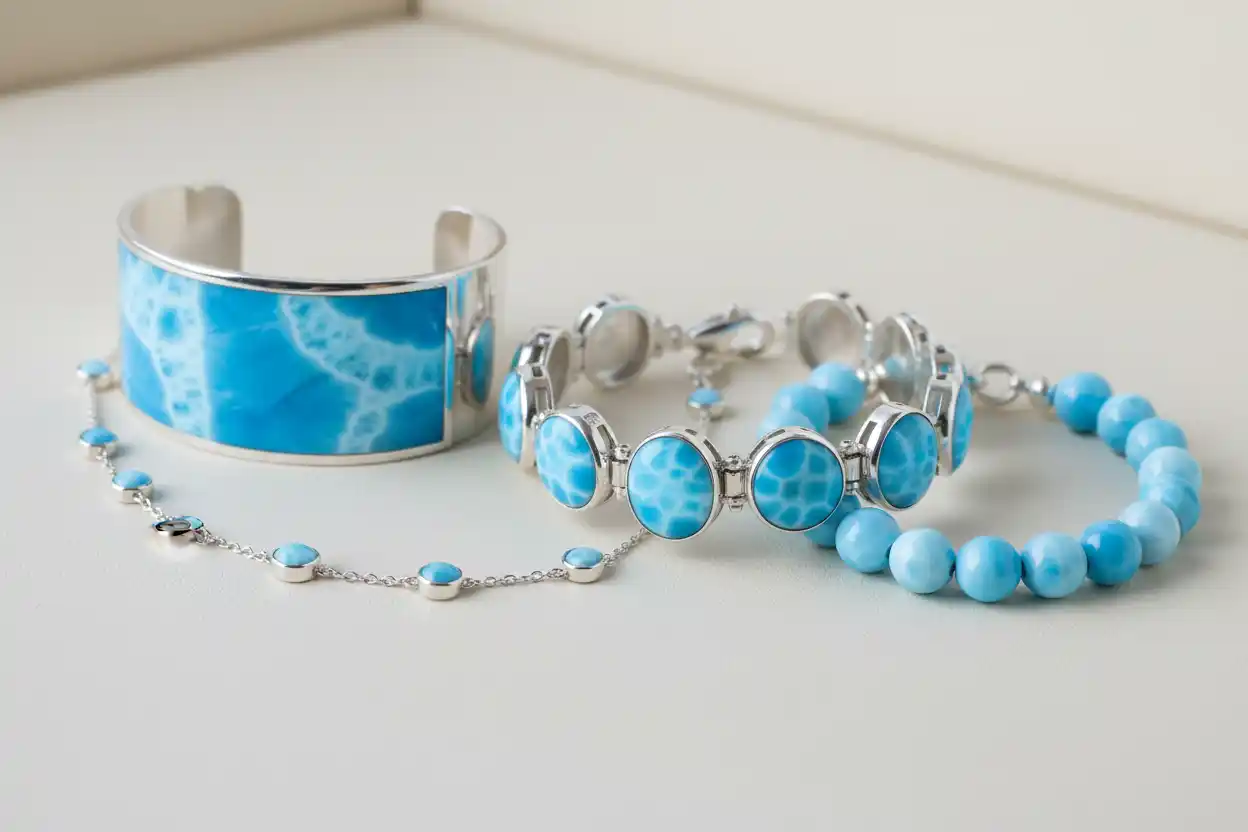
Larimar Bracelets: Styles, Quality and Buying Guide
Larimar bracelets wrap the stone’s blue-and-white patterns around the wrist, creating an appearance often compared with shallow Caribbean water, clouds or sunlight moving across the sea. No two natural stones have exactly the same pattern, so a bracelet may look carefully matched, intentionally graduated or richly varied.
The wrist is also a demanding place for Larimar. The material is blue massive pectolite with hardness of approximately 4.5–5, two strong cleavage directions and a structure that can contain veins, cavities and contrasting mineral areas. It can scratch, chip or split when struck against a desk, doorframe or another bracelet.
A successful Larimar bracelet therefore depends on more than intense blue color. Stone condition, pattern distribution, drill holes, settings, links, clasps, fit and treatment disclosure determine whether the finished piece will remain attractive during careful wear.
The broader Larimar gemstone guide explains the mineral’s identity, Dominican formation, history and symbolism. This article focuses on bracelet construction, quality, comfort and maintenance.
Larimar Bracelets at a Glance
| Feature | What to evaluate |
|---|---|
| Material | Natural Dominican blue pectolite sold as Larimar |
| Typical colors | White, pale blue, sky blue, turquoise blue, greenish blue and deeper blue |
| Mohs hardness | Approximately 4.5–5 |
| Structural concern | Cleavage, brittle areas, veins and open fractures |
| Common bracelet forms | Beads, bezel links, stations, cuffs, tablets and charms |
| Strongest construction | Low bezel links or carefully knotted beads |
| Main quality factor | Attractive blue coverage and pattern |
| Common treatments | Resin, wax, oil, dye, coating, backing and fracture filling |
| Main authenticity concern | Dyed stone, chalcedony, glass, resin and reconstructed products |
| Main mechanical concern | Drill holes, elastic, links and clasp security |
| Safest cleaning | Gentle hand cleaning with mild soap and minimal soaking |
Why Larimar Needs Extra Protection on the Wrist
Larimar is significantly softer than quartz, topaz, sapphire and diamond. Ordinary mineral dust may gradually dull its polish, while direct contact with harder jewelry can create visible scratches.
Hardness is only part of the durability question. Pectolite also has strong cleavage, meaning its internal structure can separate along preferred directions when a concentrated blow reaches the wrong point.
The gemstone hardness chart provides the numerical comparison. The distinction between scratching and breaking is explained in Gemstone Toughness vs Hardness.
Compact Larimar may tolerate normal careful handling better than its low hardness suggests, but that does not make it suitable for unrestricted gym, household or occupational wear. A bracelet should be removed before the wrist meets repeated impact, pressure, chemicals or abrasive surfaces.
Main Larimar Bracelet Styles
| Bracelet style | Main strength | Main concern |
|---|---|---|
| Round bead bracelet | Continuous casual color | Drill holes and elastic deterioration |
| Knotted bead strand | Less bead-to-bead abrasion | Cord moisture and knot wear |
| Bezel-link bracelet | Strong edge protection | Link and clasp maintenance |
| Prong-link bracelet | Shows more of each stone | Exposed edges and pressure points |
| Station bracelet | Lightweight and modern | Stones may flip or rotate |
| Cuff bracelet | Large uninterrupted Larimar surface | Correct wrist fit and impact |
| Tablet bracelet | Graphic blue-and-white pattern | Thin corners and concealed backing |
| Charm bracelet | Small movable accents | Charms can collide |
| Mixed-gem bracelet | Additional color contrast | Harder gems may scratch Larimar |
| Inlay bracelet | Smooth patterned surface | Thin stone and adhesive failure |
Larimar Bead Bracelets
Beaded bracelets are among the most accessible Larimar designs. The beads may be round, oval, barrel-shaped, disk-shaped, faceted or irregular.
Because each bead rotates independently, a strand displays more of the rough’s natural variation than a fixed cabochon bracelet. One side may show vivid blue, while another reveals white pectolite, greenish areas, brown matrix or an open vein.
The best strands do not necessarily use identical beads. Instead, their color, pattern, size and polish create a deliberate visual sequence. A bracelet may progress from pale sky blue to deeper blue, or it may repeat similarly patterned beads around the wrist.
Drill holes require close inspection. Pectolite can chip where the drill enters or exits, especially when a hole crosses a white vein, cavity or structural boundary. Cracks radiating from the opening can enlarge as the cord pulls against them.
A noticeably dark or unnaturally intense blue inside the drill hole can also indicate dye concentration. Treatment cannot be established from this clue alone, but it deserves further investigation.
Stretch Larimar Bracelets
Elastic construction makes a bracelet easy to wear, but the elastic usually has a shorter lifespan than the stones.
Repeated stretching, perspiration, heat, sunscreen and age cause the material to lose tension. Once the bracelet begins hanging farther down the wrist or showing separated fibers, it should be restrung.
The knot should be secure and protected without being forced into a bead whose hole is too narrow. A knot that sits exposed between two beads can catch and wear quickly.
Stretch bracelets should be rolled gently over the hand rather than pulled outward into a long line. Excessive stretching places unnecessary pressure on both the elastic and the drill-hole edges.
Knotted Larimar Bracelets
Knots between beads reduce direct stone-to-stone contact. They also limit the number of beads lost if the cord breaks.
This construction is useful for finer Larimar because adjacent beads cannot repeatedly rub against each other. However, cord can absorb moisture and cosmetics, so the bracelet should still be removed before washing, swimming and applying skincare products.
Knots should remain even and tight against the bead openings. Large gaps suggest stretching, while darkened or fuzzy cord indicates wear.
Cabochon Link Bracelets
A link bracelet uses individual Larimar cabochons joined by articulated metal sections.
Low bezels generally provide the strongest protection. The metal surrounds each stone’s edge while allowing the links to follow the wrist.
The bracelet should bend smoothly through its complete length. A stiff section can create leverage and place pressure on the settings whenever the wrist moves.
Closed backs may support thin Larimar tablets, but they can also hide resin, glue, backing, fractures or composite construction. Ask whether each visible blue section is a solid cabochon, a backed slab or an inlay component.
Prong-set links show more of the stones but expose the girdles. They are better reserved for occasional wear than a well-made bezel design.
Larimar Cuff Bracelets
A cuff can feature one broad cabochon, several stones or a large inlay panel.
The centerpiece should sit low and receive support beneath its complete base. A large stone set high above the wrist becomes a lever when it catches clothing or strikes a hard surface.
The cuff must match the wearer’s wrist shape. Repeatedly bending an adjustable metal band weakens the metal and can transfer force into the setting.
A wearer should put on and remove the cuff through the designed opening rather than expanding it around the stone each time.
Choosing Larimar Color
Larimar ranges from nearly white through pale blue, turquoise blue, greenish blue and deeper blue. Fine commercial material generally receives greater demand when a substantial part of the face shows attractive blue.
Deep color is not the only desirable appearance. A lighter stone can be visually successful when it has a distinctive, well-balanced pattern and enough contrast to remain recognizable.
Greenish, gray or brown areas generally reduce commercial value when they dominate the bracelet. Small natural areas may still contribute character, particularly in artisan designs.
The Larimar Buying Guide owns the complete quality-selection process, while the Larimar price guide covers value without turning this bracelet guide into a price table.
White Patterns and Matrix
Larimar’s white patterns may appear as clouds, streaks, islands, cellular networks or broad pale areas.
A pleasing pattern should support the blue rather than overwhelm it. However, the ideal balance depends on design. Some buyers prefer nearly solid blue, while others choose dramatic blue-and-white contrast.
Not every white line is harmless. Flat reflective planes, open fissures and deep cavities can resemble ordinary patterning in photographs.
Examine the surface from an angle. A structural crack may interrupt the polish, collect residue or continue beneath a setting. Natural white patterning should not automatically be treated as a fracture, but the two need to be distinguished.
Matching Several Stones
A refined link bracelet should coordinate color, pattern, shape, dimensions, polish and structural condition.
Perfect duplication is impossible because Larimar patterns are natural. Matching instead means that no single cabochon appears unintentionally dull, green, fractured or mismatched.
A deliberate gradient can move from pale to deep blue. Alternatively, a bracelet may repeat similar white cellular patterns around its circumference.
Continuous video is more revealing than individual edited photographs. The bracelet should be shown flat, curved and worn on a moving wrist.
Treatments and Alterations
The dedicated treated-Larimar guide owns treatment detection and disclosure.
Commercial alterations may include resin filling, surface coating, wax, oil, backing, dye, glue and reconstructed material. A treatment can improve polish or stabilize weak stone, but it may also alter cleaning requirements and value.
Blue dye may collect in cracks, pores and drill holes. Resin can conceal cavities or hold fractured areas together. A coating may create a glossy surface that gradually scratches or peels.
Treatment is not automatically unacceptable. The concern is whether the seller explains it accurately and whether the price reflects the material’s actual condition.
Imitations
Dyed chalcedony, dyed howlite, magnesite, glass, resin, ceramic and composite products may be sold as Larimar.
The full identification workflow belongs to Real vs Fake Larimar.
Some imitations reproduce the color but not Larimar’s natural fibrous, cloudlike or cellular texture. Others can be convincing enough to require Raman spectroscopy or another laboratory technique.
Do not use acid, flame, hot needles, scratching or solvents on a finished bracelet. These tests can damage genuine Larimar, treatments, cord and metal without producing a reliable answer.
Larimar vs Turquoise in Bracelets
Both stones can appear blue, opaque and patterned with pale or dark matrix.
Larimar is blue pectolite associated with the Dominican Republic. Turquoise is a hydrated copper-aluminum phosphate with different hardness, texture, treatment history and geological occurrence.
The direct Larimar vs Turquoise comparison owns the detailed identification boundary.
Turquoise generally shows earthy matrix patterns rather than Larimar’s white cloudlike or watery designs. Color alone remains insufficient because both materials can be treated or imitated.
Metal and Setting Choices
Sterling silver is the most common Larimar setting metal. Its cool tone complements pale and turquoise blue without competing with the pattern.
White gold provides a similar visual effect at a higher price, while yellow gold creates warm contrast. Rose gold can soften pale blue but may make greenish material appear warmer.
The metal must be thick enough for the bracelet’s weight. Very thin bezels, prongs, jump rings and clasps may deform long before the Larimar surface shows obvious wear.
The best gemstones and metals for sensitive skin explains why alloy, plating, solder and clasp composition deserve separate attention.
Bracelet Fit
A close, comfortable fit generally protects Larimar better than a very loose bracelet.
A loose strand slides over the hand and strikes desks more often. A bracelet that is too tight places constant pressure on drill holes, cord, links and clasp connections.
Measure the wrist with a flexible tape and allow additional room according to bead diameter and bracelet width. Large beads occupy space inside the bracelet, so they require more wearable length than smaller beads.
Link bracelets should articulate naturally without pinching. A safety chain can reduce loss risk when it remains short enough not to catch or strike the stones.
Buying Online
The safeguards in How to Buy Gemstones Online Without Getting Scammed are especially relevant because product editing can exaggerate Larimar’s blue.
Request neutral-light video, exact wearable length, bead or cabochon dimensions, metal composition, treatment disclosure, construction details and close views of drill holes and backs.
A report from a recognized laboratory may help with an expensive suite, a disputed treatment or a questionable imitation. The gemstone certification guide explains when testing is proportionate to the purchase.
The wider blue gemstones guide can help when a more durable or transparent blue bracelet would suit the intended wear better.
Wearing and Styling a Larimar Bracelet
Larimar works naturally with white, cream, pale gray, navy, denim and other understated colors. Silver settings create a cool coastal appearance, while yellow gold gives the blue more contrast.
Avoid stacking Larimar beside diamonds, sapphires, topaz or rough-edged metal bracelets. Their harder surfaces can scratch the pectolite.
For lower-impact options, Larimar earrings and a Larimar necklace protect the material more effectively. A Larimar ring will require even stricter impact precautions.
Remove the bracelet before exercise, gardening, cleaning, cooking, swimming, showering, lifting luggage or sleeping.
Cleaning and Storage
Follow How to Clean Larimar Jewelry Safely for the complete method.
Use lukewarm water, mild soap and a soft cloth or brush. Keep contact brief, especially when the bracelet contains elastic, cord, glue, backing or unknown treatment.
Avoid ultrasonic and steam cleaning. Vibration can exploit fractures and cleavage, while heat may affect the stone’s color or any fillers and adhesives.
Dry the bracelet thoroughly around drill holes, links and clasps. Store it flat in a separate padded compartment.
Belief-based cleansing practices belong to How to Cleanse and Charge Larimar and should avoid prolonged water, salt, heat and harsh chemicals.
The Crystals That Start With L and Gemstones That Start With L directories provide the wider alphabetical context.
Frequently Asked Questions
1. Is Larimar durable enough for a bracelet?
It can be worn carefully, but its hardness of approximately 4.5–5 and strong cleavage make it vulnerable to scratches and sharp impacts.
2. What is the safest Larimar bracelet style?
A low bezel-link bracelet generally provides the strongest protection. Knotted bead strands are also safer than tightly packed unknotted beads.
3. Is darker blue Larimar always better?
Deeper blue often receives greater demand, but pattern, condition, polish and overall design also matter.
4. Are white areas in Larimar undesirable?
Not automatically. Attractive white patterning is characteristic of Larimar, although excessive white may reduce blue coverage and open white fractures can weaken the stone.
5. Can Larimar beads crack around drill holes?
Yes. Drilling creates stress points, especially where the hole crosses a vein, cavity or existing fracture.
6. How long does a stretch Larimar bracelet last?
Elastic lifespan varies with quality and wear. It should be replaced when the bracelet loosens, fibers appear or the knot begins moving.
7. Can Larimar bracelets be dyed?
Yes. Dye and other alterations occur, although natural untreated material is also available.
8. Can Larimar be worn beside a diamond bracelet?
Direct stacking is not advisable because diamond and its setting can scratch or chip Larimar.
9. Is every blue pectolite called Larimar?
The Larimar trade name refers to blue massive pectolite associated with the Dominican Republic.
10. Can a Larimar bracelet go in water?
Brief gentle cleaning is preferable to soaking. Water can affect cord, elastic, glue, metal and treated fractures.
11. Can Larimar be cleaned ultrasonically?
No. Ultrasonic vibration can worsen fractures and cleavage-related damage.
12. What should I do when a stone or bead becomes loose?
Stop wearing the bracelet and store it flat. A jeweler or experienced restringer should inspect the complete construction before repair.
A good Larimar bracelet balances natural variation with mechanical discipline. The stones should show convincing blue and attractive patterning, but the drill holes, links, settings, fit and clasp must be equally sound. Careful construction allows the bracelet to move with the wrist without asking a relatively delicate pectolite to behave like sapphire.