How to Spot Treated or Synthetic Larimar
Larimar is the trade name for blue to greenish-blue pectolite from the Dominican Republic. Its color is associated with trace copper, while white Calcite, fibrous pectolite growth, volcanic host rock, reddish inclusions, and dark copper minerals can form part of its natural pattern.
Unlike Sapphire, Ruby, Tanzanite, or blue Topaz, Larimar does not have one dominant routine commercial color-enhancement process. Historical gemological research found no substantiated evidence that low-quality material was being commercially dyed at that time, and experimental heat damaged color, transparency, and toughness rather than improving the stone.
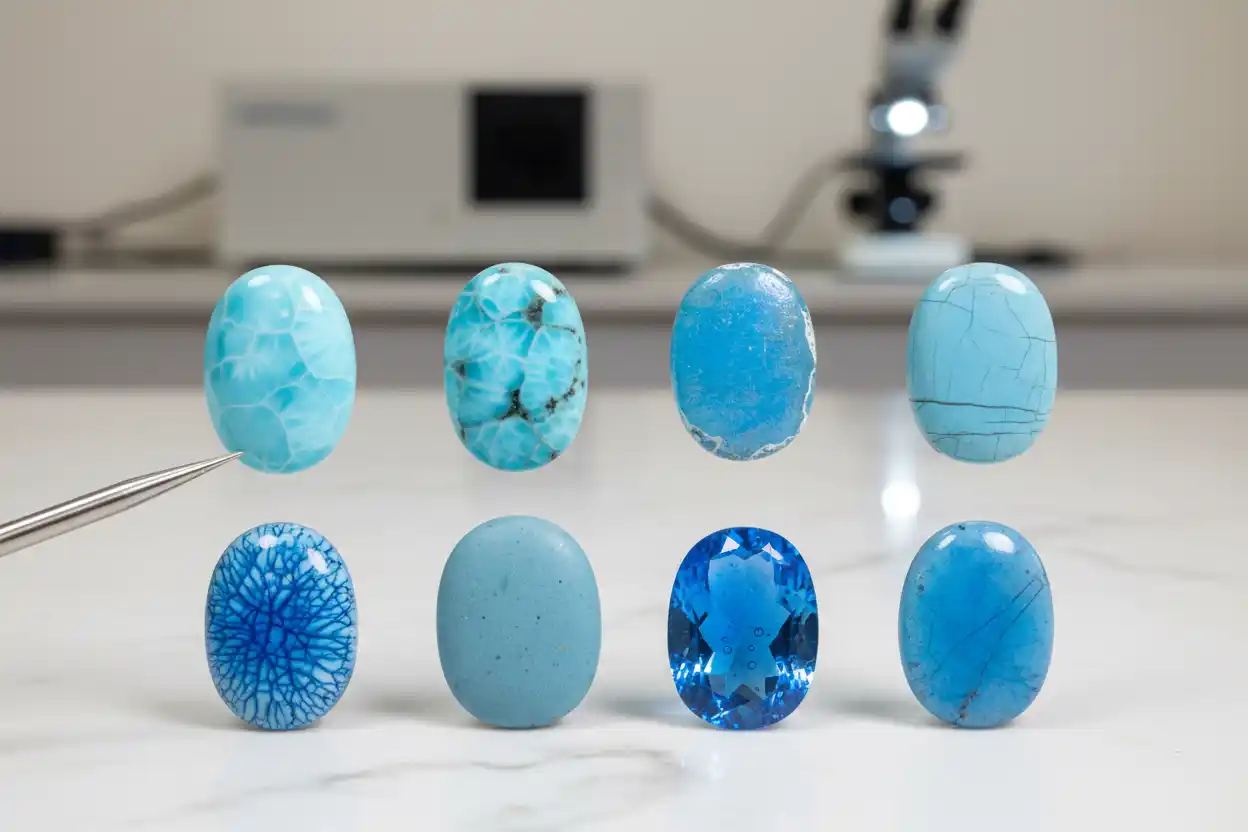
That does not mean every modern product is untreated. Dye, resin filling, stabilization, coating, backing, repair, and reconstruction are technically possible, particularly in low-grade, fractured, or manufactured pieces. More frequently, “treated Larimar” listings turn out to be complete imitations made from dyed Chalcedony, ceramic, glass, resin, polymer clay, or another blue-and-white material.
True synthetic Larimar is not a routine gemstone category. Pectolite can be synthesized for scientific purposes, but ordinary retail “lab Larimar” is more likely an imitation than laboratory-grown blue pectolite reproducing Larimar’s natural aggregate structure and Dominican origin.
Larimar treatment categories at a glance
| Product category | What it is | Common evidence | Correct description |
|---|---|---|---|
| Natural untreated Larimar | Naturally formed Dominican blue pectolite | Fibrous texture, white Calcite, volcanic matrix, pectolite spectrum | Natural Larimar |
| Dyed Larimar | Natural pectolite with introduced blue color | Dye in fractures, Calcite, pits, and drill holes | Dyed natural pectolite |
| Resin-filled Larimar | Surface-reaching cracks or cavities filled with polymer | Flash effects, bubbles, smooth filler, FTIR absorption | Filled Larimar |
| Stabilized Larimar | Fractured or porous pectolite impregnated with resin | Polymer between fibers and fractures | Stabilized natural Larimar |
| Waxed or oiled Larimar | Surface treatment used to deepen color or improve polish | Greasy luster, residue, temporary darkening | Surface-treated Larimar |
| Coated or backed Larimar | Blue film, pigment, resin, or backing alters appearance | Edge wear, peeling, flat colored layer | Coated or composite product |
| Reconstructed Larimar | Fragments or powder bonded in resin | Granular texture, binder, molded patterns | Composite containing Larimar |
| Heat-damaged Larimar | Pectolite exposed to excessive heat | Whitening, lost transparency, microfractures | Heat-altered pectolite |
| Irradiated pectolite | Pectolite whose color was changed experimentally by radiation | Violet color and altered associated minerals | Irradiated pectolite |
| Imitation Larimar | Dyed Chalcedony, ceramic, glass, resin, or other material | Different structure, bubbles, manufactured pattern | Larimar simulant |
What genuine Larimar is
Larimar is blue pectolite from the Sierra de Baoruco area of the Dominican Republic.
Pectolite is a sodium calcium silicate hydroxide mineral, commonly fibrous or radiating in habit. Larimar occurs in veins and cavities within altered volcanic rock.
The complete material profile appears in Larimar: Meaning, Healing Properties & Uses. This treatment page remains separate from Larimar’s geology, symbolism, mining history, and broad color range.
Natural material may be light blue, sky blue, turquoise-blue, greenish blue, blue-gray, or mixed with white. Some specimens contain red-brown plume-like areas, black copper minerals, Calcite, and volcanic matrix.
One uniform shade is not required for authenticity. Likewise, cloud-like white patterning alone does not prove Larimar because manufacturers can reproduce it easily.
Routine treatment is limited
Published gemological research on Dominican blue pectolite found no confirmed commercial effort to improve the color through dye at the time of study.
Rumors that low-quality material was treated with copper sulfate could not be substantiated. Researchers reported no direct evidence that the proposed process had been used commercially.
This finding should not be turned into a permanent claim that Larimar can never be dyed. Modern treatment methods and marketplace products continue to change.
The more accurate conclusion is that natural color is common and routine enhancement has historically been far less important than imitation and incorrect identification.
The Larimar Buying Guide owns color, pattern, cut, seller, and quality decisions. The Larimar Price Guide explains why fine natural blue patterning, size, workmanship, and treatment affect value.
What heat does to Larimar
High heat is more likely to damage Larimar than improve it.
In gemological experiments, brief exposure to a jeweler’s torch caused blue pectolite to become whiter, lose transparency, and develop small fractures. Those fractures reduced the specimen’s toughness.
The exact response depends on temperature, exposure time, specimen thickness, associated minerals, and the presence of fractures or filler.
This heat sensitivity matters during jewelry repair. Soldering, prong work, kiln exposure, and steam cleaning can damage the stone or any resin and adhesive present.
A jeweler should remove Larimar before applying a torch near the setting.
Moderate heating is not a reliable treatment test
Experimental pectolite heated at a lower oven temperature did not necessarily show immediate visible change, while torch-level heat caused obvious damage.
This does not provide a safe home test. Heating a polished cabochon may create delayed cracking, weaken fiber boundaries, discolor Calcite, damage adhesive, or alter a surface treatment.
A stone that survives brief warmth is not proven untreated. Likewise, a damaged response does not reveal whether the material was genuine Larimar, another pectolite, or a composite.
Professional identification should avoid destructive heating.
Irradiation experiments
Blue pectolite responds to irradiation, but the result does not resemble a straightforward commercial enhancement.
In a documented gamma-radiation experiment, much of the blue pectolite turned violet, some blue areas remained, and white Calcite-rich sections became brown.
The violet coloration was associated with manganese-related radiation effects rather than an improved Larimar-blue appearance.
This demonstrates that pectolite color centers can react to radiation. It does not establish irradiation as a routine Larimar market treatment.
An unusually violet specimen should receive mineralogical testing rather than being promoted automatically as a rare natural purple Larimar variety.
Light stability
Controlled exposure testing found Larimar’s blue color stable during prolonged illumination under the experimental conditions used.
However, long-term jewelry care involves more than color fading. Heat, acids, impact, abrasion, resin, dye, and setting construction remain concerns.
A seller should not use light stability to imply that Larimar can tolerate hot windows, torches, chemical cleaners, or steam.
Dyeing
Natural Larimar or pale pectolite can theoretically absorb dye through surface-reaching cracks, fiber boundaries, Calcite-rich regions, cavities, and drill holes.
Introduced blue may become strongest where a liquid could enter. A bead may show dark color around the drill opening, while a chipped edge can expose paler material.
Natural copper-related blue can also vary strongly across pectolite fibers and associated minerals. Consequently, dark fracture lines are not automatic proof of treatment.
The examiner must decide whether the color follows pectolite growth or penetrates open spaces like a liquid.
The general workflow appears in How to Spot Dyed Crystals.
White areas and Calcite
White areas in natural Larimar commonly contain Calcite or pale pectolite.
Dye may color porous Calcite blue, reducing the natural contrast that buyers associate with Larimar. Conversely, an imitation may use white pigment, ceramic, or resin to create false clouds.
Natural white patterns usually show irregular mineral boundaries, varied translucency, and continuity through the stone. A printed or molded imitation may repeat the same swirl across several pieces.
The properties of the associated carbonate appear in Blue Calcite: Meaning, Properties & Symbolism and Calcite: Meaning, Properties & Symbolism.
Resin filling
Larimar’s fibrous texture, fractures, cavities, and mixed mineral areas can create cutting challenges.
Clear or colored polymer may be placed in open fissures to improve stability, reduce fracture visibility, or strengthen color.
Under magnification, possible clues include blue or orange flash effects, smooth filler across an irregular cavity, round bubbles, shrinkage gaps, and different luster where resin reaches the surface.
Colored resin can hide a fracture and add blue at the same time.
FTIR identifies polymer more reliably than surface appearance. A filled stone requires gentler cleaning because heat, solvents, and ultrasonic vibration can damage the foreign material.
Stabilization
Resin stabilization impregnates a broader network of fibers and fractures rather than filling only one visible crack.
Heavily fractured pectolite may become easier to polish and less likely to crumble after treatment. The finished cabochon can display a high gloss and deeper color.
A stabilized Larimar remains partly natural pectolite, but its structural integrity may depend significantly on polymer.
Ultraviolet light may reveal contrasting fluorescence, although some resins are inert. Microscopy and FTIR provide stronger evidence.
The treatment should be disclosed because it affects value, repair, and long-term aging.
Wax and oil
Wax or oil can deepen blue color, reduce a dry surface, and improve luster temporarily.
The treatment may collect around carving recesses, drill holes, fibers, and unpolished areas.
Oil can migrate or evaporate, while wax may soften under heat and be removed during cleaning.
Natural polished Larimar can also have a soft silky or vitreous luster. A greasy appearance alone is insufficient.
Coating
A blue coating can strengthen pale pectolite or create a Larimar-like color over another material.
Possible clues include worn edges, peeling film, blue pigment restricted to the surface, and colorless or pale chips beneath the coating.
Clear coating can also seal dye, stabilize a weak polish, or create an unusually glassy surface.
Modern films can be very thin. Raman spectroscopy, FTIR, and surface chemical analysis may be necessary.
Backing and composite construction
A thin Larimar cabochon can be attached to dark or blue backing to improve color, add strength, or increase apparent thickness.
The backing may consist of resin, plastic, another stone, or dyed material.
From the side, the examiner may see a flat join, adhesive, bubbles, or a sudden texture change.
A backed stone can contain genuine Larimar but should not be described as one solid natural piece. The same principle applies to doublets and triplets.
Reconstructed Larimar
Larimar cutting fragments or pectolite powder can be bonded with resin into slabs, beads, cabochons, and carvings.
A reconstructed product may contain natural Dominican material. However, its pattern, body, and shape were manufactured rather than preserved from one natural vein.
Under magnification, angular blue and white fragments may sit inside transparent binder. Resin bubbles, repeated particle sizes, mold seams, and an artificial matrix can appear.
The correct description should state reconstructed, bonded, or composite Larimar.
Quench-crackled dyed Chalcedony imitation
GIA has documented sea-blue beads represented through Larimar-like appearance that were actually quench-crackled and dyed Chalcedony.
The host quartz had been thermally fractured, creating a network of cracks. Blue dye then entered those openings and produced a pattern resembling Larimar’s blue-and-white structure.
Raman spectroscopy confirmed Chalcedony rather than pectolite.
These beads are not treated Larimar because they contain no Larimar. They are treated Chalcedony imitations.
The broader quartz material appears in Quartz: Types, Properties & Meaning.
Ceramic, glass, resin, and plastic
Ceramic can reproduce Larimar’s opacity, light-blue body, white clouds, and stone-like feel. GIA has documented ceramic material sold specifically as a Larimar imitation.
Glass may show round bubbles, flow lines, mold seams, conchoidal chips, or an overly uniform glassy texture.
Resin and polymer clay can create blue-and-white swirls, branching clouds, red-brown spots, and dark inclusions. Possible clues include low weight, repeated patterns, mold seams, bubbles, and soft scratches.
The broader distinction appears in Glass vs. Crystal.
Is synthetic Larimar available?
Laboratory synthesis of pectolite-like phases is possible in mineralogical research, but gem-quality synthetic Larimar is not a routine commercial category.
Larimar is also a locality-linked trade material. Even laboratory-grown blue pectolite with similar chemistry would not possess a Dominican geological origin.
Retail “lab Larimar” should therefore receive close scrutiny. It is more likely glass, ceramic, resin, reconstructed pectolite, or dyed Chalcedony unless a respected laboratory proves synthetic pectolite.
A precise seller should name the actual material rather than use synthetic as a general synonym for artificial.
Natural lookalikes
Larimar can resemble Turquoise, Amazonite, Blue Calcite, Hemimorphite, Howlite, Magnesite, Chrysocolla, and other pale-blue materials.
The direct mineral comparison appears in Larimar vs Turquoise, while Turquoise: Meaning, Healing Properties & Uses covers the copper phosphate.
Amazonite’s feldspar identity appears in Amazonite: Meaning, Healing Properties & Uses, and its treatment boundaries appear in How to Spot Treated or Synthetic Amazonite.
The broad Larimar identification process belongs to Real vs Fake Larimar. This page remains limited to treatment, synthetic terminology, and manufactured construction.
Professional testing
A laboratory confirms pectolite through refractive behavior, specific gravity, microscopy, Raman spectroscopy, and X-ray diffraction.
Raman can quickly separate pectolite from Chalcedony, Calcite, glass, ceramic, and resin.
FTIR detects polymer, wax, oil, and adhesive. X-ray fluorescence or related chemical analysis identifies the calcium-sodium-silicate composition and copper-related traces.
Microscopy evaluates the fibrous texture, natural Calcite, chalcocite-related dark grains, dye, filler, coating, and reconstruction.
Several areas may require testing because a blue cabochon can contain pectolite, Calcite, volcanic matrix, resin, and adhesive together.
Reports and care
A laboratory report becomes useful for high-value cabochons, unusual colors, large matched suites, reconstructed products, or seller claims of synthetic Larimar.
The completed Gemstone Certification Labs Compared explains report services. How to Read a Gem Lab Report helps match the dimensions, photograph, material name, treatment comments, and construction to the exact item.
Before buying online, follow How to Buy Gemstones Online Without Getting Scammed.
After treatment status is known, use How to Clean Larimar Jewelry Safely. Avoid steam, ultrasonic cleaning, high heat, acids, household solvents, and prolonged soaking.
Frequently Asked Questions
1. Is Larimar commonly treated?
Routine treatment is historically limited compared with many gemstones, although dye, resin, coating, filling, repair, and reconstruction can occur.
2. Can Larimar be dyed?
Yes, dye is technically possible, especially in fractures, Calcite-rich areas, and drill holes, but bright color alone does not prove treatment.
3. Does heat improve Larimar?
No. High heat can whiten the material, reduce transparency, and create fractures that weaken it.
4. Can irradiation change Larimar?
Experimental irradiation has changed blue pectolite toward violet and altered associated Calcite, but this is not a routine market enhancement.
5. Is Larimar stable in sunlight?
Experimental light exposure found good color stability, but the stone should still be protected from heat, chemicals, impact, and uncertain treatments.
6. Can Larimar be resin filled?
Yes. Polymer may enter fractures or cavities to improve stability and apparent color.
7. What is reconstructed Larimar?
It is a manufactured composite made from Larimar fragments or pectolite powder held together with resin or another binder.
8. Is synthetic Larimar common?
No. Most products marketed as synthetic Larimar are more likely glass, ceramic, resin, dyed stone, or reconstructed material.
9. Can dyed Chalcedony imitate Larimar?
Yes. Quench-crackled blue-dyed Chalcedony can reproduce a convincing blue-and-white Larimar-like pattern.
10. Can ceramic imitate Larimar?
Yes. Ceramic material has been documented as a Larimar imitation.
11. Can a scratch test identify treatment?
No. It damages the object and cannot determine dye, polymer, synthetic origin, or Dominican provenance.
12. When should Larimar receive laboratory testing?
Testing is useful for valuable matched jewelry, unusual colors, suspected reconstruction, synthetic claims, and purchases whose price depends on natural untreated material.
Conclusion
Larimar does not have a major routine enhancement market comparable to Sapphire, Emerald, or Turquoise. Its natural copper-related blue color is commercially available without compulsory treatment.
Nevertheless, dye, filling, stabilization, coating, backing, repair, and reconstruction can alter low-grade material. Heat is more likely to damage pectolite than improve it, while experimental irradiation produces nonstandard color changes rather than a finer Larimar blue.
The most common market risk is often imitation rather than treated natural pectolite. Dyed crackled Chalcedony, ceramic, glass, resin, and molded composites can reproduce Larimar’s blue-and-white appearance without containing genuine Dominican pectolite.