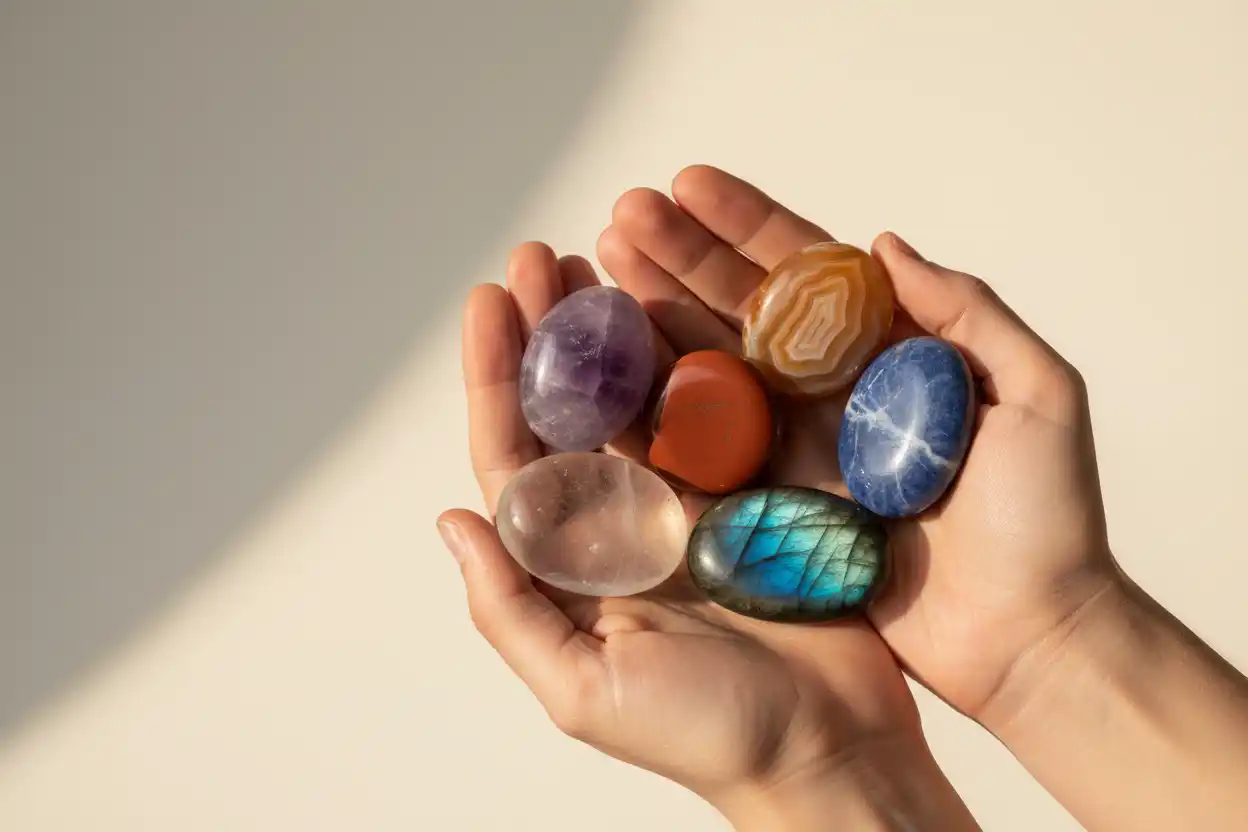
Palm Stones: Uses, Benefits and How to Choose
Palm stones are polished pieces of rock, mineral or gem material shaped to rest comfortably inside the hand. Most are oval, rounded or softly freeform, with enough width and thickness to create a noticeable tactile presence without becoming difficult to carry.
Their practical value comes from form rather than one particular mineral. A smooth stone can provide a stable focus during meditation, breathing exercises, journaling or an intentional pause. It may also function as a pocket object, desk accessory, gift or convenient way to appreciate a material’s pattern and polish.
Metaphysical traditions assign different meanings to the minerals used for palm stones. Those interpretations are personal or cultural rather than scientifically proven medical effects. Controlled research has not shown healing crystals to reduce anxiety through a mineral-specific mechanism beyond expectation and placebo-related responses.
The broader Crystal Shapes and Their Meanings guide owns comparisons among towers, spheres, points, hearts, pyramids and wands. This page focuses specifically on the palm-stone form, selection, use and safety.
Palm Stones at a Glance
| Feature | Typical palm stone |
|---|---|
| General shape | Oval, rounded rectangle or soft freeform |
| Common size | Large enough to fill part of the palm comfortably |
| Surface | Smooth and polished |
| Main practical use | Tactile focus, meditation, carrying and display |
| Main symbolic use | Intention setting based on the chosen material |
| Difference from a tumble | Usually larger, flatter and intentionally hand-filling |
| Difference from a worry stone | Usually lacks a carved thumb groove |
| Common materials | Quartz, Agate, Jasper, Calcite, Obsidian and feldspar varieties |
| Main quality factor | Comfortable shape without chips or sharp edges |
| Main buying concern | Accurate material identification and treatment |
| Main safety concern | Fragile, toxic, soluble or treated materials |
| Main care rule | Follow the requirements of the specific stone |
What Is a Palm Stone?
A palm stone is a lapidary form rather than a mineral species.
Cutters shape rough material into a smooth object that fits naturally in the hand. Most examples are flatter than spheres and larger than ordinary tumbled stones.
The shape allows patterns, inclusions and optical effects to spread across a broad polished face. Moss Agate may resemble a miniature landscape, Labradorite may reveal directional color, and Jasper may show broad scenic bands.
A seller may also use names such as hand stone, meditation stone, pocket stone or soap stone. These descriptions overlap, and no universal size standard controls the category.
Comfort and finish are therefore more useful than the label alone.
Palm Stones vs Tumbled Stones
The Tumbled Stones beginner’s guide owns the complete tumbling process and small-stone category.
Tumbled stones are commonly produced in batches inside rotating or vibratory equipment. Their final forms follow the original rough and may remain irregular.
Palm stones are generally larger and receive more deliberate shaping. They often have a broad face, rounded edge and flatter profile designed for the hand.
A large tumble can function as a palm stone, while a small polished oval may be sold under either name.
The practical difference lies in scale and ergonomics rather than spiritual strength.
Palm Stones vs Worry Stones
Worry Stones are usually small, flat polished stones with a concave thumb groove.
The indentation encourages repetitive rubbing with the thumb. Palm stones usually lack that carved depression and are held across more of the hand.
A worry stone suits discreet one-handed movement in a pocket. A palm stone provides greater weight, surface area and visual interest during meditation or desk use.
Neither form has been shown to medically treat anxiety.
A person may prefer one based on tactile comfort without assuming that the more elaborate shape has stronger energy.
Palm Stones vs Spheres
Crystal Spheres distribute pattern in every direction and roll unless placed in a stand.
Palm stones have flatter faces and remain stable on a table. They are easier to grip and less likely to fall from the hand.
Spheres often require more rough material and lapidary work, while palm stones can preserve flatter slabs or patterned sections efficiently.
The sphere carries symbolism involving unity and completeness. Palm stones are more closely associated with direct tactile use.
Those symbolic distinctions do not change the underlying mineral.
Palm Stones vs Hearts, Points and Wands
Crystal Hearts emphasize gifting and affection symbolism. Their cleft and point make them less uniformly comfortable for prolonged gripping.
Crystal Points direct attention toward a termination or carved tip. They may be natural or shaped, and their edges require more careful handling.
Crystal Wands are elongated tools associated with massage and energy practices. They can create concentrated physical pressure and should not be used to diagnose or treat injuries.
Palm stones have no directional point and distribute contact broadly across the hand, making them a simpler general-purpose shape.
How Palm Stones Are Made
The process begins with stable rough material or a slab thick enough to support the intended shape.
A cutter removes fractures, unstable edges and unwanted matrix, then grinds the material into an oval or freeform outline. Progressive abrasives smooth the surface before final polishing.
The exact process varies with hardness and sensitivity. Quartz-family materials tolerate different equipment from Calcite, Fluorite, Opal or resin-filled stone.
Pattern placement is important. A skilled cutter positions an inclusion, flash or band so it appears prominently across the broad face.
The final surface should feel continuous and should not conceal dangerous sharpness beneath wax or resin.
Choosing the Right Size
A useful palm stone should fit without forcing the fingers open uncomfortably.
Smaller examples suit pockets, travel and discreet one-handed use. Larger stones provide more weight and visual area but can strain the hand during prolonged holding.
Hand size does not determine one correct measurement. A stone that feels secure for one person may be awkward or heavy for another.
Before buying online, compare the stated dimensions with an object of similar size rather than relying on close photography.
Weight also matters. Hematite, Pyrite and dense materials feel substantially heavier than Quartz or Obsidian at the same dimensions.
Shape and Edge Quality
The best palm stone has smooth transitions without knife-like edges or abrupt corners.
A slightly domed top can feel more natural against the fingers, while a flatter underside allows the stone to rest on a desk.
Inspect the perimeter for chips, undercut fractures and areas where a soft mineral has crumbled during polishing.
Raw cavities and drusy sections can add visual interest but may catch clothing or scratch the skin.
A stone described as perfectly hand polished should not contain a sharp fracture merely because that edge is natural.
Polish Quality
Good polish reflects light evenly across the intended surface.
Cloudy areas can result from poor finishing, internal texture, soft inclusions or natural porosity. Not every matte patch is a defect, but the seller should show it clearly.
Quartz, Jasper and Agate can take strong polish. Calcite, Sodalite and some porous rocks may produce a softer luster.
Wax, oil and resin can temporarily intensify color or conceal scratches.
The finish should be evaluated in reflected light, where polishing lines, flat spots and filler become easier to see.
Common Palm-Stone Materials
Quartz, Amethyst, Rose Quartz, Smoky Quartz and Citrine are popular because they combine familiar colors with practical hardness.
Agate and Jasper provide banding, landscapes and broad pattern variation. Obsidian produces a glassy dark surface, while Labradorite can show directional flashes when cut correctly.
Sodalite, Lapis Lazuli, Calcite, Fluorite, Moonstone and Serpentine also appear frequently, although their durability and care needs differ.
The Crystal Meanings Chart provides quick symbolic context for common materials without implying that all polished stones behave alike.
Choosing by Material Rather Than Color Alone
Two blue palm stones may have completely different compositions.
Blue Calcite is soft and acid-sensitive. Sodalite can contain Calcite and Pyrite, while blue Agate may be natural, dyed or treated.
Likewise, a black palm stone might be Onyx, Obsidian, Tourmaline-rich rock, Jet, glass or resin.
Choose according to identity, durability and intended handling rather than selecting solely by color or metaphysical label.
The guide to How to Choose the Right Crystal for You can help organize visual, practical and symbolic preferences.
Using a Palm Stone for Meditation
Palm stones work well as tactile anchors in crystal meditation.
Sit comfortably and hold the stone without squeezing. Notice its weight, temperature, texture and shape while breathing normally.
When attention wanders, return to one physical characteristic instead of treating every sensation as a supernatural message.
A short session can end with one written observation or practical action.
The stone does not need to produce warmth, tingling or emotion to be useful. Absence of sensation does not indicate that the material is fake.
Using a Palm Stone for Grounding
Palm stones commonly appear in grounding-crystal practices.
A practical exercise places both feet on the floor and identifies the stone’s weight, the chair’s support and several visible objects in the room.
Next, identify one immediate need: water, food, rest, movement, information or contact with a supportive person.
The stone can help direct attention toward the present, but it does not biologically regulate the nervous system through mineral energy.
Persistent panic, dissociation or severe distress needs appropriate professional support.
Using a Palm Stone During Stress
Some people keep a palm stone on a desk or in a bag as a cue to pause before reacting.
The Crystals for Anxiety guide covers common symbolic choices while emphasizing evidence limits.
A useful routine holds the stone, names the concern in one sentence and separates what requires action from what requires waiting or additional information.
The tactile object may make the routine easier to remember. That does not establish a mineral-specific anxiety treatment.
A smooth stone should never replace prescribed medication, psychotherapy or urgent help.
Using a Palm Stone for Focus
A palm stone can mark the beginning of a defined work period.
Place it beside the keyboard, remove unnecessary notifications and choose one task. Move the stone to another location only after completing the planned interval.
This method connects the object with a visible behavioral sequence.
The Crystals for Focus guide compares traditional stone associations, but concentration also depends on sleep, health, stress and environment.
A polished mineral cannot compensate for persistent cognitive or medical problems that require assessment.
Using a Palm Stone for Journaling
The broad surface of a palm stone makes it an effective journaling cue.
Choose one question, hold the stone briefly and then write before editing the response. The ritual can help separate reflection time from ordinary distraction.
A material’s pattern may also provide a metaphor. Banded Agate can suggest layers, while Rutilated Quartz may represent intersecting priorities.
The metaphor belongs to the writer rather than the mineral.
A stone cannot retrieve suppressed memories accurately or prove that one interpretation of the past is correct.
Palm Stones and Sleep Routines
Palm stones appear in some crystal traditions for sleep.
A stone on a stable bedside surface can remind someone to dim lights, stop work, write down unfinished tasks and follow a consistent bedtime schedule.
Do not place a heavy stone, chipped material or loose jewelry beneath a pillow. Pressure and movement can damage both the person and the object.
The palm stone does not produce melatonin or treat insomnia, sleep apnea or nightmares.
Persistent sleep problems require appropriate medical evaluation.
Carrying a Palm Stone
A small palm stone can be carried in a padded pouch.
Loose storage with keys, coins and harder gemstones causes scratches and chips. Dust containing Quartz can also abrade softer materials.
The guide to How Many Crystals Can You Carry at Once? discusses practical weight, organization and symbolic overload.
Carry only what remains comfortable and safe. A pocket full of hard stones can damage a phone, while dense material can become inconvenient during movement.
Raw Pyrite, fibrous minerals and sharp fragments are poor pocket choices.
Using Palm Stones as Desk Objects
A palm stone can rest beside a computer, notebook or reading area.
Its stable shape makes it less likely to roll than a sphere. A soft pad prevents the polished underside from scratching furniture or being scratched by grit.
The object can mark breaks, focus intervals or the transition between tasks.
Placing a stone near electronics does not improve wireless signals, block electromagnetic fields or protect data.
Practical cable management, screen breaks and cybersecurity measures address those concerns more directly.
Palm Stones as Gifts
Palm stones are easy to gift because they require no ring size, chain length or piercing.
The Best Crystal Gifts for a Birthday provides occasion-based ideas.
Choose a material whose color and pattern suit the recipient rather than making strong claims about health, fertility, luck or emotional needs.
Include the mineral name, treatment disclosure and care instructions.
A pouch or stand can protect the polish and make the gift more usable.
Avoid giving fragile, toxic or shedding minerals to children or anyone likely to place the stone in the mouth.
Palm Stones for Beginners
The Best Crystals for Beginners guide offers broader starting choices.
Quartz, Agate and Jasper are practical palm-stone materials because they are widely available and reasonably durable.
Beginners should avoid purchasing only through dramatic rarity claims or promises that one stone will solve several personal problems.
A clearly identified, well-polished common material usually provides more value than an expensive trade name attached to an uncertain stone.
Start with one form that feels comfortable and learn its care before building a larger collection.
Treatments and Imitations
Palm stones may be dyed, coated, stabilized, resin-filled or reconstructed.
Agate, Howlite, Magnesite, Quartz-rich rocks and porous materials commonly receive color treatment. Glass and resin can imitate Obsidian, Quartz, Amber and included stones.
A uniform bright color concentrated inside fractures or around pits may suggest dye. Surface iridescence may come from coating rather than natural optical structure.
Treatment is acceptable when disclosed and priced appropriately.
Avoid destructive scratch, heat and chemical tests. They can damage the polish and create unsafe fragments.
Toxicity and Material Safety
Consult the Toxic Crystals safety list before using an unfamiliar material extensively.
A polished surface generally limits exposure, but damaged, powdery or fibrous specimens require additional caution.
Do not grind, lick or place palm stones in drinking water. Unknown dyes, fillers, surface contaminants and soluble minerals create avoidable risks.
Wash hands after handling arsenic-, lead-, mercury- or copper-bearing collector minerals, especially when surfaces shed.
Children and pets should not have unsupervised access to small or breakable stones.
Heating, Cooling and Massage Claims
Do not heat a palm stone in an oven, microwave, flame or boiling water.
Different minerals expand unevenly, while internal fractures, liquid inclusions, fillers and coatings may fail. A heated stone can also burn skin long after removal from the heat source.
Refrigerating porous or fractured material can introduce condensation and thermal shock.
A room-temperature palm stone may be moved gently over intact skin for relaxation, but it should not be used to press injuries, diagnose pain or replace trained massage or medical care.
The broader Crystal Wands guide owns elongated massage-tool considerations.
What Palm-Stone “Benefits” Can Realistically Mean
The most defensible benefits are practical and psychological.
The object can provide a tactile focus, create a repeatable ritual, support visual attention and help someone remember a chosen behavior. Its beauty may also make a desk, meditation area or collection more enjoyable.
Those effects do not prove that the stone emits healing energy.
Different minerals have different optical and physical properties, but no reliable evidence shows that one palm stone treats anxiety, pain, insomnia or disease more effectively than another through contact alone.
Personal meaning can remain valuable without becoming a medical claim.
Cleaning Palm Stones
There is no universal cleaning method for every palm stone.
Quartz, Agate and Jasper generally tolerate brief washing with mild soap and lukewarm water. Calcite, Fluorite, Selenite, Lapis Lazuli, Malachite, Pyrite and porous materials require more conservative care.
Use a soft dry or slightly damp cloth when identity or treatment is uncertain.
Avoid soaking, salt, acids, bleach, steam and ultrasonic equipment.
The How to Charge Crystals guide owns belief-based charging practices. Energetic ritual is separate from physical cleaning.
Storage and Damage
Store palm stones individually or with soft dividers.
Harder minerals can scratch softer ones, while sharp metal objects damage polished surfaces.
A stone that develops a chip may become uncomfortable or unsafe to hold. The guide to Why Did My Crystal Break? separates physical causes from spiritual interpretations.
Small edge damage can sometimes be repolished. A major fracture may make continued handling unsafe.
Do not glue a broken stone with unknown adhesive and then use it against the skin without understanding the product.
Frequently Asked Questions
1. What is a palm stone?
It is a smooth, polished stone shaped and sized to rest comfortably inside the hand.
2. How is a palm stone different from a tumbled stone?
Palm stones are generally larger, flatter and more deliberately shaped for holding.
3. How is it different from a worry stone?
A worry stone usually has a concave thumb groove, while a palm stone normally has a smooth uninterrupted surface.
4. Do palm stones have scientifically proven healing benefits?
No. They can support rituals and tactile focus, but mineral-specific medical effects have not been established.
5. Can a palm stone help with anxiety?
It may act as a grounding cue, but it does not treat an anxiety disorder and should not replace professional support.
6. What size should I choose?
Choose a stone that rests securely in the hand without forcing the fingers open or becoming tiring to hold.
7. Which materials are best for beginners?
Quartz, Agate and Jasper are widely available, reasonably durable and easy to maintain.
8. Can I sleep with a palm stone?
Keep it on a stable bedside surface rather than placing a heavy or breakable stone inside bedding.
9. Can palm stones be heated for massage?
Home heating is unsafe because stones, inclusions and treatments can fracture or retain enough heat to burn skin.
10. Can every palm stone go in water?
No. Solubility, porosity, dye, fillers and mineral composition vary substantially.
11. How should I carry one?
Use a soft pouch and keep it away from keys, coins and harder stones.
12. How should a palm stone be cleaned?
Follow the specific mineral’s care requirements. When uncertain, use a soft dry or slightly damp cloth.
Palm stones turn geology into a deliberately tactile object. Their broad polish and comfortable weight can make meditation, journaling or a short pause easier to structure. That usefulness comes from design, attention and repeated behavior—not from treating every sensation as evidence of invisible healing energy.
Palm-stone claims involving anxiety relief, pain treatment, sleep, chakra healing, protection and emotional recovery are cultural, spiritual or personal beliefs rather than scientifically established medical effects. Do not use a stone to replace healthcare, therapy, medication or emergency support.