

Grounding crystals are traditionally used as reminders to return attention to the body, immediate surroundings and practical next steps. They do not electrically ground the body or treat anxiety, dissociation or another health condition, yet their weight, texture and symbolism can complement evidence-based sensory and breathing techniques.
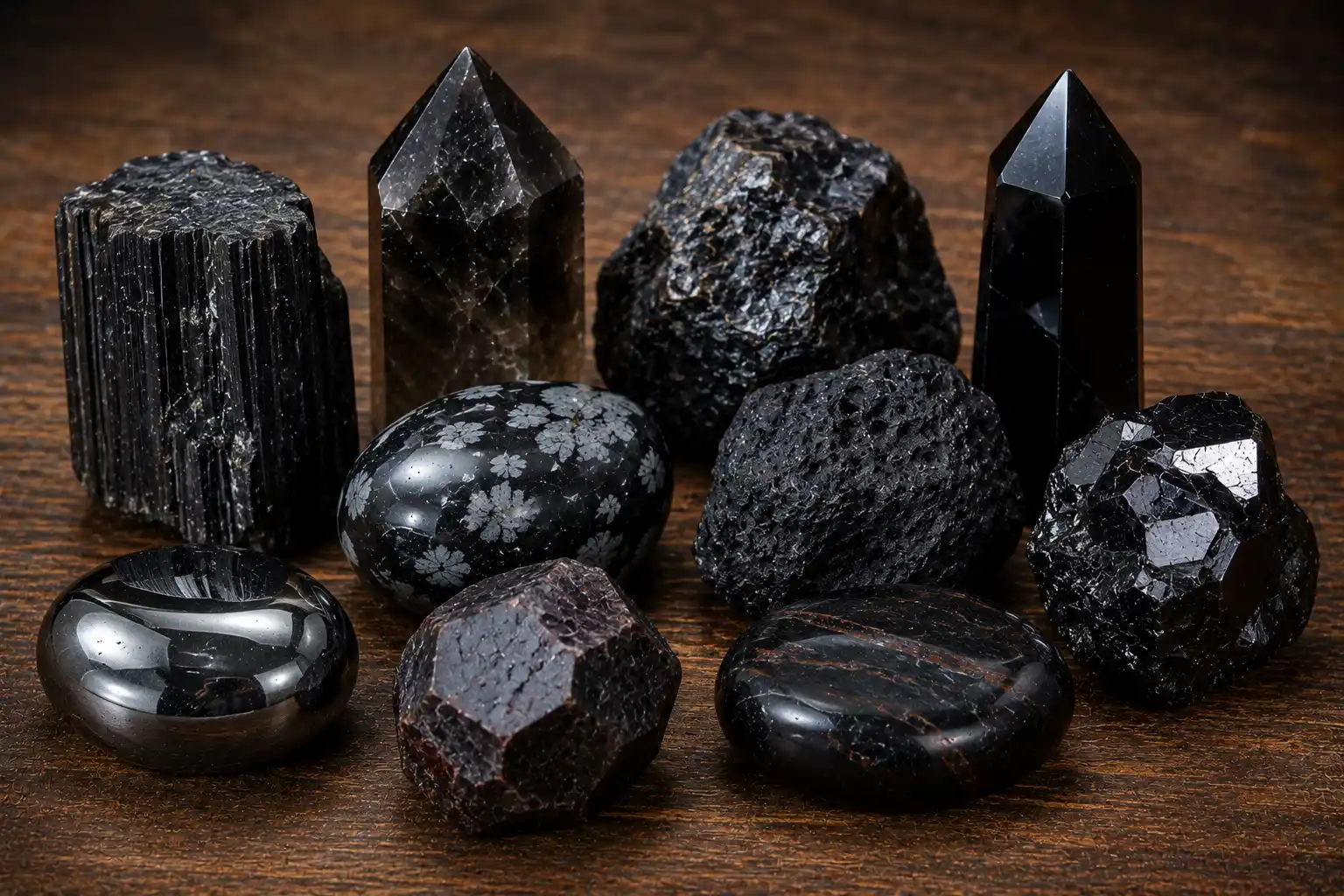
Smoky quartz is the most versatile all-purpose grounding stone, while black tourmaline suits boundaries and red jasper represents steady action. Black obsidian offers direct reflection, whereas moss agate brings a gentler connection with natural rhythms.
Top 10 Grounding Crystals at a Glance
| Rank | Crystal | Traditional grounding association | Best symbolic use |
|---|---|---|---|
| 1 | Smoky quartz | Release, perspective and present awareness | Returning to the immediate task |
| 2 | Black tourmaline | Grounding, boundaries and symbolic protection | Busy or emotionally demanding settings |
| 3 | Red jasper | Stability, endurance and embodied action | Sustained work and physical routines |
| 4 | Black obsidian | Truth, protection and pattern recognition | Focused self-reflection |
| 5 | Bloodstone | Vitality, courage and resilience | Steady action under pressure |
| 6 | Moss agate | Patience, growth and nature connection | Gentle everyday grounding |
| 7 | Tiger’s eye | Discernment, confidence and practical judgment | Decisions and problem-solving |
| 8 | Shungite | Earth connection and protection symbolism | Creating a defined grounding space |
| 9 | Snowflake obsidian | Balance and recognition of patterns | Integrating calm with honest reflection |
| 10 | Clear quartz | Intention and present focus | Structuring a grounding routine |
What Grounding Means
Grounding can refer to several different practices.
In mental-health and wellbeing contexts, grounding usually means directing attention toward the present environment through the senses, breathing, movement or factual observation. In spiritual traditions, grounding may refer to feeling connected with Earth, the physical body or stable personal energy.
Electrical grounding is a technical process involving conductive systems and safety standards. Carrying a crystal does not electrically ground a person or protect them from electrical hazards.
A responsible crystal practice should keep those meanings separate. The stone can provide a sensory object or spiritual symbol, while the actual grounding method involves attention and behavior.
1. Smoky Quartz for Returning to the Present
Smoky quartz is one of the most versatile grounding crystals. Its transparent brown-to-gray color connects it visually with earth and smoke, while traditional meanings emphasize release and practical perspective.
Use a smooth smoky quartz stone as part of a brief sensory exercise. Notice its temperature, weight, texture and visible inclusions. Then identify five details in the surrounding environment.
The purpose is not to transfer distress into the crystal. Instead, the object gives attention something concrete to observe.
Smoky quartz also suits task grounding. Write one immediate action, complete it and then reassess rather than attempting to solve every concern simultaneously.
2. Black Tourmaline for Boundaries
Black tourmaline is traditionally associated with grounding and protection. Its strongest practical use involves boundaries around time, attention and emotional capacity.
Before entering a demanding environment, define what support can realistically be offered and when the interaction needs to end. The stone can remain in a pocket or secure location as a reminder.
Black tourmaline does not create an invisible shield or prove that another person’s energy is harmful. Observable behavior should guide safety decisions.
The comparison of black tourmaline, obsidian and onyx explains why these similarly colored materials have different mineral structures and symbolic reputations.
3. Red Jasper for Embodied Action
Red jasper is traditionally associated with stability, endurance and physical presence. Its opaque red color also links it symbolically with the body and Earth.
Red jasper suits grounding routines that involve action rather than stillness. Carry it during a walk, place it near exercise equipment or use it while completing a repetitive practical task.
When thoughts feel scattered, ask what the body needs first: food, water, movement, rest, warmth or medical attention. Addressing a basic need may be more useful than continuing an abstract spiritual exercise.
Red jasper also appears in root chakra crystal practices, although chakra correspondences belong to spiritual traditions rather than anatomy.
4. Black Obsidian for Direct Reflection
Black obsidian is volcanic glass traditionally associated with truth, protection and confronting avoided patterns.
Because its symbolism can feel intense, obsidian is better suited to focused reflection than constant use for some people. Choose one question and set a time limit.
For example: What observable event triggered this response? Which part requires action now? What conclusion am I making without enough evidence?
Stop the practice if it increases distress or suspicion. Grounding should create more stability, not encourage fear about hidden energies or motives.
Broken obsidian can form extremely sharp edges. Inspect damaged pieces and handle them cautiously.
5. Bloodstone for Steady Courage
Bloodstone is traditionally associated with courage, resilience and vitality. Its dark green base with red inclusions makes it a strong visual symbol of steadiness under pressure.
Use bloodstone when grounding needs to lead into a difficult but necessary action. Examples include making a medical appointment, requesting clarification or addressing an overdue responsibility.
Begin with one sensory breath and one factual statement about the situation. Then identify the smallest action that moves the issue forward.
Bloodstone cannot increase physical stamina or treat circulation problems. Its role remains symbolic and behavioral.
6. Moss Agate for Gentle Grounding
Moss agate is traditionally connected with growth, patience and the natural world. It offers a gentler alternative to dark protective stones.
Its branch-like inclusions can support a nature-observation practice. Study one pattern in the stone, then notice shapes, colors and textures in the surrounding environment.
Moss agate also suits long-term routines. Place it near a plant, garden journal or habit tracker as a reminder that stability can develop gradually.
A grounding practice does not need to feel heavy or severe. For some people, quiet attention to ordinary natural details provides a more sustainable experience.
7. Tiger’s Eye for Practical Judgment
Tiger’s eye is traditionally associated with discernment, confidence and balanced decision-making. Its chatoyant band shifts as the stone moves, creating a useful symbol of examining more than one perspective.
When worry creates repeated indecision, write down the available evidence, realistic options and decision deadline. Distinguish choices that can be reversed from those that require greater caution.
Tiger’s eye can serve as a cue to complete the assessment rather than reopening it whenever discomfort returns.
This stone grounds through judgment rather than emotional suppression. It encourages action that remains connected with facts.
8. Shungite for an Earth-Connected Space
Shungite is a carbon-rich rock found primarily in Karelia, Russia. Modern crystal traditions often associate it with grounding, purification and protection.
Claims that ordinary shungite objects neutralize harmful electromagnetic radiation around a room or device are not established substitutes for engineering controls, product standards or professional safety advice.
A shungite stone can still mark a defined grounding area. Place it on a stable surface beside a chair, journal or breathing prompt.
Raw shungite may leave dark residue on hands and surfaces. Wash hands after handling dusty pieces and keep them away from food and drinking water.
9. Snowflake Obsidian for Balance and Pattern Recognition
Snowflake obsidian contains pale cristobalite patterns within dark volcanic glass. Its contrasting appearance is traditionally associated with balance and recognition of recurring patterns.
Use it when a situation contains both difficulty and useful information. Record what is uncomfortable, what remains stable and what repeated response may need adjustment.
This approach avoids false positivity. Grounding does not mean describing every situation as safe or beneficial; it means observing enough reality to choose the next appropriate step.
Like other obsidian varieties, damaged snowflake obsidian may produce sharp edges.
10. Clear Quartz for a Grounding Intention
Clear quartz is commonly used for intention-setting. Although it does not have the dark or earthy appearance of classic grounding stones, it can give a routine a clear structure.
Assign the crystal one instruction:
“Name five things I can see.”
“Put both feet on the floor.”
“Complete one immediate task.”
“Check whether I need food, water or rest.”
A precise cue is more useful than a vague intention to absorb all negative energy. The grounding occurs through the action connected with the stone.
Choosing a Grounding Crystal by Need
| Present need | Suitable crystals | Practical grounding action |
|---|---|---|
| Racing thoughts | Smoky quartz and clear quartz | Name visible objects and one immediate task |
| Weak personal boundaries | Black tourmaline and tiger’s eye | State a clear limit |
| Difficulty beginning | Red jasper and bloodstone | Complete one physical action |
| Emotional overstimulation | Moss agate and smoky quartz | Reduce input and observe the environment |
| Repeated indecision | Tiger’s eye and snowflake obsidian | Review evidence and set a decision time |
| Need for honest reflection | Black obsidian | Ask one focused factual question |
| Desire for nature connection | Moss agate and shungite | Spend time in a safe outdoor or plant-filled space |
| Spiritual root-chakra work | Red jasper and black tourmaline | Pair symbolism with body awareness |
A Five-Senses Grounding Practice with a Crystal
Hold a smooth, clean stone or place it safely within view. Then identify:
- Five things you can see
- Four things you can physically feel
- Three things you can hear
- Two things you can smell
- One thing you can taste or imagine tasting
Move slowly rather than trying to finish immediately. Describe concrete details such as color, temperature, pressure and distance.
The crystal is simply one of the sensory objects. If touching it feels unpleasant or distracting, set it aside and continue without it.
Grounding for Anxiety and Overstimulation
Grounding may help interrupt escalating attention, although it does not treat the cause of an anxiety disorder. Smoky quartz, moss agate and clear quartz can provide simple sensory cues.
The completed guide to crystals for anxiety addresses worry and stress-oriented routines more directly. Meanwhile, crystals for empaths and sensitive people discusses boundaries and recovery after demanding environments.
Persistent anxiety, panic, trauma responses or sensory distress deserve qualified support. A stone should complement, not replace, an appropriate care plan.
Grounding Versus Protection
Grounding brings attention toward the present body and environment. Protection practices typically focus on boundaries, safety or symbolic defense.
Black tourmaline and obsidian appear in both categories, but the intended behavior differs. For grounding, the stone prompts sensory awareness or practical action. For protection, it may remind someone to leave, decline access or seek help.
Avoid attributing all discomfort to negative energy. Check ordinary explanations such as noise, conflict, exhaustion, unsafe behavior or an unmet physical need.
Grounding and the Root Chakra
The root chakra, or Muladhara, is associated in several spiritual systems with stability, survival and connection with Earth. Red and black stones commonly appear in root-chakra practices.
The completed root chakra guide discusses the broader symbolism, while this article focuses on practical grounding across both spiritual and non-spiritual contexts.
Chakras are not anatomical structures recognized by modern medical science. Someone may value chakra symbolism while still using evidence-based healthcare.
A Grounding Crystal Set
Three stones are enough for most people. Choose one for sensory grounding, one for practical action and one for boundaries.
Smoky quartz, red jasper and black tourmaline form a balanced set. Smoky quartz supports present awareness, red jasper symbolizes action and black tourmaline reinforces limits.
For a gentler combination, moss agate, tiger’s eye and clear quartz provide nature connection, judgment and a defined cue.
Use each stone in a different location or context rather than assigning the complete set every possible purpose.
Wearing a Grounding Crystal
A bracelet, pendant or smooth pocket stone can create a portable tactile reminder. However, it should not become the only way someone feels capable of functioning.
Remove jewelry around machinery, sports equipment or tasks where it may catch. Likewise, stop wearing a piece if the metal, coating or cord irritates the skin.
Raw stones may have sharp surfaces or leave residue. A polished piece in a secure pocket is usually safer for repeated handling.
Grounding Crystals at Home
Place a stone where grounding is most often needed. Smoky quartz may sit near a work area, while black tourmaline can mark an entryway or boundary between work and rest.
Keep heavy specimens on stable surfaces. Never balance stones above beds, sofas or frequently occupied chairs.
The seasonal guide to crystals for autumn explores grounding and release through an earth-centered seasonal context without replacing year-round grounding practices.
Cleansing Grounding Crystals
Different stones tolerate different care. Shungite and pyrite-like materials may leave residue or react poorly to prolonged water exposure, while obsidian needs protection from edge damage.
The guide to cleansing crystals provides several symbolic methods. Sound, visualization and dry placement can refresh an intention without soaking the collection.
Physical cleanliness matters when a stone is handled frequently. Wipe compatible polished surfaces and wash hands after touching dusty or unidentified raw material.
When Grounding Is Not Enough
Grounding techniques may provide short-term support, but they cannot resolve every cause of distress. Seek professional help for severe anxiety, dissociation, trauma symptoms, fainting, neurological changes or persistent difficulty functioning.
Urgent medical assessment is important for sudden confusion, weakness, chest pain, breathing difficulty or other concerning physical symptoms. Do not assume such experiences are caused by spiritual imbalance.
A crystal can wait while immediate safety and healthcare take priority.
Conclusion
The best grounding crystals connect symbolism with present-moment behavior. Smoky quartz offers versatile sensory grounding, black tourmaline represents boundaries and red jasper encourages embodied action. Black obsidian supports focused reflection, while moss agate provides a gentler connection with nature and gradual stability.
No crystal electrically grounds the body or treats a medical condition. Its most useful role is to prompt observation, movement, breathing, practical decisions and appropriate support.
Frequently Asked Questions
1. What is the best overall crystal for grounding?
Smoky quartz is one of the most versatile choices because it symbolizes practical perspective and present awareness. Black tourmaline may be better when boundaries are the main concern.
2. Which grounding crystal is strongest?
“Strongest” is subjective. Black obsidian has intense reflective symbolism, while red jasper provides a steadier action-oriented theme.
3. Can crystals electrically ground the body?
No. Carrying or wearing a crystal is not equivalent to electrical grounding and provides no protection from electrical hazards.
4. Which crystal is best for anxiety grounding?
Smoky quartz and moss agate can provide sensory focal points. However, crystals do not treat anxiety disorders and should not replace appropriate care.
5. Is black tourmaline or smoky quartz better for grounding?
Black tourmaline suits boundaries and demanding environments. Smoky quartz is more adaptable for present awareness, task focus and decompression.
6. Can I combine grounding crystals?
Yes. A simple combination might include smoky quartz for awareness, red jasper for action and black tourmaline for boundaries.
7. Where should grounding crystals be placed?
Keep them near a work area, entryway or another location where a grounding routine occurs. Heavy and pointed stones require secure placement.
8. Can I sleep with a grounding crystal?
Use a stable bedside surface rather than placing loose stones in the bed. Heavy, sharp or brittle pieces may cause injury or interrupt sleep.
9. How do I use a grounding crystal during panic?
Use it only as one sensory object while noticing the environment and slowing breathing if that feels safe. Seek appropriate medical or psychological help for panic symptoms.
10. Are grounding crystals connected with the root chakra?
Many crystal traditions connect red and black stones with the root chakra. That association is spiritual symbolism rather than established anatomy.
11. How often should grounding crystals be cleansed?
There is no scientific schedule. Clean them physically when necessary and reset the symbolic intention whenever the associated routine changes.
12. Can grounding crystals stop dissociation?
No. They may function as optional sensory cues, but persistent or severe dissociation requires assessment and support from a qualified professional.
Disclaimer: Crystals are not medical or psychological treatments and do not electrically ground the body. Seek qualified care for persistent anxiety, dissociation, trauma symptoms, sudden neurological changes or other concerning symptoms.