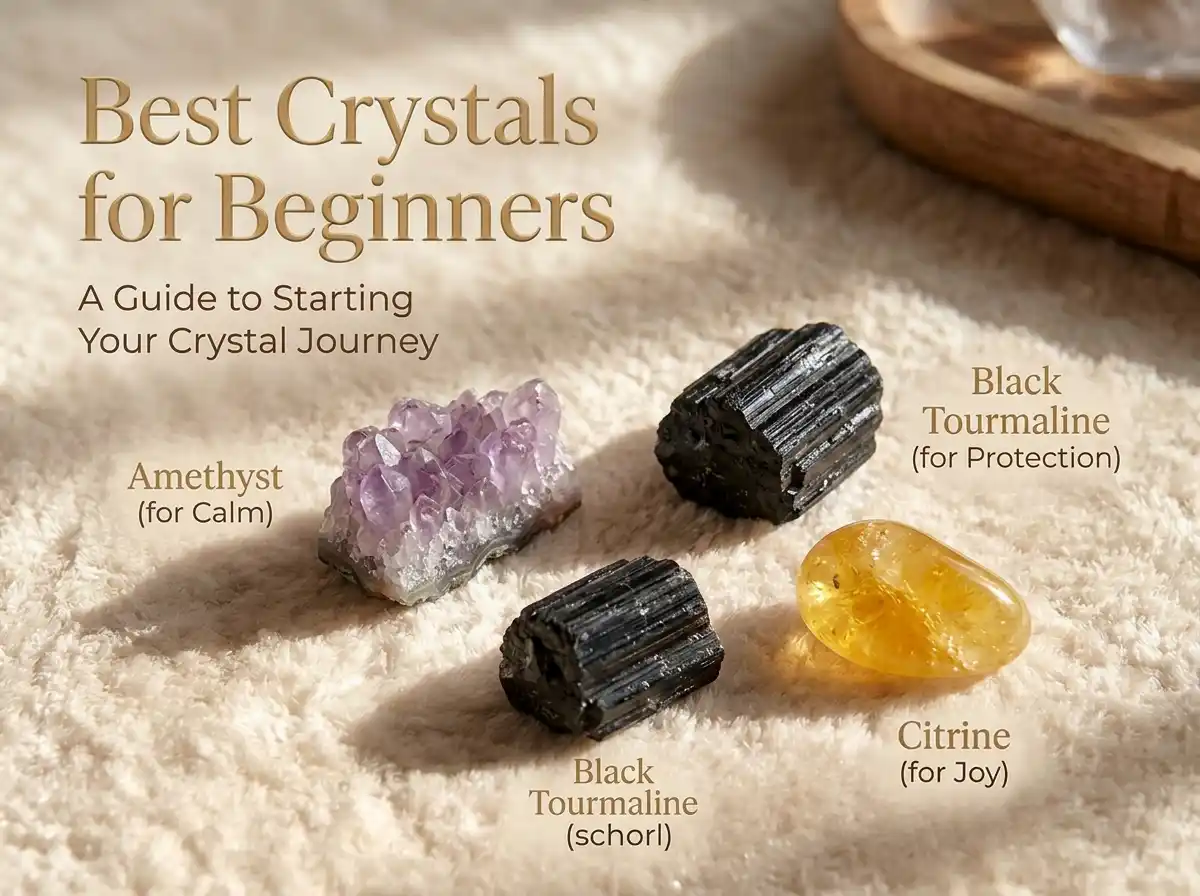
Best Crystals for Beginners: Where to Start
The best crystals for beginners are common, accurately identifiable, reasonably durable and easy to connect with a practical intention. Clear quartz, rose quartz, amethyst, smoky quartz, carnelian, agate, red jasper, aventurine, tiger’s eye and sodalite provide a useful range of colors and traditional meanings.
A beginner does not need a large set, rare specimen or complicated cleansing ritual. Starting with one to four stones creates enough variety to learn material identity, symbolism, care and personal preference without turning the collection into an expensive obligation.
Beginner Crystals at a Glance
| Crystal | Traditional theme | Why it suits beginners | Main care concern |
|---|---|---|---|
| Clear quartz | Clarity and defined intention | Common, visually varied and relatively durable | Points and internal fractures can chip |
| Rose quartz | Compassion and self-respect | Widely available in smooth forms | Glass and dyed imitations occur |
| Amethyst | Reflection and moderation | Recognizable purple quartz | Strong sunlight may fade color |
| Smoky quartz | Grounding and perspective | Durable quartz with neutral color | Natural versus treated color may be unclear |
| Carnelian | Creative action and confidence | Durable chalcedony and portable | Heating and dyeing occur |
| Agate | Stability and gradual development | Strong, patterned and widely available | Bright colors are often dyed |
| Red jasper | Endurance and practical stability | Opaque, durable and inexpensive | Trade names can be inconsistent |
| Aventurine | Opportunity and gradual growth | Durable quartz with reflective inclusions | Can be confused with aventurine glass |
| Tiger’s eye | Observation and practical confidence | Distinctive chatoyancy and useful durability | Treatment and imitation occur |
| Sodalite | Reason and communication | Recognizable blue-and-white appearance | Softer than quartz and confused with lapis |
| Hematite | Structure and practical attention | Distinctive metallic appearance and weight | Magnetic imitations are common |
| Moonstone | Transition and cycles | Teaches optical effects and careful handling | Feldspar cleavage |
What Makes a Crystal Beginner-Friendly?
A beginner-friendly stone should make learning easier rather than creating unnecessary risk.
Useful qualities include:
- Broad availability.
- Moderate price.
- Stable treatment.
- Recognizable appearance.
- Enough durability for careful handling.
- Simple storage requirements.
- Low chemical risk during normal intact use.
- Reliable educational information.
- Several common forms.
- A meaning that can be connected with ordinary behavior.
Rare, toxic, radioactive, fibrous, highly soluble or extremely fragile specimens can be interesting, but they do not belong in a first unsupervised collection.
The completed toxic-crystals safety list provides broader guidance for hazardous and metal-bearing minerals.
Start With One Intention, Not One Hundred Meanings
Crystal marketing often assigns long lists of benefits to every stone.
A beginner may then feel pressure to remember which crystal supposedly controls money, sleep, love, confidence, protection and health.
Instead, select one practical theme.
For example:
- Clear quartz for defining a goal.
- Rose quartz for practicing compassionate boundaries.
- Smoky quartz for returning attention to current conditions.
- Carnelian for beginning a project.
- Sodalite for checking facts before speaking.
The current crystal-meanings chart provides concise traditional themes without replacing the complete individual guides.
The stone does not cause the behavior. It marks the behavior you intend to practice.
Best Overall Beginner Crystal: Clear Quartz
The drafted clear quartz guide explains silicon dioxide, natural crystal habit and common inclusions.
Clear quartz works well for beginners because it can be transparent, cloudy, included, tumbled, carved or naturally pointed.
These variations teach an important lesson: natural does not always mean flawless.
Veils, fractures, mineral needles, growth lines and contact marks can all occur.
A small clear quartz point can represent one defined goal, while a smooth adult palm stone suits tactile reflection.
Modern crystal practice often calls quartz an amplifier. Reliable evidence does not show that it increases another stone’s healing force.
Rose Quartz for Compassion and Boundaries
Rose quartz is pink quartz traditionally associated with compassion, affection and self-respect.
It is widely available as tumbles, hearts, palm stones, beads and carvings.
Natural rose quartz is usually cloudy or translucent.
Perfectly clear vivid-pink pieces may be glass, synthetic material or another gemstone.
A beginner can connect rose quartz with a statement such as:
“I can care about someone without accepting harmful behavior.”
That interpretation avoids claims that the stone attracts a soulmate or guarantees reconciliation.
Amethyst for Reflection
The drafted amethyst guide covers purple quartz, color zoning and treatment.
Amethyst is recognizable, affordable in many sizes and hard enough for careful daily handling.
A small piece can represent pausing before reacting.
Natural color often varies within one stone, particularly in cluster points and carved pieces.
Heat treatment can turn amethyst yellow or orange, producing much commercial citrine.
Prolonged intense sunlight may fade the purple color.
Amethyst does not treat anxiety, addiction, insomnia or neurological conditions.
Smoky Quartz for Grounding
Smoky quartz ranges from pale gray-brown to very dark brown.
It symbolizes grounding, perspective and returning attention to immediate reality.
A beginner can use a smooth smoky quartz stone during a simple orientation practice:
- Notice the surroundings.
- Identify the immediate task.
- Separate current facts from future predictions.
- Complete one physical next step.
The stone’s color may result from natural or artificial irradiation.
This distinction can be difficult to establish visually.
Smoky quartz does not absorb stress, radiation or toxins physically.
Carnelian for Beginning
The drafted carnelian guide explains orange-to-red chalcedony.
Carnelian traditionally represents creative action, confidence and initiative.
Its microcrystalline quartz structure provides useful durability.
A beginner can place it beside a project and connect it with the first action rather than a vague wish for motivation.
Color may be improved through heating, and some commercial material is dyed.
Treatment should be disclosed when known.
Carnelian cannot increase physical energy, metabolism or courage medically.
Agate for Learning Patterns
Agate is chalcedony with banding or other organized patterns.
It suits beginners because varieties are widely available and often visually distinctive.
Agate teaches several useful buying lessons:
- Trade names can be inconsistent.
- Color may be natural or dyed.
- One specimen can look different on every side.
- Pattern often matters more than transparency.
- Similar materials may be marketed under broad agate labels.
Bright neon blue, pink, purple and green pieces are often treated.
Treatment does not make an object unusable, but it should not be hidden.
Red Jasper for Practical Stability
Red jasper is opaque microcrystalline quartz traditionally associated with stability and endurance.
Its durability and accessible price make it suitable for palm stones, beads and small carvings.
A beginner can connect red jasper with maintaining one realistic routine.
For example:
“Complete the planned task at a sustainable pace.”
Jasper names are frequently based on appearance or commercial preference rather than strict mineralogical categories.
Ask for the actual material and avoid paying large premiums for fashionable trade names alone.
Aventurine for Natural Versus Manufactured Material
Aventurine is quartz containing reflective mineral inclusions.
Green aventurine is the best-known variety.
Its symbolism involves opportunity and willingness to try again.
Manufactured aventurine glass contains bright metallic-looking particles and may be sold under similar names.
Comparing the natural stone with the glass product teaches beginners that manufactured material is not automatically inferior, but it must be represented honestly.
Natural aventurine commonly shows a subtler sparkle and uneven inclusion distribution.
Tiger’s Eye for Optical Effects
Tiger’s eye is chatoyant quartz.
A bright band moves across the polished surface as the stone turns.
This effect provides an accessible introduction to optical phenomena caused by oriented internal structures.
Traditional meanings include observation, practical confidence and risk awareness.
A beginner might use it before a purchase or decision by reviewing benefit, cost and consequences.
Tiger’s eye cannot predict danger or guarantee financial success.
Heat treatment and glass imitations occur.
Sodalite for Material Comparison
Sodalite is a blue feldspathoid mineral frequently marked by white calcite.
It traditionally symbolizes reason, evidence and communication.
The stone teaches beginners not to identify a material by color alone.
Sodalite may be confused with lapis lazuli, dyed howlite, blue glass and other materials.
Natural lapis commonly contains lazurite with variable calcite and pyrite, while sodalite usually lacks the characteristic golden pyrite pattern.
Sodalite is softer than quartz and should remain separate from harder stones during storage.
A Four-Stone Beginner Set
A simple starter set can cover four distinct functions:
| Crystal | Beginner role |
|---|---|
| Clear quartz | Define one intention |
| Rose quartz | Practice care with boundaries |
| Smoky quartz | Return attention to practical conditions |
| Carnelian | Begin the next action |
The sequence becomes:
Define → Consider → Ground → Act
A second set could replace rose quartz with sodalite when evidence and communication matter more than relationship symbolism.
Avoid buying a kit containing twenty stones with no reliable identification or care information.
Choosing the First Crystal Shape
The drafted crystal-shapes guide compares points, spheres, towers, hearts, eggs and other forms.
For a beginner:
- A tumbled stone is portable and inexpensive.
- An adult palm stone is comfortable to handle.
- A natural point teaches crystal growth.
- A tower stands vertically but has a fragile tip.
- A heart adds gift and relationship symbolism.
- A sphere displays patterns from every angle but requires a fitted stand.
- A cluster preserves natural intergrowth but may be sharp and fragile.
The best shape depends on use and safety, not supposed energy strength.
How to Use a First Crystal
A beginner does not need a complex ritual.
Try one of four simple approaches.
Visual Reminder
Place the stone beside a written goal or routine.
Journal Prompt
Choose one question connected with the stone’s traditional meaning.
Adult Tactile Focus
Hold a smooth stone while observing breathing and physical surroundings.
Safe Display
Label the mineral and note where it came from, whether it was treated and how it should be cared for.
The crystal does not need to be carried continuously.
Leaving it at home does not remove your ability to complete the behavior it represents.
Spiritual Cleansing Versus Physical Cleaning
Physical cleaning removes dust, oil and residue.
Spiritual cleansing is a symbolic practice intended to reset the object’s meaning.
They are not the same process.
The completed guide to cleansing crystals explains low-risk options.
Sound, visualization and rewriting an intention avoid unnecessary water, salt, smoke and sunlight.
A crystal does not become dangerous or spiritually contaminated because another person touched it.
Clean it physically only when necessary and use a method safe for the exact material.
Water Safety for Beginners
Do not assume every crystal can be soaked.
Gypsum, calcite, halite, pyrite, porous turquoise, glued objects and many composites require special caution.
Even water-resistant quartz may be attached to metal, cord or adhesive that reacts poorly to moisture.
Never place crystals in drinking water.
Minerals can carry contamination, treatments, metal-bearing inclusions or small fragments.
Indirect symbolic methods are simpler and safer than making crystal elixirs.
Sunlight Safety
Some stones fade with prolonged intense light.
Amethyst, rose quartz, fluorite and several treated materials may lose color.
Transparent spheres and curved polished forms can also focus sunlight and create heat or fire risk.
The completed guide to crystals that fade in sunlight explains common concerns.
A shaded shelf with indirect light is safer than a sunny window.
Moonlight is not required to “charge” a stone and outdoor overnight exposure introduces moisture, loss and animal disturbance.
Hardness and Toughness
The completed gemstone-hardness chart compares scratch resistance.
The guide to gemstone toughness versus hardness explains resistance to breaking.
These properties are different.
Quartz ranks 7 and resists many scratches, but it can still fracture.
Jade has lower hardness than sapphire yet exceptional toughness.
Topaz ranks 8 but has perfect cleavage.
Learning both concepts prevents the common mistake of treating a Mohs number as a complete durability score.
Buying a First Crystal
The completed guide to buying gemstones online provides detailed seller and image checks.
For a first purchase, ask:
- What is the exact material?
- Is it natural, laboratory-grown, glass, resin or composite?
- Has it been dyed, coated, heated or filled?
- What are its dimensions and weight?
- Is the photograph of the exact item?
- Does it stand safely?
- Are repairs disclosed?
- What is the return policy?
- What care does it require?
Avoid sellers who answer material questions only with spiritual descriptions.
“High vibration” is not an identification.
How to Check Whether a Crystal Is Real
The completed crystal-identification guide provides a structured non-destructive approach.
Begin with appearance, luster, transparency, pattern, inclusions and seller information.
Bubbles may suggest glass, while mould seams may indicate resin.
Dye often collects in fractures and porous areas.
However, no single clue proves every material.
Do not scratch, burn, dissolve or strike a finished stone.
Professional testing may be necessary when identity has significant financial importance.
Setting a Beginner Budget
A first crystal does not need to be expensive.
Common tumbles and small palm stones are usually sufficient for learning.
Set a total budget before browsing.
Include storage, stands and jewelry metal—not only the stone.
Avoid paying high prices because a seller claims the object is rare, activated or personally chosen by destiny.
The emotional meaning of a stone does not establish its market value.
A modest accurately identified piece is more educational than an expensive mystery material.
Storage
Store stones separately when hardness differs.
Quartz can scratch fluorite, calcite, gypsum and many organic gems.
Protect points, tower tips and heart carvings from impact.
Spheres need fitted stands or padded boxes.
Keep labels with the pieces.
A simple compartment box and handwritten inventory provide enough organization for a small collection.
Do not leave loose stones in beds, bags with electronics, children’s areas or pet-accessible spaces.
Common Beginner Mistakes
Buying Too Many Stones
A large collection makes identification and care harder.
Choosing by Color Alone
Several natural and manufactured materials can share the same color.
Using Water Universally
Some minerals dissolve, oxidize, flake or react.
Believing Every Marketing Claim
Spiritual descriptions do not prove origin, rarity or medical benefit.
Ignoring Shape Safety
Spheres roll, points puncture and heavy objects fall.
Treating the Crystal as a Requirement
A personal routine should still work when the object is unavailable.
Using Crystals Instead of Professional Support
Stones cannot replace healthcare, safety measures, financial advice or relationship boundaries.
Building a Collection Intentionally
Add a new stone only when it teaches something different.
One might demonstrate a natural crystal habit.
Another could show banding, chatoyancy, cleavage or a multi-mineral rock.
Record:
- Material.
- Locality, when supported.
- Natural or manufactured status.
- Treatment.
- Purchase date.
- Price.
- Care.
- Personal meaning.
This approach turns a decorative collection into an educational one.
Frequently Asked Questions
1. What is the best crystal for a complete beginner?
Clear quartz is a flexible starting point because it is common, relatively durable and available in several natural and polished forms.
2. How many crystals should a beginner buy?
One to four stones are enough to learn meanings, care and personal preferences.
3. What is a good beginner crystal set?
Clear quartz, rose quartz, smoky quartz and carnelian provide clarity, compassion, grounding and action symbolism.
4. Should a beginner choose raw or polished crystals?
Polished stones are easier to handle, while raw pieces teach natural texture and crystal habit. Either can work when safe.
5. Do beginners need to cleanse crystals?
No. Spiritual cleansing is optional. Physical cleaning should occur only when needed and must suit the exact material.
6. Can all beginner crystals go in water?
No. Water safety depends on the mineral, treatment, matrix, glue and metal components.
7. Can beginners leave crystals in sunlight?
Not universally. Some stones fade, while clear spheres and curved objects can focus heat.
8. How can a beginner tell whether a crystal is real?
Check exact material disclosure, pattern, bubbles, dye, mould seams and seller evidence. Important pieces may need professional testing.
9. Are crystal kits worth buying?
They can be useful when every stone is accurately labelled and care information is included. Avoid unidentified bulk sets.
10. Which beginner crystals are relatively durable?
Quartz, agate, jasper, aventurine and tiger’s eye generally tolerate careful handling better than fluorite, calcite or gypsum.
11. Do crystals need to touch the body to work symbolically?
No. A stone can function as a reminder on a desk, shelf or journal space.
12. Do beginner crystals have scientifically proven healing effects?
No. Their healing, chakra, protection and prosperity meanings reflect cultural and spiritual traditions rather than established effects.
Learn the Material Before Expanding the Collection
A first crystal should create curiosity rather than pressure. One accurately identified stone can teach more than a large collection whose names, treatments and care remain uncertain.
Begin with a practical meaning, learn the material’s physical properties and observe whether the object supports a useful routine. Add another stone only when it contributes a new lesson, appearance or function.
Disclaimer: Crystal healing, chakra, protection and manifestation meanings reflect cultural and spiritual traditions rather than established medical, psychological or financial effects. Crystals should not replace healthcare, professional advice, safety measures or practical action, and small, sharp, toxic or heavy specimens must be stored securely.