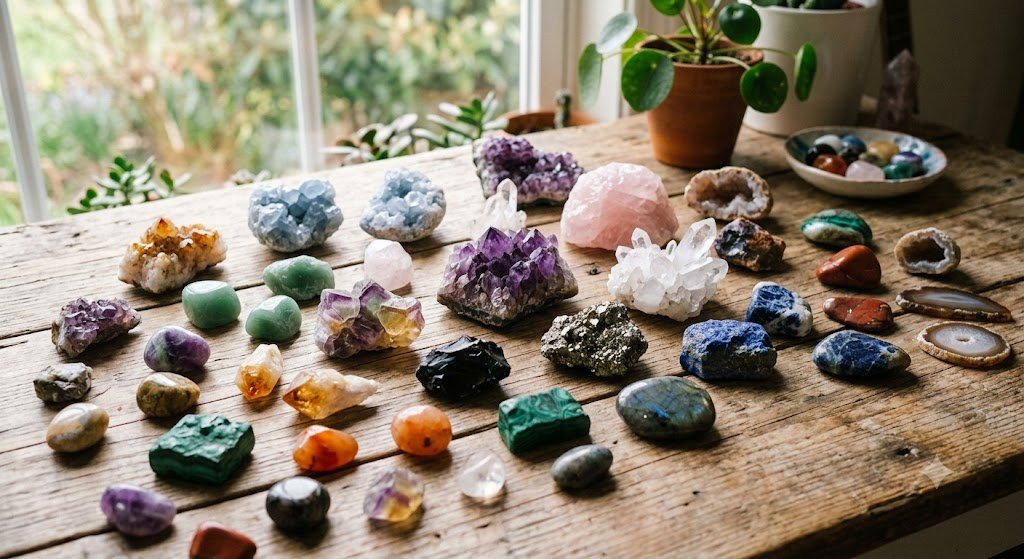
How to Identify Crystals: A Beginner’s Guide
Crystal identification works best as a process of elimination rather than a single decisive test. Begin with non-destructive observations such as color, luster, transparency, crystal form, inclusions, weight, and existing fracture surfaces. Then compare several properties before assigning a mineral name.
Color alone rarely identifies a crystal. Purple material may be Amethyst, Fluorite, glass, dyed Quartz, Lepidolite, Charoite, or another mineral. Likewise, a blue stone could be Sodalite, Lapis Lazuli, Turquoise, Azurite, dyed Howlite, glass, or a manufactured composite.
A confident identification should explain several independent observations at once.
Identification, Treatment Detection, and Authentication Are Different Tasks
Crystal identification answers: What material is this?
Treatment detection asks whether people changed the color, clarity, durability, or surface after formation.
Authentication determines whether an item matches the identity and origin claimed by the seller. It may distinguish natural material from laboratory-grown material, imitation glass, plastic, reconstructed stone, or another natural mineral sold under the wrong name.
These questions overlap, but they should not be collapsed into one home test.
Added-color indicators belong to How to Spot Dyed Crystals. Broader marketplace authenticity belongs to How to Spot Fake Crystals.
When a laboratory has examined the stone, How to Read a Gem Lab Report explains how to interpret the identification, treatment, origin, and limitation statements.
Start by Recording What You Actually Know
Before guessing a mineral name, document the object.
Record where it came from, whether it was sold as rough or polished, its approximate dimensions, weight, color, transparency, surface texture, and any label supplied by the seller.
Photograph the front, back, edges, drill holes, broken areas, matrix, and any part where the color or polish changes.
Keep the original invoice, packaging, listing screenshots, and seller description. Provenance does not prove identity, but it can reveal whether the object was sold as natural, treated, synthetic, imitation, or merely decorative.
Separate observation from interpretation in your notes. “Dark-blue stone with white veins” is an observation. “Lapis Lazuli” is a proposed identification.
A Beginner’s Identification Toolkit
Most initial observations require only simple equipment.
| Tool | Useful purpose | Main limitation |
|---|---|---|
| Neutral daylight-equivalent lamp | Comparing color and transparency | Does not establish composition |
| White and black backgrounds | Revealing edges, zoning, and translucency | Reflections can alter apparent color |
| 10× loupe | Viewing inclusions, bubbles, fractures, dye, and polish | Requires practice and good lighting |
| Millimeter ruler or caliper | Recording dimensions | Measurements do not identify a mineral alone |
| Digital scale | Comparing weight and calculating density when appropriate | Mounted and porous objects complicate results |
| Small flashlight | Checking transparency, color zoning, and internal features | Strong light may exaggerate thin areas |
| Weak magnet | Detecting an obvious magnetic response | Many minerals respond weakly or not at all |
| Longwave ultraviolet lamp | Observing fluorescence | Fluorescence is not unique to one mineral |
| Notebook and camera | Preserving observations | Quality depends on consistent documentation |
A refractometer, polariscope, dichroscope, spectroscope, microscope, hydrostatic balance, and advanced laboratory instruments extend identification substantially, but they require training and material-specific interpretation.
Step 1: Observe the Color Without Trusting It
Color is useful for narrowing possibilities but usually weak as a final identifier.
Examine the object under neutral lighting rather than a warm household bulb, colored LED, or direct sunset light. Compare it against white and black backgrounds.
Note the hue, tone, saturation, zoning, patches, bands, veins, and whether color changes near the surface.
Ask whether the color follows crystal-growth zones, mineral bands, fractures, cavities, drill holes, or worn edges.
Natural color may be uniform, strongly zoned, patchy, banded, or concentrated around inclusions. Artificial dye may also create several patterns, so no single color distribution proves treatment.
A stone that looks different between daylight and incandescent light may be pleochroic, color changing, fluorescent, coated, or simply affected by the light source.
Step 2: Identify the Luster
Luster describes how the surface reflects light.
A vitreous luster resembles glass and occurs in Quartz, Beryl, Tourmaline, Topaz, Corundum, and many other gems.
A metallic luster occurs in minerals such as Pyrite, Hematite, and Galena. Pearly luster may appear along cleavage surfaces in Moonstone, some Mica minerals, and related materials.
Waxy, greasy, resinous, silky, dull, and adamantine surfaces provide additional clues.
Luster must be judged on a clean, reasonably smooth surface. Weathering, oil, wax, resin, scratches, and poor polishing may disguise the natural appearance.
A glassy luster does not prove that an object is glass. Many natural minerals are vitreous.
Step 3: Examine Transparency and Light Transmission
Classify the object as transparent, translucent, or opaque, but inspect thin edges as well as the thick center.
Some materials that appear opaque in a large carving transmit light along their edges. This can be useful for Jade, Chalcedony, Turquoise, Lapis Lazuli, Obsidian, and many ornamental rocks.
Use a small flashlight from behind and move it slowly.
Observe whether light passes evenly, follows bands, reveals internal clouds, or stops at a backing layer.
Do not confuse a dark body color with true opacity. Likewise, a thin glass object may transmit more light than a thicker natural gemstone of the same apparent color.
Step 4: Examine Crystal Form and Growth Habit
Rough crystals may retain recognizable external forms.
Quartz commonly develops six-sided prisms ending in pyramidal faces. Fluorite frequently forms cubes or octahedra. Garnet often forms dodecahedral or trapezohedral crystals, while Pyrite commonly forms striated cubes and pyritohedra.
Calcite may form rhombohedra, scalenohedra, and many additional habits. Tourmaline commonly forms elongated striated prisms.
However, crystal form is not always preserved. Tumbled stones, cabochons, carvings, beads, and broken fragments may show no diagnostic external habit.
Manufactured glass can also be molded into crystal-like shapes. Therefore, a familiar outline should support an identification rather than decide it alone.
The spiritual interpretation of carved forms belongs separately to Crystal Shapes and Their Meanings; carving shape is not mineral identity.
Step 5: Use Magnification
A 10× loupe is one of the most useful beginner tools.
Clean the outside gently before examination so fingerprints and lint do not resemble inclusions. Hold the loupe close to your eye and bring the object toward it until the image becomes sharp.
Look for:
- Natural mineral crystals enclosed inside the host
- Needles, clouds, liquid films, healed fractures, and growth zoning
- Round gas bubbles, mold seams, or flow lines associated with some glass
- Dye concentrated inside cracks, pores, cavities, or drill holes
- Coatings peeling near edges
- Glue layers, backing, assembled sections, or reconstructed fragments
- Abraded facet edges or unusually soft surface wear
- Natural matrix entering the stone rather than sitting only on the surface
No inclusion type proves natural origin in every case. Laboratory-grown gems can contain characteristic inclusions, and natural gems may appear exceptionally clean.
Use magnification to build a pattern of evidence rather than searching for one mythical giveaway.
Step 6: Compare Heft and Density
Two objects of similar size may feel very different in the hand because their densities differ.
Amber and many plastics feel light. Hematite, Galena, Zircon, and some metallic minerals feel unusually heavy for their dimensions. Quartz and glass may overlap enough that hand-heft cannot separate them reliably.
For loose, solid specimens, hydrostatic weighing can estimate specific gravity by comparing weight in air with apparent weight in water. However, porous, water-sensitive, strung, treated, matrix-supported, glued, or assembled objects should not be immersed.
Density narrows possibilities but rarely identifies a stone alone. Several unrelated materials share overlapping specific-gravity ranges.
Step 7: Observe Existing Fracture and Cleavage Surfaces
Do not break a crystal to examine its interior.
Instead, inspect existing chips, natural breaks, and rough surfaces.
Conchoidal fracture produces curved shell-like breaks and appears in Quartz, Obsidian, glass, and many other brittle materials.
Cleavage creates breaks along structural planes. Fluorite may cleave into octahedral forms, Calcite into rhombohedra, and Topaz along a strong basal plane.
The complete structural distinction belongs to Gemstone Cleavage Explained.
Cleavage should never be tested by striking a valued object. A correct identification that destroys the specimen is not a useful result.
Step 8: Treat Hardness as a Range, Not a Scratch Challenge
Mohs hardness compares resistance to scratching.
The Gemstone Hardness Chart helps compare mineral ranges, but casual scratch testing causes avoidable damage.
Do not scratch a polished crystal, finished jewel, antique object, suspected treatment, coated surface, or valuable specimen.
A steel tool may scratch more than one candidate. Surface weathering may be softer than the fresh mineral beneath it. Aggregates can behave differently from their individual components.
Hardness testing is most appropriate on an unimportant rough fragment with a fresh hidden surface and correctly identified reference points.
Even then, confirm the result with other properties.
Hardness also does not equal toughness. The difference is explained in Gemstone Toughness vs Hardness.
Step 9: Use Streak Only on Appropriate Rough Minerals
Streak is the color of a mineral’s powder when rubbed across an unglazed porcelain plate.
It is useful mainly for opaque minerals softer than the streak plate. Hematite, for example, can produce a reddish-brown streak even when the specimen looks metallic gray.
Streak is usually unsuitable for transparent gemstones, polished cabochons, beads, carvings, jewelry, or valuable crystals.
Hard minerals may scratch the plate instead of producing powder. Dyed surfaces and mixed rocks may also create misleading results.
Never perform a streak test merely because a social-media checklist recommends it.
Step 10: Check Magnetism Carefully
A magnet can provide a useful clue for certain materials.
Magnetite responds strongly. Some Hematite, Garnet, Pyrrhotite, and iron-bearing minerals may show weaker responses.
Manufactured magnetic beads sold as Hematite can react much more strongly than typical natural Hematite.
Test with the object resting on a soft surface. Move a small magnet nearby rather than allowing it to snap against the specimen.
Magnetic response is not unique enough to establish identity by itself. Metal settings, clasps, internal pins, and contamination can affect the result.
Step 11: Observe Fluorescence Without Treating It as Proof
Some minerals emit visible light under ultraviolet radiation.
Ruby may fluoresce red. Fluorite can show several colors. Calcite, Scheelite, Hackmanite, Opal, Diamond, and many other materials may fluoresce or phosphoresce.
Treatments, fillers, glue, oil, resin, and laboratory-grown material can also produce fluorescence.
Record the ultraviolet wavelength, fluorescence color, intensity, distribution, and whether the response follows the entire object or only fractures and adhesive.
Use ultraviolet equipment designed for gem examination, protect the eyes and skin, and avoid staring directly into the lamp.
Fluorescence supports an identification but rarely proves one.
Step 12: Recognize Optical Effects
Some gems display effects that sharply narrow the possibilities.
Chatoyancy creates a moving cat’s-eye band. Asterism produces a star. Adularescence creates Moonstone’s floating glow, while labradorescence creates Labradorite’s colored flash.
Aventurescence comes from reflective inclusions. Play-of-color is characteristic of precious Opal. Pleochroism causes different colors in different crystal directions, while birefringence may create visible doubling in Zircon and some other stones.
Observe the effect while rotating the object under a small light source.
The effect’s direction, sharpness, color, and relationship to the cut can be more informative than body color alone.
Imitations can reproduce some visual effects, so additional testing remains necessary.
Step 13: Understand Standard Gemological Instruments
Professional gemologists combine observations rather than relying on one reading.
A refractometer measures refractive index and may reveal birefringence. A polariscope helps determine whether a transparent stone is singly refractive, doubly refractive, aggregate, or anomalous.
A dichroscope can reveal pleochroism. A handheld spectroscope may show absorption features associated with particular coloring elements.
Specific gravity, fluorescence, magnification, and controlled lighting provide further evidence.
Advanced laboratories may use Raman spectroscopy, infrared spectroscopy, ultraviolet-visible-near-infrared spectroscopy, X-ray fluorescence, chemical analysis, and imaging methods.
These techniques can distinguish natural from laboratory-grown material, identify treatments, and determine composition where basic testing remains inconclusive.
What a Beginner Can and Cannot Conclude
| Observation | Reasonable conclusion | Conclusion to avoid |
|---|---|---|
| Round bubbles in a transparent object | Glass becomes a possibility | Every bubble proves glass |
| Color in drill holes | Dye becomes a strong possibility | The entire object is fake |
| Strong magnetic response in “Hematite” beads | Manufactured magnetic material is possible | Magnetism proves natural Hematite |
| Six-sided prismatic rough crystal | Quartz, Beryl, Apatite, Tourmaline, or another candidate | Every six-sided crystal is Quartz |
| Red fluorescence | Ruby or another fluorescent material becomes possible | Fluorescence proves Ruby |
| Surface scratches from steel | Material may be relatively soft | One scratch identifies the exact mineral |
| High apparent weight | Dense minerals become more likely | Heft establishes composition |
| No visible inclusions | Clean natural, synthetic, glass, or another material remain possible | A flawless stone must be fake |
Good identification language includes uncertainty: “consistent with Quartz,” “likely dyed Chalcedony,” or “requires laboratory confirmation.”
Common Identification Mistakes
The most common mistake is naming a crystal from color alone.
Another is trusting a seller’s label as evidence. Labels can be copied, simplified, outdated, or deliberately misleading.
Many beginners also use destructive tests too early. Scratch, streak, acid, flame, hot-needle, saltwater, and impact tests can permanently damage natural material without producing a conclusive result.
A further mistake involves treating every inclusion as proof of natural origin. Both natural and laboratory-grown gems can contain inclusions, while glass and composite material may contain bubbles, particles, and flow features.
Finally, many people confuse treatment with imitation. A heated natural Sapphire remains natural Sapphire. Dyed Howlite remains Howlite, although it should be disclosed as dyed. Laboratory-grown Sapphire is genuine corundum made in a laboratory. Blue glass sold as Sapphire is an imitation.
Material-Specific Identification Requires Dedicated Workflows
A general process narrows possibilities, but valuable materials need dedicated comparisons.
The Real vs Fake Amber guide focuses on natural resin, pressed material, Copal, plastic, and treatment.
Real vs Fake Amethyst addresses Quartz structure, glass, synthetic material, color zoning, and treatment.
Real vs. Fake Citrine separates natural Citrine from heated Amethyst, irradiated Quartz, glass, and misleading trade descriptions.
Real vs Fake Lapis Lazuli covers natural multi-mineral rock, dye, reconstructed material, glass, ceramic, and painted imitations.
Real vs. Fake Turquoise distinguishes genuine Turquoise from dyed Howlite, Magnesite, block material, glass, and composites.
Real vs Fake Moldavite focuses on natural impact glass versus manufactured green glass.
Real vs. Fake Jade addresses Jadeite, Nephrite, treatment grades, serpentine, Quartz, glass, and polymer-supported material.
Real vs Fake Sapphire separates natural, laboratory-grown, treated, filled, glass, and other blue stones.
Real vs Fake Ruby owns natural-versus-laboratory-grown Corundum, glass-filled Ruby, glass, and red simulants.
Real vs. Fake Opal covers solid Opal, doublets, triplets, synthetic Opal, glass, and plastic imitations.
When to Request a Laboratory Report
Home observation is often sufficient for an inexpensive decorative stone when the owner only needs a likely material family.
Professional testing becomes appropriate when identity affects substantial value, insurance, resale, treatment disclosure, geographic origin, repair decisions, or a legal transaction.
A report should be issued by a laboratory with suitable colored-stone expertise and verifiable report records.
The comparison among laboratories belongs to Gemstone Certification Labs Compared.
A report normally provides a conclusion rather than every raw observation. It may identify the material, state whether it is natural or laboratory-grown, list detectable treatments, and provide origin when the laboratory offers that service and evidence is sufficient.
Frequently Asked Questions
1. What is the easiest way to identify an unknown crystal?
Begin with color, luster, transparency, crystal form, magnification, existing fracture surfaces, and weight. Compare several properties rather than trusting one observation.
2. Can crystal color identify a mineral?
Color narrows possibilities but rarely proves identity because many unrelated minerals, treatments, and imitations share similar colors.
3. Should I scratch a crystal to test it?
Do not scratch finished, polished, valuable, treated, or mounted material. Hardness tests belong only on expendable rough areas when genuinely necessary.
4. Do bubbles always mean a crystal is glass?
No. Round isolated bubbles may support a glass identification, but natural and laboratory-grown materials can also contain rounded inclusions.
5. Can a phone app identify crystals accurately?
An image app may suggest visual matches, but it cannot reliably measure composition, refractive index, density, treatment, or natural-versus-synthetic origin.
6. Can ultraviolet light identify a gemstone?
Fluorescence can narrow possibilities, but many minerals, treatments, fillers, and synthetic materials share overlapping responses.
7. What does a 10× loupe reveal?
It can reveal inclusions, bubbles, dye concentrations, fracture filling, coatings, glue, surface wear, drill-hole features, and growth structures.
8. Can magnetism identify Hematite?
Magnetism provides a clue, but strongly magnetic beads sold as Hematite are often manufactured materials. Additional testing is necessary.
9. Is a flawless crystal automatically fake?
No. Some natural gems are clean, some synthetic gems contain inclusions, and glass can contain bubbles or debris.
10. What is the difference between a synthetic crystal and a fake crystal?
A synthetic gem has essentially the same composition and structure as its natural counterpart but was made in a laboratory. An imitation only resembles another gem.
11. When should I send a crystal to a laboratory?
Use a reputable laboratory when identity, treatment, origin, insurance, resale, or purchase value justifies professional testing.
12. Can one home test prove a crystal is real?
Rarely. Reliable conclusions usually require several consistent properties and, for valuable stones, professional instruments.
Conclusion
Crystal identification becomes more accurate when observation replaces guessing. Record what you see, examine the object under magnification, compare several independent physical and optical properties, and avoid destructive shortcuts. A beginner does not need to name every specimen immediately; recognizing when the evidence remains incomplete is itself an essential identification skill.