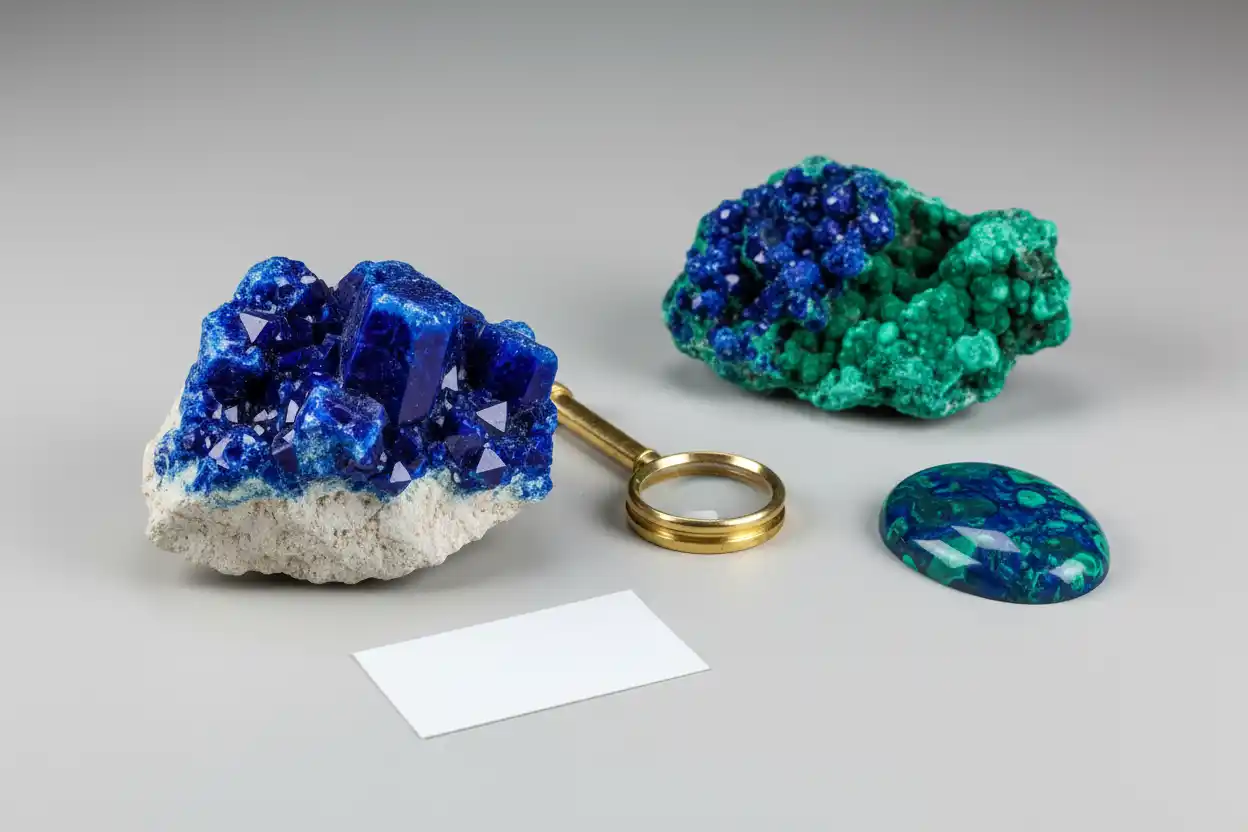
Where to Buy Real Azurite: Trusted Sellers and Fake-Spotting Tips
Real azurite is readily available as mineral specimens, mixed azurite-malachite material, cabochons, beads, carvings and occasional jewelry. However, a vivid blue color alone does not confirm that a listing contains well-identified azurite. Dyed carbonate, reconstituted material, blue glass, resin, mislabeled sodalite and heavily repaired specimens can all enter the same retail market.
A good purchase begins with the mineral’s limitations. Azurite is a copper carbonate hydroxide with a Mohs hardness of approximately 3.5 to 4, distinct cleavage and brittle tenacity. Although its rich blue color makes it visually compelling, those properties also make it vulnerable to scratches, impact, acids, prolonged moisture and careless cleaning.
The azurite meaning and properties guide covers the mineral’s identity, formation and traditional symbolism. This buying guide instead concentrates on seller selection, condition, authenticity, treatment disclosure and choosing the right form for your intended use.
Choose the Right Kind of Azurite
Azurite products cannot all be evaluated in the same way. A collector specimen should preserve natural crystal form and reliable locality information, whereas a cabochon should be judged for stability, polish and disclosure of mixed minerals or resin.
| Azurite product | Best buying source | Main risk to investigate |
|---|---|---|
| Fine crystal specimen | Established mineral dealer or specialist mineral show | Repairs, reattached crystals, incorrect locality and concealed damage |
| Azurite with malachite | Mineral dealer or experienced lapidary supplier | Misleading percentages, dye, unstable matrix and undisclosed filling |
| Rough or slab | Lapidary supplier | Hidden fractures, low usable yield and temporary oil enhancement |
| Cabochon | Lapidary artist or gem dealer | Resin impregnation, backing, dye and uneven durability |
| Beads or carving | Established bead or crystal retailer | Reconstituted material, dyed stone, filled pits and weak drill holes |
| Jewelry | Jeweler familiar with soft collector gems | Fragile setting, glue, surface coating and unrealistic wear claims |
Collectors should prioritize exact-item photographs and labels. Jewelry buyers, meanwhile, should place more weight on protective construction and treatment disclosure than on locality prestige.
Where to Buy Genuine Azurite
Specialist mineral dealers
A reputable mineral dealer is normally the best source for individual crystals, rosettes, nodules and documented azurite-malachite specimens. The dealer should provide the specimen’s dimensions, weight, locality, condition and repair history.
Strong listings show the front, rear, base and both sides. Additionally, close-up photographs should reveal terminations, cleavage breaks, matrix contacts and areas where adhesive might have been applied. A rotating video under neutral light is especially valuable because azurite can look nearly black in one photograph and electric blue in another.
Ask whether the locality information came from an original collection label, a trusted supplier or visual assumption. Classic localities can add value, but color and crystal habit rarely prove origin without documentation.
Gem and mineral shows
Shows let you compare several grades in person. Under a loupe, you can examine crystal edges, matrix stability, repairs and the transition between blue azurite and green malachite. Moving the specimen beneath a focused lamp also reveals whether the color belongs to the mineral or comes from a superficial coating.
Do not scratch, streak or apply acid to a seller’s specimen. Instead, ask how the dealer identified it and whether any analytical work accompanies an expensive or unusual piece. The crystal identification guide explains which observations are useful without damaging the material.
Established online mineral shops
Online shops are suitable when the seller has a traceable business identity, clear policies and exact-item images. Check whether the listing uses actual dimensions rather than only weight, since dense mineral specimens can look much larger in tightly cropped photographs.
The online gemstone buying guide explains payment protection, return windows and seller verification. For azurite specifically, make sure the seller discusses repairs, loose crystals and shipping precautions instead of describing only color and metaphysical associations.
Lapidary suppliers
Lapidary sellers are the most useful source for slabs, rough, calibrated cabochons and cutting material. Good suppliers disclose whether a slab was photographed wet, oiled temporarily for photography, permanently stabilized or treated with resin.
Because azurite often occurs with malachite, chrysocolla, cuprite and host rock, the seller should not imply that a multi-mineral slab is pure azurite. Mixed material can be natural and beautiful, but the description should match the actual composition.
Jewelry specialists
Azurite jewelry requires a seller who understands low durability. Pendants, earrings, brooches and protected beads are more practical than exposed everyday rings. A jeweler should explain whether the stone is solid, backed, assembled or adhesive-set.
Avoid sellers who promise that an azurite ring will tolerate constant handwashing, household cleaners and gym wear. A protective bezel can reduce edge damage, although no setting can make azurite as durable as sapphire or quartz.
What Natural Azurite Looks Like
Azurite is famous for dark azure, royal-blue and deep blue-black coloration. Transparent areas can appear brighter, while thick crystals may look almost opaque. Natural specimens may form prismatic crystals, tabular crystals, rosettes, blades, nodules, crusts, stalactitic forms or earthy masses.
The mineral frequently occurs with malachite because both form in oxidized copper deposits. Blue and green zones may intergrow, follow fractures or form layered patterns. For a focused comparison, the malachite versus azurite guide explains how the two copper carbonates differ.
Magnification may reveal natural growth lines, cleavage, small edge contacts, matrix grains and irregular color distribution. In contrast, resin casts can contain round bubbles, mold seams and repeated forms. Dyed material may show blue concentrations in fractures, pits and drill holes.
Not every irregularity is proof of authenticity. Natural azurite may be polished, stabilized, repaired or combined with another material, so the buyer must evaluate both mineral identity and construction.
Azurite Versus Malachite
Azurite and malachite are closely associated copper minerals, yet they are not interchangeable. Azurite provides blue coloration, whereas malachite is green and commonly shows banding, botryoidal growth or fibrous texture.
Natural azurite can gradually alter to malachite under environmental conditions. Consequently, some specimens contain green surfaces, replacement zones or mixed blue-green areas. That alteration is not necessarily a treatment or fake.
However, a seller should distinguish an azurite-dominant specimen from malachite with minor azurite. If the value depends on vivid azurite crystals, ask for close-ups showing how much of the display face is actually blue mineral.
Azurite Versus Sodalite
Massive azurite can be confused with sodalite in low-quality listings because both may appear deep blue with pale matrix. Nevertheless, sodalite is a different silicate mineral and commonly shows white veining rather than green malachite association.
Azurite tends to have greater density, a different luster and copper-mineral associations. Even so, photographs may not provide enough evidence for polished or opaque material. The sodalite versus azurite comparison keeps that identification question separate from this seller-focused guide.
Do not rely on acid testing at home. Acids can damage azurite and release copper-bearing residues while providing less certainty than proper instrumental analysis.
Common Fakes and Misrepresented Products
Dyed howlite, magnesite or carbonate
Pale porous minerals can absorb strong blue dye. Color often gathers in surface pores, fractures and drill holes, producing an unnatural web of intense blue. However, dyed stones can be coated afterward, making the concentration less obvious.
Reconstituted azurite
Small particles or fragments may be mixed with resin and molded into beads, carvings or cabochons. Reconstituted material can contain real azurite, but it is not equivalent to a solid natural piece. Under magnification, it may show crushed grains, resin boundaries, bubbles and an unusually uniform texture.
Blue glass and resin
Glass imitations can show rounded bubbles, flow features and a homogenous body. Resin may feel relatively light, develop surface scratches quickly or reveal mold seams. Hand feel alone is not diagnostic, so use it only as supporting evidence.
Painted or coated rock
Some inexpensive decorative objects use blue paint or pigmented resin over ordinary stone. Look around pits, edges and the underside for areas where the coating becomes thin or changes color.
Misidentified lapis lazuli or sodalite
Dark blue opaque stones sometimes receive whichever name appears more marketable. Azurite does not normally show the pyrite grains associated with many lapis products, although a lack of pyrite does not prove azurite.
Repaired and assembled specimens
Natural azurite crystals can be reattached to matrix, grouped into an artificial cluster or mounted on a fabricated base. Repair is not inherently unacceptable, especially for fragile collector material, but it must be disclosed.
The fake-crystal buyer’s guide provides a broader framework for detecting coatings, glass, resin, assembly and misleading labels.
Treatments and Enhancement
Azurite may be stabilized with resin, fracture-filled, backed, waxed, oiled or coated. Stabilization can help porous material survive cutting, while a backing can support a thin cabochon. These treatments may be practical, but they alter durability, value and cleaning requirements.
Temporary oil or water may also be applied to rough material before photography. This treatment darkens the surface and increases color contrast without permanently improving the stone. Therefore, request dry photographs before buying slabs or rough.
A seller should specify whether treatment is limited to the surface or penetrates the material. The gemstone treatments guide explains the difference between accepted treatment, enhancement and undisclosed composite construction.
How to Judge an Azurite Crystal Specimen
Start with crystal quality. Well-formed crystals with strong luster, recognizable terminations and an attractive arrangement normally command more interest than a larger but heavily damaged mass.
Next, inspect condition. Minor contact points may reflect how the specimen grew or was removed from the matrix. In contrast, fresh white breaks, crushed edges, glued terminations and unstable crystals should influence the price.
The matrix should support the specimen securely. A heavy azurite cluster attached to a thin or crumbly base may fail during transport. Ask whether the base has been stabilized and whether any crystals move when the box is handled.
Color matters, although photographs often exaggerate it. Request images under neutral daylight, indirect indoor light and a focused lamp. A stone that looks bright blue only under intense illumination may appear much darker in ordinary display conditions.
Finally, evaluate composition and balance. A specimen with contrasting malachite may be more visually appealing than pure azurite, while collectors seeking a particular crystal habit may prefer minimal associated minerals.
How to Judge Polished Azurite-Malachite
Cabochons and carvings are usually multi-mineral materials. Look for a stable polish, pleasing distribution of blue and green, and no large open fractures. Small pits can occur because minerals and host rock polish at different rates, but thick glossy filling should be disclosed.
Inspect the back and sides. A dark backing, resin layer or glued support may improve stability while also changing the apparent depth of color. Consequently, ask whether the piece is solid, backed or a doublet.
Drill holes deserve particular attention in beads. Radiating fractures, loose grains and concentrated dye near holes indicate weakness or treatment. Beads should not shed blue powder during normal handling.
Locality and Provenance Claims
Azurite occurs in oxidized zones of copper deposits worldwide. Material from Arizona, Utah, New Mexico, Morocco, Namibia, Mexico, Australia, France, China and several other regions circulates through the collector market.
Nevertheless, visual appearance cannot reliably prove a country or mine. A dealer should provide an original label, previous collection record or credible supply-chain information when locality adds a premium.
Be cautious with broad claims such as “Bisbee azurite” or “old-stock Tsumeb” when the seller offers no supporting label. Historic mining districts can produce highly desirable specimens, which also makes their names attractive for inaccurate marketing.
Price and Value Factors
Azurite value depends on crystal form, luster, color, condition, specimen composition, size, locality, provenance, repair history and overall aesthetics. A small crystal with exceptional form and documentation can be worth more than a large polished mass.
For cabochons, value reflects the pattern, percentage of visible azurite, structural stability, polish and craftsmanship. In jewelry, the metal, setting quality and designer’s work may contribute more to price than the stone itself.
Avoid arbitrary labels such as “AAA,” “museum grade” or “investment crystal” unless the seller explains the grading criteria. The gemstone pricing guide shows how observable quality, rarity, treatment and market demand interact.
Seller Questions Worth Asking
Before purchasing a meaningful azurite piece, ask whether the photographs show the exact specimen and request its dimensions, weight and locality. Confirm whether any crystal has been reattached, whether the matrix has been stabilized and whether resin, wax, oil, dye or coating is present.
For polished material, ask whether it is solid or backed and which minerals appear alongside the azurite. For jewelry, determine how the stone is secured and whether the design is suitable only for occasional wear.
Finally, request the inspection period and return conditions in writing. A seller’s willingness to answer these questions is often more informative than a decorative authenticity certificate created by the shop itself.
Professional Identification
A qualified gemologist or mineral laboratory may use microscopy, refractive-index testing where possible, specific-gravity measurements, Raman spectroscopy or X-ray diffraction. Mixed specimens can require analysis of several points because one test may identify the matrix rather than the blue mineral.
Professional testing becomes worthwhile for high-priced cabochons, disputed locality specimens, historically important pieces and items represented as untreated solid azurite. An ordinary appraisal without mineralogical testing does not necessarily confirm species.
Shipping and Returns
Azurite specimens should be immobilized inside a rigid inner container. Packing material must support the matrix without pressing against delicate crystals, and the inner box should sit inside a cushioned outer shipping carton.
Large polished objects require separate wrapping because harder items can scratch them. Jewelry should not move freely against metal chains or clasps during transport.
For valuable purchases, choose tracking and insurance. Photograph the parcel, packaging and specimen during opening so that transit damage can be documented accurately.
Responsible Sourcing
Ask whether the seller can name the country, district or mine and whether the material entered the market through established mineral channels. Mine-level traceability is not always realistic for inexpensive polished pieces, but sellers should avoid unsupported claims about artisanal partnerships or direct sourcing.
The ethical crystal sourcing guide explains how to evaluate labor, environmental and provenance claims without treating vague assurances as proof.
Cleaning and Storage
Do not expose azurite to acids, vinegar, chemical cleaners, salt solutions, steam or ultrasonic cleaning. Prolonged water exposure can damage some specimens, particularly those with porous matrix, resin, repairs or mixed copper minerals.
Start specimen cleaning with a hand air blower or a very soft dry brush. If a polished piece is known to be untreated and structurally sound, a barely damp soft cloth may be appropriate, followed by immediate drying. However, the dedicated water-safety guide should be consulted before using water routinely.
The planned ultrasonic-cleaner guide addresses why vibration can worsen cleavage, fractures and repairs. For traditional nonphysical practices, the azurite cleansing and charging guide keeps symbolic methods separate from material care.
Store azurite in a padded box away from harder gems. Support specimens from the base and never lift a cluster by its crystals.
Buy the Specimen You Can Verify
A dependable azurite listing identifies the mineral, shows the entire specimen, discloses repairs and treatments, explains the locality claim and allows inspection after delivery. Those factors matter more than exaggerated saturation or spiritual marketing.
The A crystal directory, A gemstone directory and gemstone types guide provide additional context for comparing azurite with other blue minerals. Ultimately, the best purchase is a piece whose condition and construction remain clear after the dramatic photographs are set aside.
Frequently Asked Questions
1. Is azurite commonly faked?
Common azurite is not usually worth producing as a sophisticated synthetic crystal. More realistic problems include dyed stone, resin, reconstituted material, incorrect mineral names and natural specimens with undisclosed repairs.
2. How can I tell whether blue stone is azurite or sodalite?
Azurite often occurs with copper minerals such as malachite and may show crystal forms or dense blue masses. Sodalite commonly has pale veining and a different mineral structure. Professional analysis is safer than destructive home testing.
3. Is azurite with malachite genuine?
Yes. The two minerals frequently form together in oxidized copper deposits. A mixed blue-green specimen can be completely natural, although repairs and stabilization should still be disclosed.
4. Does green color mean an azurite specimen is deteriorating?
Green areas may represent natural malachite association or alteration of azurite to malachite. The change does not automatically mean the specimen is currently unstable, but humidity and chemical exposure should be controlled.
5. Can real azurite contain resin?
Yes. Natural azurite rough or cabochons may be resin-stabilized or fracture-filled. The stone remains natural in origin, but the treatment must be disclosed.
6. Is polished azurite usually pure?
No. Much polished material contains malachite, host rock and other copper minerals. Ask the seller to describe the complete material rather than assuming the entire object is azurite.
7. Is azurite suitable for an everyday ring?
Generally, no. Its low hardness, brittle tenacity and cleavage make it vulnerable to scratching and impact. Pendants, earrings and protected occasional-wear pieces are more practical.
8. Can I test azurite with vinegar?
Do not use vinegar or other acids. They can damage carbonate minerals, alter the surface and create copper-bearing residues without providing a complete identification.
9. Does a repaired crystal specimen have value?
Yes, especially when the repair is limited, stable and fully disclosed. However, the price should reflect the location and extent of the repair.
10. What photographs should an online seller provide?
Look for neutral-light images of the front, back, base, sides, crystal terminations and repaired areas, plus a rotating video and a size reference.
11. Is an authenticity certificate necessary?
A store-created certificate adds little unless it identifies the testing method and responsible laboratory. For ordinary specimens, reliable provenance and disclosure are usually more useful.
12. What is the strongest red flag in an azurite listing?
Be cautious when a seller claims a famous locality, perfect condition and untreated material but provides only saturated front-facing photographs, no condition report and no return policy.
Safety note: Azurite contains copper. Do not ingest it, place it in drinking water, lick it or use it to prepare crystal elixirs. Avoid generating dust through cutting, sanding or grinding, and use professional lapidary controls when working the material.