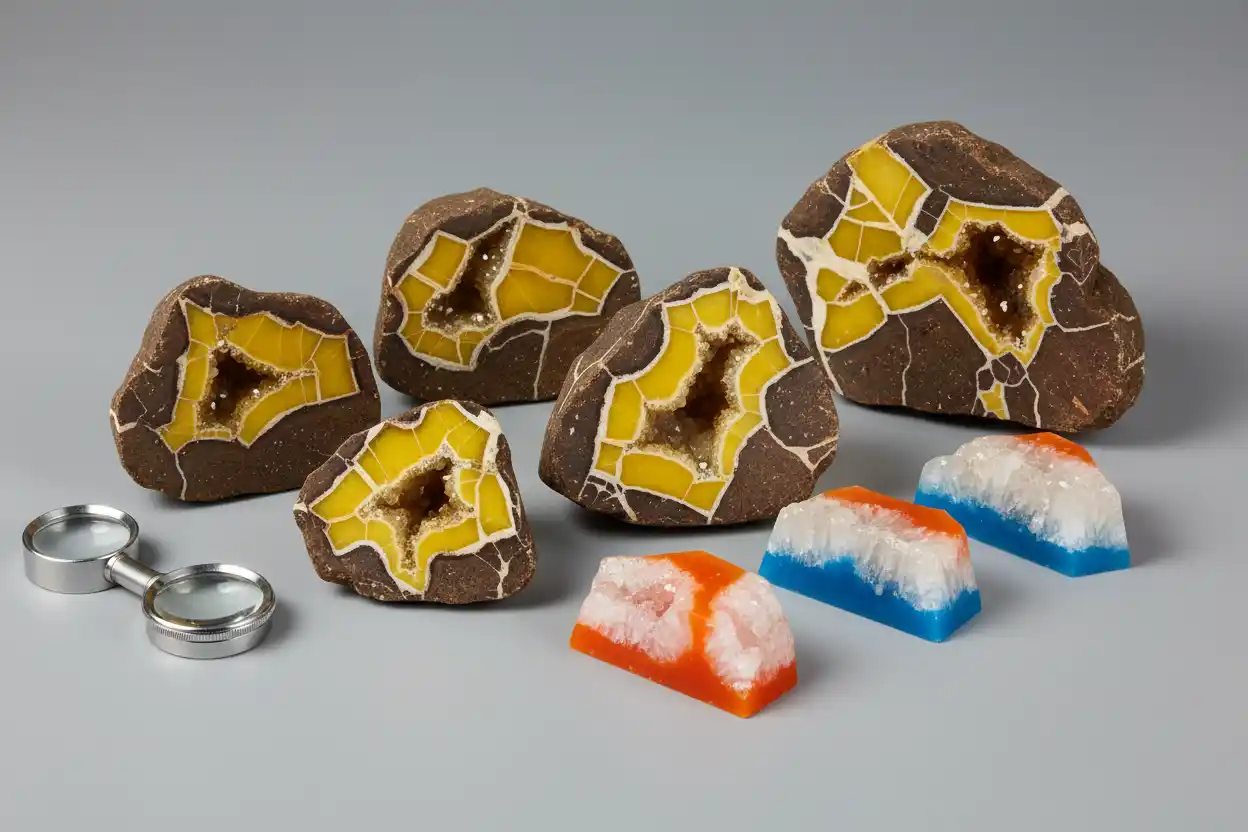
Where to Buy Real Septarian and Avoid Dyed or Resin Fakes
Real Septarian is a cracked concretion or nodule formed within sedimentary rock. Its distinctive internal pattern consists of polygonal sections divided by mineral-filled fractures called septaria.
Commercial Septarian commonly combines brown or gray mudstone with yellow, honey or cream Calcite, pale Aragonite and occasional Siderite, Barite, Quartz or other mineral phases. The exact composition varies with locality.
Cut and polished nodules may resemble turtle shells, dragon skin, lightning, stained glass or cracked earth. Those patterns are natural geological structures rather than painted designs.
However, the market also contains ordinary concrete-like rock with artificial grooves, dyed Calcite, resin-filled cracks, joined nodule halves, molded composites and unrelated brecciated stone sold as Septarian. The Septarian meaning and properties guide covers formation and traditional symbolism. This page focuses on authentic crack geometry, sellers, composition, treatment, locality and lapidary quality.
Septarian Is a Rock, Not One Mineral
Septarian is a multi-mineral geological structure rather than an approved mineral species.
The nodule’s host is commonly mudstone, claystone, shale-rich material or another fine-grained sedimentary concretion.
Its cracks may be filled by:
- Calcite
- Aragonite
- Siderite
- Barite
- Quartz or Chalcedony
- Iron oxides
- Other local cements
The Calcite meaning and properties guide, Aragonite meaning and properties guide and Barite meaning and properties guide explain several common components.
One hardness number or formula cannot describe an entire Septarian object because each zone may behave differently.
How Septarian Nodules Form
A concretion develops when mineral cement precipitates within sediment and creates a compact mass that differs from the surrounding softer rock.
During or after concretion growth, internal shrinkage, dehydration, compaction or stress can open cracks. Those cracks generally widen toward the center and narrow toward the exterior.
Later groundwater deposits minerals within the openings.
The result is a nodule divided into natural polygonal sections. On a cut face, the filled fractures produce the familiar yellow-and-brown pattern.
Geologists continue to study the details because formation conditions differ among deposits. Sellers should avoid presenting one dramatic drying-lake story as the only mechanism for every Septarian source.
Septarian Is Not Necessarily a Geode
A geode has a cavity lined with crystals.
Some Septarian nodules contain open centers with Calcite or other crystals, so those specimens can have geode-like interiors.
However, many Septarian nodules are solid. Their cracks are completely filled with mineral cement.
The term “Septarian geode” is therefore appropriate only when a genuine cavity and crystal lining are present. A polished solid sphere should not be marketed as a geode solely because its pattern looks dramatic.
Choose the Product Form Before Shopping
| Septarian product | Best source | Main buying concern |
|---|---|---|
| Whole natural nodule | Geological or fossil dealer | Authentic concretion, source and internal uncertainty |
| Cut pair | Lapidary or geological supplier | Matching halves, dye and filler |
| Polished slab | Specialist lapidary dealer | Crack continuity, resin and composition |
| Crystal cavity specimen | Mineral dealer | Natural lining, repairs and glued crystals |
| Sphere | Experienced carving retailer | Pattern coverage, filler and assembly |
| Egg | Lapidary supplier | Natural nodule structure and repaired fractures |
| Tower | Stone retailer with exact-item video | Carved shape, resin and mixed hardness |
| Freeform | Independent cutter | Stable matrix and polish |
| Bead strand | Established supplier | Reconstructed material and weak drill holes |
| Jewelry | Jeweler familiar with mixed rocks | Backing, filler and carbonate care |
A whole rough nodule gives limited information about its interior. A cut pair offers better evidence because the two sides should mirror one another naturally.
Where to Buy Genuine Septarian
Geological and fossil dealers
A geological dealer should identify the specimen as a concretion or Septarian nodule rather than a fossil egg or petrified organism.
Request the locality, geologic formation and collection history.
If the specimen contains a visible fossil nucleus, ask whether the fossil was identified professionally or merely assumed from shape.
The seller should distinguish natural geological association from imaginative pattern interpretation.
Specialist lapidary suppliers
Lapidary suppliers should show dry photographs of both cut faces and the outer rind.
The crack system should continue through the object. A surface-only network raises concern about paint, engraving or a thin applied layer.
Ask whether resin was used to fill cavities or stabilize the host rock.
Because Calcite and mudstone polish differently, minor undercutting may occur at their boundaries. Excessive resin can hide poor structural quality.
Gem and mineral shows
Shows allow direct comparison with brecciated Jasper, Calcite, concrete, dyed carbonate and resin composites.
Inspect the edge and back. Natural fractures should have variable widths and mineral fillings that penetrate the stone.
Use a loupe to look for bubbles, glue, paint and repeated molded texture.
Do not apply acid. Calcite and Aragonite are acid-sensitive, and the test would permanently etch the specimen.
Established online sellers
The online gemstone buying guide covers seller verification and return rights.
Request a continuous rotation for spheres, eggs and towers. One side may have vivid yellow cracks while the reverse is mostly plain mudstone.
Ask whether images were photographed wet or saturated digitally. Water can make brown matrix and yellow Calcite look much richer.
For cut pairs, verify that the two halves match along their crack and cavity structures.
What Genuine Septarian Looks Like
Commercial Septarian commonly combines:
- Brown or gray outer rind
- Dark brown, black or gray mudstone sections
- Yellow, honey, amber or cream Calcite
- White or pale Aragonite rims
- Brown Siderite-rich zones
- Clear or white crystal cavities
- Rust-colored iron staining
The cracks form irregular polygons rather than perfectly identical geometric cells.
Mineral veins can widen toward the center and narrow toward the exterior.
Cut pairs should display corresponding structures. The patterns will be mirrored, although polishing depth can alter their exact size.
Some pieces contain drusy or larger Calcite crystals in open spaces. Others remain completely solid.
Septarian Versus Brecciated Jasper
Brecciated Jasper contains angular fragments that broke and were later cemented by silica-rich material.
Septarian is a concretion whose cracks developed inside a sedimentary nodule and were filled by later minerals.
The two can look similar after polishing.
Jasper-rich material is generally harder and more silica-dominant, while common Septarian includes softer carbonate veins and mudstone matrix.
The completed general Jasper buying guide provides the broader Jasper market context.
Septarian Versus Dragon Stone
“Dragon Stone” is applied to several unrelated commercial materials.
Some sellers use it for Septarian because the crack pattern resembles scales. Others use the name for green-and-red Epidote-bearing rock, carved artificial products or different patterned stones.
The listing should identify Septarian as a concretion and avoid relying on the Dragon Stone name alone.
A product labeled only “Dragon Egg” may be a carved Septarian nodule, a geode, resin or ceramic.
Septarian Versus Fossils
Septarian nodules may form around organic material, shells or fossils, but the nodule itself is not automatically a fossil.
The Fossil Coral guide and Orthoceras fossil guide cover genuine fossil materials with preserved biological structures.
A turtle-shell-like pattern does not mean the object is a fossilized turtle shell or dinosaur egg.
Extraordinary fossil claims require paleontological evidence and legal provenance.
Septarian Versus Geodes
A conventional geode commonly has an outer shell and a cavity lined with inward-growing Quartz, Calcite or other crystals.
Septarian nodules are defined by internal cracks. They may be solid or partly hollow.
A cavity does not make the object fake, but the seller should identify the crystal lining and distinguish natural spaces from drilled or enlarged openings.
Septarian Versus Concrete
Artificial cement can be cast with brown aggregate and yellow filler to imitate Septarian.
Warning signs include:
- Mold seams
- Uniform factory texture
- Repeated crack patterns
- Air bubbles throughout the matrix
- Painted outer rind
- Perfectly straight cut-and-fill channels
- Identical objects
Natural Septarian should display several mineral textures rather than one uniform cement body.
Dyed Septarian
Pale Calcite and porous mudstone can absorb dye.
Yellow dye may intensify the fracture fill, while brown or black color can increase contrast in the host.
Artificial color often concentrates in open pores, saw marks and surface-reaching cracks.
Natural iron staining can also follow fractures, so uneven color alone does not prove treatment.
Request untreated dry photographs and a written treatment statement.
Resin Filling and Stabilization
Open cracks, crystal cavities and soft mudstone can be filled with resin.
Clear filler may strengthen a sphere or tower and improve polish. Yellow or brown polymer can conceal missing mineral and exaggerate contrast.
Inspect filled areas for bubbles, glossy pools and a different ultraviolet response.
Limited stabilization may be necessary for large carvings, but the seller should disclose its extent.
The gemstone treatments guide explains filling, impregnation and composite construction.
Reconstructed Septarian
Fragments or powder can be mixed with polymer and molded into spheres, skulls, towers and other carvings.
The object may contain genuine Septarian without being one natural nodule.
Mold seams, repeated polygonal designs and resin-rich chips support reconstruction.
A heavily polymer-bound composite should not be priced like a solid natural sphere.
Glued Nodules and Artificial Cavities
Two unrelated halves can be joined to form a complete nodule.
Inspect the equator for an adhesive seam and pattern mismatch.
Crystal fragments may also be glued into a cavity to create a dramatic geode effect.
Natural cavity crystals should emerge from the lining or walls rather than sit on visible adhesive.
A repaired original pair differs from a fabricated nodule, but both need disclosure.
How to Evaluate a Whole Nodule
A natural exterior may be rounded, oval or irregular with brown, gray or tan weathering.
Visible exterior cracks can provide clues, but they do not guarantee an attractive interior.
Ask whether the seller used imaging, test cuts or comparable material from the same deposit.
Buying unopened nodules involves risk. Price should reflect that uncertainty rather than assume a museum-quality center.
How to Evaluate Cut Pairs
The two faces should correspond across their polygonal sections and mineral veins.
Compare the outer rind, host sections, cavities and crack intersections.
A strong pair offers balanced contrast, limited resin and stable edges.
Inspect the saw and polish quality. Uneven scratches may be especially visible across soft mudstone and Calcite.
Ask whether the two halves came from one nodule or were matched aesthetically.
How to Judge Spheres and Eggs
Request a complete rotation under neutral light.
The pattern should continue around the object without an artificial equatorial join.
Check beneath the stand for filler, cavities and unfinished areas.
Because the component minerals differ in hardness, the surface may show slight undercutting. A heavy glossy coating can conceal that texture.
A smaller sphere with balanced pattern coverage may be more attractive than a large object with one vivid face and a plain reverse.
Buying Towers and Carvings
Septarian towers are manufactured shapes. The points did not form naturally.
Inspect the tip for repairs and the base for resin.
Thin projections across Calcite veins or soft host rock can break.
Carvers may orient the strongest crack system on the display face. Request a full rotation so the price reflects the complete object.
Buying Septarian Jewelry
Septarian jewelry has variable durability because it combines several materials.
Calcite and Aragonite areas are soft and acid-sensitive, while mudstone and other phases may be porous or weak.
The gemstone hardness chart, gemstone cleavage guide and gemstone toughness-versus-hardness guide explain why one hardness rating cannot describe the complete rock.
Pendants and brooches are generally safer than rings and bracelets.
A bezel or backing can support a thin cabochon, but any adhesive or resin should be disclosed.
Utah Septarian
Utah is famous in the lapidary market for brown nodules containing yellow Calcite-filled cracks, pale Aragonite and occasional additional minerals.
Orderville-area material is especially well known commercially.
A Utah claim requires supplier or collection records because similar nodules occur elsewhere.
Some Utah pieces contain ammonite or other fossil-related material, but not every nodule formed around a recognizable fossil.
Madagascar Septarian
Madagascar supplies many polished Septarian spheres, eggs, freeforms and carvings.
The material often contains strong brown, yellow and cream contrast.
Ask whether the object was cut and polished locally or exported as rough. This information can help assess traceability and labor claims.
Appearance cannot establish Madagascar by itself.
Other Localities
Septarian nodules occur in sedimentary formations worldwide, including New Zealand, England, Canada, Morocco and the United States.
Different deposits may contain different mineral fillings and colors.
A pale gray nodule with white Calcite can be genuine Septarian even when it lacks the familiar yellow-and-brown commercial palette.
Source-specific claims should come from records rather than color.
Price and Value
Septarian is generally affordable.
Value depends on:
- Strong natural crack pattern
- Contrast among minerals
- Balanced color distribution
- Stable host rock
- Attractive crystal cavities
- Size
- Cutting quality
- Polish
- Limited filler
- Solid construction
- Locality
- Provenance
A natural cut pair with matching structures can carry more geological interest than a large heavily filled carving.
Rare fossil association can add value when properly identified and documented.
Questions to Ask the Seller
Ask whether the object is a natural Septarian concretion, ordinary breccia, cast composite or reconstructed stone.
Request the locality and evidence supporting it.
Ask which minerals are believed to fill the cracks and whether they were identified or inferred from color.
Confirm dye, resin, filler, coating, glue and assembly.
For pairs, ask whether both halves came from one nodule. For spheres and carvings, request a complete rotation.
Finally, obtain a return policy that covers undisclosed composite construction or treatment.
Professional Identification
Petrographic microscopy can identify the mudstone or concretion host and the relationships among crack fillings.
Raman spectroscopy and X-ray diffraction can identify Calcite, Aragonite, Barite, Quartz and other crystalline phases.
Microscopy can reveal dye, resin, glue and reconstructed texture.
Several test points are necessary because one Septarian object can contain multiple minerals.
Laboratory confirmation of Calcite alone does not prove the complete nodule’s locality or natural construction.
Cleaning and Storage
Use a soft dry cloth or a barely damp cloth followed by immediate drying.
Avoid vinegar, lemon juice, acidic cleaners and descalers because they etch carbonate veins.
Do not soak Septarian. Water can enter porous mudstone, weaken filler and alter glued areas.
Avoid ultrasonic and steam cleaning.
Store polished objects away from harder gemstones and support large nodules securely so they cannot roll or fall.
Frequently Asked Questions
1. Is Septarian a mineral?
No. Septarian is a multi-mineral concretion or nodule containing a sedimentary host and mineral-filled cracks.
2. What are the yellow veins in Septarian?
They are commonly Calcite, though exact crack fillings vary by locality.
3. What creates the brown areas?
The brown sections are commonly mudstone, claystone, iron-rich host rock or related sedimentary material.
4. Is Septarian a fossil?
Not necessarily. Nodules may form around organic material, but the crack pattern itself is geological rather than a preserved organism.
5. Is Septarian a geode?
Some nodules have crystal-lined cavities, but many are solid. Septarian is defined by its internal cracks rather than hollowness.
6. Is Septarian the same as Dragon Stone?
Dragon Stone is an ambiguous trade name used for several materials. The seller should identify the object specifically as Septarian.
7. Can Septarian be dyed?
Yes. Its porous host and Calcite-filled cracks can absorb artificial color.
8. Can Septarian contain resin?
Yes. Cracks, cavities and soft matrix may be filled or stabilized.
9. Are Septarian spheres sometimes reconstructed?
Yes. Fragments and mineral powder can be molded with polymer or joined into composite objects.
10. Is every turtle-shell pattern Septarian?
No. Brecciated rocks, concrete and painted products can create similar polygonal designs.
11. Is Septarian suitable for rings?
Generally, pendants and decorative objects are safer because mixed minerals, softness and acid sensitivity reduce ring durability.
12. What is the biggest warning sign in a listing?
Be cautious when identical crack patterns repeat across molded objects or when the seller refuses to show edges, reverse surfaces and treatment details.
Buy the Natural Concretion, Not Merely the Crack Pattern
Septarian’s appeal comes from a geological sequence: concretion growth, internal cracking and later mineral filling. A convincing piece should preserve that sequence through its host, veins, edges and interior.
The brown crystals guide, brown gemstones guide, S crystal directory, S gemstone directory and visual gemstone guide provide wider comparisons. Choose a seller who describes the object as a multi-mineral rock rather than one mysterious crystal.
Safety note: Septarian may contain Calcite, Aragonite, Barite, iron minerals and other phases. Do not use acids or ingest powdered material. Cutting and grinding should use wet methods, effective extraction and appropriate respiratory and eye protection.