Worry Stones: How to Use Them for Anxiety and Grounding
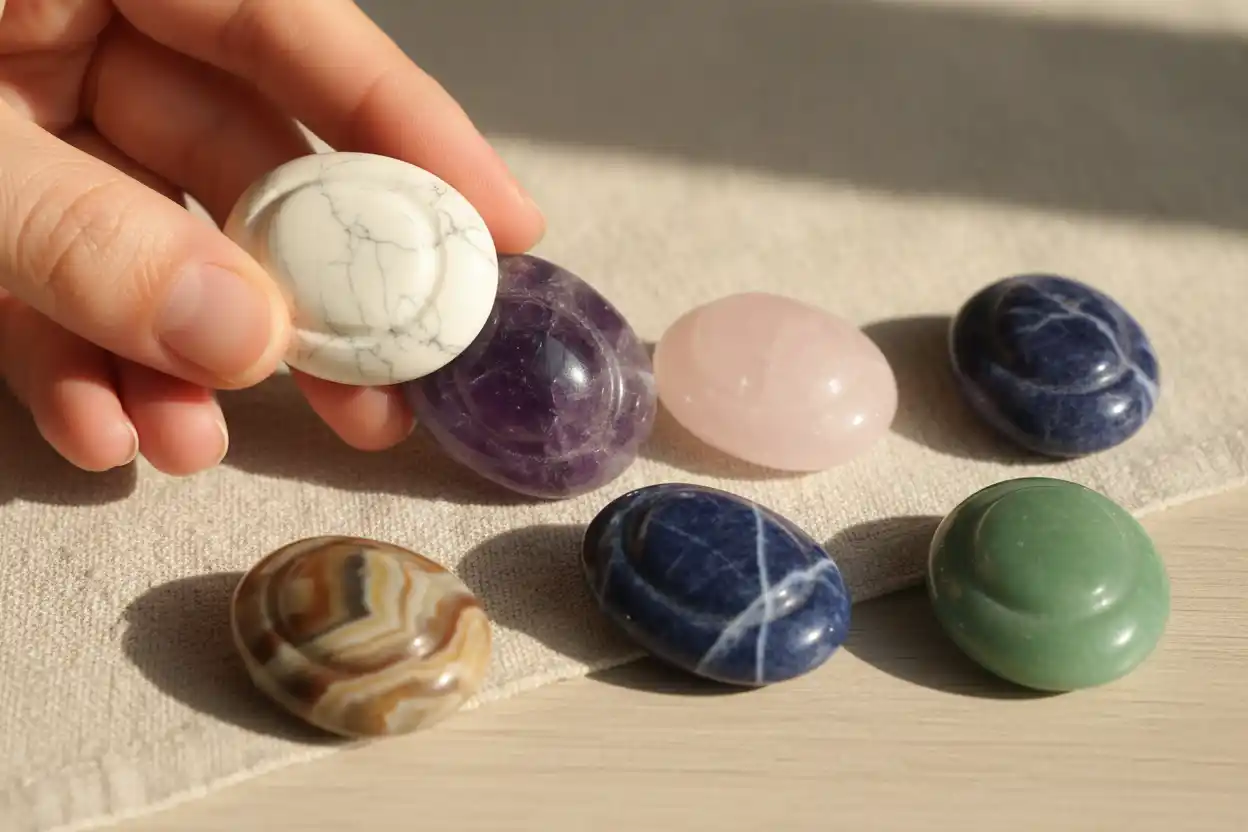
A worry stone is a small smooth object, usually oval or rounded, with a shallow groove sized for a thumb. A person holds the stone between the fingers and rubs the recessed area in a repeated motion.
The stone does not treat an anxiety disorder through mineral composition or spiritual energy. However, its texture, weight and repetitive movement can provide a convenient sensory focus during a broader grounding or relaxation practice.
For some people, holding a familiar object creates a simple prompt to slow down, notice the present environment and choose the next manageable action. Others find repetitive rubbing distracting or irritating. A worry stone is therefore an optional personal tool rather than a universal technique.
The best crystals for anxiety guide covers traditional stone choices. This page owns the practical use of a grooved stone without claiming that one mineral can diagnose, prevent or cure anxiety.
What a Worry Stone Looks Like
Most worry stones are:
- Small enough to fit inside one palm
- Smooth around the edges
- Flat or gently domed
- Oval, round or asymmetrical
- Polished rather than rough
- Made with one shallow thumb groove
- Easy to carry in a pocket or pouch
- Free from sharp projections
- Thick enough not to snap under pressure
The groove differentiates a conventional worry stone from an ordinary tumbled stone.
A tumbled stone has a polished rounded surface but may not include a recessed thumb area. A palm stone is generally larger and designed to fill more of the hand.
All three forms can provide a tactile object, but the worry stone’s groove encourages repeated thumb movement.
How a Worry Stone May Help
A worry stone can support a coping routine through ordinary sensory and behavioral mechanisms.
Its surface gives the fingers something specific to notice. The repeated motion may redirect some attention away from racing thoughts and toward touch.
The object can also function as a learned reminder. After practicing a calming routine repeatedly with the same stone, picking it up may prompt the person to remember the steps.
Possible practical roles include:
- A sensory grounding cue
- A reminder to breathe more slowly
- A substitute for nail biting or skin picking in some situations
- A focus object during meditation
- A prompt to name present-moment facts
- A discreet object during meetings or travel
- A reminder to use a previously learned coping skill
- A transition object before sleep
- A focus for journaling or prayer
- A small gift representing support
These uses do not establish that the stone’s mineral has an anti-anxiety effect. The useful element may be the person’s attention, movement, expectation and practiced routine.
What a Worry Stone Cannot Do
A worry stone cannot diagnose anxiety, stop every panic attack or replace effective treatment.
It should not be used to delay professional care when anxiety:
- Interferes with work, study or relationships
- Causes persistent avoidance
- Leads to frequent panic symptoms
- Disrupts sleep repeatedly
- Produces significant physical distress
- Is worsening over time
- Is linked to trauma or compulsive behavior
- Causes reliance on alcohol or other substances
- Makes a person feel unable to cope
- Includes thoughts of self-harm or feeling unsafe
A clinician can assess whether symptoms reflect an anxiety disorder, another health condition, medication effects or a temporary stress response.
New or severe chest pain, fainting, breathing difficulty or other concerning physical symptoms require medical assessment rather than being assumed to be anxiety.
A One-Minute Worry-Stone Routine
Hold the stone comfortably without gripping it hard.
Place the thumb inside the groove and notice three physical details, such as temperature, texture and weight.
Next, breathe gently rather than forcing a very deep breath. Let the inhale remain comfortable, then allow the exhale to become slightly slower.
Move the thumb across the groove once during each exhale.
Name one present fact silently:
“I am sitting in this room.”
“I can feel the chair beneath me.”
“This feeling is uncomfortable, and I am taking one step at a time.”
Continue for approximately five comfortable breaths.
Finally, identify one small action, such as drinking water, sending a needed message, returning to one task or stepping into a quieter place.
The goal is not to eliminate every anxious sensation. Instead, the routine creates a short pause between the feeling and the next action.
Using a Worry Stone with Slow Breathing
Breathing exercises can become counterproductive when a person forces large breaths, holds the breath for too long or begins monitoring every sensation fearfully.
Keep the practice gentle.
A simple approach is to breathe in comfortably through the nose and out without strain. Count slowly if counting feels helpful, but do not compete with a target.
The thumb can move from one end of the groove to the other during the exhale and return during the inhale.
Stop or return to normal breathing if the exercise causes dizziness, tingling or increased panic.
A worry stone is not necessary for breathing practice. It merely gives the hand a physical rhythm to follow.
Using the Stone for Sensory Grounding
Grounding directs attention toward the current surroundings.
Hold the stone and describe it precisely:
- Is it cool or warm?
- Is the groove shallow or deep?
- Does the surface feel glassy, waxy or slightly textured?
- Where does the edge meet the palm?
- Does the stone feel heavier than expected?
- Are there bands, inclusions or color changes?
- Does the temperature change after a minute?
Then notice other senses in the environment.
A worry stone can serve as one of the objects in a 5-4-3-2-1 grounding exercise:
- Five things you can see
- Four things you can physically feel
- Three sounds you can hear
- Two smells you can notice
- One taste or one slow breath
The stone belongs in the touch portion rather than acting as the entire technique.
Using a Worry Stone During a Panic Surge
A panic surge can create intense physical sensations and an urge to escape.
If a worry stone has helped during previous practice, use it as a cue to orient to the present.
Keep the eyes open and identify the location, date and immediate surroundings. Feel both feet against the floor when possible.
Describe the stone in concrete terms rather than asking whether it is “working.”
Avoid rubbing so forcefully that the skin becomes sore or the stone becomes another source of urgency.
Remind yourself that a familiar panic pattern can feel frightening without being permanent.
Nevertheless, do not assume that unfamiliar or severe physical symptoms are panic. Seek medical assessment when symptoms are new, substantially different or potentially urgent.
Using a Worry Stone at Work or School
A small stone can be used discreetly in a pocket, beneath a desk or during a short break.
Before a meeting or presentation, hold it while identifying one realistic objective.
For example:
“I need to explain the first two points clearly.”
“I can pause before answering.”
“I do not need to predict every question.”
During a demanding task, use the stone for one brief reset rather than rubbing it continuously for hours.
The purpose is to return attention to the activity, not to avoid it.
Students should follow school policies and avoid stones that resemble projectiles, distract classmates or create noise when dropped.
Using a Worry Stone Before Sleep
A worry stone can be part of a bedtime wind-down routine, although it is not a treatment for insomnia.
Use it while sitting or lying comfortably and identify the physical sensations of the bed, clothing and stone.
Instead of solving every problem mentally, write down one issue that needs action tomorrow.
Then place the stone on a stable bedside surface rather than holding it throughout sleep.
The crystals for sleep guide covers traditional sleep-related choices, while the wearing crystals to sleep guide addresses jewelry and physical safety.
Do not sleep with a small loose stone where a child, pet or vulnerable adult could swallow it.
Using a Worry Stone for Meditation
A worry stone can provide one tactile anchor during meditation.
Sit comfortably and hold the stone without attempting to suppress every thought.
When attention wanders, notice the groove and return gently to the chosen focus.
The crystals for meditation guide covers stones traditionally associated with contemplative practice.
The mineral does not determine whether meditation will be beneficial. Practice quality, comfort, expectations and individual response matter more.
Some people find inward attention increases distress. Keeping the eyes open or focusing on external sights and sounds may feel safer.
Using a Worry Stone with Journaling
Hold the stone while writing one sentence for each prompt:
“What am I noticing right now?”
“What am I predicting?”
“What evidence supports that prediction?”
“What is within my control?”
“What is one small next step?”
The stone can mark the transition from repetitive thinking to written reflection.
Avoid using the exercise to seek absolute certainty. Anxiety often persists when a person repeatedly checks, reassures or analyzes a fear without taking a proportionate action.
A worry stone should support a decision rather than extend an endless reassurance ritual.
Can a Worry Stone Become a Compulsion?
Yes, in some circumstances.
A person may begin believing that a feared event will occur unless the stone is rubbed a specific number of times or carried everywhere.
That pattern differs from flexible grounding.
Warning signs include:
- Feeling unable to leave home without the stone
- Repeating the motion until it feels exactly right
- Believing the stone prevents catastrophe
- Restarting a ritual after interruption
- Avoiding activities when the stone is unavailable
- Spending increasing time checking the stone
- Using it to neutralize every unwanted thought
When a worry stone becomes part of a rigid compulsion, discuss the pattern with a qualified mental-health professional rather than strengthening the ritual.
Choosing the Right Size
The stone should fit comfortably between the thumb and fingers.
A common worry stone is approximately the size of a large coin or small oval pendant, although hand size varies.
Choose a larger stone when:
- Small objects are difficult to grip
- Hand stiffness is present
- A more noticeable weight feels useful
- Swallowing risk must be reduced
Choose a smaller stone when discreet pocket use matters.
The groove should accommodate the thumb without forcing the joint into an awkward angle.
Sharp edges, deep cracks and unstable repairs are unsuitable.
Choosing the Surface Texture
Some people prefer a high glassy polish, while others respond better to a satin or lightly textured surface.
A highly polished Agate or Quartz stone allows smooth repetitive movement.
A waxy Jade or Serpentine surface can feel softer.
A slightly textured stone gives more sensory detail but may irritate sensitive skin during prolonged rubbing.
Avoid exposed crystal points, metallic coatings, loose glitter, rough druzy surfaces and fibrous minerals.
The ideal object feels neutral or pleasant rather than intense.
Best Materials for Worry Stones
| Material | Tactile quality | Traditional association | Practical concern |
|---|---|---|---|
| Howlite | Smooth, light and softly waxy | Patience and slowing down | Softer and frequently dyed |
| Agate | Dense, smooth and polishable | Stability and balance | Dye and composite construction |
| Jade | Smooth, tough and substantial | Peace and steady judgment | Correct Jade identity |
| Rose Quartz | Smooth and gently translucent | Compassion and emotional softness | Internal fractures and glass |
| Amethyst | Glassy and cool | Reflection and moderation | Chips and synthetic or glass products |
| Sodalite | Smooth with natural grain variation | Clear communication and order | Softer associated minerals |
| Aventurine | Smooth with subtle sparkle | Optimism and opportunity | Glass imitations |
| Jasper | Opaque and substantial | Grounding and endurance | Broad commercial naming |
| Clear Quartz | Cool and glassy | Clarity and intention | Glass substitution and fractures |
| Black Tourmaline | Best only when fully polished | Protection in modern traditions | Rough material is brittle and striated |
The traditional associations describe cultural and spiritual use rather than clinical effects.
Howlite Worry Stones
Howlite is a popular choice because it is naturally white with gray or black veins and takes a smooth polish.
Its traditional meanings emphasize patience and reflective routines.
Howlite is softer than Quartz and may develop surface wear over time.
Blue, green or purple stones sold as Howlite are often dyed. Dye is not necessarily unsafe for ordinary dry handling, but it should be disclosed and should not rub onto skin.
Avoid soaking Howlite or using alcohol-based cleaners.
Agate and Jasper Worry Stones
Agate and Jasper are durable, widely available and offered in numerous natural patterns.
Their density and smooth polish make them practical tactile objects.
Traditional meanings commonly emphasize stability, grounding and steady progress.
Commercial names can be confusing, and some brightly colored Agates are dyed.
Choose rounded stones with no open cavities, exposed druzy or sharp band boundaries.
The exact variety matters less than the comfort of the finished surface.
Jade Worry Stones
Jade can provide a smooth, tough and substantial worry stone.
White, green and lavender Jade forms are all used in carvings.
Traditional associations include harmony, judgment and long-term steadiness.
Confirm whether the material is Jadeite or Nephrite. Serpentine, Quartz, Calcite, glass and resin are often sold under loose Jade names.
A laboratory report is unnecessary for an inexpensive tactile object unless the seller charges a significant Jade premium.
Rose Quartz Worry Stones
Rose Quartz has a pale pink body and smooth glassy polish.
Within crystal traditions, it represents compassion, emotional gentleness and supportive relationships.
Natural material commonly contains clouds, veils and fractures.
Inspect the groove for sharp chips. A fracture crossing the thinnest section may cause the stone to break under pressure.
Glass imitations may contain bubbles or overly uniform color, although visual inspection alone is not always conclusive.
Amethyst Worry Stones
Amethyst provides a cool, smooth surface and colors ranging from pale lavender to deep purple.
Traditional symbolism includes reflection, moderation and clear thinking.
Amethyst has Quartz-family hardness but can chip at edges or internal fractures.
Avoid very thin stones and deep grooves.
Strong sunlight can fade some Amethyst over prolonged exposure, so do not leave the stone permanently on a bright windowsill.
Sodalite Worry Stones
Sodalite commonly appears blue with white mineral veining.
Its traditional associations emphasize communication, thought organization and speaking deliberately.
A polished Sodalite worry stone may contain Calcite and other softer minerals. These areas can undercut or scratch more quickly than the blue body.
Avoid acids and prolonged soaking.
The stone should be shown from both sides because one face may contain substantially more white matrix.
Aventurine Worry Stones
Aventurine is a Quartz-rich material that may display subtle sparkle from mineral inclusions.
Green Aventurine is the most common worry-stone form.
Traditional associations include opportunity, optimism and approaching change with openness.
Aventurine glass can imitate natural sparkle and may contain unnaturally uniform metallic particles.
Natural material generally has softer, less perfectly distributed reflections.
Clear Quartz Worry Stones
Clear Quartz creates a cool glassy object with visible inclusions and internal veils.
Traditional symbolism focuses on clarity and intention.
A worry stone does not amplify a medical treatment or remove anxiety through Quartz properties.
Glass can imitate clear polished stones, and both materials may feel similar in the hand.
For a tactile tool, authenticity may matter less than safe construction and honest labeling.
Black Tourmaline Worry Stones
Black Tourmaline is usually sold as rough striated crystals rather than smooth worry stones.
Only choose fully polished, structurally stable material without exposed splinters or sharp crystal ridges.
Traditional practices associate Black Tourmaline with protection and boundaries.
Many black worry stones sold under the name may be Obsidian, Onyx, resin or another dark material.
Request the exact identity when mineral symbolism matters.
Worry Stones and Grounding Crystals
The best crystals for grounding guide lists stones traditionally associated with steadiness and present-moment awareness.
A grounding exercise works through attention and sensory orientation rather than through a specific mineral.
Therefore, a wooden disc, smooth coin, fabric patch or ordinary pebble can serve the same tactile purpose.
Choose crystal only when its appearance or personal meaning makes the routine easier to remember.
Worry Stones and Stress
The best crystals for stress guide covers traditional selections for demanding periods.
Stress and anxiety overlap but are not identical. Stress commonly relates to identifiable demands, while anxiety can persist without an immediate external threat.
A worry stone may create a short pause during either experience.
However, it does not remove the source of stress. Follow the pause with a practical step such as clarifying a deadline, asking for help, resting or setting a boundary.
Making a Worry Stone
A simple worry stone can be made from a thick, structurally sound piece of suitable lapidary material.
The basic process involves:
- Selecting a stone without major fractures
- Cutting or grinding an oval blank
- Rounding every edge
- Creating a shallow thumb depression
- Smoothing progressive scratches
- Polishing the complete surface
- Cleaning and inspecting the finished groove
The depression should remain shallow enough to preserve structural thickness.
Do not begin with asbestos-form minerals, lead-bearing specimens, radioactive minerals, soluble salts or unidentified rough.
Quartz, Agate and Jasper create hazardous respirable silica dust when dry-worked. Use wet lapidary methods, effective extraction, eye protection and appropriate respiratory protection.
A preformed blank or commercially finished stone is safer for beginners without lapidary equipment.
Cleaning a Worry Stone
Cleaning depends on the material.
Sound Quartz, Agate and Jasper can usually be wiped with mild soap and lukewarm water, then dried.
Avoid soaking Howlite, Sodalite, coated stones, glued composites and unknown minerals.
Do not use acids on Calcite or carbonate-rich material.
Alcohol and solvents can damage dye, resin and coatings.
Because the stone touches the hands frequently, wipe it with a clean soft cloth and allow it to dry fully.
Replace a stone that develops sharp chips, unstable cracks or peeling coating.
Worry Stones for Children
A worry stone should be large enough not to create a choking hazard and should be used under appropriate adult supervision.
Avoid stones with:
- Sharp edges
- Loose coatings
- Fibrous surfaces
- Lead-bearing minerals
- Small detachable pieces
- Strong dyes that transfer
- Heavy spheres that can be thrown
- Unstable cracks
A soft fabric object, silicone fidget or larger wooden token may be safer for younger children.
A worry stone should not be used to dismiss a child’s anxiety. Adults should listen, identify stressors and seek qualified support when distress persists.
Frequently Asked Questions
1. What is a worry stone?
A worry stone is a small smooth object with a thumb-sized groove designed for repeated rubbing or tactile focus.
2. Do worry stones scientifically treat anxiety?
No. The stone itself is not a proven anxiety treatment, although it can support sensory grounding, breathing and other coping routines.
3. How should I use a worry stone?
Hold it gently, notice its texture and temperature, breathe comfortably and use it as a cue to focus on the present moment.
4. How long should I rub a worry stone?
Use it briefly enough to regain focus, often for several comfortable breaths. Stop if rubbing becomes irritating or compulsive.
5. Can a worry stone help during a panic attack?
It may provide a familiar grounding cue, but unfamiliar or severe physical symptoms should receive appropriate medical assessment.
6. What is the best crystal for a worry stone?
The best material is smooth, durable, safe and personally comfortable. Agate, Jade, Jasper, Quartz and Howlite are common choices.
7. Does the mineral type change how the technique works?
There is no established evidence that one mineral treats anxiety better than another. Texture, familiarity and the practiced routine are more relevant.
8. Can I use an ordinary pebble instead?
Yes. Any safe, comfortable object can serve as a tactile anchor.
9. Can worry-stone use become compulsive?
Yes. Seek professional guidance when you feel required to rub it a specific number of times or believe harm will occur without it.
10. Can children use worry stones?
Older children may use appropriately sized, nontoxic stones with supervision. Small objects can create choking or throwing hazards.
11. Can I sleep while holding a worry stone?
Place it safely on a bedside surface before sleeping. Do not leave small loose stones in a bed with children, pets or anyone at risk of swallowing them.
12. When should I seek professional help for anxiety?
Seek help when anxiety is persistent, worsening, disrupts daily life, causes significant avoidance or panic, or makes you feel unsafe.
Use the Stone as a Prompt, Not a Promise
A worry stone works best as a modest cue: notice the present, soften the grip, breathe without forcing and choose one manageable next action.
Its mineral name can carry personal symbolism, but the practical value comes from how the object supports a flexible coping skill. Keep it only when it helps you return to life rather than becoming another rule anxiety requires you to follow.
Mental-health and safety note: A worry stone is not a medical or psychological treatment. Persistent, worsening or disabling anxiety should be discussed with a qualified healthcare professional. Seek urgent local help if you feel unsafe or experience potentially serious physical symptoms. Small stones can be choking hazards, while cutting stone can generate hazardous dust.