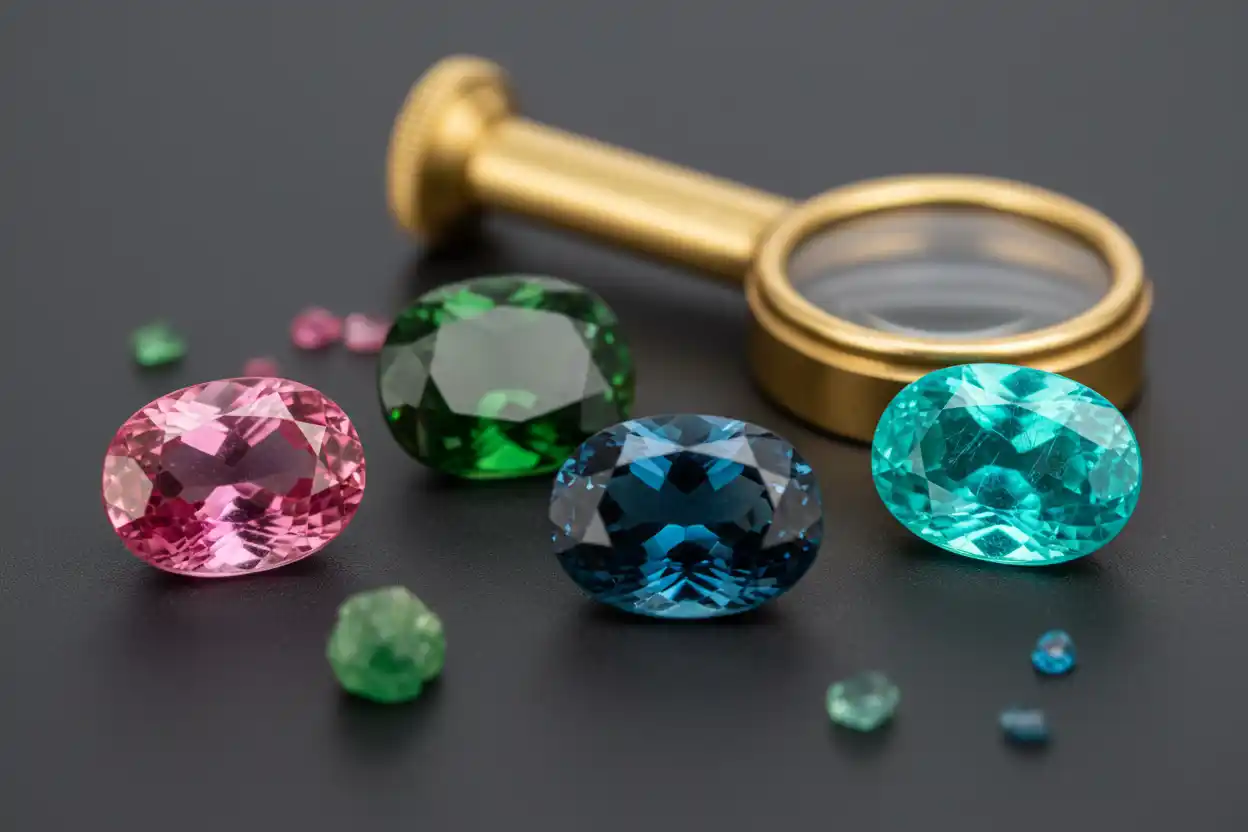
How to Spot Treated or Synthetic Tourmaline
Tourmaline is valued for an extraordinary range of colors, from black and earthy brown to vivid green, blue, pink, red, and multicolored combinations. Most gem tourmaline reaches the market with little or no enhancement, but heating, irradiation, and fracture filling are known treatments that can alter color or apparent clarity.
Detecting those treatments is not always straightforward. In fact, some heated and irradiated tourmalines may show no reliable microscopic evidence of enhancement, which means visual inspection alone cannot always establish treatment status. True synthetic gem tourmaline presents a different situation: it is not a routine commercial counterpart to natural tourmaline, so buyers are far more likely to encounter treated natural stones or unrelated imitations than genuine laboratory-grown tourmaline.
Treated Tourmaline at a Glance
| Question | Practical Answer |
|---|---|
| Is tourmaline commonly treated? | Less extensively than many major colored gems, although treatment occurs |
| Main color treatment | Heating |
| Other important color treatment | Irradiation |
| Clarity enhancement | Oil or resin fracture filling can occur |
| Is heating always detectable? | No |
| Is irradiation always detectable? | No |
| Can fracture filling be detected? | Often easier to detect under magnification |
| Is heat treatment stable? | Generally yes |
| Can irradiated color fade? | Some irradiation-related color can fade with heat or strong light |
| Is commercial synthetic tourmaline common? | No; true synthetic gem tourmaline is not a normal commercial product |
| Does treatment make tourmaline fake? | No |
| Best confirmation | Reputable gemological laboratory |
The broader Tourmaline guide covers the mineral group, colors, properties, and symbolism. This page focuses only on treatment, enhancement, laboratory-grown material, disclosure, and what buyers can realistically detect.
Does Tourmaline Get Treated?
Yes, although untreated tourmaline is also widely available.
The principal treatments encountered in gem tourmaline are low-temperature heating and irradiation. Both are primarily used to modify color.
Fracture filling may also be used to reduce the visibility of surface-reaching fractures and improve apparent clarity.
Treatment frequency varies considerably with color, variety, origin, value, and the characteristics of individual rough.
Therefore, it would be incorrect to assume either that all tourmaline is untreated or that most brightly colored tourmaline must be enhanced.
Is Treated Tourmaline Still Real?
Yes.
Treatment does not change a naturally formed tourmaline into a fake gemstone.
A natural crystal that formed geologically and was subsequently heated, irradiated, or clarity enhanced remains natural tourmaline with treatment.
That distinction matters because four different concepts are often confused:
Natural untreated tourmaline formed naturally and has no detected enhancement.
Natural treated tourmaline formed naturally but was modified after mining.
Synthetic tourmaline would have the essential properties of tourmaline but would be grown artificially.
Tourmaline imitation is another material made or selected to resemble tourmaline.
Treatment status and natural origin are therefore separate questions.
Heat Treatment in Tourmaline
Heating is one of the most important enhancements used on tourmaline.
It is generally performed at relatively low temperatures compared with the heating used for some other colored gemstones.
The objective is usually to improve color rather than clarity.
Dark blue or green tourmaline may be heated to produce a lighter or more attractive tone. Certain violetish, purplish, or pinkish copper-bearing tourmalines can also change dramatically after heating.
However, treatment response depends on the chemistry of the individual stone. Not every tourmaline changes desirably, and inclusions may make some gems unsuitable for heating.
What Does Heating Do to Tourmaline Color?
Heating can reduce undesirable brown, purple, or overly dark components in suitable material.
In copper-bearing tourmaline, for example, heating can modify manganese-related absorption and reduce pink or violet components. The resulting stone may appear blue, blue-green, or green.
That transformation is particularly important in the market for Paraiba-type copper-bearing tourmaline.
Likewise, some dark green or blue tourmaline may become lighter after treatment.
Heating cannot simply transform any inexpensive tourmaline into any desired color. The original chemistry must already be suitable for the intended change.
The site’s Tourmaline Color Meaning page covers color symbolism and variety distinctions rather than treatment detection.
Can You Tell If Tourmaline Has Been Heated?
Often, no.
This is one of the most important facts buyers should understand.
Low-temperature heating of tourmaline can leave little or no diagnostic evidence. Consequently, even a trained gemologist may be unable to determine definitively whether a particular tourmaline was heated.
Natural inclusions cannot automatically solve the problem either.
A stone may clearly be natural yet still have undergone an undetectable color treatment.
Therefore, statements such as “I can tell this tourmaline is unheated because it has inclusions” are unreliable.
Heat Treatment and Liquid Inclusions
Tourmaline commonly contains fluid-filled growth tubes and other liquid inclusions.
These inclusions can create difficulties during heat treatment.
When a liquid inclusion is heated, internal pressure may increase enough to rupture the surrounding area. That can create new fractures or enlarge existing ones.
For this reason, heavily included stones may be unsuitable for heating.
A treated stone can therefore sometimes develop fractures as an indirect consequence of the heating process, but those fractures alone do not prove treatment.
Natural tourmaline also fractures during geological formation, mining, cutting, and ordinary handling.
Paraiba Tourmaline and Heat Treatment
Treatment disclosure becomes especially important with high-value copper-bearing tourmaline.
Fine Paraiba Tourmaline is prized for vivid blue, green-blue, turquoise, and related colors caused primarily by copper, often interacting with manganese and other elements.
Heating certain purplish or pinkish copper-bearing stones can reduce manganese-related coloration and reveal a more commercially desirable blue-to-green appearance.
Unfortunately for buyers looking specifically for unheated gems, that heat treatment may be impossible to detect reliably.
Therefore, attractive blue-green color by itself cannot prove that a Paraiba-type tourmaline was naturally that color when mined.
For a major purchase, treatment and origin documentation deserve far more weight than seller assurances based solely on appearance.
Does Heat Treatment Lower Tourmaline Value?
Potentially, but the effect depends strongly on the market segment.
In ordinary commercial tourmaline, treatment may have relatively little influence compared with color, clarity, size, cut, and overall beauty.
At the highest end of the market, however, documented natural color can command a premium when buyers place special value on rarity and untreated status.
This is especially relevant for exceptional Paraiba, rubellite, and other collectible tourmalines.
A beautifully colored treated stone can still be valuable. The central issue is disclosure and appropriate pricing rather than assuming treatment automatically destroys value.
The Tourmaline Buying Guide should govern the broader purchase decision, while treatment status remains the focus here.
Irradiated Tourmaline
Irradiation is another established tourmaline color treatment.
It is particularly associated with pink and red material.
Exposure to ionizing radiation can create or modify color centers within the crystal. In suitable tourmaline, this may intensify pale pink coloration or convert comparatively weak material into a more saturated pink or red appearance.
Some yellow coloration can also relate to radiation-induced color centers.
Importantly, radiation occurs naturally in geological environments too. A color center associated with radiation is therefore not automatically evidence of laboratory treatment.
The difficulty is determining whether the responsible irradiation occurred naturally underground or artificially after mining.
Can Irradiated Tourmaline Be Identified?
Often, reliable detection is difficult or impossible.
The resulting color can closely resemble natural color because the treatment modifies mechanisms that can also occur naturally.
Consequently, a bright pink tourmaline should not automatically be labeled irradiated.
Likewise, a seller cannot prove that pink color is natural merely by saying that no treatment is visible through a loupe.
In some circumstances, laboratory spectroscopy and other analytical methods contribute useful evidence, but not every irradiation treatment has a definitive routine detection method.
Can Irradiated Tourmaline Fade?
Some irradiation-induced colors can be less stable than heat-treated colors.
Exposure to heat or prolonged strong light can alter or fade certain irradiation-related colors.
That does not mean every pink tourmaline will fade in normal wear. Natural coloration and treatment response vary significantly.
Nevertheless, collectors should avoid deliberately heating an unknown pink or red tourmaline as an identification experiment.
The test could permanently alter the gemstone without proving how the color originated.
Pink and Red Tourmaline Treatment
Pink-to-red tourmaline deserves particular treatment scrutiny because irradiation may increase color saturation.
Fine red tourmaline is commonly called Rubellite, although the trade term involves more than simply any pale pink stone.
Natural pink and red tourmalines can contain significant inclusions, which are not necessarily signs of low quality or artificial treatment.
Therefore, neither an included appearance nor vivid saturation proves whether a stone has been irradiated.
When untreated status materially affects price, laboratory documentation and conservative disclosure are preferable to visual assumptions.
Blue and Green Tourmaline Treatment
Blue and green stones are more closely associated with heating than irradiation in normal commercial practice.
Heating may lighten dark material or modify undesirable secondary color.
indicolite covers blue tourmaline as a variety-level topic, while Verdelite focuses on green tourmaline.
Neither color name guarantees treatment status.
A naturally vivid green tourmaline can exist, while a similar-looking specimen might have received low-temperature heat treatment.
Again, appearance alone is insufficient.
Fracture-Filled Tourmaline
Tourmaline may contain fractures that reach the surface.
When those fractures are prominent, they can reduce transparency and interrupt the passage of light through the gemstone.
A clarity enhancer can introduce oil, resin, or another filler into these openings. Because the filler has optical properties closer to the gemstone than air does, the fracture becomes less obvious.
The process does not heal the fracture.
Instead, it masks its visual impact.
Which Tourmalines Are Fracture Filled?
Fracture filling can theoretically be applied to multiple colors and varieties.
In practice, it makes the most economic sense when improved clarity substantially increases the appearance and marketability of an already valuable stone.
High-value Paraiba, rubellite, and bicolor material can therefore receive this type of enhancement.
These varieties may naturally contain numerous surface-reaching fractures.
Filling them can produce a cleaner-looking gem without removing the underlying structural weakness.
How to Spot Fracture Filling in Tourmaline
Fracture filling is generally more visually detectable than heating or irradiation.
Under magnification and suitable illumination, a gemologist may find evidence within surface-reaching fractures that suggests oil or resin.
Possible observations can include unusual optical effects, irregular filler distribution, trapped material, changes in relief, or characteristics that differ from an ordinary unfilled fracture.
However, interpretation requires experience.
Natural thin-film iridescence within an untreated fracture can sometimes resemble features associated with enhancement.
Therefore, a single rainbow flash should not automatically be labeled resin.
When filling matters commercially, microscopic examination combined with appropriate analytical techniques is safer than a casual loupe diagnosis.
Heat Treatment Can Lead to Fracture Filling
These treatments can occasionally be related.
Tourmalines containing fluid inclusions may develop fractures when heated because internal fluids expand or rupture their surrounding cavities.
Those newly visible fractures can subsequently be filled with oil or resin to reduce their appearance.
Therefore, one stone can potentially have undergone more than one enhancement.
This possibility is particularly important when evaluating highly included material that appears unusually clean around surface-reaching fissures.
Are Tourmaline Coatings Common?
Coating is not one of the principal routine treatments associated with natural tourmaline.
However, coatings can theoretically be applied to almost any gemstone.
A surface film can alter apparent color, luster, or interference effects without changing the gemstone underneath.
Evidence may include concentrated color along facet junctions, damaged coating around scratches, uneven coloration, or differences between protected and exposed areas.
Still, those signs are not unique enough to diagnose a coating without proper examination.
The site’s Gemstone Treatments guide explains coating, filling, heating, irradiation, diffusion, and other enhancement categories at the broader gem-industry level.
Is Tourmaline Dyed?
Dyeing is not a standard enhancement for transparent faceted tourmaline.
Because high-quality tourmaline receives its color throughout the crystal, surface-applied dye does not reproduce natural internal color effectively in the way it can with porous or aggregate materials.
However, low-quality beads, imitation materials, and composite jewelry sold loosely under the word “tourmaline” may create different concerns.
When a suspiciously colored inexpensive bead strand is involved, first establish whether the material is actually tourmaline before attempting to determine treatment.
Material identification should always precede sophisticated treatment analysis.
Is Synthetic Tourmaline Available?
For practical jewelry buying, true synthetic gem tourmaline is not a normal commercial product.
Tourmaline has extraordinarily complex chemistry, which makes production of gem-quality synthetic counterparts far more difficult than growing materials such as synthetic corundum or synthetic spinel.
Tourmaline has been produced or studied experimentally for scientific purposes, but that is not equivalent to a commercial supply of synthetic gemstones.
Current gemological guidance states that no synthetic gem tourmaline exists in the ordinary jewelry market.
Consequently, if a marketplace seller advertises a cheap stone as “lab-created tourmaline,” investigate carefully rather than assuming it is a true synthetic version of natural tourmaline.
What Is Usually Sold as “Synthetic Tourmaline”?
The material may actually be an imitation.
Glass, synthetic spinel, synthetic corundum, colored cubic zirconia, or another manufactured material can be cut in tourmaline-like colors.
Such a stone is not synthetic tourmaline unless it actually reproduces the essential chemical composition, crystal structure, and properties of tourmaline.
This terminology matters.
Synthetic means a laboratory-grown counterpart to a natural gem.
Simulant or imitation means a different material that merely resembles the gem.
A seller describing green glass as “synthetic green tourmaline” is therefore using inaccurate terminology.
Is Lab-Grown Tourmaline Fake?
A true laboratory-grown counterpart, if commercially produced, would be synthetic rather than an imitation.
However, because synthetic gem tourmaline is not a normal commercial material, shoppers should be skeptical of ordinary retail listings using this phrase.
Ask for an independent gemological report identifying the material.
Do not rely on an attractive product name or seller-created certificate.
Natural Tourmaline Inclusions
Magnification can help confirm natural origin because tourmaline can contain distinctive internal features.
Growth tubes are particularly characteristic. Tourmaline may also contain fluid inclusions, mineral crystals, healed fractures, color zoning, and growth features.
Elbaite—the species responsible for many gem-quality tourmalines—can contain inclusions of mica, feldspar, zircon, and other minerals associated with pegmatitic formation.
The Elbaite guide covers that mineral-species relationship separately.
Natural inclusions are useful evidence of geological origin, but they usually cannot prove that the gemstone was never heated or irradiated.
Color Zoning Does Not Prove Untreated Status
Tourmaline is famous for color zoning.
Individual crystals may change from green to pink, blue to green, or nearly colorless to strongly saturated sections during growth.
Watermelon Tourmaline is the best-known example, with contrasting pink and green zones.
Natural zoning confirms something about the crystal’s growth history, but it does not automatically establish that no subsequent treatment occurred.
A gemstone can form with natural zoning and still undergo enhancement later.
Can Heat Remove Tourmaline Color Zoning?
Treatment may alter the appearance of color components, but heating does not provide a universal way to erase every natural growth zone.
Tourmaline coloration results from complex combinations of trace elements, oxidation states, color centers, and crystal chemistry.
Different zones within one crystal can therefore respond differently.
As a result, an unusual or uneven color response is not necessarily evidence of artificial treatment.
Can You Test Tourmaline at Home?
You can examine a stone, but home testing has strict limits.
A 10× loupe may reveal growth tubes, inclusions, fractures, filler-related features, or suspicious surface characteristics.
Observe color distribution from several directions and under neutral lighting.
Check seller documentation and compare the gem’s physical properties with known tourmaline ranges.
However, heating, irradiation, and many other treatments should never be tested experimentally at home.
Do not place the stone under extreme heat or UV exposure simply to see whether the color changes.
Do not use acids or scratch tests.
These approaches can damage a genuine gem while providing little reliable information.
Does a Loupe Show Heat Treatment?
Usually not.
Heat-treated tourmaline often lacks diagnostic microscopic evidence.
In fact, modern gemological research emphasizes that heating and irradiation generally have little visible microscopic impact in tourmaline compared with fracture filling.
A loupe is therefore useful for finding inclusions and suspicious clarity enhancement, but it cannot certify “unheated.”
Does a Certificate Prove a Tourmaline Is Untreated?
Only if a reputable laboratory’s report addresses treatment and the treatment in question is detectable.
A report identifying a stone as natural tourmaline confirms material identity and natural origin within the laboratory’s testing scope.
It may also state whether detectable treatments were observed.
However, an important limitation remains: if a treatment is scientifically undetectable, a laboratory cannot prove that it never happened.
Consequently, report wording needs to be read literally rather than interpreted as a guarantee beyond current analytical capabilities.
The Gemstone Certification guide explains why laboratory reputation, report type, and wording matter.
How Laboratories Examine Tourmaline
Gem laboratories use a combination of classical gemology and advanced instrumentation.
Refractive index, birefringence, specific gravity, pleochroism, absorption spectra, and microscopy help establish material identity.
Spectroscopy and trace-element analysis can provide additional information regarding composition, color causes, and—in some cases—geographic origin.
Microscopy is particularly useful for fracture filling and natural inclusion analysis.
However, no amount of instrumentation can reliably identify every historic heat or irradiation treatment if that treatment leaves no measurable diagnostic signature.
Professional gemology therefore includes knowing when a conclusion cannot be made.
Paraiba Origin and Treatment Are Separate Questions
A report stating that a tourmaline is copper-bearing does not automatically establish its geographic origin.
Likewise, a geographic-origin opinion does not automatically mean the stone is untreated.
Brazil, Mozambique, and Nigeria have all produced copper-bearing tourmalines recognized in the Paraiba market category under modern laboratory nomenclature, although origin can have major value implications.
For expensive material, buyers may therefore want answers to three independent questions:
Is the stone natural tourmaline?
Is it copper-bearing, and does it qualify for the relevant variety designation?
Can its geographic origin and treatment status be determined?
The Paraiba Tourmaline Buying Guide covers the broader purchasing considerations separately.
Treatment and Tourmaline Value
Treatment does not have one universal effect on price.
A moderately priced green tourmaline may be valued almost entirely on appearance, size, clarity, and cutting, with treatment status having limited commercial effect.
At the high end, the situation changes.
Fine Paraiba, rubellite, unusual multicolored material, historically important stones, and exceptional collector gems can carry premiums for documented natural characteristics.
An undisclosed clarity treatment may be especially problematic because it changes apparent clarity and can affect care requirements.
Therefore, value depends not only on whether treatment exists but also on what treatment was performed, how extensively, whether it is stable, whether it can be detected, and whether the seller disclosed it.
What Sellers Should Disclose
A responsible seller should distinguish natural origin from treatment status.
Descriptions such as natural tourmaline, heat treated or natural tourmaline, clarity enhanced are more informative than simply saying “genuine.”
If treatment cannot be determined, the seller should avoid unsupported promises of “100% unheated” unless reliable evidence exists.
For irradiation, the challenge is particularly important because treatment can be undetectable.
Likewise, Paraiba origin should be supported by laboratory documentation when it materially influences price.
Red Flags When Buying Tourmaline
Be cautious when a seller promises that every gemstone is untreated simply because it came “directly from the mine.”
Mining provenance does not prove what happened to the stone after extraction.
Likewise, claims that bright Paraiba color proves untreated status are unreliable because heating can improve some copper-bearing tourmalines.
Another red flag is “lab-grown tourmaline” offered cheaply without an independent report identifying the material.
Finally, be careful with dramatic claims that a phone flashlight, magnet, scratch test, or one visible inclusion can reveal every treatment.
Tourmaline enhancement is more complicated than those shortcuts suggest.
How to Buy Tourmaline When Treatment Matters
Begin by deciding whether treatment status actually affects your purchase.
For modestly priced everyday jewelry, beauty, durability, accurate material identity, and transparent seller disclosure may matter more than proving unheated status.
For expensive rubellite, Paraiba, collector stones, or important untreated-color claims, independent laboratory documentation becomes much more valuable.
Ask whether heating, irradiation, fracture filling, coating, or other clarity enhancement has been detected.
If a seller makes an unusually strong claim such as “guaranteed untreated Paraiba,” request evidence appropriate to the price.
Most importantly, do not assume that “natural” means “untreated.”
How to Care for Treated Tourmaline
Warm, soapy water is the safest general cleaning method for tourmaline.
Avoid steam and ultrasonic cleaners, especially when the treatment history is unknown or fractures are present.
Heat is a particular concern. High temperatures can alter tourmaline color, while sudden temperature changes can cause fracturing.
Irradiation-related colors may also be vulnerable to heat or intense light.
Fracture-filled stones require additional caution because oils and resins can respond differently from the host gemstone to heat, solvents, chemicals, and jewelry repair procedures.
The site’s tourmaline jewelry cleaning guide provides the physical cleaning workflow without duplicating treatment identification here.
Caring for Treated Paraiba Tourmaline
High-value copper-bearing material deserves especially conservative handling.
Avoid steam cleaning, prolonged heat, aggressive chemicals, and unnecessary ultrasonic exposure.
If fracture filling has been reported, inform any jeweler before resizing, soldering, retipping, or performing other work involving heat or chemicals.
For material-specific maintenance, use the Paraiba Tourmaline cleaning guide.
A valuable treated stone can remain beautiful for many years when its treatment status is known and care is adjusted accordingly.
Frequently Asked Questions
Is most tourmaline treated?
No. Untreated tourmaline is widely available. However, heating, irradiation, and fracture filling do occur, and frequency varies by variety, color, and market segment.
What is the most common tourmaline treatment?
Heating and irradiation are the two most important color treatments. Fracture filling is also encountered as a clarity enhancement.
Can you tell if tourmaline has been heated?
Not always. Low-temperature heat treatment can be undetectable, which means visual examination cannot reliably prove every tourmaline is unheated.
Is blue tourmaline heat treated?
Some blue and blue-green tourmalines are heated to improve or lighten color, but naturally blue material also exists. Blue color alone does not establish treatment.
Is Paraiba tourmaline heated?
Some copper-bearing Paraiba-type tourmalines are heat treated to remove undesirable purple or pink components and improve blue-to-green color. The treatment may be difficult or impossible to detect.
Is pink tourmaline irradiated?
Some pink tourmalines are irradiated to increase color saturation. Natural pink tourmaline is also common, and irradiation can be difficult to detect.
Does irradiated tourmaline fade?
Some irradiation-induced color can fade or change when exposed to heat or strong light. Stability depends on the material and color mechanism.
Is fracture-filled tourmaline real?
Yes. The underlying stone can be natural tourmaline. Fracture filling is a clarity enhancement that introduces oil, resin, or another material into surface-reaching fractures.
Does fracture filling make tourmaline weaker?
The original fracture remains present even when filler makes it less visible. Therefore, a clarity-enhanced gemstone should still be handled as fractured material.
Does heat treatment make tourmaline fake?
No. Heat-treated natural tourmaline remains natural tourmaline.
Does synthetic tourmaline exist?
True tourmaline has been studied and produced experimentally, but synthetic gem-quality tourmaline is not a routine commercial jewelry product. Modern gemological references state that no synthetic gem tourmaline is commercially established.
What does “lab-created tourmaline” usually mean?
The phrase should be treated cautiously. It may refer to an imitation such as glass or another synthetic gem rather than a true synthetic counterpart of tourmaline. Independent identification is advisable.
Can inclusions prove a tourmaline is untreated?
No. Natural inclusions can support natural origin, but a naturally included stone may still have been heated or irradiated.
Can a gem lab determine every tourmaline treatment?
No. Laboratories can identify many treatments, particularly some forms of clarity enhancement, but certain heating and irradiation treatments may be undetectable.
Is untreated tourmaline more valuable?
Sometimes. Documented untreated status can command a premium for exceptional high-value stones, but color, rarity, clarity, cut, size, origin, and overall beauty usually remain major value factors.
Final Takeaway
Tourmaline treatment is less straightforward than simply dividing stones into “real” and “fake.”
Heating can lighten or improve blue, green, and copper-bearing tourmaline, and the resulting treatment may leave no reliable diagnostic evidence.
Irradiation can intensify pink and related colors, yet distinguishing natural radiation-related color from laboratory-induced color can also be difficult.
Fracture filling uses oils or resins to reduce the visibility of surface-reaching fissures and is generally the treatment most likely to leave microscopic evidence.
True synthetic gem tourmaline is not a normal commercial product, so listings advertising inexpensive “lab-created tourmaline” deserve careful verification. Imitations made from other materials are a much more realistic concern.
Most importantly, treated natural tourmaline remains natural tourmaline. The buyer’s concern should be accurate disclosure, treatment stability, appropriate care, and fair pricing, not the assumption that every enhancement makes a gemstone fake.
For ordinary purchases, transparent seller disclosure may be sufficient. For valuable Paraiba, rubellite, exceptional color, or stones carrying a premium for untreated status, an independent gemological report provides the strongest available evidence—while recognizing that some tourmaline treatments remain scientifically undetectable.