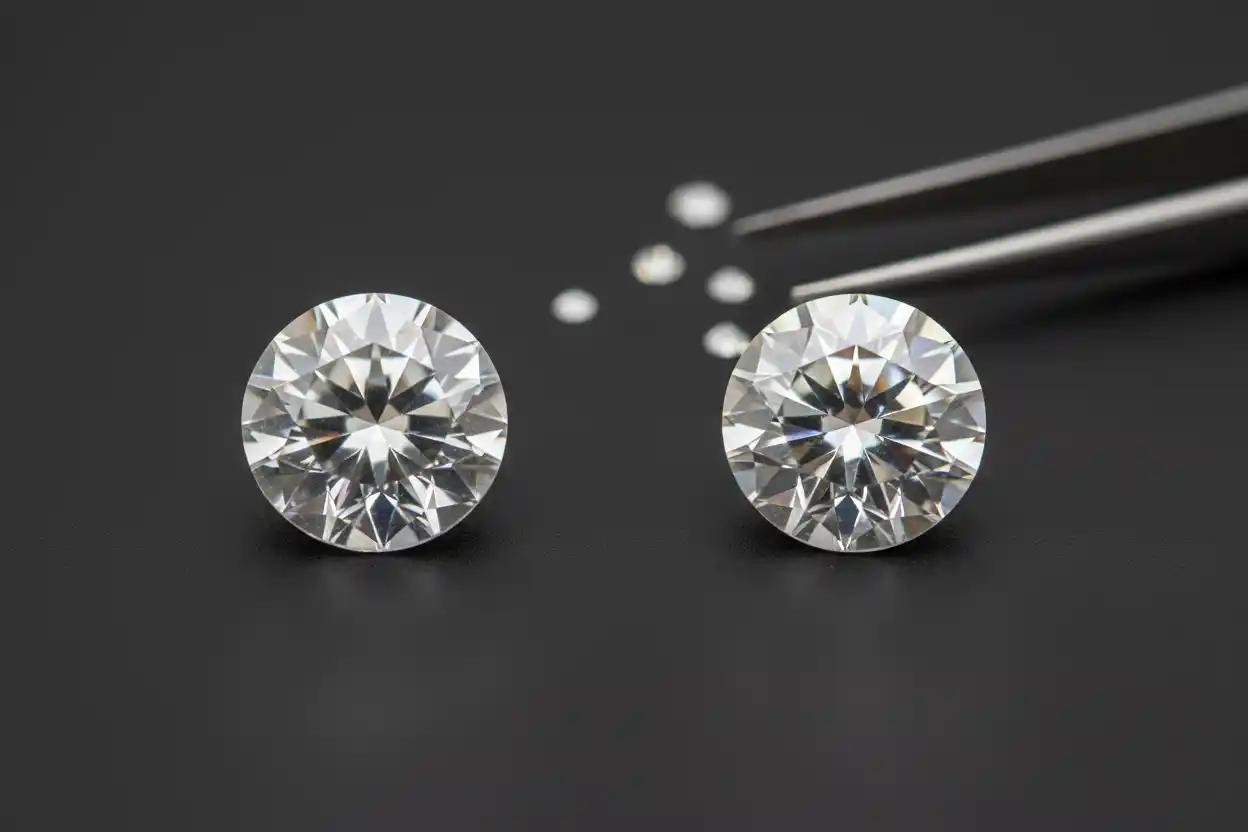
White Sapphire vs Diamond: How to Tell Them Apart
White sapphire and diamond can both produce a bright, colorless center-stone look, but they are fundamentally different gemstones. White sapphire is colorless corundum with a refractive index around 1.76 and Mohs hardness 9, whereas diamond is crystalline carbon with a much higher refractive index of 2.42 and Mohs hardness 10.
Those differences create noticeably different brilliance, fire, surface durability, and price positions. Diamond normally looks brighter and more contrast-rich, while white sapphire tends to have a softer, glassier appearance and offers a natural-gem alternative at a substantially lower cost.
White Sapphire vs Diamond at a Glance
| Feature | White Sapphire | Diamond |
|---|---|---|
| Mineral/material | Corundum | Diamond |
| Chemistry | Al₂O₃ | C |
| Natural versions | Yes | Yes |
| Laboratory-grown versions | Yes | Yes |
| Crystal system | Trigonal | Cubic |
| Refractive index | 1.762–1.770 | About 2.42 |
| Birefringence | 0.008–0.010 | None |
| Specific gravity | About 4.00 | About 3.52 |
| Mohs hardness | 9 | 10 |
| Luster | Vitreous | Adamantine |
| Brilliance | Good, but comparatively subdued | Very high when well cut |
| Fire | Lower | Stronger |
| Typical visual character | Soft, silvery-white brilliance | Crisp brightness with stronger contrast and fire |
| Scratch resistance | Excellent | Exceptional |
| Cleavage | None | Perfect octahedral cleavage |
| Everyday ring suitability | Very good | Excellent |
| Typical price position | Significantly lower | Higher, especially natural diamond |
| Most useful identification clues | RI, birefringence, density | RI, thermal conductivity, spectroscopy |
The White Sapphire guide covers colorless corundum itself. Here, the focus is narrower: how white sapphire compares directly with natural and laboratory-grown diamond when the two compete for the same jewelry role.
What Is White Sapphire?
White sapphire is colorless or nearly colorless corundum, the same mineral family that produces blue, yellow, pink and many other sapphire colors.
Its chemical composition is aluminum oxide, Al₂O₃.
Pure corundum is colorless. Trace elements and defects create the familiar colors seen in other sapphires and ruby, so white sapphire is not created simply by “removing blue” from an ordinary blue sapphire.
Natural colorless sapphire occurs geologically, although laboratory-grown white sapphire is also commercially available.
The parent Sapphire guide provides the broader corundum mineralogy without needing to repeat it throughout this comparison.
What Is Diamond?
Diamond is crystalline carbon.
Its carbon atoms form a three-dimensional structure that gives the mineral an exceptional combination of hardness, refractive power, thermal conductivity, and durability.
Natural diamonds crystallize deep within Earth under high-pressure, high-temperature conditions and reach the surface through particular volcanic processes.
Laboratory-grown diamonds are produced technologically, commonly through HPHT or CVD growth.
A lab-grown diamond is still diamond. It has essentially the same fundamental chemical composition, crystal structure, physical properties, and optical properties as natural diamond.
That distinction matters because white sapphire versus diamond is different from natural diamond versus lab-grown diamond.
The Diamond guide covers diamond itself separately.
Is White Sapphire a Diamond?
No.
White sapphire and diamond can both be colorless, transparent gemstones, but they are different minerals.
White sapphire is aluminum oxide.
Diamond is carbon.
Their refractive indices, densities, optical characters, hardness, luster, dispersion and thermal behavior are different enough that a trained gemologist can separate them readily.
Calling white sapphire a “type of diamond” is therefore inaccurate.
At most, white sapphire can serve as a diamond alternative or simulant when used to create a similar colorless appearance in jewelry.
Is White Sapphire a Fake Diamond?
Not when it is sold accurately.
A natural white sapphire is a genuine natural gemstone.
If someone deliberately represents white sapphire as diamond, the stone is functioning as a diamond imitation in that transaction. However, that does not make sapphire itself an artificial or fake material.
The same principle applies to many colorless gemstones.
A natural gem can imitate the appearance of another gemstone while remaining perfectly genuine under its own name.
Clear product disclosure is what matters.
The Biggest Visual Difference Is Brilliance
Diamond usually looks noticeably brighter than white sapphire.
This difference originates largely from refractive index and cut.
Diamond’s refractive index is approximately 2.42, whereas sapphire’s is approximately 1.762–1.770.
A higher refractive index allows a properly proportioned diamond to bend light more strongly and return a greater proportion of it through the crown.
Therefore, a well-cut diamond typically produces stronger brightness, sharper light-dark contrast, and a livelier face-up appearance.
White sapphire can still be attractive and brilliant, but its light performance is generally softer.
Does White Sapphire Sparkle Like a Diamond?
Not exactly.
Both stones sparkle when faceted, yet the visual experience differs.
Diamond commonly produces crisp white flashes combined with noticeable spectral fire. Strong contrast among bright and dark areas also contributes to the characteristic “diamond look.”
White sapphire often appears more uniformly bright or silvery, with fewer intense flashes.
Under soft indoor lighting, the difference can be particularly noticeable. Diamond often remains lively, whereas a sapphire with mediocre cutting may look comparatively sleepy.
Cut quality matters enormously, though.
A precision-cut white sapphire can outperform a badly proportioned diamond in some viewing conditions even though diamond has inherently stronger optical potential.
Which Has More Fire?
Diamond generally shows substantially more noticeable fire.
Fire refers to the separation of white light into spectral colors.
Diamond combines high refractive index with relatively strong dispersion, so flashes of red, orange, yellow, green, blue and violet can appear as the stone moves.
Sapphire has much lower dispersion.
Consequently, white sapphire’s appeal usually comes more from clear brilliance and luster than from intense rainbow flashes.
A stone showing unusually strong rainbow fire may therefore be less consistent with white sapphire, although appearance alone cannot identify the material.
Why Can White Sapphire Look Cloudier?
White sapphire can appear less crisp than diamond for several reasons.
First, sapphire has lower refractive power, so its baseline optical appearance is softer.
Second, inclusions can reduce transparency.
Third, scratches, facet-edge abrasion and surface residue can scatter light and create a hazy appearance.
Finally, cutting quality matters. A deep or poorly proportioned sapphire may leak light rather than returning it efficiently through the crown.
The result is sometimes described informally as a “cloudy” or “glassy” look.
That description should not be interpreted as proof that the sapphire is poor quality. Fine transparent white sapphires can still have excellent clarity and polish.
Diamond Has a More Distinctive Luster
Polished diamond has adamantine luster, the exceptionally bright surface reflection associated with high-refractive-index gems.
White sapphire has a vitreous, or glass-like, luster.
When experienced gemologists compare the stones directly, that surface character can provide an immediate clue.
However, jewelry lighting, dirt, setting style, coatings and photography can distort luster dramatically.
A bright showroom spotlight can make many colorless gems look more similar than they appear in ordinary daylight.
White Sapphire Is Doubly Refractive
Sapphire is optically doubly refractive.
Its refractive index varies with the direction in which light travels through the crystal, producing birefringence of approximately 0.008–0.010.
Diamond has a cubic crystal structure and is singly refractive.
This gives gemologists another reliable separation method.
However, sapphire’s birefringence is fairly modest, so consumers should not expect dramatic naked-eye facet doubling comparable with strongly birefringent gemstones.
A polariscope and refractometer provide much more meaningful evidence than simply looking for doubled facets.
Refractive Index Makes Separation Straightforward
The refractive-index difference is large.
White sapphire measures approximately 1.762–1.770.
Diamond is approximately 2.42, beyond the measurement range of a conventional standard gem refractometer.
A trained gemologist can therefore separate sapphire from diamond rapidly using standard testing procedures.
This test also helps distinguish white sapphire from many other colorless gems.
Because the result comes from a physical optical property, it is far more reliable than comparing sparkle in photographs.
Which Stone Is Heavier?
Interestingly, white sapphire is denser than diamond.
Sapphire has a specific gravity around 4.00, while diamond is about 3.52.
Therefore, two loose stones with the exact same dimensions and similar cutting proportions will generally not weigh the same. The sapphire should weigh somewhat more.
Conversely, a one-carat sapphire normally occupies less physical volume than a one-carat diamond.
This is why carat weight alone should never be used to predict apparent size across different gemstone species.
For engagement-ring shopping, compare millimeter dimensions, not just carat weight.
A One-Carat White Sapphire May Look Smaller
Carat is a unit of weight rather than visual size.
Since sapphire has greater density than diamond, a one-carat white sapphire can face up smaller than a one-carat diamond cut to comparable proportions.
Cut depth can amplify the difference.
Some colored gemstones are cut deeper to preserve weight, color, or usable rough. Therefore, a deeply cut sapphire may carry substantial hidden weight beneath the setting.
When comparing stones for a ring, diameter or length-and-width measurements provide a clearer idea of how large the center stone will actually look.
Which Is Harder?
Diamond is harder.
Diamond defines 10 on the Mohs scale, while sapphire ranks 9.
Both are exceptionally resistant to ordinary scratching, but the difference between Mohs 9 and 10 is much larger than the neighboring numbers might imply.
The Mohs scale is ordinal rather than linear.
Consequently, diamond has extraordinary resistance to surface abrasion.
White sapphire remains one of the hardest natural gemstones available and performs very well in rings.
The site’s Gemstone Hardness Chart provides the broader ranking without turning this comparison into another hardness guide.
Does Diamond Never Chip?
Diamond can chip.
Hardness measures scratch resistance, not immunity to breaking.
Diamond has perfect cleavage in several crystallographic directions. A sufficiently severe blow at a vulnerable angle can chip or split a diamond despite its Mohs hardness of 10.
White sapphire does not have diamond’s perfect cleavage and is also a tough jewelry material.
Therefore, saying “diamond cannot break because it is the hardest gemstone” is incorrect.
The distinction between resistance to scratching and resistance to fracture is covered separately in Gemstone Toughness vs Hardness.
Which Is Better for Everyday Rings?
Both can work very well.
Diamond provides superior resistance to surface scratching and is exceptionally well suited to decades of frequent wear.
White sapphire’s Mohs hardness of 9 also makes it one of the strongest natural options for everyday jewelry.
Over many years, however, a frequently worn white sapphire may accumulate fine abrasion more readily than diamond, particularly along exposed facet junctions.
Setting design remains important for either material.
Even a diamond can chip when its girdle, corners or points are repeatedly struck.
White Sapphire vs Diamond for Engagement Rings
White sapphire can be an excellent engagement-ring choice when the buyer wants a durable natural gemstone, restrained sparkle and a substantially lower center-stone cost.
Diamond is usually preferable when maximum brilliance, fire, exceptional scratch resistance and the traditional diamond appearance are priorities.
Neither choice is universally superior.
A buyer who loves the softer visual character of white sapphire should not choose diamond merely because diamond has greater refractive index.
Similarly, someone expecting a white sapphire to reproduce diamond’s exact optical performance may be disappointed.
The Diamond Engagement Ring guide covers settings and diamond-specific ring choices separately.
Natural White Sapphire vs Natural Diamond
When both stones are natural, they represent very different market categories.
Natural white sapphire is colorless corundum and is generally far more affordable than a natural diamond of comparable visible size and jewelry quality.
Natural diamond pricing is heavily structured around carat weight, cut, color and clarity—the familiar 4Cs—along with certification and other market factors.
White sapphire also varies in clarity, cutting and colorlessness, but it does not occupy the same standardized pricing structure.
This makes sapphire particularly attractive when a buyer values natural origin but does not need the optical behavior or market positioning of diamond.
White Sapphire vs Lab-Grown Diamond
This comparison changes the economics but not the underlying optical difference.
A laboratory-grown diamond is genuine diamond, so it retains diamond’s hardness, refractive index, density, brilliance and other fundamental properties.
Therefore, lab-grown diamond will still generally look more diamond-like than white sapphire because it is diamond.
The major distinction from natural diamond is origin.
Laboratory-grown diamond is produced technologically, while natural diamond formed geologically.
Modern gemological laboratories can distinguish the two using specialized instruments that reveal growth-related and atomic-level characteristics.
Ordinary visual inspection generally cannot reliably determine whether a polished diamond is natural or laboratory-grown.
Is Lab-Grown Diamond the Same as White Sapphire?
No.
Laboratory-grown diamond is crystalline carbon.
White sapphire is corundum.
Even laboratory-grown white sapphire remains aluminum oxide, not diamond.
Similarly, a synthetic sapphire is a laboratory-grown version of sapphire rather than a diamond simulant by definition.
The word synthetic describes origin, not what material the gemstone resembles.
Natural and Synthetic White Sapphire
White sapphire itself can be natural or laboratory-grown.
Synthetic corundum has existed commercially for well over a century and can be manufactured in colorless form.
A true synthetic white sapphire has essentially the same fundamental composition and crystal structure as natural sapphire.
Its origin, however, is artificial.
Therefore, buyers comparing white sapphire and diamond may actually be dealing with four categories:
natural white sapphire, laboratory-grown white sapphire, natural diamond, and laboratory-grown diamond.
Accurate product descriptions should make those distinctions clear.
Can a Diamond Tester Separate White Sapphire and Diamond?
A conventional thermal diamond tester can often help separate diamond from white sapphire because diamond has exceptionally high thermal conductivity.
White sapphire does not conduct heat like diamond.
However, testers have limitations.
Instrument condition, stone size, mounting, user technique and the presence of other high-thermal-conductivity materials can affect results.
Moreover, a basic diamond tester does not determine whether a positive diamond is natural or laboratory-grown.
Advanced testing is required for that question.
Therefore, a tester can support sapphire-versus-diamond identification without providing a complete diamond-origin diagnosis.
Can You Tell With a Loupe?
Sometimes you can gather useful clues, but a loupe alone is not definitive.
Natural sapphire may contain mineral inclusions, growth zoning, healed fractures, needles or other internal features.
Natural diamond may contain crystals, feathers, clouds, pinpoints, graining or other characteristic inclusions.
Laboratory-grown examples of either gem can show different growth-related features.
However, both white sapphire and diamond can also be extremely clean.
An inclusion-free appearance therefore proves neither material identity nor natural origin.
Magnification is strongest when combined with refractive, optical and spectroscopic tests.
Which Looks Whiter?
This depends on the individual stones.
A high-color-grade diamond can appear exceptionally colorless.
White sapphire can also be effectively colorless, although some material carries subtle gray, yellow, blue or other undertones.
Because sapphire has weaker brilliance, minor bodycolor can sometimes appear more obvious than it would in a highly brilliant diamond.
Lighting also matters.
Warm indoor lighting may mask slight yellow coloration, while neutral daylight or controlled grading illumination reveals it more easily.
“White” is therefore a commercial appearance description rather than a guarantee that every sapphire is spectrally colorless.
Which Gets Dirty Faster?
Both gemstones collect oils and surface films.
Diamond has a particular affinity for grease, so fingerprints and skin oils can reduce its apparent brightness surprisingly quickly.
White sapphire also looks dull when coated with lotion, soap residue or skin oils. Because its baseline brilliance is lower, surface contamination can sometimes make the difference appear especially dramatic.
Routine cleaning can restore much of the apparent sparkle when dirt—not abrasion or internal inclusions—is responsible.
The appropriate routines are covered in How to Clean Sapphire Jewelry Safely and How to Clean Diamond Jewelry Safely.
Does White Sapphire Become Cloudy Over Time?
White sapphire does not normally transform chemically into a cloudy material through ordinary wear.
Instead, several other factors can create the impression of cloudiness.
Surface oils may form a film. Soap and cosmetic residue can collect around the setting. Fine scratches and abrasion can reduce surface crispness. Existing inclusions can also become more noticeable in certain lighting.
Professional repolishing can improve a genuinely abraded sapphire when sufficient material and setting conditions allow it.
Diamond resists surface abrasion more strongly, so polished facet edges typically remain crisp longer under equivalent wear.
Which Holds Its Sparkle Longer?
Diamond generally does.
Its exceptional hardness makes it highly resistant to the microscopic surface wear that gradually dulls many gemstones.
White sapphire is still very hard, but over long periods of frequent ring wear it can develop more facet-edge abrasion and fine scratches than diamond.
Maintenance can minimize the difference.
Regular cleaning removes oils and residue, while sensible storage prevents harder jewelry from rubbing against the sapphire.
The difference becomes most relevant over years of heavy everyday use rather than during occasional wear.
Is White Sapphire More Ethical Than Diamond?
The material name alone cannot answer that question.
Natural sapphire and natural diamond both involve mining, and environmental and labor conditions vary by deposit, country, company and supply chain.
Laboratory-grown stones have different energy, manufacturing and supply-chain considerations.
Therefore, broad claims that one material is automatically “ethical” while another is automatically “unethical” oversimplify complex sourcing issues.
Buyers who prioritize sourcing should request meaningful provenance information, responsible-mining documentation where available, and transparent seller policies.
Which Is More Expensive?
Diamond normally commands a much higher price.
Natural diamond value depends strongly on carat weight, cut quality, color grade, clarity grade, shape, certification and market conditions.
Laboratory-grown diamonds typically occupy a lower price tier than comparable natural diamonds, although they remain distinct from inexpensive diamond simulants.
White sapphire is generally much less costly than a visually similar natural diamond.
However, a large high-quality natural white sapphire, fine designer jewelry, or an elaborate precious-metal setting can still be expensive.
For diamond-specific market analysis, use the Diamond Price Guide rather than applying one generalized number to every stone.
Does White Sapphire Hold Value Like Diamond?
Neither gemstone should be purchased with a guaranteed-return assumption.
Natural diamonds have an established global market and standardized grading framework, but retail purchase price and secondary-market resale value can differ considerably.
White sapphire has a much smaller market and typically carries a lower material value.
Laboratory-grown diamond pricing has its own rapidly changing market dynamics and should not be treated as identical to natural diamond pricing.
For most jewelry buyers, the better question is whether the purchase delivers the desired appearance, durability and personal value at an acceptable price.
White Sapphire Treatments
Natural sapphire can undergo treatment.
Heating is widely used within the sapphire trade, although treatment relevance varies with the individual stone and its color characteristics. Other enhancement methods also exist.
Treatment does not transform natural sapphire into diamond or make it automatically fake.
However, disclosure can affect value.
Someone paying a premium for natural untreated white sapphire should therefore distinguish natural origin from treatment status.
The diagnostic workflow belongs on How to Spot Treated or Synthetic Sapphire rather than being duplicated here.
Diamond Treatments
Diamonds can also be treated.
Color and apparent clarity may be modified through several specialized processes.
Laboratory-grown diamond represents an origin category rather than a treatment category.
Consequently, three questions should remain separate:
Is the stone diamond?
Is the diamond natural or laboratory-grown?
Has its color or clarity been treated?
The site’s treated diamond guide owns that treatment-detection intent.
Can White Sapphire Pass as Diamond?
At a quick glance, particularly in a small stone or photograph, it can.
Both can be transparent and colorless, and both can be faceted into familiar round, oval, cushion or emerald-cut shapes.
Under closer examination, however, their optical behavior differs substantially.
Diamond generally produces greater brilliance and stronger fire.
White sapphire has lower refractive index, double refraction and greater specific gravity.
Standard gemological testing makes the distinction straightforward.
Therefore, white sapphire is visually similar enough to work as a diamond alternative but not gemologically similar enough to create a serious identification problem for a trained professional.
White Sapphire vs Diamond vs Moissanite
These three materials occupy different optical positions.
Diamond combines extremely high hardness, RI around 2.42, strong brilliance and substantial fire.
Moissanite has even higher refractive properties and very strong dispersion, often creating more rainbow fire than diamond.
White sapphire has much lower refractive index and dispersion, producing the most restrained appearance of the three.
Because the sapphire-versus-moissanite decision already has its own dedicated White Sapphire vs Moissanite page, this article should remain focused on white sapphire and diamond.
Similarly, Moissanite vs Diamond owns that separate comparison.
How a Gemologist Tells Them Apart
A professional identification can use several straightforward properties.
Sapphire’s refractive index of approximately 1.762–1.770 is diagnostic.
Its birefringence confirms that the material is doubly refractive.
Specific gravity near 4.00 provides additional support.
Diamond, meanwhile, has RI around 2.42, SG around 3.52, cubic optical character and exceptionally high thermal conductivity.
Microscopy can provide further evidence, while spectroscopy confirms material identity and helps address more complicated questions.
Once the material is identified as diamond, specialized equipment can then determine whether that diamond is natural or laboratory-grown.
Natural vs Lab-Grown Diamond Requires a Different Test
A white sapphire-versus-diamond test is comparatively easy because the materials have markedly different properties.
Natural diamond versus laboratory-grown diamond is much harder.
The two types of diamond have essentially the same chemical composition and fundamental physical and optical properties.
Professional laboratories instead examine subtle growth structures, fluorescence behavior, trace-element patterns and atomic-scale defects using specialized instruments.
Therefore, a loupe, thermal tester or ordinary refractometer cannot reliably establish natural diamond origin.
If natural-versus-lab origin materially affects the price, independent documentation is essential.
Check the Laboratory Report
High-value diamond purchases should normally include an appropriate report from a reputable independent laboratory.
White sapphire may also merit a laboratory report when the stone is large, expensive, represented as untreated, or accompanied by significant origin claims.
A report should be read for what it actually establishes.
For diamond, this can include natural versus laboratory-grown origin as well as 4Cs grading.
For sapphire, reports may address natural versus synthetic origin and detectable treatments.
The site’s Gemstone Certification Labs guide explains why the issuing laboratory and report scope matter.
How to Buy White Sapphire Instead of Diamond
Start by accepting the visual difference rather than searching for a sapphire that behaves exactly like diamond.
Look for high transparency, strong polish and cutting that returns light evenly across the face.
Avoid excessively deep stones that hide weight beneath the setting unless their proportions are intentionally chosen for performance.
Inspect the sapphire under daylight, ordinary indoor light and directional lighting.
If natural origin matters, request appropriate disclosure or independent identification.
The Sapphire Buying Guide covers sapphire purchasing more broadly without duplicating this comparison.
How to Buy Diamond Instead of White Sapphire
When diamond is the preferred choice, prioritize cut quality rather than carat weight alone.
A well-cut diamond can look brighter and sometimes larger than a heavier poorly cut stone.
Then evaluate color and clarity according to what is visible rather than paying automatically for grades that provide little perceptible benefit.
Decide whether natural or laboratory-grown origin matters before comparing prices.
For significant purchases, verify the grading report independently.
The Diamond Buying Guide covers the 4Cs and diamond-specific buying process in detail.
Which Should You Choose?
Choose white sapphire when you want a durable colorless gemstone, prefer natural corundum, like understated brilliance, or want to devote less of the jewelry budget to the center stone.
Choose diamond when maximum brilliance, stronger fire, superior long-term scratch resistance, and classic diamond optical performance are priorities.
Choose laboratory-grown diamond when you specifically want diamond’s physical and optical properties but do not require geological origin.
The important point is to compare the materials for what they actually are rather than treating white sapphire as simply a cheaper version of diamond.
Frequently Asked Questions
Is white sapphire the same as diamond?
No. White sapphire is colorless corundum, Al₂O₃. Diamond is crystalline carbon. Their optical and physical properties are distinctly different.
Which sparkles more, white sapphire or diamond?
Diamond generally produces substantially greater brilliance and fire because its refractive index and dispersion are higher.
Is white sapphire harder than diamond?
No. White sapphire ranks 9 on the Mohs scale, while diamond ranks 10. Both are suitable for frequent jewelry wear.
Which is heavier, sapphire or diamond?
White sapphire is denser. Sapphire’s specific gravity is about 4.00 compared with about 3.52 for diamond.
Does a one-carat white sapphire look as large as a one-carat diamond?
Usually not when cut to comparable proportions. Because sapphire is denser, a one-carat sapphire generally occupies less physical volume.
Can white sapphire fool a diamond tester?
A conventional thermal diamond tester should normally distinguish sapphire from diamond because diamond has much greater thermal conductivity. However, testers should not be treated as complete identification laboratories.
Can a diamond tester tell natural diamond from lab diamond?
Not an ordinary thermal tester. Natural and laboratory-grown diamonds share essentially the same fundamental physical properties, so advanced instrumentation is needed to establish growth origin reliably.
Is lab-grown diamond a fake diamond?
No. Laboratory-grown diamond is diamond produced technologically rather than geologically. It has essentially the same fundamental chemical, physical and optical properties as natural diamond.
Is lab-grown white sapphire real sapphire?
It is synthetic sapphire rather than naturally mined sapphire. Chemically and structurally it is corundum, so it is a laboratory-grown counterpart rather than a different imitation material.
Is white sapphire good for an engagement ring?
Yes. Mohs hardness 9 and good overall durability make sapphire highly suitable for everyday rings when properly set and cared for.
Does white sapphire get cloudy?
It can look dull from oils, residue or surface abrasion, but the gemstone does not normally become chemically cloudy simply through ordinary wear.
Does white sapphire scratch easily?
Not easily compared with most gemstones. It ranks 9 on the Mohs scale, although diamond can scratch it and years of heavy wear can cause fine abrasion.
Is white sapphire cheaper than diamond?
Generally, yes. Natural white sapphire usually costs considerably less than a comparable natural diamond, although actual jewelry prices depend on size, quality, setting, metal and brand.
Does white sapphire have rainbow fire?
It can show some dispersion, but much less than diamond. Its appearance is generally more silvery or glass-like and less rainbow-rich.
Can a jeweler easily tell white sapphire from diamond?
Yes. Their refractive indices, optical characters, thermal properties and specific gravities are sufficiently different for routine professional separation.
Final Takeaway
White sapphire and diamond can fill the same role in colorless jewelry, but they do not produce the same visual or gemological experience.
White sapphire is corundum with Mohs hardness 9, refractive index approximately 1.762–1.770, specific gravity around 4.00 and modest double refraction. It offers excellent durability, natural-gem appeal and comparatively understated brilliance.
Diamond is crystalline carbon with Mohs hardness 10, refractive index about 2.42, specific gravity around 3.52 and exceptional light performance. A well-cut diamond normally shows stronger brightness, contrast and fire while resisting surface abrasion better over decades of wear.
For identification, the two are relatively easy to separate using refractive index, optical character, density and thermal behavior. Determining whether a confirmed diamond is natural or laboratory-grown is a different and much more specialized question.
For buyers, the decision ultimately comes down to priorities. White sapphire offers durability and a genuine gemstone identity at a lower price point. Diamond offers unmatched scratch resistance and the distinct brilliance expected from diamond itself.