Moonstone Rings: Styles and Buying Tips
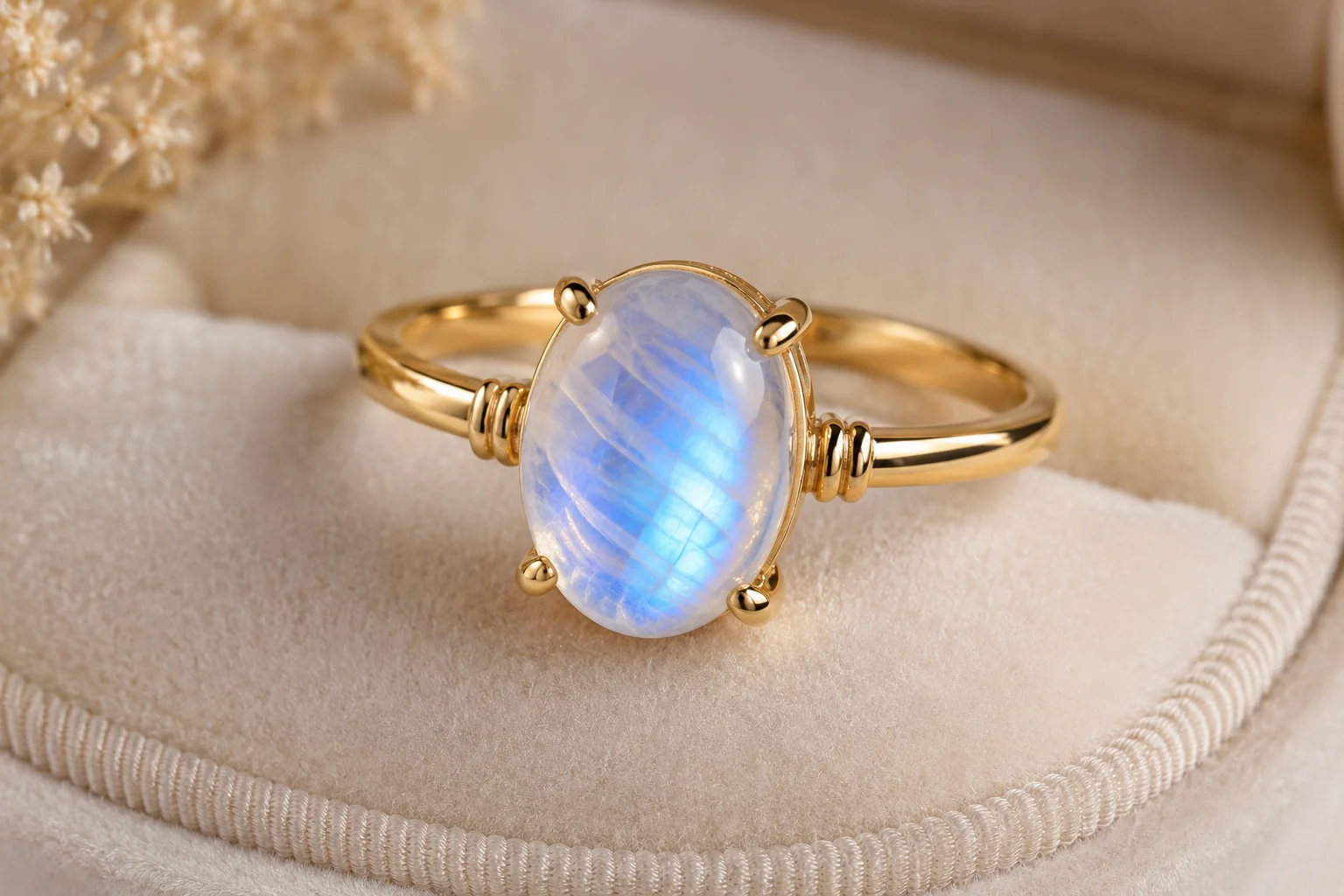
Moonstone rings place the gem’s moving internal glow where the wearer can observe it throughout the day. A correctly oriented cabochon may appear quiet from one angle and then fill with blue, white or silver light as the hand turns.
The ring format also exposes Moonstone to more mechanical stress than earrings or necklaces. Feldspar ranks 6–6.5 on the Mohs scale, has poor toughness and possesses cleavage directions that can allow a hard blow to split or chip the stone.
A successful Moonstone ring therefore depends on protective construction. The cabochon should sit low, its edges should be supported, and the setting should match the wearer’s routine rather than relying on the gem’s beauty alone.
The broader Moonstone gemstone guide owns the mineral’s structure, adularescence, history and symbolism. This page focuses specifically on ring styles, settings, durability, sizing, treatment, buying and care.
Moonstone Rings at a Glance
| Feature | What to evaluate |
|---|---|
| Gem family | Feldspar |
| Defining optical effect | Adularescence |
| Mohs hardness | 6–6.5 |
| Toughness | Poor |
| Structural concern | Cleavage and impact sensitivity |
| Best protective setting | Low full or substantial partial bezel |
| Classic cut | Oval or round cabochon |
| Main quality factor | Bright mobile sheen centered on the visible face |
| Main ring concern | Desk impact, exposed edges and high settings |
| Common varieties | White, blue-sheen, peach, dark and rainbow Moonstone |
| Common alterations | Backing, coating, filling, resin and assembled construction |
| Safest cleaning | Lukewarm water, mild soap and a soft brush |
Is Moonstone Suitable for Rings?
Moonstone can be used in rings, but it is not a carefree everyday stone.
Its moderate hardness means Quartz dust and harder gemstones can scratch the polish. More importantly, cleavage can allow a concentrated impact to break the feldspar internally.
The Gemstone Hardness Chart provides the numerical comparison, while Gemstone Toughness vs Hardness explains why a reasonably hard gem can still split.
A carefully worn bezel-set ring can remain attractive for years. A tall prong-set Moonstone worn during exercise, cleaning, lifting or mechanical work faces a much greater risk of damage.
Someone seeking a ring that can remain on through nearly every activity should compare harder choices in Best Gemstones for Everyday Wear.
Main Moonstone Ring Styles
| Ring style | Main advantage | Main concern |
|---|---|---|
| Full-bezel solitaire | Strong edge protection and low snagging | More visible metal |
| Partial-bezel solitaire | Balances visibility and protection | Open sides remain exposed |
| Prong-set cabochon | Shows more of the stone | Pressure points and vulnerable girdle |
| Halo ring | Adds contrast and visual size | Hard accent stones and numerous prongs |
| Signet ring | Broad metal support and low profile | Correct stone depth and metal weight |
| Cocktail ring | Displays a large dramatic cabochon | Height, leverage and occasional-wear limits |
| Cluster ring | Combines several Moonstones | Optical matching and maintenance |
| Three-stone ring | Balanced composition | Stone separation and matching |
| Rose-cut ring | Broad antique-style face-up spread | Thin stone and possible backing |
| Carved Moonstone ring | Artistic surface and symbolism | Fragile projections |
| Inlay ring | Smooth geometric appearance | Thin stone and adhesive dependence |
| Adjustable ring | Flexible initial fit | Repeated bending weakens metal |
Full-Bezel Moonstone Rings
A full bezel surrounds the cabochon’s perimeter with metal.
This is generally the strongest ring construction for Moonstone because it protects vulnerable edges and reduces snagging. A low bezel also limits the leverage created when the ring strikes a surface.
The metal should meet the stone evenly. Ripples, gaps, exposed glue or a cabochon that moves under gentle pressure indicate poor workmanship.
The bezel should not press aggressively over a surface-reaching fracture. Setting pressure can enlarge an existing weakness before the ring is even worn.
A closed metal back can support a thin cabochon, but it may conceal backing, filling or assembled construction. The seller should describe what lies beneath the visible face.
Partial Bezels
A partial bezel holds selected sides while leaving other edges open.
This construction can show more of the Moonstone and make the ring appear lighter than a full surround. It works best when the exposed sides are rounded, thick and structurally sound.
Open areas remain vulnerable to impact. A partial bezel around a pear, rectangle or sharp freeform needs particular attention near points and corners.
The ring should be assessed from the side. A protective-looking top view can conceal a cabochon that projects far above the metal.
Prong-Set Moonstone Rings
Prongs expose more of the stone but concentrate pressure at a few points.
A Moonstone should sit inside a supportive basket rather than balance only between the prong tips. The basket should contact the underside evenly and prevent rocking.
Prongs must not sit over visible fractures or tension cracks. During tightening, pressure can cause cleavage-related damage.
Rounded cabochons perform better than sharp pears or rectangular tablets in open prongs.
A prong-set ring is more appropriate for controlled or occasional wear than for unrestricted daily use.
Halo Moonstone Rings
A halo surrounds Moonstone with smaller accent stones.
Diamond, Sapphire, Moissanite and Cubic Zirconia can create bright contrast around a pale cabochon. However, these materials are harder than Moonstone and must not touch it directly.
Metal should separate every girdle. If the ring flexes and an accent rubs the center, the harder stone can scratch or chip the feldspar.
A halo introduces many prongs and joints, increasing maintenance. The center should sit low enough that the halo provides genuine protection rather than acting only as decoration.
The invoice should identify the accent stones rather than describing them vaguely as crystals.
Moonstone Signet Rings
A signet design places the cabochon inside a broad metal face.
This structure can be practical because the stone sits low and receives support from substantial surrounding metal. Oval, cushion, rectangular and freeform Moonstones all work in signet-style settings.
The face should remain thick enough beneath the cabochon. Hollow or very thin construction can flex, loosening the bezel.
A closed-back signet may hide a thin slab, backing or composite stone. Construction should be disclosed before the buyer assumes the gem is solid through its complete depth.
Signet styling is not limited by gender. Proportions, metal, stone color and wearer preference matter more than gendered product labels.
Cocktail and Statement Rings
A large Moonstone cabochon can create a dramatic cocktail ring.
Broad domes reveal strong movement and may show adularescence across a large surface. Nevertheless, a large stone also produces greater leverage and occupies more physical space above the finger.
A statement ring should sit securely without rotating. A broad lower shank, sizing beads or a well-balanced setting can improve stability.
High cocktail designs are best reserved for social occasions and controlled wear. They should be removed before driving long distances, carrying luggage or handling hard objects.
A dramatic blue flash does not compensate for an open fracture or poorly supported base.
Three-Stone and Cluster Rings
Three-stone designs may combine one large Moonstone with two smaller Moonstones or contrasting gems.
Matching several Moonstones is difficult because each stone’s glow depends on internal-layer orientation. The stones should coordinate in bodycolor, sheen color, brightness and viewing angle.
A cluster may use multiple small cabochons to create a floral, celestial or geometric design. Each additional stone introduces another setting that requires maintenance.
The stones should not collide when the ring flexes. Metal separation is especially important when Moonstone is combined with harder gems.
A deliberate gradient can use stronger center adularescence and softer side stones, provided the progression looks intentional.
Choosing Adularescence
Adularescence is the central visual quality factor.
Fine material shows a bright internal glow that moves broadly across the face. Blue sheen over a transparent or nearly transparent colorless body usually receives the strongest demand.
White and silver sheen are more available but can remain beautiful. Peach, gray and dark Moonstones create different visual effects that should not be evaluated solely against the blue-sheen ideal.
The glow should appear in the ring’s normal wearing position. Request video showing the exact piece upright on a hand or ring holder.
A flash visible only when the ring is tilted sharply away from the viewer will have less everyday impact.
The full material-quality framework belongs to the Moonstone Buying Guide, while market valuation belongs to the Moonstone Price Guide.
Cabochon Orientation and Dome
The cutter must orient Moonstone so its microscopic feldspar layers present the sheen toward the top.
An incorrectly oriented cabochon may show its strongest light at the side or beneath the setting.
The dome should be even. A very flat top can weaken the optical movement, while an excessively high dome creates unnecessary exposure and weight.
The base should sit securely within the ring without rocking. A highly curved or uneven underside may require extra filler or pressure to stabilize, neither of which is ideal.
Round and oval cabochons generally provide the most forgiving combination of optical display and edge safety.
Rose-Cut and Faceted Moonstone Rings
Rose-cut Moonstone has a flat base and faceted dome.
The style creates a broad face-up spread and works well in antique-inspired rings. Milky material is commonly fashioned this way because the facets add surface interest.
The thin profile may rely on metal or reflective backing to strengthen appearance. Such construction should be disclosed.
Transparent Moonstone can also be fully faceted. Faceting adds brilliance, but it may display adularescence less continuously than a cabochon.
A faceted stone remains cleavage-prone despite resembling a conventional transparent gem.
White Moonstone Rings
White Moonstone creates the classic pale ring appearance.
Transparent material with blue sheen can look cool and luminous in platinum, white gold or silver. Yellow gold produces stronger contrast, while rose gold softens the design.
Milky white material may show a diffused glow rather than a sharp blue flash. It can be effective in larger cabochons and vintage settings.
Cloudiness caused by internal structure should not be confused with a scratched or deteriorated surface.
Peach Moonstone Rings
Peach Moonstone ranges from cream and apricot to pink-orange and warm brownish peach.
Its sheen is usually white or silver rather than electric blue.
Rose gold and yellow gold complement the warm bodycolor, although white metal can create an attractive modern contrast.
A fine peach ring should still show mobile internal light. Bodycolor alone does not establish high quality.
Peach Moonstone is often more affordable than top colorless blue-sheen material, making it suitable for larger cabochons and artistic rings.
Black Moonstone Rings
Black Moonstone is a trade description for dark gray, brown or nearly black feldspar with pale sheen or patterned areas.
Its darker body creates a more dramatic ring and often works well in silver, oxidized metal or broad signet settings.
The stone may contain peach bands, gray zoning or light internal streaks.
A seller should photograph it under ordinary light. Strong backlighting can make dark material look more transparent and luminous than it appears during wear.
Rainbow Moonstone Rings
Rainbow Moonstone is normally transparent Labradorite showing blue or multicolored labradorescence.
It is a feldspar and a legitimate jewelry material, but it is not traditional orthoclase Moonstone.
The direct Labradorite vs Moonstone guide owns that mineral distinction.
Rainbow material often contains visible fractures or tension features. A vivid blue or multicolored flash should not overshadow structural inspection.
The trade name and underlying Labradorite identity should both be clear in the product description.
Moonstone vs Opal Rings
Moonstone and Opal can both appear luminous, but they differ in composition, optical effect and care.
Moonstone is crystalline feldspar displaying adularescence. Opal is hydrated amorphous silica and may display play-of-color.
The direct Moonstone vs Opal comparison owns the identification boundary.
Both require careful ring wear. Moonstone can cleave, while Opal can scratch, craze or absorb liquids depending on its type.
Neither should be purchased as a carefree substitute for Sapphire or Diamond.
Treatments, Backing and Imitations
Moonstone is not routinely treated through one universal commercial process, but coatings, backing, resin, fracture filling and assembled construction occur.
A dark or reflective backing can strengthen apparent blue sheen. A coating may add artificial color or surface flash.
Milky glass, Opalite, white Chalcedony and other feldspars can imitate the appearance.
The complete diagnostic process belongs to Real vs Fake Moonstone.
Avoid scratch, flame, acid and hot-needle testing. These methods can damage genuine Moonstone, coatings and settings without producing a dependable conclusion.
Choosing the Metal
Sterling silver and white gold complement blue and white sheen.
Yellow gold creates a traditional contrast, while rose gold pairs naturally with peach Moonstone.
The setting’s strength matters more than color. Prong thickness, bezel fit, gallery support and shank dimensions determine long-term durability.
Recipients with metal sensitivity should consult Best Gemstones and Metals for Sensitive Skin and obtain the full alloy description.
A plated ring may require periodic refinishing, and repair heat must be kept away from the Moonstone.
Shank Width and Ring Balance
A narrow shank can make the cabochon appear larger, but it may allow a top-heavy ring to rotate.
Large stones need enough lower-shank width to stabilize the design.
A tapered shank can look delicate near the Moonstone while retaining more metal beneath the finger.
The ring should pass the knuckle securely without compressing the finger. Wide signets and substantial bezels usually fit more tightly than thin bands of the same nominal size.
Sizing beads can reduce rotation when the finger and knuckle proportions make conventional sizing difficult.
Buying Moonstone Rings Online
Follow How to Buy Gemstones Online Without Getting Scammed.
Request continuous video of the exact ring in its normal upright position under diffused light. Stock images cannot represent the individual stone’s sheen angle or inclusions.
The seller should provide cabochon dimensions, ring size, metal alloy, total weight, treatment disclosure, resizing limits and views of the reverse.
For an expensive blue-sheen stone, an independent report may help confirm material identity and disclose detectable assembly or treatment. The Gemstone Certification guide explains what reports can establish.
A return period is essential because adularescence may look different from the seller’s photography.
Cleaning and Maintenance
Follow How to Clean Moonstone Jewelry Safely.
Use lukewarm water, mild soap and a soft brush or cloth. Keep cleaning brief when backing, filler or glue may be present.
Never use steam or ultrasonic equipment.
Remove the ring before exercise, cleaning, gardening, cooking, swimming and sleep.
Store it separately from harder gemstones and metal edges. Belief-based energetic care belongs to How to Cleanse and Charge Moonstone.
A loose cabochon, catching prong, new surface crack or bent shank requires professional inspection before further wear.
Frequently Asked Questions
1. Is Moonstone suitable for everyday rings?
It can be worn regularly with care, but cleavage, poor toughness and moderate hardness make it unsuitable for unrestricted wear.
2. What is the safest Moonstone ring setting?
A low full bezel generally offers the best edge protection and reduced snagging.
3. Can Moonstone be used in an engagement ring?
Yes, but it requires realistic maintenance and careful wear. Sapphire, Spinel and Diamond provide greater durability.
4. What is the best Moonstone color for a ring?
Transparent colorless material with strong mobile blue sheen receives the highest market demand, although white, peach and dark varieties have separate appeal.
5. Why does my Moonstone flash only at one angle?
The internal layers may be narrowly oriented or the cabochon may have been cut with limited face-up sheen.
6. Is rainbow Moonstone the same as traditional Moonstone?
No. It is generally transparent Labradorite sold under an accepted trade name.
7. Can Moonstone rings be backed?
Yes. Backing may support a thin stone or strengthen the apparent sheen, but it should be disclosed.
8. Are Moonstone halos safe?
They can be, provided harder accent stones do not touch the Moonstone and the center is properly supported.
9. Can a scratched Moonstone be repolished?
Minor surface wear may sometimes be repolished, but material loss can change the dome and optical orientation.
10. Can Moonstone rings be resized?
Many can, but heat, setting design, full bezels and fragile stones may restrict the amount of safe resizing.
11. Can Moonstone be cleaned ultrasonically?
No. Vibration can enlarge fractures or cause cleavage-related damage.
12. How often should a Moonstone ring be inspected?
A frequently worn ring should be checked periodically and immediately whenever the stone moves, a prong catches or a crack appears.
A Moonstone ring works best when the design accepts the feldspar’s limitations. A low setting, protected perimeter and correctly oriented cabochon allow the internal light to remain the focus without treating a cleavage-prone gem as though it were Diamond. The most successful ring is not the one that exposes the most stone, but the one that preserves the glow through realistic wear.