White Moonstone Meaning, Properties, Value and Identification
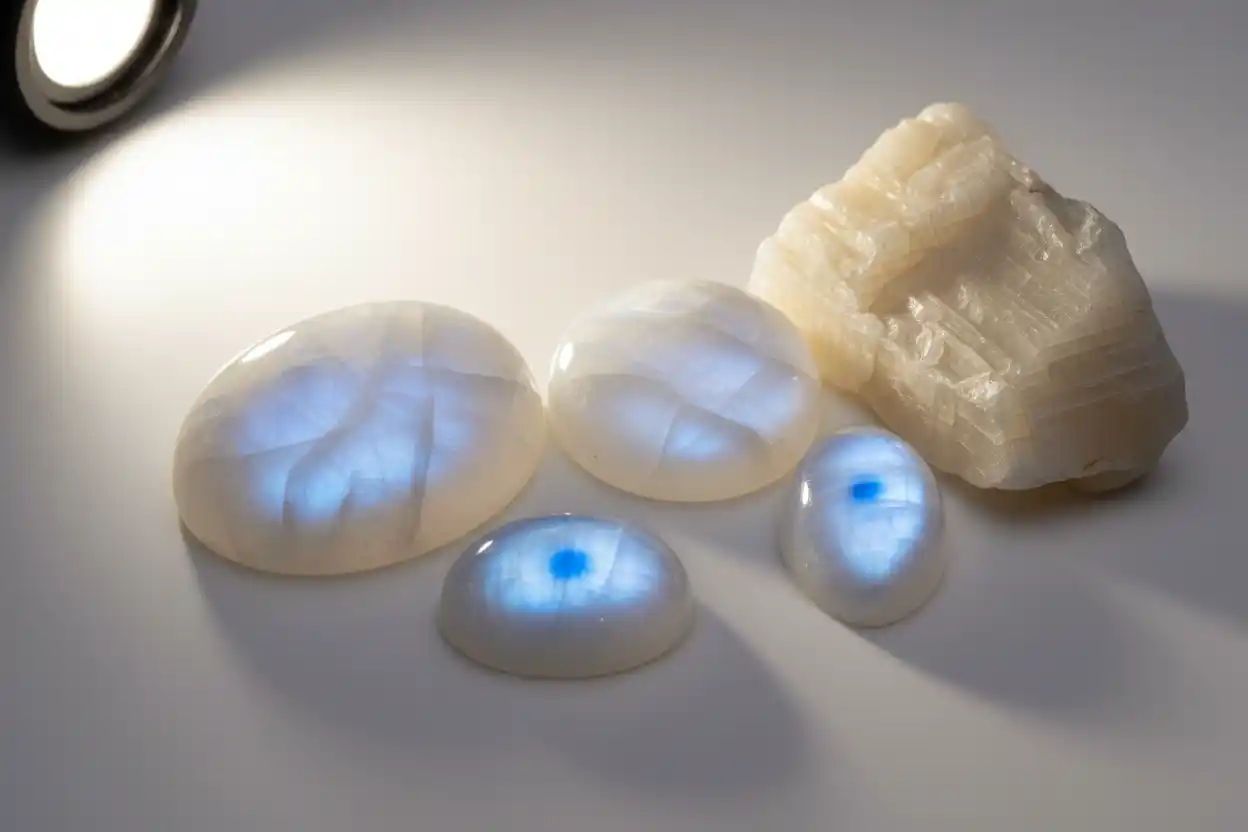
White moonstone is pale feldspar that displays adularescence—a floating white, silver or blue glow that appears to move beneath the surface as the stone or light changes position. Fine material combines a colorless-to-white body with a centered blue sheen, strong translucence and minimal distracting fractures.
The name is sometimes applied loosely to several iridescent feldspars. Classic white moonstone belongs to alkali feldspar, whereas most material sold as rainbow moonstone is light-colored labradorite from the plagioclase series.
White Moonstone at a Glance
| Property | White Moonstone |
|---|---|
| Mineral family | Feldspar |
| Typical mineral identity | Alkali feldspar intergrowth, commonly orthoclase with albite lamellae |
| Typical body colors | Colorless, white, cream, pale gray and faint beige |
| Optical phenomenon | Adularescence, commonly white, silver or blue |
| Crystal system | Monoclinic for orthoclase; internal intergrowth can be structurally complex |
| Common habit | Blocky or prismatic feldspar crystals, cleavage fragments and massive rough |
| Luster | Vitreous to pearly |
| Transparency | Transparent to opaque |
| Refractive index | Commonly approximately 1.518–1.526 |
| Specific gravity | Commonly approximately 2.56–2.59 |
| Mohs hardness | Approximately 6–6.5 |
| Cleavage | Perfect in two directions |
| Tenacity | Brittle |
| Common cuts | Cabochons, beads, carvings and occasional faceted stones |
| Main care concern | Cleavage, surface-reaching fractures, thermal shock and fracture filling |
What Is White Moonstone?
Moonstone is a gem-quality feldspar defined commercially by its adularescence.
Classic material consists of microscopic layers or intergrowths of feldspars with slightly different refractive properties. Light scatters and interferes within these layers, producing the floating glow.
The body can be colorless, white, gray, peach, green, brown or dark. White moonstone specifically owns the pale-to-white body-color category.
The parent moonstone guide covers broader history and traditional uses, while Types of Moonstone classifies the major body colors and feldspar materials.
The wider mineral relationships remain with the feldspar guide.
What Is Adularescence?
Adularescence is a billowing light effect that appears to float just below the moonstone’s surface.
It forms when light encounters microscopic feldspar layers with different refractive indices.
The scattered rays interfere and return to the viewer as a soft glow.
Thin, regularly spaced layers can create blue adularescence. Coarser or more irregular structures commonly produce white or silver light.
The glow moves because the angle between the light, internal layers and viewer changes.
Adularescence is not the same as opal’s play-of-color. Moonstone generally shows a broad white or blue sheen, whereas precious opal can display multiple spectral colors in patches or flashes.
White Body Color Versus White Sheen
The body color describes the stone when the optical glow is not dominating the view.
A white moonstone may have a white, cream, colorless or pale gray body.
The sheen describes the floating light effect. It may appear white, silver or blue.
Therefore, a white-bodied stone can display blue adularescence, while a nearly transparent stone can show a white glow.
Market descriptions should separate these two features. “Blue moonstone” can refer either to blue sheen or, less commonly, a bluish body color.
The most valued classic material usually has a colorless or nearly colorless body with a strong blue sheen.
White Moonstone Versus Rainbow Moonstone
Rainbow moonstone is generally transparent-to-white labradorite rather than classic orthoclase moonstone.
It can show blue, green, yellow, orange and multicolored flashes.
Classic white moonstone normally produces a softer white, silver or blue adularescence without the broad rainbow spectrum.
Both belong to the feldspar family, so the market has long used moonstone terminology for their similar visual effects.
The distinction matters because the materials have different feldspar composition, optical behavior and inclusion patterns.
A seller should disclose whether the stone is alkali-feldspar moonstone or white labradorite sold under the rainbow-moonstone trade name.
White Moonstone Versus Peach and Black Moonstone
Peach moonstone has a peach, orange, tan or warm beige body produced by inclusions and trace-element effects.
White moonstone lacks the dominant warm peach body color, although faint cream or beige undertones can occur.
Black moonstone has a dark gray, brown or black body, often with silver or pale adularescence.
These color pages should retain their own body-color, buying and symbolism intent rather than being reduced to sections of one generic moonstone article.
Why Is White Moonstone White?
Low concentrations of strong coloring elements allow the feldspar to remain colorless or pale.
Microscopic inclusions, cleavage planes and exsolution structures scatter light and create a milky white appearance.
More transparent material contains fewer visible inclusions and allows the adularescence to appear sharper.
Cream or beige tones can result from iron staining, mineral inclusions or body-color absorption.
A chalky white appearance may reflect dense internal fractures, coarse structure or treatment rather than high quality.
Cat’s-Eye and Star White Moonstone
Parallel inclusions or structural features can produce a narrow moving line known as chatoyancy.
Cat’s-eye white moonstone should show a distinct eye that moves across the dome under one light source.
When two or more directions of aligned features occur, a star effect may develop.
Phenomenal moonstones require careful cutting. The cabochon base must align with the internal structure for the eye or star to appear centered.
A vague broad glow should not be marketed as a sharp cat’s eye merely to justify a higher price.
How White Moonstone Forms
Moonstone develops when feldspar crystallizes and later separates into extremely fine intergrowths during cooling.
At high temperature, different feldspar components may mix more completely. As the crystal cools, they separate into microscopic layers or lamellae.
The thickness and spacing of these layers determine the appearance of adularescence.
Pegmatites and other feldspar-rich igneous environments commonly produce moonstone rough.
Metamorphic processes can also recrystallize feldspar and produce material with an optical sheen.
Weathering releases feldspar crystals into alluvial deposits, where miners recover rounded moonstone pebbles.
Important Sources
Sri Lanka is the classic source of transparent white moonstone with blue sheen. Fine Sri Lankan stones can combine excellent translucence with a centered floating glow.
India supplies large quantities of commercial white, cream, gray, peach and rainbow-moonstone material. Much Indian white material has a soft white sheen and moderate translucence.
Myanmar has produced high-quality moonstone, including nearly colorless stones with blue adularescence.
Madagascar and Tanzania supply white and pale feldspar with blue, silver or white sheen.
Brazil, Mexico, the United States and several European localities also contain moonstone-bearing feldspars.
Origin alone does not determine quality. A fine Indian or Tanzanian stone can outperform a weak Sri Lankan example.
Inclusions and Internal Features
Moonstone commonly contains stress fractures, cleavage planes, mineral crystals and fluid inclusions.
A characteristic inclusion pattern sometimes called the centipede consists of short fractures intersecting a longer central line.
These inclusions can support natural identification but are not present in every stone.
Exsolution lamellae create the optical effect but usually remain too small to see with ordinary magnification.
Fine fractures may reflect light and compete with the adularescence.
Surface-reaching cracks can collect oil, resin or polishing compound. They also reduce durability.
Strong internal strain may become visible under polarized light.
Cutting and Orientation
Moonstone is usually cut as a cabochon because a curved surface allows the sheen to move smoothly.
The cutter must orient the rough so the adularescent layer lies parallel to the base of the cabochon.
Poor orientation places the glow near one edge or makes it visible only from a narrow angle.
A high dome can improve movement but adds weight and may darken included material.
A very flat cabochon can weaken the optical effect or expose cleavage-related fractures.
Transparent rough is occasionally faceted, but ordinary facets can break the broad glow into smaller reflections.
Carvings and beads preserve more weight but often display less centered adularescence than carefully oriented cabochons.
White Moonstone Quality Factors
Sheen Strength
The glow should appear bright enough to remain visible under moderate lighting.
Sheen Color
Blue generally commands the highest premium, followed by bright silver or white.
Centering and Movement
The sheen should move smoothly across the center rather than remaining trapped at an edge.
Body Color
Colorless or clean white bodies generally receive stronger demand than gray, yellow or brown backgrounds.
Transparency
Fine moonstone ranges from semitransparent to transparent. Excessive cloudiness can hide the optical effect.
Clarity
Some inclusions are expected, but large cracks and obvious pits reduce value and durability.
Cut
A symmetrical dome and correct orientation contribute directly to the optical performance.
White Moonstone Versus Opal
Moonstone vs Opal explains the complete comparison.
Moonstone is feldspar and displays adularescence. Opal is hydrated silica and can show spectral play-of-color.
Moonstone generally has cleavage, while opal lacks cleavage but may craze because of water loss or internal stress.
White common opal can resemble milky moonstone when neither shows a strong optical phenomenon.
Refractive index, density and microscopic structure provide dependable separation.
White Moonstone Versus Labradorite
The complete distinction appears in Labradorite vs Moonstone.
Classic moonstone usually belongs to alkali feldspar and shows soft adularescence.
Labradorite belongs to plagioclase feldspar and commonly produces stronger labradorescence in blue, green, yellow and other colors.
White labradorite is widely marketed as rainbow moonstone.
Both can be legitimate natural feldspars, but precise naming improves buyer expectations.
White Moonstone Versus Selenite
Selenite is gypsum and has a hardness of approximately 2, making it far softer than moonstone.
Fibrous satin spar can show a moving silky line that resembles chatoyancy.
Moonstone has a harder feldspar surface, different cleavage and an internal floating glow rather than a simple surface fiber effect.
White Moonstone Versus Glass
Glass imitations may contain rounded bubbles, flow lines and a uniform internal glow.
Manufacturers can create blue-film cabochons or fiber-optic glass that produces a moving line.
Natural moonstone commonly shows irregular inclusions, cleavage-related features and a softer, less mechanically perfect sheen.
Laboratory refractive-index and microscopic testing provide stronger separation than appearance alone.
Identifying Real White Moonstone
A spot refractive-index reading around 1.52 supports common moonstone.
Specific gravity near 2.56–2.59 also fits alkali feldspar.
Magnification may reveal centipede inclusions, cleavage cracks, layered scattering and natural mineral inclusions.
The adularescence should originate from within the material rather than from a surface coating.
Raman spectroscopy can identify the feldspar phase and distinguish alkali moonstone from labradorite.
The complete consumer checks appear in Real vs Fake Moonstone and the broader crystal identification guide.
Treatments, Fillers and Imitations
Most white moonstone is sold without color enhancement.
However, fracture filling with oil, wax or polymer can reduce the visibility of surface-reaching cracks.
GIA has documented filled moonstone beads with blue adularescence. Infrared spectroscopy and microscopy can reveal some filling materials.
Coatings may create or intensify a blue sheen. Surface abrasion around drill holes and facet edges can expose them.
Doublets may combine a thin natural feldspar layer with another backing.
Heat treatment is not a routine commercial process for producing white moonstone adularescence.
Synthetic feldspar and manufactured glass can imitate appearance, but they should be disclosed as laboratory-grown or simulated products.
The broader categories appear in Gemstone Treatments Explained and Lab-Grown vs Natural Gemstones.
Hardness, Cleavage and Durability
Moonstone measures approximately 6–6.5 on the gemstone hardness chart.
That hardness offers moderate scratch resistance but does not protect the stone from impact.
Feldspar has perfect cleavage in two directions. A sharp blow can split the gem or create a large internal crack.
The relationship between scratch resistance and breaking appears in gemstone toughness versus hardness and gemstone cleavage explained.
Pendants and earrings provide safer wear than rings and bracelets.
Jewelry Suitability
A protected moonstone ring can work for occasional wear, especially when the cabochon sits low within a bezel.
High exposed domes chip more easily.
Moonstone necklaces and moonstone earrings expose the stone to fewer hard impacts.
Moonstone bracelets face repeated contact with desks and doorframes, so thick stones and protective settings are preferable.
Inspect drill holes in beads because cleavage fractures can begin there.
Moonstone is also recognized as one of the June birthstones.
White Moonstone Prices in 2026
Commercial milky white moonstone with weak or broad sheen commonly retails for approximately $2–$15 per carat.
Better white cabochons with visible centered silver or blue adularescence often range from $15–$50 per carat.
Fine transparent or highly translucent stones with strong blue sheen commonly reach $50–$200 per carat.
Exceptional large stones with vivid centered blue adularescence, clean bodies and desirable provenance may exceed $200–$300 per carat.
Cat’s-eye or star material can receive a premium when the phenomenon is sharp and centered.
Beads, carvings and opaque commercial material are often priced by piece rather than by carat.
Rainbow moonstone belongs to a related but distinct market, so its prices should not be transferred automatically to classic white moonstone.
The detailed valuation framework remains with the Moonstone Price Guide.
What Determines White Moonstone Value?
Blue adularescence usually commands the highest premium.
The effect should be bright, centered and visible over a wide range of movement.
A clean colorless or white body allows the sheen to dominate.
Transparency adds value when it does not reveal distracting fractures.
Large stones become more valuable only when they retain strong adularescence and good clarity.
Cut orientation is essential. A poorly centered sheen can reduce the value of otherwise fine rough substantially.
Treatment disclosure and correct identification also matter, particularly when rainbow moonstone or filled beads are involved.
Buying Guidance
Use the Moonstone Buying Guide for the full quality and seller checklist.
Ask whether the stone is classic moonstone or white labradorite marketed as rainbow moonstone.
View a video under one moving light source. Still photographs can exaggerate or hide adularescence.
Check whether the sheen crosses the center or remains visible only at one extreme angle.
Inspect the stone dry and under neutral lighting.
Ask about fracture filling, coating and assembled construction.
For a high-value cabochon, obtain an independent laboratory report.
Avoid paying a blue-sheen premium for a cloudy white stone that shows only a surface reflection.
Cleaning, Water, Heat and Sunlight
Clean white moonstone with lukewarm water, mild soap and a very soft brush or cloth.
The complete process appears in How to Clean Moonstone Jewelry.
Avoid ultrasonic and steam cleaners. Vibration, heat, cleavage and surface-reaching fractures create unnecessary risk.
Brief water contact is generally acceptable for an untreated solid stone. Prolonged soaking is unnecessary, especially when filling, glue or coatings may be present.
Sudden temperature changes can extend fractures. Do not move the stone directly from hot water into cold water.
Most natural white moonstone color is stable in ordinary indoor light. However, prolonged heat can damage fillers and adhesives.
Store each piece separately so harder gems do not scratch the feldspar surface.
For belief-based cleansing, use the gentle options in How to Cleanse and Charge Moonstone rather than prolonged saltwater or direct hot sunlight.
Meaning and Symbolism
Moonstone has long been associated with lunar imagery because its glow appears to move like light across clouds.
Modern traditions connect white moonstone with reflection, intuition, new beginnings, emotional awareness and changing life cycles.
Some wearers use it as a reminder to pause before responding or to accept that clarity can develop gradually.
White body color also supports associations with honesty, renewal and quiet focus.
These meanings are cultural, spiritual or personal rather than scientifically demonstrated effects.
White moonstone appears in modern collections of white crystals and white gemstones, but its adularescence—not white color alone—defines its gemological identity.
Frequently Asked Questions
1. What is white moonstone?
White moonstone is pale feldspar that displays a floating white, silver or blue adularescent glow.
2. Is white moonstone the same as rainbow moonstone?
Not exactly. Classic white moonstone is usually alkali feldspar, while rainbow moonstone is commonly white labradorite.
3. What causes the glow in white moonstone?
Light scatters and interferes within microscopic feldspar layers, creating adularescence.
4. Is blue sheen more valuable than white sheen?
Usually yes. Strong centered blue adularescence on a clean colorless or white body receives the highest broad market demand.
5. Is milky white moonstone natural?
Yes. Microscopic inclusions, fractures and feldspar structure can create a natural milky appearance.
6. Can white moonstone show a cat’s eye?
Yes. Parallel internal features can produce chatoyancy when the stone is cut and oriented correctly.
7. How can white moonstone be distinguished from opal?
Moonstone is feldspar and shows adularescence. Opal is hydrated silica and may show spectral play-of-color.
8. Is white moonstone treated?
Most material is untreated, but fracture filling, coatings and assembled stones can occur.
9. Is white moonstone suitable for an everyday ring?
It requires a protective setting and careful wear because feldspar has cleavage and only moderate hardness.
10. Can white moonstone go in water?
Brief gentle cleaning is usually acceptable for untreated material. Avoid prolonged soaking when treatment or glue may be present.
11. How much is white moonstone worth?
Commercial material may cost a few dollars per carat, while fine blue-sheen stones commonly reach $50–$200 per carat. Exceptional gems can exceed that range.
12. Does white moonstone have scientifically proven healing properties?
No. Its symbolism can hold personal meaning, but scientific evidence does not establish healing effects.
White moonstone earns its value through movement rather than static color. The finest cabochon should change as it turns, allowing a concentrated blue or silver glow to travel across a clean pale body instead of remaining fixed like a coating or ordinary reflection.
White moonstone appears in Crystals That Start With W and Gemstones That Start With W.