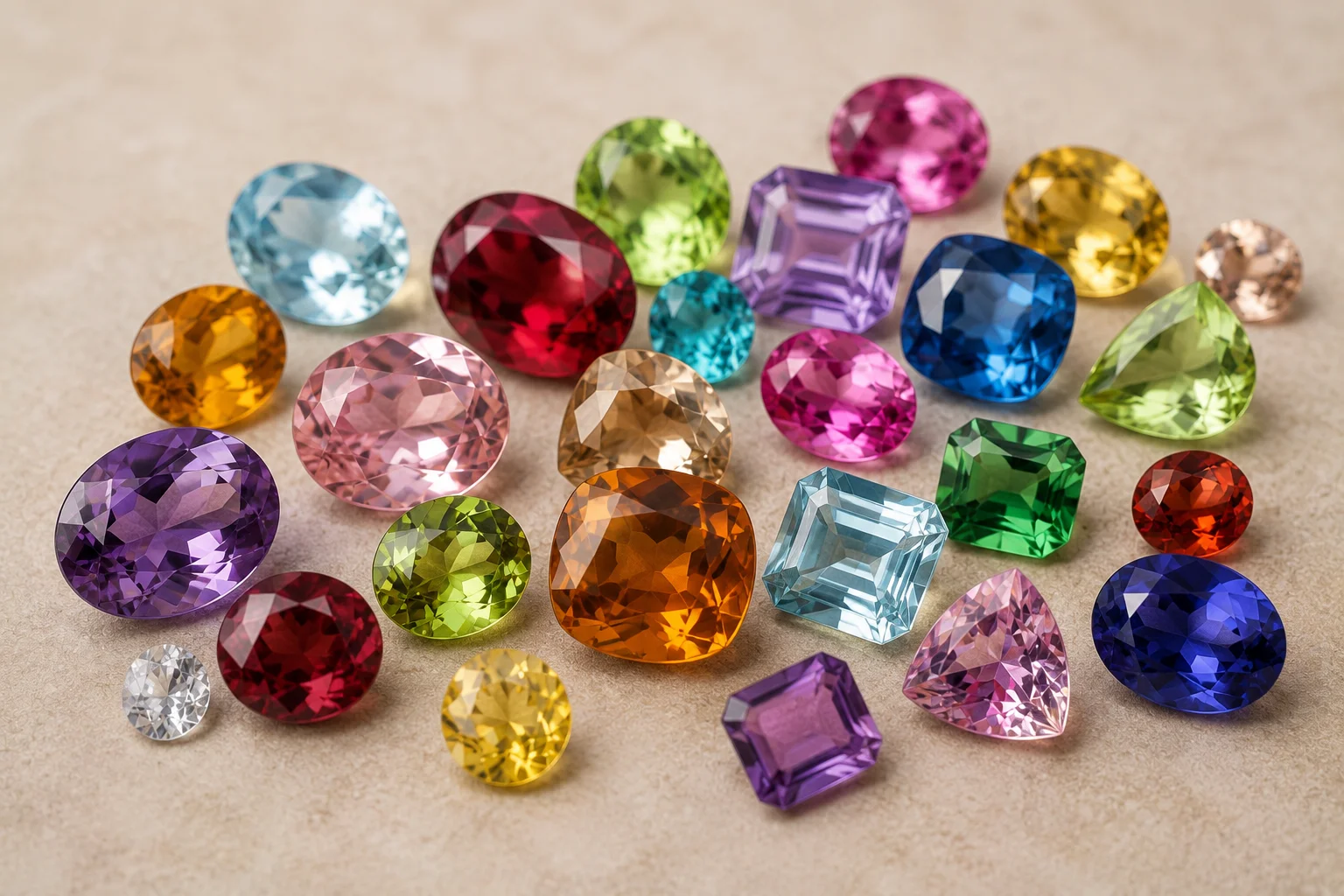
Affordable Gemstones: Best Options for Every Budget
Affordable gemstones can deliver excellent color, durability and visual impact without requiring the budget associated with fine ruby, emerald, alexandrite or premium sapphire. The challenge is that “affordable” does not mean the same thing for every gem—or every buyer.
A large amethyst may remain reasonably priced because clean quartz crystals are widely available. A red garnet can be accessible while an equally sized tsavorite garnet belongs to a much higher market tier. Blue topaz can provide substantial size and vivid color at a modest cost, but buyers should understand that its blue color is normally treatment-produced. Certain spinels can be affordable, while exceptional red or cobalt-blue spinel can be anything but inexpensive.
The best affordable gemstones are therefore not simply the cheapest stones.
They offer a useful combination of:
appearance + durability + honest disclosure + appropriate size + sensible total cost.
That final point matters. A $40 loose gemstone placed into a $900 custom gold setting is no longer a $40 jewelry purchase. Likewise, a slightly more expensive stone that survives regular wear can provide better long-term value than a cheaper gem that requires frequent replacement.
This guide compares affordable gemstones by color, jewelry use, durability, treatment and buying priorities so you can choose a stone that fits both your budget and how you actually plan to wear it.
Best Affordable Gemstones at a Glance
| Gemstone | Typical budget position | Mohs hardness | Strongest reason to choose it | Main caution |
|---|---|---|---|---|
| Amethyst | Low | 7 | Rich purple, many sizes | Very dark stones can lose brightness |
| Smoky quartz | Low | 7 | Large sizes at accessible prices | Excessively dark material can appear black |
| Rose quartz | Low | 7 | Soft pink color, large decorative pieces | Usually translucent rather than brilliant |
| Citrine | Low to moderate | 7 | Warm yellow to orange color | Much commercial material is heat-treated |
| Common red garnet | Low to moderate | ~6.5–7.5 | Saturated natural red | Rare garnet varieties can be expensive |
| Blue topaz | Low to moderate | 8 | Large, clean blue stones | Perfect cleavage; blue is usually treated |
| Peridot | Moderate | 6.5–7 | Natural yellow-green to green color | Needs more protection than sapphire |
| Iolite | Moderate | 7–7.5 | Natural blue-violet appearance | Strong pleochroism makes cutting critical |
| Zircon | Moderate | 6–7.5 | Exceptional brilliance and dispersion | Brittle; facet edges can abrade |
| Selected spinel colors | Moderate | 8 | Strong durability and brilliance | Premium red and cobalt colors can be costly |
| Lab-grown sapphire | Low to moderate relative to natural sapphire | 9 | Excellent durability and saturated color | Laboratory origin must be disclosed |
These categories are relative. Fine cutting, unusual size, premium color, provenance, rare optical effects or designer jewelry can make normally affordable gemstones substantially more expensive.
What Makes a Gemstone Affordable?
Gemstone price is not determined by beauty alone.
Supply matters.
Demand matters.
Large-crystal availability matters.
Treatment availability matters.
Fashion matters.
Rarity at a particular quality level matters.
An inexpensive gemstone may be completely natural and attractive simply because nature supplies enough material to meet demand.
Amethyst is a good example. Large transparent quartz crystals occur in significant quantities, so increasing from two carats to ten carats does not necessarily create the dramatic price multiplication seen in much rarer gems.
The opposite can happen in a scarce material.
A gemstone may be reasonably affordable below one carat but become dramatically more expensive once clean stones above two or three carats become difficult to find.
The broader Buying & Value section explores these differences across individual gem markets.
When comparing affordable gemstones, ask why the stone is inexpensive.
There is a significant difference between:
- inexpensive because the material is abundant;
- inexpensive because the color is less desirable;
- inexpensive because the stone is treated;
- inexpensive because the cut is poor;
- inexpensive because it is laboratory-grown;
- and inexpensive because the seller has described the material inaccurately.
Price makes more sense once you understand the reason behind it.
Best Affordable Gemstones by Color
Color is often the fastest way to narrow the options.
Purple: Amethyst
Amethyst remains one of the strongest affordable gemstones for buyers who want an obviously colorful natural gem.
As purple quartz, it combines Mohs hardness 7 with broad availability and an enormous range of sizes.
The best-value amethyst is not necessarily the darkest.
Very deep purple material can become so dark that it loses liveliness in ordinary indoor light. A medium-to-rich purple stone with good brightness and minimal distracting zoning can be far more attractive.
Large size is another advantage. Because sizable clean material occurs naturally, buyers can often choose substantial center stones without encountering the steep per-carat premiums common in rarer gems.
The amethyst price guide explains why color and cutting usually matter more than size alone.
Amethyst is particularly useful for earrings, pendants, necklaces and occasional-wear rings.
Brown and Smoky Gray: Smoky Quartz
Smoky quartz is among the best affordable gemstones when size and visual presence matter more than rarity.
It ranges from pale gray-brown through warm smoky brown to very dark material.
Large transparent stones are common enough that bold pendants, cocktail jewelry and statement cuts can remain accessible.
The main buying issue is tone.
A smoky quartz may photograph beautifully under intense lighting but look almost black in ordinary conditions if it is excessively dark.
Ask to see the gem under neutral lighting before purchasing online.
The smoky quartz price guide provides more context on size, tone and cutting.
For buyers who like earthy colors, smoky quartz can offer excellent visual size per dollar.
Pink: Rose Quartz
Rose quartz is one of the most accessible affordable gemstones for soft pink color.
Much rose quartz is translucent rather than transparent, so it should not be purchased with the expectation that it will behave optically like pink sapphire or spinel.
Its appeal is softer.
Good material can show an attractive pastel pink appearance in cabochons, beads, carvings and polished jewelry.
Because rough is widely available, size can remain substantial without creating a rare-gem price structure.
Some material may also show star effects when cut appropriately.
The rose quartz price guide explains how color, translucency, workmanship and unusual optical characteristics affect value.
Rose quartz is especially appealing when the jewelry design matters more than brilliance.
Yellow and Orange: Citrine
Citrine is one of the most practical affordable gemstones for yellow, golden and warm orange-brown color.
It belongs to the quartz family and therefore has Mohs hardness around 7.
Large stones are readily available.
However, buyers should understand treatment.
Much commercial citrine is produced by heating suitable amethyst or related quartz material. That does not make it fake. Heated natural quartz remains natural quartz, but treatment should be understood because naturally colored citrine and heat-produced material can occupy different market positions.
The citrine price guide provides more detail on these value differences.
When comparing citrine, prioritize attractive color and cutting rather than assuming deeper orange automatically means greater rarity.
Red: Garnet
Common red garnets are among the most useful affordable gemstones for deep natural red color.
But “garnet” is a mineral group, not one uniform gem.
This distinction is critical.
Commercial almandine and some related red garnets can be very accessible.
Fine tsavorite, demantoid and certain exceptional orange garnets can command dramatically higher prices.
Therefore, a seller saying “garnet is inexpensive” tells you very little until the actual variety is identified.
Common red garnet is attractive because it can deliver saturated red without ruby-level cost.
Many examples also have sufficient durability for regular jewelry when appropriately set and worn.
The garnet price guide separates common and premium garnet markets.
For budget jewelry, red garnet can be one of the strongest combinations of natural color, traditional gem character and moderate cost.
Blue: Blue Topaz
Blue topaz is one of the most visually impressive affordable gemstones when you want a large, bright blue center stone.
Topaz reaches Mohs hardness 8, giving it strong scratch resistance.
However, hardness alone does not describe durability.
Topaz has perfect cleavage, which means a sufficiently strong impact in an unfavorable direction can split or chip the stone.
This makes setting design important for rings.
Another key consideration is treatment.
Strong blue topaz is widely available because suitable topaz can be treated to produce blue colors commonly marketed as Sky Blue, Swiss Blue and London Blue.
The treatment is well established, but buyers should not mistake ordinary treated blue topaz for an exceptionally rare naturally blue gemstone.
The topaz price guide explains why common blue topaz and rarer topaz colors occupy very different price levels.
Blue topaz is particularly attractive when size, clarity and vivid color matter more than rarity.
Green: Peridot
Peridot is one of the better affordable gemstones when you want a naturally green gem rather than green color produced through routine commercial treatment.
Its characteristic color ranges from yellow-green to greener shades.
More attractive stones generally minimize muddy brown components while maintaining enough saturation to look clearly green.
Peridot is softer and somewhat less robust than sapphire or spinel, so protective settings are useful for frequent ring wear.
Pendants and earrings expose the stone to fewer knocks.
The peridot price guide covers how color, clarity, cutting and size influence price.
Peridot is particularly appealing to buyers who want a recognizable natural green without entering the pricing territory of fine emerald or tsavorite.
Blue-Violet: Iolite
Iolite deserves more attention in discussions of affordable gemstones.
The gem-quality variety of cordierite can show attractive blue to violet-blue color at accessible price levels.
Its strongest feature is also its biggest buying challenge: pleochroism.
Iolite can show dramatically different colors along different crystal directions. A cutter must orient the rough carefully so the most attractive blue or violet-blue direction dominates face-up.
Poor orientation can leave the finished stone looking gray, brownish or watery.
This means cutting quality can matter more in iolite than many first-time buyers expect.
The iolite price guide explains why orientation is central to value.
Iolite works well for buyers who want a natural blue-violet gem that feels less conventional than blue topaz.
High Brilliance: Natural Zircon
Natural zircon is one of the most underrated affordable gemstones.
It should not be confused with cubic zirconia.
Zircon is a naturally occurring mineral.
Cubic zirconia is a laboratory-made diamond simulant with a completely different chemistry and crystal structure.
Well-cut zircon can show excellent brilliance and noticeable dispersion, creating colorful flashes of light.
It occurs naturally in several colors, although some commercially important zircon colors are produced through heat treatment.
The main disadvantage is durability.
Zircon can be relatively brittle, and facet edges may abrade with repeated wear.
The zircon price guide explains differences among color, treatment and quality levels.
Zircon can be a compelling option for earrings and pendants or carefully worn rings when optical liveliness is a priority.
Selected Spinel Colors
Spinel demonstrates why entire gemstone species should not be labeled simply “cheap” or “expensive.”
Fine red spinel can be highly valuable.
Cobalt-blue material can also command exceptional prices.
Certain vivid pink stones occupy premium markets.
But lavender, purple, grayish, pastel or less commercially sought-after colors may sometimes offer far more approachable pricing.
Spinel has an important advantage over many other affordable gemstones: durability.
At Mohs 8 with generally good toughness, it can be an excellent ring stone.
The spinel price guide helps separate accessible colors from premium market categories.
If you want a natural gem with strong jewelry performance, selected spinel colors deserve serious consideration.
Lab-Grown Sapphire: Maximum Durability for the Budget
Not every buyer requires natural geological origin.
If durability and color matter more than natural rarity, laboratory-grown sapphire can provide exceptional performance for the price.
Synthetic sapphire is laboratory-grown corundum.
It has essentially the same basic crystal structure, hardness and major physical properties as natural sapphire, but its origin is artificial.
That makes it fundamentally different from glass or an unrelated imitation.
At Mohs 9, sapphire offers excellent scratch resistance for rings and frequently worn jewelry.
Laboratory growth can also provide saturated colors and clean appearance at prices far below equivalent fine natural sapphire.
The origin must be disclosed clearly.
The lab sapphire price guide explains why laboratory-grown and natural sapphire have different value structures despite sharing the same basic mineral identity.
For buyers prioritizing daily wear over rarity, lab-grown sapphire may outperform many natural affordable gemstones.
Which Affordable Gemstones Are Best for Rings?
Rings receive more abuse than most jewelry.
They strike desks, doors, tools and household surfaces. They encounter soap, cosmetics, temperature changes and repeated abrasion.
That makes durability a major part of value.
For rings, selected spinel and laboratory-grown sapphire are particularly strong options.
Amethyst and other quartz varieties can also perform reasonably well when worn with normal care.
Red garnet can make an effective ring stone depending on variety and construction.
Blue topaz offers excellent hardness but requires protection from sharp impacts because of cleavage.
Peridot, iolite and zircon can certainly appear in rings, but settings and wear habits become more important.
A bezel, partial bezel, halo or other protective architecture can reduce direct exposure to vulnerable edges.
If you want affordable gemstones for a ring worn every day, choosing the right material may be more important than saving the final 10% of the purchase price.
Best Affordable Gemstones for Earrings
Earrings are one of the easiest places to use more delicate affordable gemstones because they experience relatively little impact.
Amethyst, citrine, garnet, blue topaz, peridot, iolite and zircon can all work well.
Even large stones can remain practical because earrings do not rub against hard surfaces as frequently as rings.
Weight becomes important with very large gems and metal settings.
For earrings, you can prioritize color and visual size more heavily than toughness.
This makes earrings an excellent place to use unusually large affordable gemstones without designing around constant impact risk.
Best Affordable Gemstones for Pendants
Pendants offer similar advantages.
They experience less impact than rings and allow large stones to be displayed effectively.
Smoky quartz, rose quartz, amethyst, citrine and blue topaz can create substantial visual presence at comparatively accessible prices.
Pendants are also useful for gems whose cleavage or brittleness would make them less attractive for daily rings.
Setting quality still matters, particularly around bail construction and stone security.
Affordable Gemstones for Engagement Rings
Engagement rings create a more demanding use case because they may be worn daily for decades.
A low initial price should not be the only consideration.
Selected natural spinel can provide a strong balance of durability and color.
Laboratory-grown sapphire is another highly practical choice where synthetic origin is acceptable.
Amethyst can work for someone willing to accept more maintenance and realistic wear, but it is less scratch-resistant than sapphire.
Topaz needs respect for cleavage.
Peridot, iolite and zircon require more protection and may be better suited to people comfortable with occasional repair or replacement.
There is no rule that an engagement ring must use diamond.
But the replacement risk of a softer affordable gemstone should be included in the long-term budget.
Affordable Gemstones When Size Matters
Some buyers care more about visual size than rarity.
Quartz varieties excel here.
Amethyst, smoky quartz, rose quartz and citrine can occur in large crystals, which makes substantial finished stones relatively accessible.
Blue topaz also performs strongly when size matters.
A large stone can create dramatic jewelry without automatically creating the price expected for equally sized ruby, sapphire or emerald.
However, carat weight can be misleading.
Different gemstones have different densities, and two stones with the same carat weight can have noticeably different face-up dimensions.
Cut proportions matter too.
A deep stone may hide substantial weight below the setting while looking smaller from above than a lighter but better-spread gem.
For affordable gemstones, compare millimeter dimensions as well as carat weight.
Budget Under $100: What to Prioritize
At a very limited budget, spend less time chasing rarity and more time looking for a good-looking example of an abundant material.
Strong options may include:
- Amethyst
- Smoky quartz
- Rose quartz
- Citrine
- Small common red garnets
- Commercial blue topaz
- Small peridot or iolite
The exact purchase depends heavily on whether you are buying a loose gem or finished jewelry.
At this level, cutting and seller accuracy can matter more than whether the stone has a famous origin.
A well-cut modest amethyst may look far better than an aggressively marketed “rare” stone with poor proportions.
Budget Around $100–$300
This range gives buyers much more flexibility.
You can often move toward:
larger amethyst, better-cut garnet, more attractive peridot, iolite, natural zircon, selected spinel colors, larger blue topaz or better jewelry settings.
At this level, start paying more attention to total craftsmanship.
If the setting is inexpensive plated metal, spending almost the entire budget on a larger stone may not produce the most durable finished piece.
Sterling silver or a well-made lower-cost gold setting may provide better overall value depending on the intended use.
Budget Around $300–$500
A moderate jewelry budget can open access to noticeably better color, cutting and setting quality.
Instead of buying the largest affordable gemstones available, consider whether upgrading the cut creates more visual improvement.
A precision-cut iolite can outperform a much larger but poorly oriented stone.
A bright medium-size spinel may be more appealing than a larger dull example.
A well-proportioned zircon can show far more life than a heavier stone with obvious windowing.
This is the point where comparing finished jewelry quality becomes especially important.
Budget Above $500
Affordable gemstones do not stop being useful when the budget increases.
A larger budget can be directed toward:
- superior cutting;
- custom settings;
- higher-quality metal;
- unusually fine color;
- matched stones;
- larger sizes;
- documented provenance;
- specialty lapidary work.
The advantage of choosing affordable gemstones at this budget is that more of the purchase can go toward craftsmanship rather than raw-material scarcity.
A beautifully made gold ring with an excellent amethyst may provide more visual and personal value than a tiny low-quality example of a prestigious gem purchased only for the name.
The Setting Can Cost More Than the Gemstone
This is one of the most important principles when shopping for affordable gemstones.
Loose-stone cost is only one component of finished jewelry.
A setting can include:
gold or platinum, side stones, labor, design, casting, finishing, sizing, engraving, branding and retail margin.
Suppose an attractive loose gem costs $75.
A custom 18-karat gold ring may cost many times that amount.
Therefore, “gemstone budget” and “jewelry budget” should be treated separately.
Before buying a loose stone, determine approximately what setting it will require.
An unusual shape may need custom work that eliminates much of the saving you achieved by choosing an inexpensive center gem.
Better Cutting Can Beat Bigger Size
Affordable gemstones are often available in larger sizes, which creates temptation to maximize carat weight.
Bigger is not automatically better.
A poorly cut gem can have:
- a transparent window through the center;
- large dark areas;
- uneven color;
- excessive depth;
- poor symmetry;
- unattractive proportions.
A slightly smaller stone with stronger light return and better proportions may look considerably more impressive.
This is especially important with iolite because orientation affects color and with zircon because good cutting highlights its brilliance.
When your budget is limited, visible performance is usually a better priority than hidden weight.
Treatments and Affordable Gemstones
Treatments play a major role in keeping certain colors accessible.
Heat treatment can improve or alter color in several gemstone families.
Blue topaz is typically treatment-produced.
Much commercial citrine comes from heated quartz.
Other gems may be irradiated, filled, dyed, coated, diffused or impregnated.
Treatment is not automatically a reason to reject affordable gemstones.
The important questions are:
What was done?
Is it stable?
Does it change care requirements?
Was it disclosed?
Does the price reflect the treatment?
The gemstone treatments guide explains why heat, diffusion, filling, coating and other processes should not be treated as equivalent.
Accurate disclosure is more useful than blindly demanding “untreated” material.
Natural vs. Lab-Grown Affordable Gemstones
Natural origin matters to many buyers.
For others, it matters less than appearance, durability or budget.
Laboratory-grown gemstones can provide another route to strong color and excellent physical performance.
Synthetic sapphire, ruby, spinel and other materials can be chemically and structurally closely comparable to natural counterparts while lacking geological rarity.
That distinction affects price and resale.
A laboratory-grown gemstone should always be disclosed as such.
It should not be represented merely as “real sapphire” in a way that hides its manufactured origin.
For a buyer who wants a durable colored ring rather than geological rarity, laboratory-grown material may provide excellent practical value.
For a collector who values natural formation and provenance, the same stone may be much less appealing.
Neither preference is universally correct.
Does an Affordable Gemstone Need Certification?
Usually not.
Independent laboratory reports can cost enough that testing an inexpensive loose gemstone becomes economically inefficient.
A $40 amethyst generally does not need a major gemological report solely because it is natural.
Certification becomes more useful when:
the identity is uncertain, significant treatment claims affect value, natural versus laboratory-grown origin matters, an unusual geographic origin creates a premium, or the stone is expensive enough that independent documentation is reasonable.
The gemstone certification guide explains what major laboratory reports can and cannot establish.
A report identifies or characterizes the submitted stone according to the laboratory’s service.
It does not automatically prove that the retail price is fair.
Cheap Does Not Mean Fake
One of the biggest mistakes buyers make with affordable gemstones is assuming that a low price automatically indicates imitation material.
Many genuine natural gems are inexpensive.
Abundance is real.
Commercial-grade material is real.
Lower-demand colors are real.
Large quartz crystals are genuinely common enough that impressive stones can remain accessible.
Price can provide context, but it cannot authenticate a gemstone.
A very low price for a supposedly untreated top-quality ruby should raise questions.
A very low price for ordinary amethyst may be entirely normal.
Evaluate the economics of the specific gem rather than using one rule for every material.
Affordable Does Not Mean Low Quality
Price and quality overlap, but they are not identical.
A gemstone can be inexpensive because the species is abundant while still having excellent color and cutting.
Conversely, a rare gemstone can be expensive while being visibly included, poorly cut or unattractive.
This is why affordable gemstones can provide such strong value.
You can often spend proportionally more on workmanship, cut and design instead of paying primarily for rarity.
The best purchase is the stone whose visible qualities justify the price you are paying.
Do Affordable Gemstones Hold Their Value?
Most widely available affordable gemstones should not be purchased primarily as investments.
Retail jewelry includes markups for labor, setting, marketing and distribution that are not automatically recovered in resale.
Supply also matters.
If similar new stones remain readily available, a buyer has little reason to pay the original retail price for a secondhand loose gem.
Exceptional specimens, precision-cut stones, important designer jewelry or unusual provenance can behave differently.
Even then, appreciation is not guaranteed.
The guide to whether gemstones hold their value explains why rarity, documentation, demand and resale liquidity matter more than simply calling a stone an investment.
Buy affordable gemstones primarily because you value their appearance and use today.
How to Compare Affordable Gemstones Online
Online photographs can make inexpensive stones look more impressive than they appear in normal conditions.
Before purchasing, check:
the exact dimensions, carat weight, treatment disclosure, natural or laboratory-grown origin, return period and photographs under neutral light.
Video is particularly useful.
Rotate the stone if possible.
Look for:
windowing, excessive darkness, color zoning, extinction, obvious chips and unattractive inclusions.
Do not judge affordable gemstones solely from one heavily saturated image.
The cheapest listing may not provide the best value if the seller gives poor information and no meaningful return option.
Which Affordable Gemstone Is Best for You?
Choose by use before price.
If you want purple, amethyst is difficult to beat.
If you want large smoky or earthy color, smoky quartz provides substantial visual size.
If you prefer soft pink, rose quartz is highly accessible.
For yellow or golden tones, citrine provides many options.
For deep red, common red garnet offers strong natural color.
For large vivid blue, treated blue topaz can be extremely practical.
For natural green, peridot deserves consideration.
For blue-violet, iolite offers individuality.
For strong brilliance, natural zircon can be impressive.
For durable natural color, selected spinel colors perform well.
For maximum durability at an accessible price, laboratory-grown sapphire is difficult to ignore when natural origin is not essential.
The best affordable gemstones are the ones whose strengths match the way you intend to use them.
A Simple Buying Checklist
Before paying for affordable gemstones, answer six questions.
What is it?
Natural, laboratory-grown, treated, assembled or imitation?
How will I wear it?
Daily ring, occasional ring, pendant, earrings or collection piece?
How durable is it?
Consider cleavage and toughness, not only Mohs hardness.
What produced the color?
Natural chemistry, heat, irradiation, coating or another treatment?
Does the cut look good?
Check brightness, windowing, extinction and face-up dimensions.
What is the total cost?
Include setting, metal, sizing, shipping and future maintenance.
If two affordable gemstones satisfy those questions equally well, then price becomes a meaningful final comparison.
Frequently Asked Questions
What are the best affordable gemstones?
Amethyst, smoky quartz, rose quartz, citrine, common red garnet, blue topaz, peridot, iolite and natural zircon are among the strongest affordable gemstones for many buyers. Selected spinel colors and laboratory-grown sapphire can also provide excellent value.
What is the cheapest real gemstone?
There is no universal cheapest natural gemstone because price changes with quality, size and seller. Quartz varieties such as amethyst, smoky quartz and rose quartz are often among the most accessible genuine natural gem materials.
Are affordable gemstones real?
Yes. Many affordable gemstones are completely natural. A low price can result from abundance, lower demand or wide availability rather than imitation.
Which affordable gemstones are best for rings?
Selected spinel and laboratory-grown sapphire are strong options where durability matters. Amethyst and garnet can also work with appropriate care. Topaz requires protection from strong impact because of cleavage.
Which affordable gemstones are best for everyday wear?
Durable spinel colors and lab-grown sapphire are especially practical. Other affordable gemstones can also be worn regularly when their specific hardness, cleavage and toughness are considered.
What is the best affordable purple gemstone?
Amethyst is usually the most practical affordable purple gemstone because natural material is widely available in many sizes and quality levels.
What is the best affordable blue gemstone?
Blue topaz offers large vivid blue stones at accessible prices, while iolite provides a natural blue-violet alternative. Lab-grown blue sapphire offers greater hardness when laboratory origin is acceptable.
What is the best affordable green gemstone?
Peridot is one of the strongest affordable gemstones for natural green color. Selected green tourmaline or spinel may also be accessible in some qualities, but pricing varies more widely.
What is the best affordable red gemstone?
Common red garnet is one of the most practical options. Buyers should remember that rare garnet varieties can cost far more than ordinary red material.
What affordable gemstone looks most like a premium gem?
Well-cut zircon, spinel, garnet, blue topaz, iolite and lab-grown sapphire can all have a high-end jewelry appearance. Quality of cutting and setting often affects perceived luxury more than the gemstone’s price.
Are treated affordable gemstones worth buying?
They can be. Treatment is not automatically negative. The treatment should be disclosed, stable enough for the intended use and reflected appropriately in the price.
Are lab-grown gemstones a good budget option?
Yes, particularly when natural geological origin is not important. Lab-grown sapphire can provide excellent hardness, color and clarity at significantly more accessible prices than comparable fine natural material.
Should I buy a large cheap gemstone or a smaller better-quality stone?
For most jewelry, the smaller stone with stronger color, better cutting and more attractive light return is the better choice. Carat weight alone does not determine beauty.
Do affordable gemstones need laboratory certificates?
Most inexpensive stones do not. A laboratory report becomes more useful when identity, treatment, origin or natural-versus-lab-grown status materially affects the price.
Can affordable gemstones be used in engagement rings?
Yes, but durability should receive more weight than initial price. Spinel and lab-grown sapphire are particularly strong alternatives, while softer or more brittle gems require realistic wear expectations.
Do affordable gemstones hold their value?
Most commercial affordable gemstones have limited resale liquidity and should not be treated as guaranteed investments. Exceptional cutting, provenance, designer jewelry or unusual specimens can create different collector markets.
Why are some natural gemstones so inexpensive?
A natural gemstone can be inexpensive because supply is large, demand is moderate, large crystals are common or commercial-grade material is widely available. Natural formation does not automatically mean rarity.
Is blue topaz natural?
Topaz itself is natural when mined, but most strong blue topaz in the jewelry market has been treated to produce its color. Treatment should be disclosed accurately.
Is natural zircon the same as cubic zirconia?
No. Natural zircon is a naturally occurring zirconium silicate mineral. Cubic zirconia is a laboratory-manufactured zirconium oxide diamond simulant.
Is bigger always better when buying affordable gemstones?
No. Excessive depth, poor cutting, weak color or large windows can make a bigger stone less attractive than a smaller well-cut gem.
The Best Value Is the Gemstone That Fits the Job
Affordable gemstones make it possible to choose for beauty and practicality rather than prestige alone.
Amethyst can provide saturated purple without a scarcity premium.
Smoky quartz and rose quartz offer substantial size.
Citrine provides warm color.
Common red garnet gives natural depth and richness.
Blue topaz delivers vivid blue at large sizes.
Peridot offers distinctive natural green.
Iolite supplies an unusual blue-violet alternative.
Zircon provides exceptional brilliance.
Selected spinel colors combine beauty with strong durability.
Laboratory-grown sapphire offers extremely practical performance when natural rarity is not part of the goal.
The most important question is therefore not:
“Which gemstone is cheapest?”
It is:
“Which affordable gemstone gives me the appearance, durability and honest description I need at a total cost I am comfortable paying?”
Start with the way the jewelry will be used.
Understand what the material actually is.
Check treatment and origin disclosures.
Look closely at cutting rather than chasing carat weight.
Budget for the setting as well as the stone.
Then compare prices between genuinely similar options.
That approach turns affordable gemstones from merely inexpensive purchases into genuinely good value.