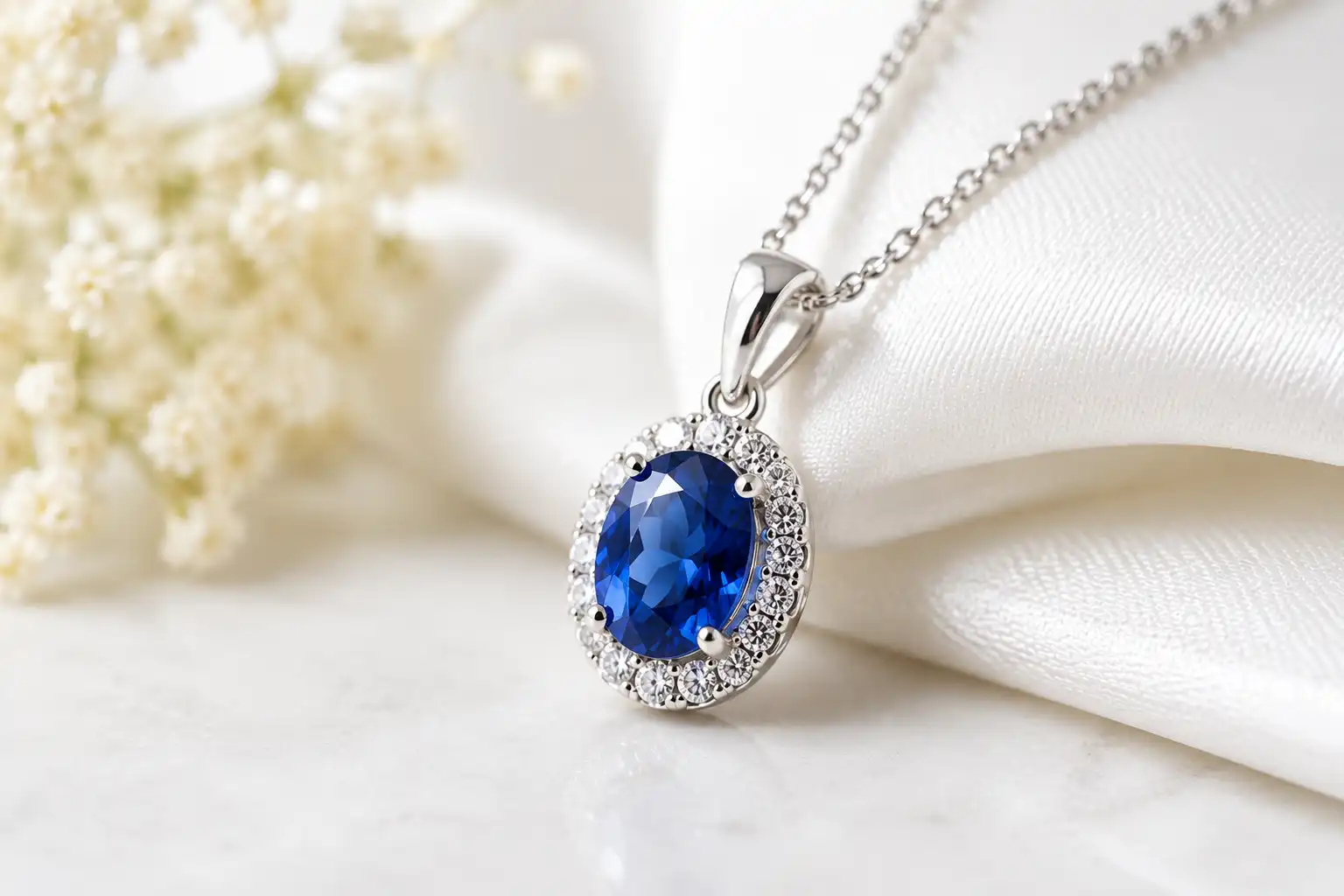
Sapphire Necklaces and Pendants: Styles and Buying Guide
A sapphire necklace combines exceptional gemstone durability with one of jewelry’s widest color ranges. Blue solitaire pendants remain classic, but pink, yellow, green, white, padparadscha, parti-colored and star sapphires support designs ranging from understated daily jewelry to major formal pieces.
The neck is a relatively protected location, allowing cutters and designers to use large stones, high domes, delicate drops and elaborate halos with less risk than the same gems would face in rings or bracelets.
Nevertheless, necklace durability depends on more than sapphire’s Mohs hardness of 9. A weak bail, fine chain, unsoldered jump ring or fracture-filled stone can create significant risk even when the corundum itself remains scratch resistant.
A successful purchase should evaluate the sapphire, setting, bail, chain and clasp as one system.
The gemstone’s geology and symbolism appear in Sapphire: Meaning, Properties & Symbolism. Loose-stone evaluation belongs in the Sapphire Buying Guide, while values remain within the Sapphire Price Guide.
Sapphire Necklaces at a Glance
| Necklace style | Appearance | Best use | Main concern |
|---|---|---|---|
| Solitaire pendant | One principal sapphire | Daily, birthstone and milestone jewelry | Bail security and pendant balance |
| Bezel pendant | Smooth metal-framed gem | Frequent wear with reduced snagging | Deep metal can darken strong color |
| Prong pendant | Open, light-admitting setting | Showing fine faceted material | Raised prongs can catch |
| Halo pendant | Sapphire surrounded by bright accents | Formal and romantic styling | Numerous small settings need inspection |
| Three-stone pendant | Center with two companion gems | Anniversary and symbolic gifts | Stone separation and balanced weight |
| Star sapphire pendant | Cabochon displaying asterism | Collector and distinctive jewelry | Star orientation and treatment |
| Cluster pendant | Several small sapphires | Broad color at moderate cost | Shared prongs and residue |
| Station necklace | Sapphires spaced along a chain | Minimal and layerable styling | Flipping stations and fine-chain strain |
| Graduated necklace | Gems increase toward the center | Formal and traditional jewelry | Matching many stones |
| Sapphire bead strand | Continuous opaque or translucent color | Casual, cultural and statement wear | Drill holes, cord and material identity |
| Choker | High line of sapphire color | Contemporary or formal appearance | Accurate internal length |
| Multi-color necklace | Rainbow or coordinated fancy sapphires | Individual modern styling | Treatment and color consistency |
Why Sapphire Works Well in Necklaces
Sapphire resists scratches extremely well and has no perfect cleavage.
Because necklaces remain away from most work surfaces, even included, cabochon and star material can perform reliably when properly set.
A necklace can also display sapphire color more effectively than a small ring. Larger pendants provide enough light path for pale pink, yellow or blue stones to show visible saturation.
Movement helps faceted sapphire return flashes from different angles.
The Gemstone Hardness Chart compares its scratch resistance, while Gemstone Toughness vs Hardness explains why impact, fractures and setting design still matter.
Solitaire Sapphire Pendants
A solitaire pendant places one sapphire at the center.
Round, oval and cushion cuts create balanced everyday designs. Pears produce a natural downward line, while hearts add overt romantic symbolism.
The sapphire should hang with its table facing outward.
An unbalanced basket or poorly positioned bail may cause the pendant to tilt toward the floor or flip repeatedly.
Open-backed settings preserve brightness and provide cleaning access.
The bail must be large and strong enough for the chain but not so oversized that it dominates the gemstone.
Bezel-Set Pendants
A bezel surrounds all or part of the sapphire’s girdle.
This construction protects the edge, creates a smooth profile and reduces snagging.
It is particularly practical for daily pendants and cabochons.
A full bezel can deepen the appearance of a dark blue stone. Open-backed construction and a narrow rim preserve more light.
Partial bezels expose more sapphire but protect fewer sides.
The metal should meet the gemstone evenly. Gaps, ripples or movement indicate poor setting work.
Prong-Set Pendants
Prongs expose more of the sapphire and admit side light.
Four prongs provide an open appearance. Six add redundancy and work well around larger rounds and ovals.
Pear, marquise and heart shapes need protection at their points.
The sapphire should sit level rather than leaning in the basket.
Run a fingertip gently around the setting. A sharp or raised prong should be repaired before it catches clothing or hair.
A pendant worn daily benefits from lower prongs than an occasional formal design.
Halo Sapphire Pendants
A halo surrounds the sapphire with diamonds, white sapphires, moissanite or another contrasting material.
The bright border increases apparent size and strengthens color contrast.
A medium blue or pink sapphire can appear more saturated beside a white halo.
The center should not sit excessively high.
Small shared prongs need regular inspection, while the gallery should remain open enough for cleaning.
Diamond accents are harder than sapphire. Their exposed girdles should not rub directly against the center or neighboring sapphires.
Three-Stone Pendants
A three-stone pendant may symbolize past, present and future, family members or another personal sequence.
The central sapphire can be paired with diamonds, white sapphires or smaller colored sapphires.
Graduated dimensions create the clearest hierarchy.
The stones should not touch directly. Individual baskets or metal separators prevent abrasion.
When all three stones are sapphire, color and treatment status should be compatible enough for the design and price claims.
Star Sapphire Pendants
Star Sapphire is especially well suited to pendants.
The necklace position protects the domed cabochon better than a ring, while movement brings the star into different light.
A fine star should be complete, reasonably centered and mobile.
The stone should hang in the orientation that displays its rays attractively.
Synthetic star sapphire and diffusion-related effects occur, so treatment and growth origin deserve verification.
A bezel protects the perimeter without hiding the dome.
Cluster Pendants
Cluster designs combine several small sapphires into a broader form.
Floral, geometric and starburst arrangements can create strong color without requiring one rare large stone.
Matching should be intentional. A deliberate color gradient can work, while random dark and pale stones may look poorly selected.
Shared prongs reduce visible metal but may secure several adjacent gems.
An open back improves cleaning because soap, lotion and textile fibers accumulate between the stones.
Sapphire Station Necklaces
Station necklaces place individual sapphires at intervals along a chain.
Bezel-set stations are smooth and practical. Prong stations admit more light but may catch fine clothing.
Each station should connect symmetrically so it faces forward rather than flipping continually.
The chain must support the combined weight.
Several large stations can distort an extremely fine chain, especially when worn at longer lengths.
Station necklaces layer easily because they provide color without one dominant pendant.
Graduated Sapphire Necklaces
A graduated necklace places smaller stones near the clasp and larger stones toward the center.
Matching a natural suite is demanding.
Color, treatment, transparency, shape and cut should transition smoothly.
Many graduated necklaces use heated natural sapphire, laboratory-grown sapphire, opaque beads or mixed commercial qualities to achieve consistent appearance.
The material category should be disclosed accurately.
The strand must drape without stiff sections, and the clasp should be proportionate to the total weight.
Sapphire Bead Necklaces
Sapphire bead strands range from opaque commercial corundum to transparent faceted stones.
Most affordable strands use included, translucent or opaque material.
Some beads may contain color zoning, matrix or a mixture of sapphire colors.
Inspect drill holes for chips, white stress marks and surface-reaching fractures.
Knots between beads reduce collision and limit loss after cord failure.
Strongly colored inexpensive transparent beads may be laboratory-grown, diffusion-treated, filled or imitations.
A seller should identify the material and treatment rather than relying only on genuine gemstone language.
Blue Sapphire Necklaces
Blue sapphire provides the classic formal appearance.
Fine material remains visibly blue under ordinary light rather than appearing black.
White gold and platinum create strong contrast, while yellow gold adds warmth.
A deep blue sapphire may work better in an open prong setting than a closed heavy bezel.
Pale stones can benefit from a reflective white-metal frame or halo.
The broader color meanings appear in Sapphire Color Meaning.
Pink, Yellow and White Sapphire Necklaces
Pink sapphire ranges from blush to vivid magenta and works naturally in rose or white gold.
Yellow sapphire ranges from lemon to golden and can create a bright alternative to citrine or yellow diamond.
Yellow Sapphire requires careful treatment disclosure because diffusion may influence color.
White Sapphire offers colorless corundum durability but less brilliance than diamond.
In every color, face-up brightness and cut should take priority over a poetic trade name.
Padparadscha Sapphire Necklaces
Padparadscha Sapphire combines pink and orange within a narrow accepted range.
A pendant protects this rare color while allowing enough stone size for the balance to remain visible.
The dedicated Padparadscha Sapphire Necklace guide owns its color matching, styles and reports.
A significant stone should have documentation addressing natural or laboratory-grown origin, treatment, color stability and classification.
Not every peach sapphire qualifies for the name.
Parti and Color-Change Necklaces
Parti sapphire can display blue, green and yellow zones in one pendant.
The cutter should orient the zones so they remain attractive from the front rather than merging into a muddy color.
Color-change sapphire should be examined under daylight-equivalent and warm illumination before purchase.
A pendant can be particularly effective for these varieties because its larger visible surface shows zoning or change clearly.
The seller should provide video or photographs under more than one light source.
Natural and Lab-Grown Sapphire
Natural sapphire formed geologically.
Lab Sapphire is manufactured corundum with the same basic hardness, composition and refractive properties.
Laboratory growth can produce large clean stones and precisely matched necklace suites at a lower price.
The dedicated Lab Sapphire Necklace guide owns manufactured-material construction and pricing boundaries.
A lab-grown necklace should be disclosed explicitly and should not be priced according to natural geological rarity.
Heat and Diffusion Treatments
Conventional heat is common and generally stable.
A heated sapphire remains natural corundum.
Lattice diffusion uses heat and added elements to alter color. Penetration may be shallow or deeper depending on the treatment.
Repolishing a shallow diffusion-treated stone can remove part of its color.
Filling, dye and coating create additional care limitations.
The complete treatment taxonomy appears in How to Spot Treated or Synthetic Sapphire.
Choosing Color
Judge sapphire under neutral daylight-equivalent and warm indoor light.
Blue should remain recognizably blue rather than becoming black.
Pink should have an undertone that works with the metal and design.
Yellow and orange should avoid excessive brown unless that appearance is desired.
Green and parti stones should show enough brightness to reveal their zoning.
Color names such as royal, cornflower and vivid are not standardized quality grades.
The actual stone should determine the decision.
Clarity and Inclusions
Natural sapphire may contain crystals, needles, fingerprints, healed fissures, particle clouds and color zoning.
Small inclusions can add character without reducing durability.
Large surface-reaching fractures near a prong, drill hole or bail deserve caution.
A pendant receives less impact than a ring, but an unstable fracture can still open during setting or repair.
Completely clean sapphire can be natural or laboratory-grown. Inclusions alone do not establish geological origin.
Cut and Face-Up Appearance
Cut controls brightness, color distribution and visible size.
Deep sapphires can look dark. Shallow stones may show a transparent window.
Ovals, cushions and pears dominate pendants because they preserve weight and create an attractive vertical line.
Round sapphires provide balanced brilliance but may cost more because cutting wastes additional rough.
Review the side profile and millimeter measurements, not only the front photograph.
Carat Weight and Pendant Size
Carat measures weight rather than visible dimensions.
Sapphire’s density makes it look smaller than many gemstones of the same carat weight.
The Carat vs Millimeter Size Chart explains this relationship.
Millimeter dimensions show how large the pendant will appear.
A halo, frame or broad bezel can increase visual footprint without requiring a much larger sapphire.
For strands, total carat weight provides little information without stone count, bead dimensions and treatment.
Chain Length
| Approximate length | Typical position |
|---|---|
| 14–16 inches | Choker or high neckline |
| 17–18 inches | Collarbone level |
| 20 inches | Just below the collarbone |
| 22–24 inches | Upper chest |
| 28–36 inches | Long pendant or layering length |
Body proportions and clothing alter these positions.
A pendant should sit clearly above or below a neckline rather than directly on its edge.
Long chains create more swing and increase the chance that the sapphire strikes a hard surface.
Choosing the Chain
Cable chains suit small and medium pendants.
Box, wheat and rope chains provide greater structural substance for heavier sapphires.
Snake chains create a smooth line but can kink when bent sharply.
The chain should move freely through the bail without binding.
For a removable pendant, the bail opening must also pass over the clasp.
Check the rings beside the clasp. Unsoldered jump rings are common failure points.
Bail Construction
The bail carries the pendant’s complete weight.
A fixed bail keeps the sapphire oriented.
A hinged bail permits movement and may help the pendant lie flat.
Hidden bails create a clean front view but often fit only narrow chains.
Decorative diamond or sapphire bails add more settings that require inspection.
The bail should not rub against an exposed sapphire edge, and its thickness should match the pendant’s weight.
Choosing the Metal
White gold and platinum create strong contrast with blue, pink and yellow sapphire.
Yellow gold warms blue and green stones and complements yellow or orange material.
Rose gold suits pink, peach and padparadscha colors.
Sterling silver provides an accessible option but tarnishes and offers less structural strength for very fine prongs.
Ask for metal fineness and whether plating will require renewal.
Some white-gold alloys contain nickel, which matters for sensitive wearers.
Sapphire and Diamond Necklaces
Diamond halos and accents create strong contrast.
Diamond is harder than sapphire.
Metal should separate exposed girdles so movement does not produce abrasion.
Lab-grown diamonds may provide the same basic optical and physical properties at another price structure.
The necklace should disclose the origins of both sapphire and diamonds rather than using one generic natural description for the entire piece.
Styling and Layering
A small blue solitaire works with everyday clothing and open necklines.
A pink or yellow station necklace adds subtle color and layers easily.
Large star, parti or padparadscha pendants work best as the principal jewelry element.
Use clearly separated lengths when layering.
Prevent pendants from striking one another.
Sapphire can scratch quartz, pearl, opal, tourmaline and many other gems, while diamond can scratch sapphire.
A necklace separator can reduce tangling but must support the combined weight.
September Birthstone Jewelry
Sapphire is September’s birthstone.
The September Birthstone guide explains its calendar history, while September Birthstone Jewelry compares gift formats.
A necklace is practical when ring sizing is unknown.
Blue remains traditional, but pink, yellow, white or parti sapphire may suit the recipient better.
Birthstone meaning does not require one prescribed gender or jewelry style.
Coordinating Sapphire Jewelry
Sapphire Earrings repeat color near the face.
A Sapphire Bracelet creates stronger formal coordination, while Sapphire Rings add a hand-worn focal point.
A Sapphire Engagement Ring can be paired with a restrained pendant without copying every design element.
Repeating metal or general color often creates enough unity.
Buying a Sapphire Necklace
Confirm whether the chain is included.
Ask whether the sapphire is natural or laboratory-grown and whether it has been heated, diffusion-treated, filled, dyed or coated.
Request stone dimensions, weight, chain length, metal fineness, clasp type and total necklace weight.
Inspect the front, side and back.
A valuable natural sapphire may justify an independent report.
Use Gemstone Certification to compare reports and How to Read a Gem Lab Report to interpret treatment and origin wording.
For remote transactions, follow How to Buy Gemstones Online.
Cleaning and Storage
Warm water, mild soap and a soft brush suit sound untreated, heated and many diffusion-treated sapphires.
Filled, cavity-filled, dyed or uncertain material needs gentler care.
The detailed procedure appears in How to Clean Sapphire Jewelry.
Fasten the clasp before storing the necklace flat or hanging individually.
Keep sapphire away from diamond and from softer gemstones it can scratch.
Do not place heavy jewelry on top of fine chains or high-domed star cabochons.
Frequently Asked Questions
1. Is sapphire suitable for a necklace?
Yes. Its hardness and the protected neck position make sapphire excellent for pendants, stations, strands and formal necklaces.
2. Which sapphire pendant setting is most protective?
A low full or partial bezel provides strong girdle protection and reduced snagging.
3. Which sapphire color is best for a necklace?
There is no universal best color. Blue is classic, while pink, yellow, white, parti and padparadscha create distinct styles.
4. Is heated sapphire suitable for necklaces?
Yes. Conventional heating is stable and compatible with normal jewelry wear when disclosed.
5. Can diffusion-treated sapphire be used in a pendant?
Yes, but treatment affects value, and shallow color penetration can be altered by repolishing or recutting.
6. Is lab-grown sapphire durable?
Yes. Laboratory-grown sapphire is corundum and shares natural sapphire’s basic hardness.
7. Can sapphire bead necklaces be natural?
Yes, although affordable strands often use opaque, included, heated or commercial-quality material.
8. How can a star sapphire pendant be evaluated?
Look for a mobile, reasonably centered star, attractive bodycolor, a sound cabochon and clear origin and treatment disclosure.
9. What chain length suits a sapphire pendant?
About 18 inches works for many collarbone-level designs, but body proportions, clothing and pendant size should decide.
10. Does carat weight show how large the pendant looks?
Not reliably. Millimeter dimensions and setting design provide a better indication of visible size.
11. Does a sapphire necklace need a laboratory report?
A report is advisable when natural origin, treatment, locality or significant value depends on the claim.
12. How should a sapphire necklace be cleaned?
Use warm soapy water for sound untreated or heated stones. Filled, dyed or uncertain sapphire requires gentler care.
A strong sapphire necklace combines the gem’s durability with chain and setting construction proportionate to its weight. Color creates the focal point, but treatment disclosure, bail strength, clasp security and cleaning access determine whether the piece performs well through regular wear.
Sapphire is indexed in Crystals That Start With S and Gemstones That Start With S.