Rose Quartz Necklaces and Pendants: Complete Style Guide
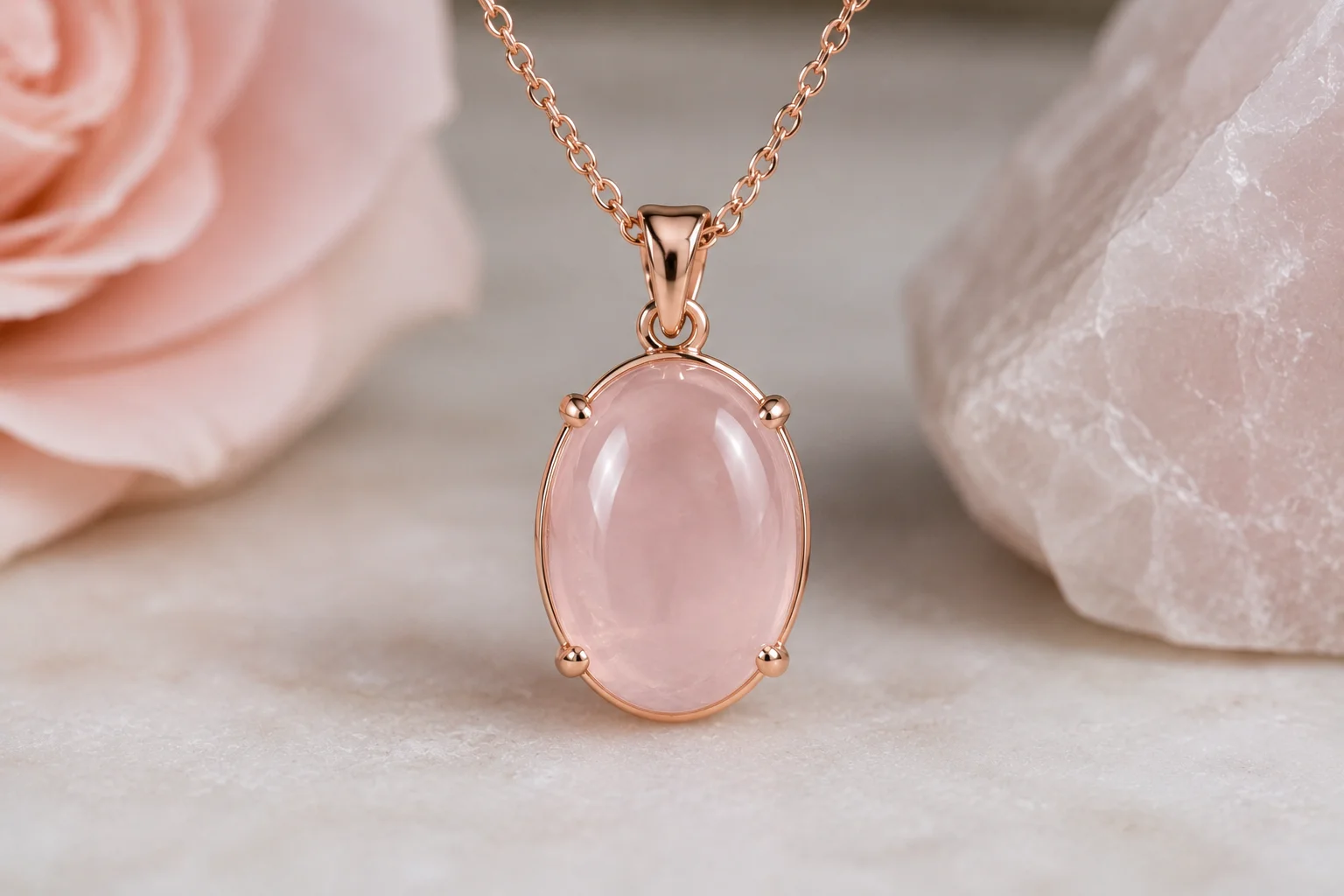
A rose quartz necklace displays the gemstone’s pale blush, soft pink or lavender-pink color in one of its most protected jewelry forms. Pendants receive less impact than rings and bracelets, allowing cutters and designers to use larger cabochons, carved hearts, faceted stones and star rose quartz without exposing them continually to hard surfaces.
Most rose quartz is translucent and naturally cloudy rather than transparent and brilliant. Consequently, the best necklace design does not try to make the material behave like diamond. It uses broad polished surfaces, soft light, movement and suitable metal contrast to emphasize the stone’s bodycolor and internal glow.
This guide owns necklace and pendant construction, chain length, proportions, settings, styling and chest wear. Loose-stone selection belongs in the rose quartz buying guide, while current market values remain within the completed rose quartz price guide.
Rose Quartz Necklaces at a Glance
| Necklace style | Visual effect | Best use | Main concern |
|---|---|---|---|
| Solitaire pendant | One clear focal stone | Everyday and gift jewelry | Bail strength and pendant balance |
| Cabochon pendant | Broad, softly glowing pink surface | Showing natural translucence | Surface scratches and internal fractures |
| Faceted pendant | More reflection and geometry | Dressier or contemporary styling | Pale color and windowing |
| Star rose quartz pendant | Moving six-rayed optical effect | Collector and statement jewelry | Correct orientation and protective setting |
| Carved-heart pendant | Romantic and recognizable | Symbolic gifts | Thin points and material authenticity |
| Bezel pendant | Smooth metal-framed stone | Frequent wear with reduced snagging | Deep metal may darken the stone |
| Halo pendant | Rose quartz surrounded by accents | Formal and romantic designs | Numerous small settings need maintenance |
| Station necklace | Individual stones spaced along a chain | Minimal layering | Flipping and chain distortion |
| Beaded strand | Continuous pink color | Casual, vintage and meditation wear | Drill holes, string and bead abrasion |
| Graduated necklace | Stones grow larger toward the center | Formal or traditional styling | Matching many stones accurately |
| Lariat | Adjustable or open-ended drop | Modern styling | Sliding parts and end weight |
| Choker | High continuous color near the neck | Contemporary statement wear | Accurate internal length |
Why Rose Quartz Works Well in Necklaces
The complete mineral and symbolic profile appears in Rose Quartz: Meaning, Healing Properties & Uses.
Rose quartz often develops stronger visible color in larger pieces. A pendant can therefore show more pink than a pair of small studs cut from similar rough.
The chest is also a relatively protected location. Although a pendant can strike a desk or countertop when the wearer leans forward, it normally experiences fewer repeated impacts than a bracelet or ring.
Movement improves the appearance of translucent stones. As a pendant shifts, changing angles allow light to enter its edges and internal veils.
The necklace form also suits the stone’s modern heart-centered symbolism without requiring the wearer to interpret that symbolism literally or medically.
Necklace Versus Pendant
A pendant is the decorative component suspended from a chain or cord.
A necklace can refer to the complete chain-and-pendant combination, a station design or a strand of beads without a separate hanging element.
This difference matters when buying. A listing may include only the pendant even though the photographs show a chain.
Confirm whether the chain is included, which metal it contains, how long it is and whether it fits through the bail.
A valuable pendant should not depend on an undersized promotional chain that cannot safely support its weight.
Solitaire Rose Quartz Pendants
A solitaire pendant places one stone at the center of the design.
Round and oval cabochons are the most common choices because they show color and internal texture across a broad surface.
Faceted cushions, ovals and pears offer more surface reflection. However, the stone may remain softly luminous rather than intensely brilliant.
The pendant should hang with its face directed outward. A poorly balanced basket can tilt toward the floor or rotate constantly.
A fixed bail provides greater orientation control. An articulated bail allows additional movement and may help the pendant lie naturally against the body.
The back should remain open enough for inspection and cleaning unless a closed design is necessary for structural support.
Cabochon Pendants
Cabochons are particularly well suited to ordinary massive rose quartz.
Their rounded surface emphasizes color, haze and internal veils rather than magnifying fractures through flat facets.
A higher dome may show stronger color but adds weight and projection. A low dome creates a flatter, more modern profile.
Check the polish under reflected light. Dull patches, flat spots and fine scratches reduce the uniform glow.
The girdle should be even and fully supported. Thin irregular edges are easier to chip during setting or accidental impact.
Bezel settings work especially well with cabochons because the metal follows the outline and protects the perimeter.
Faceted Rose Quartz Pendants
Faceted rose quartz requires sufficiently transparent rough.
A good cut creates bright surface flashes without producing a large pale window through the center.
Excessive depth can make the stone appear gray or dark at certain angles, while shallow cutting reduces visible color.
Transparent faceted pink quartz deserves careful identification. It may be rare crystalline pink quartz, synthetic quartz, morganite, pink tourmaline, glass or another material.
The completed morganite versus rose quartz guide explains the most common transparent pink comparison.
Faceting does not make a stone inherently more valuable than an attractive star cabochon or strongly colored carving. Material quality and workmanship determine the result.
Star Rose Quartz Pendants
Star rose quartz contains aligned microscopic inclusions capable of producing asterism.
When the stone is cut with the correct orientation, a six-rayed star moves across the dome beneath a small direct light source.
A pendant protects this effect better than a ring because the cabochon receives less impact.
The star should be reasonably centered when the stone faces forward. The rays may appear soft rather than razor-sharp, especially in natural diffused light.
A closed dark backing may increase visual contrast, although the buyer should still be able to examine the stone from the side or back.
Artificial fiber-optic glass and engraved effects can imitate a star. The completed real-versus-fake rose quartz guide owns the authentication process.
Carved-Heart Pendants
The carved heart is one of the most familiar rose quartz designs.
Its shape reinforces the stone’s traditional associations with affection and compassion, making it a common romantic or friendship gift.
Inspect the point and upper cleft carefully. These narrow areas are more vulnerable to chipping than the rounded sides.
The drill hole or bail fitting should not intersect a major internal fracture.
A carved heart does not prove genuine rose quartz. Glass, resin, dyed quartz and reconstructed products can use the same design.
A well-cut heart should appear symmetrical without requiring the natural internal pattern to be perfectly uniform.
Bezel-Set Pendants
A bezel surrounds all or most of the stone’s edge.
This construction offers strong protection, creates a smooth profile and reduces snagging on clothing.
Rose gold can reinforce the warm pink appearance. White metal creates a cleaner outline, while yellow gold may shift pale material toward peach.
A thick full bezel can darken a medium-tone stone by limiting side light. An open back and a reasonably thin rim preserve more brightness.
The metal should contact the stone evenly. Gaps, ripples and visible movement indicate weak setting work.
Prong-Set Pendants
Prongs expose more of the gemstone.
Four prongs create a lighter visual structure. Six provide additional redundancy around larger rounds and ovals.
Pear and heart shapes need protection at their points. A V-prong or partial bezel is preferable to leaving the tip exposed.
Prongs should cover enough of the girdle to hold the stone without hiding most of a pale gem.
Run a fingertip gently around the setting. Sharp, raised or catching prongs should be repaired before the pendant is worn.
Halo Pendants
A halo surrounds rose quartz with diamonds, white sapphires, cubic zirconia or another contrasting material.
The bright border enlarges the apparent size and can make a pale center look pinker.
A narrow rose-gold frame between the quartz and white accents can improve color definition.
The halo should follow the outline evenly. One tilted accent or irregular gap disrupts the entire design.
Small shared prongs need periodic inspection.
The back should provide enough access for a soft brush because lotion and cosmetics accumulate easily beneath a halo.
Station Necklaces
Station necklaces place multiple rose quartz stones at intervals along a chain.
Bezel-set stations are practical because they lie smoothly against the skin and resist snagging.
Each station should connect at opposite sides with balanced links. Otherwise, the stone may flip repeatedly and display its back.
Spacing determines the visual effect. Wide spacing creates a subtle necklace, while closer stations produce a stronger line of pink.
The chain must be strong enough for the combined gemstone weight. Several large stations can stretch an extremely fine chain.
A station necklace layers easily with the completed rose quartz bracelet guide or rose quartz earrings guide without requiring an identical matching set.
Beaded Rose Quartz Necklaces
A beaded strand creates continuous color around the neck.
Smooth round beads emphasize bodycolor and polish, while faceted beads add surface sparkle.
Inspect drill holes for chips, whitening and fractures. A damaged hole can cut the string or expand under tension.
Knots between beads reduce direct impact and prevent the entire strand from scattering if the cord breaks.
Large beads need a strong clasp and suitable stringing material. Their total weight can become substantial even though quartz is not an exceptionally dense gem.
A heavily opaque strand may display less color than expected unless the beads are large or strongly saturated.
Graduated Necklaces
A graduated necklace uses smaller beads or gems near the clasp and larger stones toward the center.
The transition should appear smooth rather than jumping unpredictably between sizes.
Color also needs matching. Larger rose quartz pieces often show deeper pink, so the necklace may require careful sorting to prevent the center from looking unrelated to the sides.
The strand should drape naturally without stiff sections or beads pressing at awkward angles.
A substantial center section may require a clasp larger than the one used on a lightweight uniform strand.
Choosing Rose Quartz Color
Rose quartz ranges from nearly colorless blush to medium pink, lavender-pink and occasional peach-pink.
No one shade is universally best.
Pale material creates a restrained, delicate necklace. Medium pink remains more visible against skin and clothing.
A gray modifier can make the stone look dull, while excessive yellow may move the appearance toward peach.
Natural variation is acceptable, especially in beads and carvings. However, one nearly white stone within a strongly pink formal necklace may look poorly matched.
The broader color family appears in Pink Crystals and Pink Gemstones.
Clarity and Internal Texture
Ordinary rose quartz commonly contains microscopic fibers, veils and fractures.
These features create its characteristic cloudy translucence.
A necklace stone does not need to be transparent to be attractive. Even color, pleasing internal light and sound structure matter more.
Large surface-reaching fractures can weaken a pendant and collect dirt.
Internal veils that remain enclosed are generally less concerning.
When a faceted stone appears completely transparent, its natural versus synthetic growth origin deserves closer examination.
Pendant Size and Proportion
Millimeter dimensions are more useful than carat weight when judging visible size.
Rose quartz has a specific gravity near 2.65, so a stone may face up differently from a denser garnet or sapphire of equal weight.
The completed carat-versus-millimeter size chart explains density-based size differences.
A small pendant can disappear on a long heavy chain. Conversely, a large carving may overwhelm a delicate chain and pull uncomfortably.
The bail, chain width and pendant height should look proportionate as a complete object.
Chain Length
Common necklace lengths create different positions on the body.
| Approximate length | Typical position |
|---|---|
| 14–16 inches | Choker or high at the neck |
| 17–18 inches | Near the collarbone |
| 20 inches | Just below the collarbone |
| 22–24 inches | Upper chest |
| 28–36 inches | Long pendant or layering length |
Body proportions, neck circumference and clothing alter the final position.
A pendant should generally sit clearly above or below a neckline rather than directly on its edge.
Long chains give a pendant more swing, increasing the chance that it strikes a desk or countertop.
Choosing a Chain
Cable chains suit light and medium pendants.
Box, wheat and rope chains provide greater visual and structural substance for heavier pieces.
A fine snake chain creates a smooth line but can kink if bent sharply.
The chain should pass through the bail without binding or scraping.
For a removable pendant, the bail opening must also pass over the clasp.
Inspect soldered rings near the clasp. Open jump rings are common weak points.
Bail Design
The bail transfers the pendant’s entire weight to the chain.
A fixed bail maintains orientation. A hinged bail allows movement and can help a pendant lie flat.
Hidden bails create a clean front view but may accommodate only thin chains.
Decorative bails can include small gemstones or engraving, although the design should not overwhelm a pale center.
The bail should not rub directly against an exposed quartz edge.
A heavy pendant needs a substantial attachment rather than a thin wire loop.
Choosing the Metal
Rose gold creates a tonal pink appearance.
Yellow gold adds warmth and may emphasize peach undertones.
White gold, platinum and silver create stronger contrast and can make lavender-pink stones appear cooler.
Metal choice should reflect appearance, budget, weight and alloy sensitivity.
Sterling silver tarnishes. Plated finishes wear over time, and some white-gold alloys contain nickel.
Ask for exact metal fineness rather than assuming that a warm or white color identifies the alloy.
Styling With Necklines
A small solitaire pendant works well with open collars, scoop necks and V-necks.
A long pendant suits high-necked clothing and simple solid fabrics.
Beaded chokers create a stronger contemporary statement and work best when the neckline leaves sufficient space.
Rose quartz pairs naturally with cream, gray, navy, brown, green, burgundy and black.
Patterned clothing can compete with a small pale pendant. A larger carving or halo provides greater visual presence when worn against a busy fabric.
Layering Rose Quartz Necklaces
Layered necklaces should use clearly separated lengths.
A short rose quartz pendant can sit above a plain chain, while a longer station necklace provides additional pink repetition.
Prevent the quartz from rubbing continuously against diamond, sapphire or ruby components, which are harder and can scratch it.
Rose quartz can scratch softer pearls, opals and calcite, so those materials also need spacing.
The completed gemstone hardness chart and toughness-versus-hardness guide explain why visual compatibility does not guarantee physical compatibility.
Symbolism and Gift Use
Rose quartz is traditionally associated with affection, compassion and self-kindness.
A pendant near the chest fits the stone’s modern heart-centered symbolism, but the jewelry does not physically alter the heart or guarantee a relationship outcome.
The broader love intent belongs in Best Crystals for Love and Romance, while inward compassion is compared in Best Crystals for Self Love.
The heart chakra guide explains the spiritual framework, and heart chakra crystals owns the full stone list.
Rose quartz also appears in selected anniversary traditions. The complete year-by-year context remains in Anniversary Gemstones by Year.
A gift should communicate the giver’s intention clearly rather than assuming that every pink heart implies romance.
Treatments and Imitations
Rose quartz may be irradiated to strengthen its color.
Dyed crackle quartz can show intense pigment concentrated in fractures. Coated quartz may reveal wear at edges, while synthetic pink quartz can share natural quartz’s physical properties.
Glass and resin imitate pale pink carvings and beads.
The completed treated and synthetic rose quartz guide owns the detailed treatment boundary.
The broader gemstone treatments guide explains why irradiation, dyeing, coating and laboratory growth are separate categories.
A credible seller should identify the material first and then disclose every significant treatment.
Buying a Rose Quartz Necklace
Check whether the listing includes the chain.
Request the pendant’s millimeter dimensions, chain length, metal fineness, clasp type and total weight.
Examine photographs of the front, side and back.
Look for pleasing color, sound polish and internal fractures that do not threaten the setting.
Confirm whether the stone is natural quartz and whether it has been irradiated, dyed, coated or reconstructed.
An unsupported AAA grade does not replace measurable details.
For online purchases, follow how to buy gemstones online and use the return period to examine balance, color and chain strength.
For an unusually valuable transparent or star specimen, the gemstone certification guide explains when independent testing is proportionate.
Daily Wear
Rose quartz necklaces are suitable for regular wear.
Remove them before exercise, swimming, bathing and household cleaning.
Long pendants should be secured or removed when leaning over work surfaces.
Perfume, sunscreen and lotion can accumulate on the stone and chain. Apply cosmetics before putting the necklace on.
Inspect the clasp, bail and connecting rings periodically.
A loose bail or stretched chain should be repaired before the necklace is worn again.
Cleaning and Storage
Use warm water, mild soap and a soft cloth or brush.
Clean behind the stone and inside the bail, then rinse briefly and dry thoroughly.
Avoid steam and ultrasonic cleaning.
The completed rose quartz jewelry cleaning guide owns the full care procedure.
Fasten the clasp before storage and lay fine chains flat or hang them individually.
Keep the necklace away from harder gems and do not place heavy jewelry on top of a carved or star pendant.
Frequently Asked Questions
1. Is rose quartz suitable for a necklace?
Yes. Its hardness and protected position make necklaces one of the most practical rose quartz jewelry forms.
2. Which rose quartz pendant style is most durable?
A low full or partial bezel offers strong edge protection and minimizes snagging.
3. Is a cabochon better than a faceted rose quartz pendant?
Cabochons suit cloudy massive material and star effects, while faceted cuts suit more transparent rough. Neither is automatically superior.
4. Why does a large rose quartz pendant look pinker than a small one?
A longer path through the colored material often makes the pink more visible.
5. Can rose quartz pendants show a star?
Yes. Properly oriented microscopic inclusions can create a six-rayed star in a domed stone.
6. What chain length is best for a rose quartz pendant?
An 18-inch chain suits many collarbone-level designs, but the wearer’s proportions, neckline and pendant size should decide.
7. Does rose gold make rose quartz look pinker?
It commonly strengthens the warm pink impression, while white metal creates more contrast.
8. Are transparent faceted pink pendants always rose quartz?
No. They may be synthetic quartz, morganite, pink tourmaline, glass or another gemstone.
9. Is rose quartz commonly treated?
Occasional irradiation is used, while dyeing, coating and synthetic products also occur.
10. Can a rose quartz necklace be worn every day?
Yes, provided the chain and setting are secure and the necklace is removed for physical or chemical exposure.
11. Can rose quartz necklaces be cleaned ultrasonically?
Ultrasonic and steam cleaning should be avoided. Warm soapy water is safer.
12. What does a rose quartz necklace symbolize?
It is traditionally associated with affection, compassion and self-kindness, but it does not guarantee health or relationship outcomes.
A rose quartz necklace succeeds when the chain, bail and setting support the gemstone’s natural visual character. The best examples do not depend on extreme transparency or exaggerated claims. They use proportion, movement and thoughtful metal contrast to reveal the soft pink color while protecting the stone from avoidable damage.
Rose quartz is indexed in Crystals That Start With R and Gemstones That Start With R.
Rose quartz symbolism belongs to spiritual and cultural traditions rather than medical science. Jewelry cannot control another person’s feelings or replace relationship safety and healthcare.