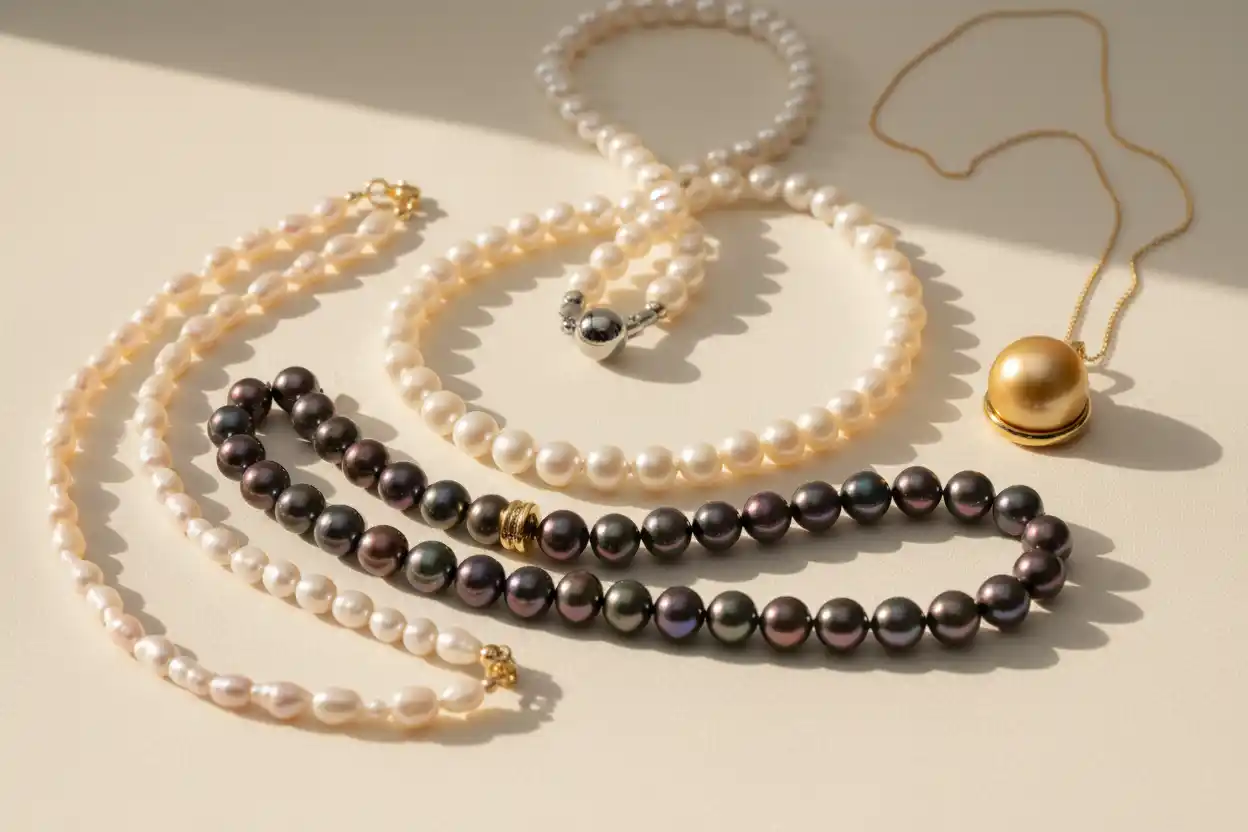
Pearl Necklaces and Pendants: Styles and Buying Guide
A pearl necklace can be a short, precisely matched strand, a long rope of irregular freshwater pearls or a single South Sea pearl suspended from a fine chain. Although all three place pearls at the neckline, they demand different standards of matching, drilling, stringing, clasp design and care.
The apparent simplicity of a strand can hide substantial craftsmanship. Each pearl must be selected, arranged and drilled, while the stringing material, knots, end connections and clasp need to support repeated movement without damaging the nacre.
This guide concentrates on necklace construction, length, proportion, strand matching and purchase decisions. The pearl meaning guide owns pearl formation, history, physical identity and general symbolism.
Pearl Necklace Styles
| Necklace style | Typical character | Construction priority | Best use |
|---|---|---|---|
| Uniform strand | Consistent pearl diameter | Matching and knot spacing | Classic daily or formal wear |
| Graduated strand | Larger pearls at the center | Smooth size progression | Traditional statement jewelry |
| Baroque strand | Organic, varied outlines | Intentional arrangement | Contemporary and artistic styling |
| Tin-cup or station necklace | Pearls spaced along chain | Secure pearl connections | Lightweight layering |
| Multi-strand necklace | Greater volume and texture | Strand alignment and clasp strength | Formal or statement wear |
| Pearl pendant | One focal pearl | Bail, peg and chain security | Minimal daily jewelry |
| Lariat necklace | Adjustable vertical line | End-weight balance | Open necklines |
| Rope necklace | Long and versatile | Durable stringing and even drape | Layering, knotting or doubling |
Understanding Pearl Necklace Lengths
Pearl-necklace terminology varies slightly among sellers, so actual measurements should always be confirmed.
| Common name | Approximate length | Typical position |
|---|---|---|
| Collar | 12–13 inches | High around the neck |
| Choker | 14–16 inches | At or just above the base of the neck |
| Princess | 17–19 inches | Near the collarbone |
| Matinee | 20–24 inches | Upper chest |
| Opera | 28–36 inches | Mid to lower chest |
| Rope | Over 36 inches | Long, doubled or knotted |
The wearer’s neck circumference, height, body proportions and clothing affect the final position. A 16-inch strand may sit comfortably on one person and feel restrictive on another.
Extender chains can provide flexibility, but a heavy pearl strand requires an extender and clasp designed for its weight. A delicate extender intended for a fine chain may not support a substantial necklace safely.
Collar and Choker Pearl Necklaces
Collar-length pearls create a formal, structured effect. Multi-row collars require precise strand spacing so each row lies flat without twisting or crossing.
A choker is among the most familiar pearl lengths. It works with open collars, dresses and higher necklines, though the exact fit should allow comfortable movement and breathing.
Because the strand sits close to the skin, it receives more contact with perspiration, perfume and cosmetics. Wiping the pearls after wear becomes especially important.
Short strands also place greater stress on the clasp and end connections when the wearer turns their head. A slightly longer fit may be more comfortable for frequent use.
Princess-Length Strands
The princess length generally sits near the collarbone and suits many necklines. It is long enough to move comfortably but short enough to keep the pearls visible above many garments.
Uniform white Akoya strands are strongly associated with this format, although freshwater, Tahitian and South Sea pearls can produce very different effects.
A princess strand should hang in a smooth curve. Kinks, uneven knots or misaligned drill holes can interrupt the line.
When buying remotely, request the complete strand length, including the clasp. Some listings quote only the pearl section, creating an unexpected fit.
Matinee and Opera Lengths
Matinee strands create a less formal line and can sit over knitwear, dresses or shirts. The additional length increases movement, so the necklace may contact buttons, zippers and desk edges.
Opera strands provide enough length for a dramatic single loop or, in some cases, a doubled arrangement. The clasp and stringing should be strong enough for the added pearl weight.
Long strands should be checked for even drape. One section should not twist outward because of poorly aligned drill holes or uneven knot tension.
A strand intended for doubling needs a clasp or length that allows the desired arrangement without excessive pressure around the neck.
Rope Necklaces
A pearl rope can be worn long, doubled, tripled or loosely knotted. That versatility increases mechanical stress because the pearls rub against clothing and may contact one another more often.
Repeated knotting of the entire necklace should be gentle. Tight decorative knots can place pressure on individual pearls and make the stringing difficult to inspect.
Very long strands are heavier than they appear. The clasp, if present, should be substantial, and the wearer should avoid catching the rope on handles or furniture.
A long baroque freshwater rope can create an informal, textural look, while a carefully matched round rope becomes a significant fine-jewelry piece.
Pearl Pendant Necklaces
A pearl pendant concentrates attention on one pearl rather than the matching of an entire strand. Round, drop, oval and baroque pearls can all work, depending on the design.
Peg-and-cup fittings are common. The pearl is partially drilled, fitted over a metal peg and secured with adhesive. The pearl should sit flush against its cap without visible gaps.
Fully drilled pearls may be mounted on wire, chain or decorative pins. The hole edges should be clean, without obvious chipping or nacre loss.
Pear-shaped pearls suit vertical pendants naturally. Baroque pearls can become one-of-a-kind focal points when the setting responds to their outline rather than forcing them into a conventional frame.
Tin-Cup and Station Necklaces
A tin-cup necklace spaces pearls along a chain, wire or cord. The design feels lighter than a full strand and works well for layering.
Each pearl connection must prevent the pearl from sliding against abrasive metal. Wire-wrapped links, small cups or carefully finished end connections can provide separation.
Spacing should look intentional when the necklace hangs. Uneven intervals may cause the pearls to gather on one side or leave the center visually empty.
Station necklaces require fewer pearls than a full strand, allowing the buyer to prioritize luster or larger size while maintaining a lighter overall design.
Multi-Strand Pearl Necklaces
Multi-strand necklaces combine two or more rows, sometimes using graduated lengths. The clasp must carry more weight and keep the strands in their intended order.
Spacer bars can prevent tangling, but they add metal contact points. Their openings and edges should be smooth.
A well-designed multi-strand piece should lie naturally rather than bunching near the clasp. Each row needs enough length to follow a separate curve around the neck.
Mixed strands may combine pearls of different sizes, colors or shapes. The composition should remain deliberate, with a clear rhythm rather than random distribution.
Selecting Pearl Type
The major cultured-pearl categories have distinct visual tendencies, though quality varies within every group.
Akoya cultured pearls are known for relatively compact sizes, round shapes and potentially sharp luster. They are strongly associated with traditional white strands.
Freshwater cultured pearls offer wide variation in size, shape, color and price. High-quality round freshwater pearls can produce refined strands, while baroque forms support more contemporary designs.
Tahitian cultured pearls develop naturally dark bodycolors with green, blue, silver, aubergine or peacock overtones. A full strand requires careful color arrangement because each pearl may display a complex combination.
South Sea cultured pearls include white, silver and golden colors and generally occur in larger sizes. Their broad glow can create substantial necklaces even with a relatively simple design.
The types of pearl guide provides a fuller comparison of these categories.
The Seven Pearl Quality Factors in a Necklace
Pearl quality is evaluated through size, shape, color, luster, surface, nacre and matching. Matching becomes especially important in a necklace because many pearls are viewed together.
A necklace does not need perfect uniformity unless that is the intended design. Graduated strands deliberately vary in size, while multicolor and baroque strands use controlled differences.
Even so, luster should remain compatible. A few dull pearls can interrupt the visual rhythm of an otherwise bright strand.
Surface features may be acceptable when distributed discreetly. Broad damage, peeling nacre or severe abrasions should not be hidden merely by positioning them near the clasp.
The pearl buying guide covers quality evaluation in greater depth, while the pearl price guide owns current cost and value considerations.
Matching a Uniform Strand
Uniform strands require consistency in diameter, shape, bodycolor, overtone, luster, surface and nacre appearance.
Examine the necklace as a whole before inspecting individual pearls. The first impression reveals whether one area looks darker, yellower, duller or smaller.
Next, inspect the center section, which receives the most attention. The best-matched pearls are often positioned toward the front, while slightly less consistent examples may appear closer to the clasp.
Matching can account for a meaningful part of the necklace’s value because assembling dozens of compatible pearls requires sorting through a much larger inventory.
Graduated Pearl Strands
A graduated strand places the largest pearl at the center and reduces size gradually toward the clasp. The progression should be smooth.
Abrupt jumps can make the necklace look uneven unless they are a deliberate design feature. Measurements should be given as a range, such as the smallest and largest pearl diameters.
The center pearl carries visual emphasis and deserves particularly strong luster and surface quality. However, it should not look disconnected from the rest of the strand in color or shape.
Graduated strands can make larger center pearls more affordable than a uniform necklace in which every pearl matches the maximum diameter.
Multicolor Strands
Multicolor pearl necklaces may combine naturally colored freshwater, Tahitian or South Sea pearls. The arrangement can follow a gradient, repeat a pattern or distribute complementary colors.
Natural-color representation matters. Unusual bright colors may indicate dye or another treatment, and the seller should disclose that information.
The treated pearl guide explains pearl-specific enhancements. General treatment terminology is covered in gemstone treatments explained.
A treated strand can still be attractive and durable enough for wear. Its description and price should reflect what it is.
Baroque Pearl Strands
Baroque pearls create texture through irregular shapes, ridges and changing reflections. Matching focuses on visual rhythm rather than identical geometry.
A successful strand may alternate larger and smaller forms, align similar silhouettes or place a particularly expressive pearl at the center.
The drill direction influences how each pearl hangs. Poorly planned drilling can make a beautiful pearl turn sideways or push neighboring pearls out of line.
Deep surface cavities, peeling layers or fragile projections should be distinguished from desirable organic texture.
Knotted Versus Unknotted Strands
Fine pearl strands are often knotted between each pearl. Knots reduce contact between adjacent pearls and help limit loss if the string breaks.
The knots should be small, tight and positioned close to the drill holes. Large, uneven or loose knots interrupt the line and may allow the pearls to rub.
Some inexpensive strands use wire or cord without individual knots. This construction is not automatically unusable, but the pearls may contact one another, and a break can release several pearls.
Very small seed pearls or certain contemporary designs may require different stringing techniques. Construction should be judged according to the pearl size, necklace weight and intended wear.
Stringing Materials
Traditional silk thread remains common because it drapes softly and accepts tight knots. Modern synthetic cords can offer greater resistance to stretching and moisture.
No stringing material lasts indefinitely. Skin oils, cosmetics, movement and necklace weight gradually weaken the thread.
Inspect the strand for fraying, stretching, discoloration and gaps between the knots and pearls. A strand that appears longer than before may have stretched even if the thread has not broken.
The necklace should not be washed or soaked while strung because moisture can weaken or soil the thread.
Clasp Construction
The clasp should match the necklace’s weight and value. Small fishhook, box and safety clasps can all work when properly made.
A good clasp closes positively without requiring excessive force. It should not open when the necklace is gently tugged.
Double or triple strands need clasps designed to keep the rows aligned. Safety catches add security to substantial pieces, but they must be easy enough for the wearer to operate.
Inspect the junction between string and clasp. French wire, gimp or another protective component may shield the thread where it passes through metal.
The end knots should remain tight and neatly concealed.
Restringing a Pearl Necklace
There is no universal calendar for restringing. A frequently worn strand may need attention sooner than one worn only occasionally.
Visible fraying, stretching, loose knots, gaps near drill holes or movement at the clasp indicate that professional restringing should not be delayed.
A jeweler or specialist should preserve the original pearl order when matching or graduation matters. Before handing over an important strand, photograph it and document the clasp and pearl arrangement.
Restringing also provides an opportunity to adjust length, replace a worn clasp or correct earlier construction problems.
Natural, Cultured and Imitation Pearl Necklaces
Most contemporary fine pearl necklaces contain cultured pearls. Natural pearl strands are exceptionally rare and may require specialized laboratory examination.
Imitation pearl necklaces use manufactured beads with pearlescent coatings or other simulated surfaces. They can be practical fashion jewelry, but the seller should identify them accurately.
“Cultured” does not mean imitation. Cultured pearls are biological products formed in living mollusks with human intervention.
Likewise, cultured pearls are not simply the pearl equivalent of laboratory-grown crystals. The lab-grown versus natural gemstones guide provides general terminology, though pearl nomenclature has its own specialized distinctions.
The planned real versus fake pearl guide owns the detailed identification workflow.
Pearl Reports and Documentation
A routine freshwater or Akoya strand may not need an individual laboratory report. Documentation becomes more relevant for claimed natural pearls, exceptional sizes, rare colors or important provenance.
Pearl reports can examine whether a pearl is natural or cultured and may describe the mollusk environment, structure or treatment evidence depending on the service.
A retail appraisal is not the same as a gemological identification report. The gemstone certification guide explains report-provider differences, while how to read a gem lab report helps interpret cautious laboratory wording.
The report should correspond to the necklace being sold. Compare pearl count, dimensions, photographs and identifying details.
Choosing a Pearl Pendant Chain
A pendant chain needs enough strength for the pearl, fitting and accent stones. Very thin chains may look delicate but can kink or break.
Cable, box, curb and wheat chains can all work when their scale matches the pendant. The bail opening must accommodate the chain and clasp if the pendant is removable.
Adjustable chains offer useful flexibility. However, the sliding mechanism or extender should not place rough metal directly against the pearl.
A pendant should sit where it does not continually strike buttons, desk edges or other necklaces.
Buying a Pearl Necklace Online
Online listings should identify whether the pearls are natural, cultured or imitation. Cultured-pearl type, size range, shape, bodycolor, treatment disclosure, necklace length, clasp metal and stringing method should also be stated.
Request photographs of the entire necklace laid straight, fastened in a curve and shown near the clasp. Close-up images should reveal luster and surface condition without relying only on heavily diffused lighting.
For baroque and multicolor strands, confirm that the exact necklace shown is the piece being sold.
The online gemstone buying guide provides transaction safeguards such as independent inspection, return terms and secure payment. High-value strands should have a meaningful return period.
Styling a Pearl Necklace
A short white strand creates a structured effect with tailoring, simple dresses and open collars. Longer strands feel less formal and can be layered over knitwear or understated evening clothing.
Dark Tahitian pearls pair naturally with black, gray, navy, green and metallic tones. Golden South Sea pearls work with cream, brown, olive, burgundy and warm neutrals.
Baroque strands suit textured fabrics and contemporary silhouettes. Their irregularity can make a simple outfit look intentional without relying on additional gemstones.
When wearing earrings and a necklace together, the pearls do not need identical diameters. A smaller earring can balance a substantial strand. The pearl earrings guide covers that relationship from the earring side.
Layering Pearl Necklaces
Layering works best when the strands have clearly separated lengths. Two necklaces that sit at nearly the same level may twist together.
A pearl strand can be combined with a plain gold chain, a fine diamond pendant or another pearl necklace with a contrasting scale. Rough-textured chains should not rub continuously against the nacre.
Keep clasps and extenders from sliding toward the front. Necklace separators can help, although their edges and weight should be appropriate for delicate pearls.
A high-value strand is often safer worn alone rather than crowded between harder jewelry.
Pearl Necklaces as June Birthstone Jewelry
Pearl is one of June’s birthstones. A necklace can therefore serve as a birthday gift, milestone piece or family heirloom.
The June birthstone guide explains pearl’s place alongside moonstone and alexandrite. The June birthstone jewelry guide addresses gift formats and personalization.
Birthstone association does not determine quality. The necklace should still be evaluated for luster, matching, construction and accurate disclosure.
Pearl Necklace Symbolism
Pearl necklaces have been associated with refinement, wisdom, status, marriage and maturity. Contemporary wearers may also connect them with calm, self-respect or family continuity.
These interpretations remain cultural and personal. The pearl healing properties guide discusses intention-based practices without presenting pearls as medical devices.
Inherited necklaces may derive much of their value from history and connection rather than market quality. Repair and restringing can preserve that meaning while making the piece wearable.
Mother-of-Pearl Necklaces
Mother of pearl may appear as flat pendants, beads, inlays or carved components. It comes from nacreous shell rather than forming as a separate whole pearl.
The mother-of-pearl meaning guide explains this distinction. Types of mother of pearl covers shell sources, colors and material forms.
A necklace containing both pearls and mother of pearl should be represented accurately rather than describing every component simply as “pearl.”
Cleaning a Pearl Necklace
Pearls should be put on after perfume, hairspray, lotion and cosmetics have dried. After wear, wipe the strand gently with a clean, soft cloth.
Avoid steam, ultrasonic cleaning, harsh detergents, acids and abrasive brushes. Do not soak a strung necklace because moisture can weaken or soil the thread.
The dedicated pearl jewelry cleaning guide provides the complete physical-care procedure.
Mother-of-pearl pendants and beads also need gentle care; use the separate mother-of-pearl cleaning guide when the necklace contains shell components.
Storage
Lay a pearl strand flat in a lined compartment rather than hanging it permanently. Long-term hanging can stretch the thread.
Keep pearls away from diamonds, metal edges and other hard materials. Plastic bags may trap residues or create an unsuitable environment, while rough fabric can abrade the surface.
Fasten the clasp before storage so it does not swing against the pearls. Long ropes should be arranged in loose curves without tight knots.
Pearls benefit from ordinary wear and reasonable environmental humidity, but that does not justify exposing them to water, cosmetics or uncontrolled storage conditions.
Frequently Asked Questions
1. What is the most versatile pearl necklace length?
A princess-length strand of approximately 17–19 inches suits many necklines and body proportions. Actual fit should be confirmed rather than relying only on the style name.
2. Should pearls be knotted individually?
Individual knots are desirable for many fine strands because they limit pearl-to-pearl contact and reduce loss if the thread breaks. Very small pearls and some modern designs may use alternative construction.
3. How often should a pearl necklace be restrung?
Restringing depends on wear, weight and thread condition. Fraying, stretching, loose knots or gaps near the drill holes mean the necklace should be restrung promptly.
4. Is silk always the best pearl-stringing material?
Silk provides soft drape and traditional appearance, but quality synthetic cords can offer useful strength and resistance to stretching. The material should suit the necklace’s weight and construction.
5. Are baroque pearl necklaces valuable?
They can be. Value depends on pearl type, luster, color, surface, size, arrangement and design rather than roundness alone.
6. What is the difference between a pearl strand and a pearl station necklace?
A strand places pearls next to one another along most of the necklace. A station necklace spaces individual pearls along chain, wire or cord for a lighter appearance.
7. Can I shower while wearing a pearl necklace?
No. Water, soap, shampoo and repeated moisture can affect the pearls, thread, adhesive and metal components.
8. Why are there knots between the pearls?
The knots help prevent adjacent pearls from rubbing and limit how many pearls are lost if the thread breaks.
9. How can I tell whether a strand is well matched?
View the full necklace for consistent luster, color, shape and size progression. One section should not appear noticeably duller, yellower or smaller without intentional design.
10. Are cultured pearl necklaces real pearl jewelry?
Yes. Cultured pearls form in living mollusks with human assistance. They differ from imitation pearls, which are manufactured to simulate the appearance.
11. Can a pearl necklace be shortened?
Usually, yes. A professional restringer can remove pearls and reconstruct the strand, although graduation, clasp design and the intended symmetry must be considered.
12. Should pearl necklaces be stored hanging?
Long-term hanging is not recommended because the thread may stretch. Lay the necklace flat in a soft, divided compartment.
A pearl necklace earns its elegance through hidden details. Bright pearls matter, but so do tight knots, clean drill holes, a clasp proportioned to the strand and an arrangement that produces an even curve around the neck. Examining those elements turns the purchase from a choice based only on color and size into an assessment of the complete piece.
Pearl can also be located through Gemstones That Start With P and Crystals That Start With P.