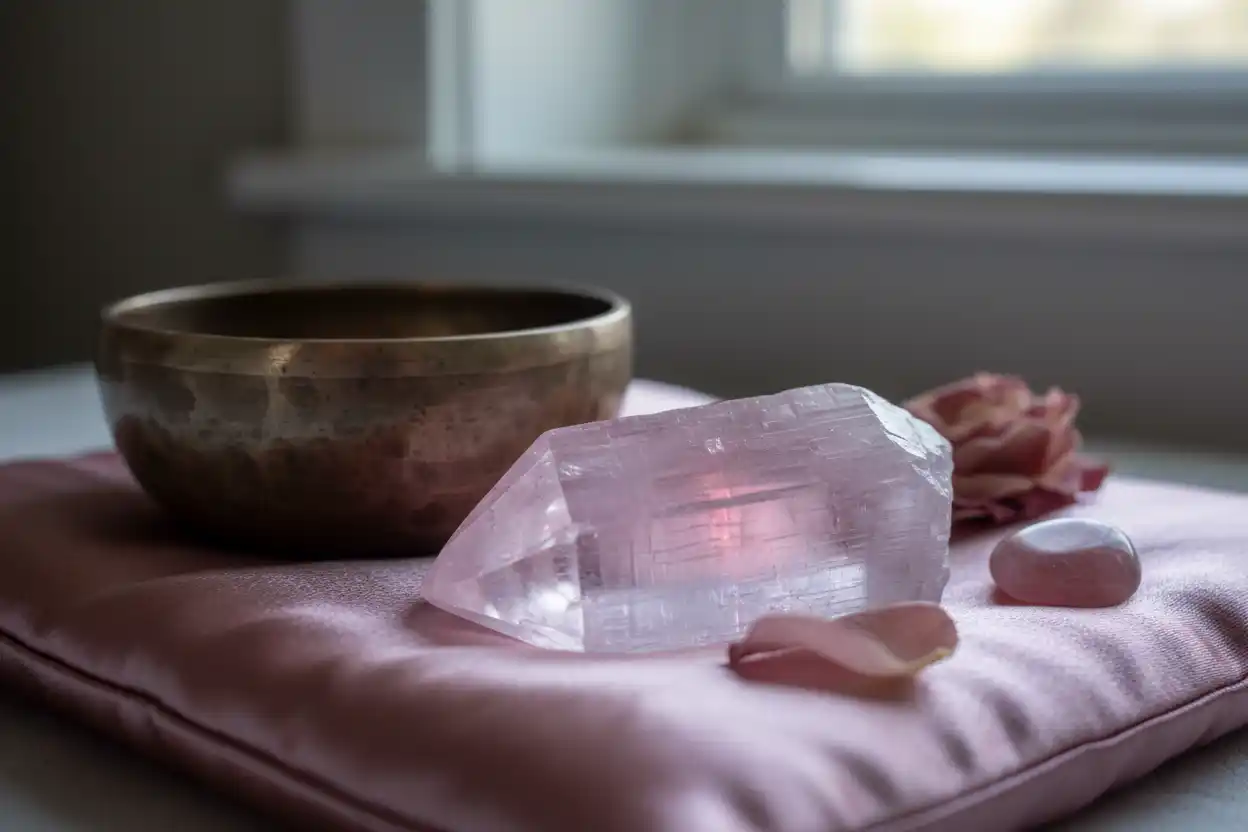
How to Cleanse and Charge Kunzite
The safest ways to cleanse and charge Kunzite are sound, intention, visualization, gentle breath, indirect indoor moonlight, and a written dedication. A brief lukewarm-water rinse may be appropriate for a sound, untreated stone, but dry methods offer a wider safety margin for jewelry, fractured crystals, treated color, glue, and delicate settings.
Kunzite should not be charged in prolonged direct sunlight or exposed to steam, high heat, abrupt temperature changes, salt burial, or forceful vibration. Its color can fade under intense light and heat, while two perfect cleavage directions make the gemstone vulnerable to splitting.
What Cleansing and Charging Mean
Cleansing is a personal or spiritual ritual used to mark a transition, release an object’s previous associations, or prepare it for meditation and intentional use.
Charging generally means dedicating the object to a chosen purpose, habit, memory, or personal value.
Neither practice is required to preserve Kunzite physically. No established scientific evidence shows that cleansing alters its chemistry, color centers, health effects, or measurable energy.
The gemstone’s mineralogy, pink-to-violet color, localities, and traditional symbolism belong to the broader Kunzite guide.
Why Kunzite Requires Gentle Rituals
Kunzite is the pink-to-violet variety of spodumene. Its color is associated principally with manganese within the crystal structure.
Although the gemstone ranks approximately 6.5 to 7 on the Mohs scale, its toughness is poor because it has perfect cleavage in two directions.
| Property | Ritual implication |
|---|---|
| Mineral species | Spodumene |
| Typical color | Pale pink, lilac, violet pink, or violetish purple |
| Mohs hardness | Approximately 6.5 to 7 |
| Toughness | Poor |
| Cleavage | Perfect in two directions |
| Safest ritual methods | Sound, intention, visualization, breath, and indoor moonlight |
| Water exposure | Brief contact only for sound, suitable material |
| Sunlight exposure | Avoid prolonged intense light |
| Main risks | Fading, cleavage, impact, thermal shock, treatments, glue, and settings |
The gemstone hardness chart explains why Kunzite resists many ordinary scratches.
However, hardness does not protect it from splitting under pressure. The wider distinction appears in Gemstone Toughness vs Hardness and Gemstone Cleavage Explained.
Inspect the Kunzite Before Beginning
Examine the stone beneath bright but indirect light.
Look for open fractures, chipped corners, loose prongs, cloudy glue, damaged drill holes, worn facet junctions, peeling coatings, stretched elastic, and movement within the setting.
Kunzite crystals are commonly elongated, so cut stones may have long sides, pointed ends, or broad tables. These areas deserve careful support.
Natural inclusions and pleochroic color differences are not dirt. Do not press on an internal line or scrape a pale area.
When the gemstone moves, clicks, or contains a visible surface-reaching fissure, leave it on a padded surface and use a completely non-contact method.
Separate Physical Cleaning from Symbolic Cleansing
Symbolic cleansing does not remove skin oil, cosmetics, soap film, or setting residue.
The complete cleaning method belongs to How to Clean Kunzite Jewelry Safely.
A sound Kunzite can be cleaned with lukewarm water, mild soap, and a soft brush. Steam and ultrasonic machines should not be used.
The broader equipment limitations appear in Which Gemstones Can Go in an Ultrasonic Cleaner?.
Allow the gemstone and setting to dry fully before beginning a ritual.
Method 1: Cleanse Kunzite with Sound
Place the Kunzite on a folded cloth or padded tray.
Ring a bell, chime, tuning fork, or singing bowl nearby. You may also hum, chant, clap gently, or play quiet music.
Do not place the gemstone inside a hard metal bowl while striking it. Concentrated vibration and contact can stress cleavage planes or chip a facet edge.
Several gentle tones are sufficient. Greater volume does not make the ritual more effective.
Sound is particularly suitable for jewelry with glue, fracture filling, delicate prongs, or companion stones.
Method 2: Use Intention
Leave the Kunzite on a padded surface or hold it loosely above a cloth.
Choose one clear purpose. It might remind you to communicate with patience, protect time for a relationship, respond more thoughtfully, or approach a difficult conversation with care.
State the intention silently or aloud.
The stone does not need to be squeezed or held for an extended period. Minimal handling reduces pressure against the cleavage directions.
A short, specific intention also helps keep the ritual separate from unsupported medical or psychological claims.
Method 3: Use Visualization
Place the Kunzite where it cannot roll or fall.
Imagine earlier associations fading while the pale pink or violet color becomes connected with your chosen purpose.
Some practitioners visualize pink, violet, white, or neutral light. The imagery is symbolic rather than a physical emission from the gemstone.
Continue for several slow breaths or a few minutes.
Visualization works especially well for high-value, included, treated, fractured, or mounted Kunzite because no physical exposure is required.
Method 4: Use Gentle Breath
Keep the gemstone supported on a soft cloth.
Take several slow breaths and exhale gently toward it once or twice.
Avoid forceful blowing or visible condensation, especially around fractures, drill holes, glue seams, and jewelry galleries.
State the intention afterward.
Do not hold a long crystal by one end while performing the ritual. Support its entire length.
Method 5: Use Indirect Moonlight Indoors
Place Kunzite indoors near a window on a padded tray or inside an open lined jewelry box.
An hour, an evening, or overnight indoor placement may be used according to personal preference.
Outdoor placement introduces dew, rain, falling debris, theft, animals, and abrupt temperature changes.
The moon phase affects personal symbolism rather than the stone’s physical properties.
Indoor moonlight is particularly suitable because it avoids the prolonged intense exposure discussed in Which Crystals Can and Can’t Go in the Sun.
Method 6: Use a Written Dedication
Write one concise statement and place it beside the padded Kunzite.
The statement might describe a specific action, such as listening without interrupting, scheduling regular time with someone important, or pausing before sending a difficult message.
Keep pens, clips, staples, and metal objects away from the gemstone.
Leave the arrangement for several minutes or an evening.
A written ritual creates a clear association without exposing the stone to light, water, smoke, or another mineral.
Method 7: Use a Brief Water Ritual
A sound, untreated or stably treated Kunzite may receive a brief rinse in clean lukewarm water.
Hold it over a bowl rather than an open drain. Keep the temperature moderate and dry the stone immediately.
Do not soak it overnight.
Avoid water rituals for fractured, filled, glued, coated, antique, strung, or loosely mounted pieces.
The broader distinction between mineral tolerance and complete jewelry construction belongs to Which Crystals Can and Can’t Go in Water.
Water remains optional. Sound and intention provide safer choices when the stone’s condition is uncertain.
Method 8: Use a Companion Object with Separation
Kunzite may be placed near Clear Quartz, Selenite, a written intention, a photograph, or another meaningful object.
Use separate soft cloths and leave physical space between them.
Quartz is at least as hard as Kunzite and may scratch it. Crystal points, metal chains, and earring posts can also cause chips.
Direct contact is unnecessary for a symbolic arrangement.
The broader comparison among cleansing methods belongs to How to Cleanse Crystals.
Do Not Use Prolonged Direct Sunlight
Kunzite is known for color that can fade under prolonged intense light.
Both naturally colored and irradiated-and-heated stones may lose color after excessive exposure to bright light or heat.
Brief ordinary wear outdoors is different from leaving Kunzite on a sunny windowsill for hours.
Do not attempt to deepen pale color through sunlight. Exposure may produce the opposite result.
Indirect indoor moonlight, visualization, or sound provides a safer light-based ritual.
Avoid High Heat and Thermal Shock
High heat and sharp temperature changes can cause Kunzite to break.
Keep it away from candle flames, incense coals, fireplaces, steam, boiling water, radiators, heated ritual bowls, and hot vehicle interiors.
Do not move the gemstone from a hot windowsill directly into cold water.
Heat may also accelerate fading in both natural and treated color.
Avoid Direct Salt Contact
Salt grains can collect inside setting openings, drill holes, fractures, and around prongs.
Coarse salt may trap harder grit that scratches the surface.
Saltwater adds prolonged moisture and may affect glue, elastic, filler, metal, and companion stones.
When salt carries symbolic importance, keep it in a separate bowl while the Kunzite remains on a lined dish nearby.
Avoid Soil Burial
Soil contains Quartz grains, moisture, fertilizers, organic acids, microorganisms, and mineral debris.
These materials can scratch Kunzite, enter fractures, or lodge inside settings.
Outdoor burial also creates pressure and loss risks.
A nature-based alternative places the stone near a plant while keeping it dry and separated from soil.
Use Smoke Conservatively
A brief cool-smoke ritual may be used cautiously in traditions that include it.
Keep Kunzite away from flame, hot ash, incense coal, and heated containers.
Smoke may leave oils, soot, or fragrance residue that requires further cleaning.
Sound or visualization is preferable for pale gems and jewelry worn against the skin.
Kunzite and Hiddenite
Kunzite and Hiddenite are both gem varieties of spodumene.
Kunzite is pink to violet, while Hiddenite is green and associated with chromium-related color.
The Hiddenite material profile belongs to the Hiddenite guide, while purchase considerations appear in the Hiddenite buying guide.
Both varieties share spodumene’s cleavage and poor toughness.
Consequently, neither should be exposed to pressure, thermal shock, ultrasonic vibration, or rough contact during a ritual.
Kunzite Versus Morganite
Kunzite and Morganite can overlap in pale pink, peach, or lilac color.
Kunzite is spodumene with perfect cleavage in two directions, whereas Morganite is pink beryl with a different crystal structure and durability profile.
The full identification comparison belongs to Kunzite vs Morganite.
Cleaning or ritual response should never be used as an identification test.
Both stones can have personal symbolic value, but the Kunzite method should be used whenever identity is uncertain and cleavage risk may be present.
Jewelry-Specific Ritual Care
A Kunzite ring should remain on a padded tray during cleansing because rings expose the stone to more impact and setting pressure.
Kunzite earrings should be separated so their posts cannot strike the opposite gemstone.
A Kunzite necklace should be laid flat so its chain does not rub across the facets.
Likewise, a Kunzite bracelet should not be hung from one end or placed where multiple stones press together.
The complete object—not the gemstone alone—determines whether water or prolonged handling is suitable.
Buying and Value Context
The Kunzite buying guide covers color strength, fading risk, pleochroism, clarity, cut, size, treatment, and setting protection.
Market factors belong to the Kunzite price guide.
Kunzite also belongs to the wider family covered in Pink Gemstones.
No ritual can restore color that has already faded or repair a chipped cleavage surface. Those issues require professional gemological or lapidary assessment.
Frequently Asked Questions
1. What is the safest way to cleanse Kunzite?
Sound, intention, visualization, gentle breath, a written dedication, and indirect indoor moonlight are the safest methods.
2. Can Kunzite be cleansed in water?
A sound stone may receive a brief lukewarm rinse. Avoid soaking fractured, filled, glued, coated, strung, or loose jewelry.
3. Can Kunzite be left in moonlight overnight?
Yes, when kept indoors on a padded surface away from condensation and direct morning sunlight.
4. Can Kunzite be charged in sunlight?
Prolonged direct sunlight is not recommended because the pink-to-violet color can fade.
5. Can Kunzite be cleansed with salt?
Direct salt contact is best avoided because grains can lodge in fractures and settings or scratch the stone.
6. Can Kunzite be cleansed with smoke?
A brief cool-smoke ritual is possible, but sound or visualization avoids heat, soot, and fragrance residue.
7. Can Kunzite touch Clear Quartz?
Use a soft barrier. Quartz can scratch Kunzite or chip an exposed edge.
8. Why is Kunzite easy to split?
It has perfect cleavage in two directions and poor toughness despite moderate surface hardness.
9. Does heat-treated Kunzite need different cleansing?
The same gentle methods apply, but treated color can also fade under heat and bright light.
10. How long should Kunzite charge?
A few minutes or an evening is sufficient. There is no scientifically required duration.
11. How often should Kunzite be cleansed?
Use a schedule that fits your practice while minimizing unnecessary handling and light exposure.
12. Does cleansing change Kunzite scientifically?
No established evidence shows that cleansing changes its chemistry, health effects, color centers, or measurable physical energy.
Conclusion
Kunzite’s delicate color and strong cleavage make quiet rituals more appropriate than dramatic exposure. Sound, intention, visualization, and protected moonlight preserve its pink-to-violet appearance without adding heat, vibration, or pressure. A successful ritual should clarify the stone’s personal purpose while leaving every facet, cleavage plane, and color center physically unchanged.
Crystal cleansing and charging are spiritual or personal practices, not scientifically established methods for changing health, energy, or the physical properties of Kunzite.