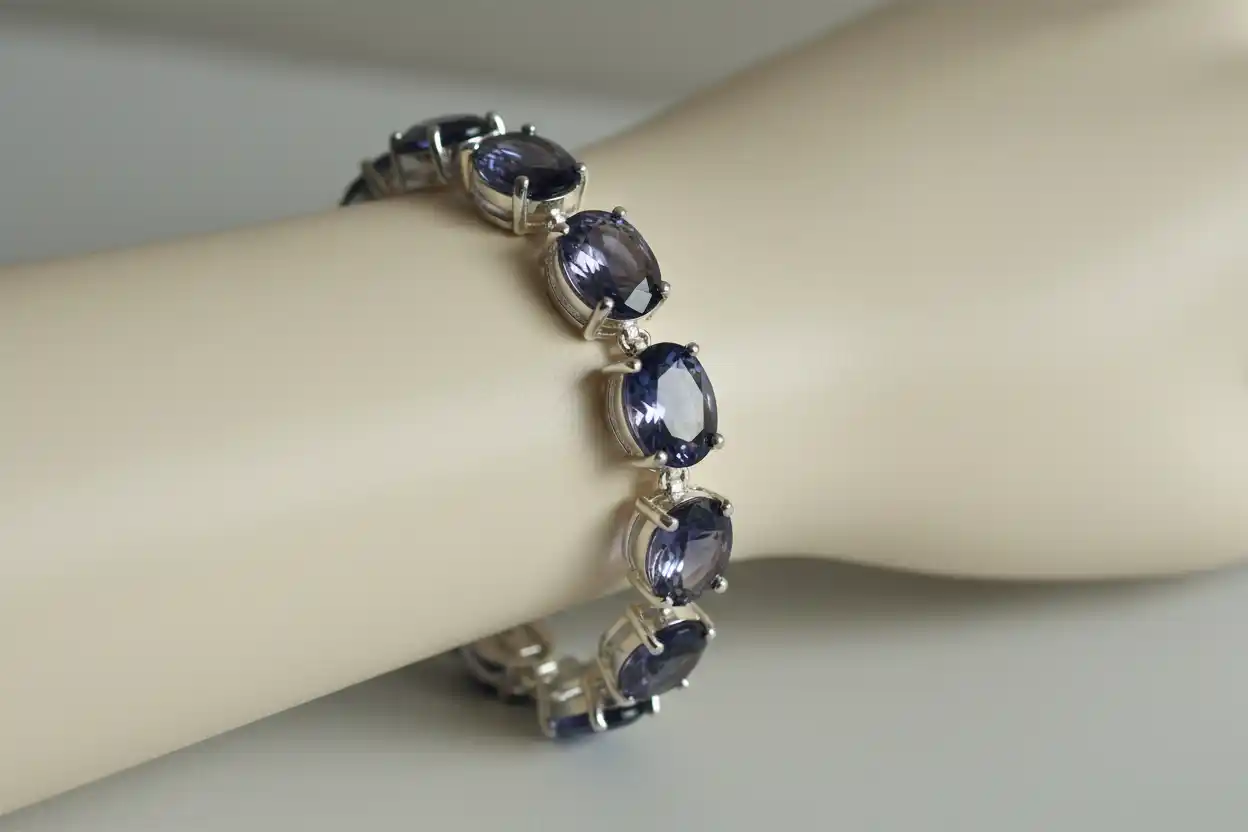
Iolite Bracelets: How to Choose and Wear
Iolite bracelets offer violet-blue color at a generally more accessible price than comparable Tanzanite or fine blue Sapphire jewelry. Their appeal comes largely from pleochroism: the same stone can appear blue, violet, gray, pale yellow, or nearly colorless when viewed from different directions.
That optical character makes Iolite distinctive, but it also complicates bracelet selection. Every stone in a multi-gem bracelet should face in a compatible direction, and the construction must protect a gem that is reasonably hard yet vulnerable to splitting after a sharp blow.
The gemstone’s geology, composition, symbolism, and full material profile belong to Iolite: Meaning, Properties & Symbolism. This guide focuses specifically on choosing, evaluating, styling, wearing, and maintaining Iolite bracelets.
Iolite Bracelet at a Glance
| Feature | What to look for |
|---|---|
| Best color | Saturated violet blue or blue violet with limited gray or brown |
| Optical feature | Strong pleochroism |
| Mohs hardness | Approximately 7–7.5 |
| Toughness | Fair rather than exceptional |
| Cleavage | One direction of perfect cleavage |
| Common cuts | Oval, round, cushion, pear, emerald cut, beads, and cabochons |
| Safer bracelet styles | Low-profile bezel, partial bezel, station, and protected link designs |
| Higher-risk styles | Tall prongs, exposed points, loose bead stacks, and rigid contact with harder gems |
| Common metals | Sterling silver, white gold, yellow gold, and rose gold |
| Treatments | Iolite is not usually treated |
| Cleaning | Lukewarm water, mild soap, and gentle manual cleaning |
| Main care concern | Sharp impacts and pressure across the cleavage direction |
Is Iolite Durable Enough for a Bracelet?
Iolite ranks approximately 7–7.5 on the Mohs scale. That gives it useful resistance to ordinary surface scratches, as shown in the gemstone hardness chart.
However, hardness is not the same as toughness. Iolite has one direction of perfect cleavage and may split after a concentrated impact, excessive pressure, or a sudden temperature change.
The distinction between scratch resistance and breakage appears in Gemstone Toughness vs Hardness. The structural reason a hard gemstone may still divide along a weak direction is explained in Gemstone Cleavage Explained.
Bracelets receive more contact than earrings and many necklaces. They strike desks, doorframes, handbags, countertops, watches, exercise equipment, and other bracelets. Consequently, Iolite is better suited to thoughtful daily wear than rough, uninterrupted wear.
A low-profile setting, secure clasp, and close but comfortable fit reduce risk substantially.
Pleochroism Matters More in a Bracelet
Iolite is strongly pleochroic. A well-cut stone may display violet blue from one direction, blue gray from another, and pale yellow, gray, or nearly colorless from a third.
A skilled cutter orients the rough so the most attractive color appears through the face of the finished gem. That orientation is especially important in bracelets containing several stones.
When neighboring Iolites face different crystallographic directions, one may appear richly violet while the next looks gray or pale. The bracelet can seem mismatched even when all stones come from the same parcel.
Examine the entire bracelet under neutral light and rotate it slowly. The colors should shift naturally without one or two gems becoming conspicuously dull.
The wider quality factors—including pleochroic orientation, clarity, cut, and color—belong to the Iolite buying guide.
Choose the Bracelet Construction First
The safest design depends on how frequently the bracelet will be worn.
Bezel-Set Iolite Bracelets
A bezel surrounds most or all of the stone’s perimeter with metal.
This design protects vulnerable girdle edges and reduces the chance that a gem will catch on clothing. A full bezel may obscure part of the stone and make a dark Iolite appear deeper in tone, but it remains one of the most practical choices for routine wear.
Partial bezels can admit more light while still protecting two sides.
Prong-Set Link Bracelets
Prongs expose more of each Iolite and allow light to enter from several directions.
However, exposed girdles and corners receive less protection. Inspect every prong for even contact, smooth tips, and adequate thickness.
A loose prong can allow the stone to rattle, while an over-tightened prong may place pressure against a cleavage-sensitive area.
Station Bracelets
A station bracelet spaces individual Iolites along a chain.
The reduced number of gems can keep the piece light and flexible. Because the stones are separated, they are less likely to strike one another than gems in a continuous tennis-style row.
The chain must still be strong enough for the combined weight, and each station should connect without a thin or distorted jump ring.
Iolite Tennis Bracelets
A tennis bracelet creates a continuous or nearly continuous row of matched stones.
Matching is critical. The Iolites should have compatible hue, tone, saturation, face-up color, dimensions, and pleochroic orientation.
Look for articulated links that move freely without twisting. A safety latch or secondary clasp provides valuable protection because a bracelet can fall unnoticed if the primary clasp opens.
Beaded Iolite Bracelets
Beaded bracelets may use transparent faceted beads, smooth rounds, chips, or mixed stones.
Inspect every drill hole. Chipping, pale stress lines, rough edges, and deeply worn openings can eventually cut the cord.
Elastic is convenient but stretches and degrades. Professional bead wire with a secure clasp generally offers a more durable structure for valuable material.
The wider relationship between symbolism, sizing, stacking, and bead construction appears in Crystal Bracelets: Meanings and How to Wear.
Evaluate Iolite Color
The most valued Iolite typically shows an attractive violet-blue to blue-violet face-up color.
Some stones lean strongly blue, while others appear more violet. Gray and brown modifiers usually reduce visual brightness and market appeal, although a smoky blue-gray stone may suit a subdued design.
Color should be judged under several conditions:
- Neutral daylight-equivalent lighting
- Diffused natural daylight
- Typical indoor lighting
- Light and dark backgrounds
- The bracelet’s normal position on the wrist
Direct spotlights can make pale stones look much more saturated than they will during ordinary wear.
Turn the bracelet through several angles. Pleochroic change is expected, but the design should remain attractive through the range of normal wrist movement.
Compare Color Across Every Stone
A multi-stone bracelet should not be judged from one central gem alone.
Compare the Iolites side by side. Look for consistent face-up color, even spacing, similar transparency, and compatible cutting style.
Perfect matching is neither realistic nor necessary in a natural gem bracelet. Slight variation can make the piece feel individual.
However, one brownish, heavily gray, badly windowed, or incorrectly oriented stone can disrupt the whole row.
In graduated designs, size should change deliberately rather than randomly. Color may need careful selection because larger Iolites can appear darker than smaller stones of similar saturation.
Inspect Clarity and Inclusions
Faceted Iolite is often relatively clean to the unaided eye.
Common internal features may include mineral crystals, needles, fluid-related inclusions, fractures, and color zoning. Some included Iolite can display cat’s-eye effects or aventurescence when cut appropriately.
For ordinary transparent bracelet stones, obvious fractures generally reduce value and durability.
Examine each gem under magnification, paying particular attention to fractures reaching the surface near prongs, drill holes, corners, and girdles.
A natural inclusion does not automatically create a weakness. Its position, size, orientation, and relationship to the surface matter more than its mere presence.
Check the Cut and Orientation
A well-cut Iolite should display pleasing face-up color, adequate brightness, balanced proportions, and reasonably symmetrical facets.
A large transparent area through which you can see the setting directly may indicate windowing. Excessive depth can make the stone appear dark and add unnecessary weight.
Pleochroism makes orientation particularly important. Two stones cut to the same outline may face up in different colors if their crystallographic directions differ.
Step cuts can emphasize transparency and clean lines. Ovals and cushions often balance color retention with wearable proportions, while rounds can be harder to orient efficiently from the original rough.
Cabochons may be chosen for included, chatoyant, or aventurescent material.
Select the Right Stone Size
Small Iolites can show attractive blue-violet color, although extremely small melee may appear darker or grayer when enclosed by metal.
Larger stones reveal pleochroism more clearly and may show stronger visual depth. They also create more leverage against the setting when the bracelet is struck.
A practical daily bracelet often balances several moderate stones rather than using one large high-profile centerpiece.
Measure the gemstone dimensions rather than relying only on carat weight. Iolite’s cut depth and outline affect how large it appears on the wrist.
Choose the Metal
Sterling Silver and White Gold
Cool-toned metals emphasize Iolite’s blue and violet directions.
Sterling silver provides an accessible option but requires tarnish maintenance. White gold offers greater long-term resistance to tarnish, although rhodium plating may need renewal.
Yellow Gold
Yellow gold creates a strong warm-versus-cool contrast.
It can also echo the pale yellow pleochroic direction visible when the Iolite turns. Rich yellow metal may make grayish stones appear slightly warmer.
Rose Gold
Rose gold creates a softer contrast with violet Iolite.
It works particularly well with stones showing lavender or purple rather than predominantly blue color.
Metal preference should also account for skin sensitivity, clasp durability, repair access, and whether plating is present.
How to Size an Iolite Bracelet
Measure the wrist with a flexible tape at the point where the bracelet will sit.
For a close fit, add approximately 0.5–1 centimeter. For a comfortable fit with moderate movement, add about 1–1.5 centimeters. A loose drape may require more, depending on the bracelet’s depth and construction.
Large beads and thick settings occupy interior space, so a bracelet’s stated circumference may not equal its usable internal fit.
An Iolite bracelet should not rotate so freely that the gems repeatedly strike the underside of the wrist, but it should not compress the stones against the skin or prevent normal movement.
Rigid cuffs need enough opening to pass over the wrist without being bent repeatedly.
How to Wear an Iolite Bracelet
Iolite works well with navy, white, gray, black, lavender, cream, and muted blue clothing.
A violet-dominant bracelet can complement cool pinks and purples, while a blue-dominant stone suits denim and tailored neutral outfits.
The broad color families appear in Blue Gemstones and Purple Gemstones.
For professional wear, choose a low-profile station or small-link bracelet. A continuous faceted row offers more evening impact.
Wear the bracelet on either wrist according to comfort and dominant-hand activity. There is no gemological requirement to use a particular side.
A bracelet on the non-dominant wrist usually receives fewer impacts.
Stacking Iolite Bracelets
Stacking increases both visual interest and physical contact.
Place Iolite beside smooth, rounded bracelets rather than sharp metal edges, Diamond-set bangles, or rough crystal beads.
Avoid stacking it directly with Sapphire bracelets during active wear. Sapphire is harder and can scratch Iolite.
Design comparisons can be made with Sapphire Bracelets and Tanzanite Bracelets, but those gemstones have different durability and treatment profiles.
Add soft spacer bracelets when several pieces move against one another.
For maximum protection, wear the Iolite bracelet alone.
Iolite Versus Tanzanite in Bracelets
Iolite and Tanzanite overlap in blue-to-violet appearance and both show pleochroism.
Iolite is harder and generally more affordable, while Tanzanite can display a highly saturated blue-violet color but has lower hardness and strong cleavage-related concerns.
Iolite often shows more gray or a pale yellow direction. Tanzanite commonly receives heat treatment, whereas Iolite is not typically treated.
The complete identification and buying distinction belongs to Iolite vs Tanzanite.
Neither gem should be treated as impact-proof in a bracelet.
Buying and Price Considerations
The bracelet’s value depends on total gemstone weight, color quality, pleochroic orientation, clarity, cut, matching, metal, clasp, craftsmanship, and brand.
The underlying market ranges and value factors belong to the Iolite price guide.
Iolite is not typically treated, which can be an appealing feature. Nevertheless, treatments, coatings, synthetic materials, glass, and misidentified blue stones remain possible in the wider market.
Treatment terminology is explained in Gemstone Treatments Explained.
Ask the seller to state the stone identity, treatment status, metal fineness, total weight, bracelet length, clasp type, and return policy on the invoice.
Inspect the Clasp and Connections
A valuable bracelet needs more than attractive gemstones.
Open and close the clasp several times. It should engage positively without excessive force.
Check solder points, hinge pins, jump rings, and link articulation under magnification. Thin connectors can wear through gradually.
A box clasp should align accurately. Lobster clasps should close completely, while toggle clasps require enough bar length to resist accidental release.
A tennis bracelet benefits from a safety latch or figure-eight safety.
Beaded bracelets should have properly finished crimps or knots. Exposed wire ends and crushed beads indicate poor assembly.
Everyday-Wear Boundaries
Remove an Iolite bracelet before:
- Exercise and weight training
- Cleaning and chemical use
- Gardening
- Contact sports
- Swimming and bathing
- Sleeping
- Mechanical work
- Moving furniture
- Applying perfume, lotion, or hairspray
Put jewelry on after cosmetics have dried.
The bracelet can tolerate normal light, but it should not be left in a hot car or moved abruptly between temperature extremes.
Iolite’s color is stable; impact and thermal stress are the greater concerns.
How to Clean an Iolite Bracelet
Use lukewarm water, mild liquid soap, and a very soft brush.
Support the bracelet rather than allowing it to hang from the clasp. Clean beneath settings and between links without forcing the brush into prongs.
Rinse briefly and dry with a lint-free cloth. Allow hidden moisture around hinges and settings to evaporate before storage.
The dedicated process belongs to How to Clean Iolite Jewelry Safely.
Steam and ultrasonic cleaning should be avoided because pressure, heat, vibration, inclusions, cleavage, and weakened settings can lead to damage. The broader equipment guide is Which Gemstones Can Go in an Ultrasonic Cleaner?.
Water exposure should remain controlled rather than prolonged, as discussed in Which Crystals Can and Can’t Go in Water.
The gem’s color is stable in ordinary light, but jewelry should still be protected from hot windowsills and uncontrolled outdoor storage. The broader comparison appears in Which Crystals Can and Can’t Go in the Sun.
Store the Bracelet Separately
Close the clasp before storage so the bracelet does not tangle.
Lay it flat inside a lined compartment or soft individual pouch. Avoid folding a tennis bracelet sharply at one point.
Do not store Iolite against Diamond, Sapphire, Ruby, or other harder gems.
Likewise, Iolite can scratch softer materials such as Turquoise, Pearl, Opal, Fluorite, and Calcite.
Inspect the bracelet periodically for loose gems, worn links, thinning prongs, damaged drill holes, stretched stringing, and clasp movement.
Have a jeweler repair structural wear before the bracelet is worn again.
Frequently Asked Questions
1. Is Iolite suitable for a bracelet?
Yes, when the bracelet uses secure low-profile construction and is removed before impact-prone activities.
2. What is the best Iolite bracelet color?
Saturated violet blue or blue violet with limited gray or brown is generally preferred.
3. Why do Iolite bracelet stones look different from one another?
Strong pleochroism can make stones appear blue, violet, gray, yellowish, or pale depending on their orientation.
4. Is a bezel setting better than prongs?
A bezel normally protects Iolite’s edges more effectively, while prongs admit more light but leave more of the gem exposed.
5. Can an Iolite bracelet be worn every day?
It can be worn regularly with care, but it should be removed for exercise, cleaning, sports, sleep, and manual work.
6. Can I stack Iolite with other bracelets?
Yes, although hard or sharp neighboring jewelry can scratch or chip it. Smooth separators or solo wear are safer.
7. Is elastic suitable for an Iolite bead bracelet?
Elastic is convenient but stretches and deteriorates. Professional bead wire with a clasp is generally more secure for valuable beads.
8. Does Iolite receive treatment?
Iolite is not typically treated, although seller disclosure should still be requested.
9. Is Iolite more durable than Tanzanite?
Iolite is harder, but both have cleavage-related breakage concerns and should be protected from sharp blows.
10. Can Iolite bracelets go in an ultrasonic cleaner?
Ultrasonic cleaning is not recommended. Use lukewarm water, mild soap, and gentle manual cleaning.
11. Which wrist should an Iolite bracelet be worn on?
Either wrist is suitable. The non-dominant wrist usually receives fewer impacts.
12. How should an Iolite bracelet be stored?
Close the clasp and lay the bracelet flat in its own lined compartment or soft pouch away from harder gems.
Conclusion
The best Iolite bracelet balances face-up violet-blue color with disciplined construction. Compare every stone through normal wrist movement, confirm that the pleochroic directions match, and favor low settings, reliable links, and a secure clasp. Iolite can provide years of wear when the design protects its cleavage rather than relying on hardness alone.