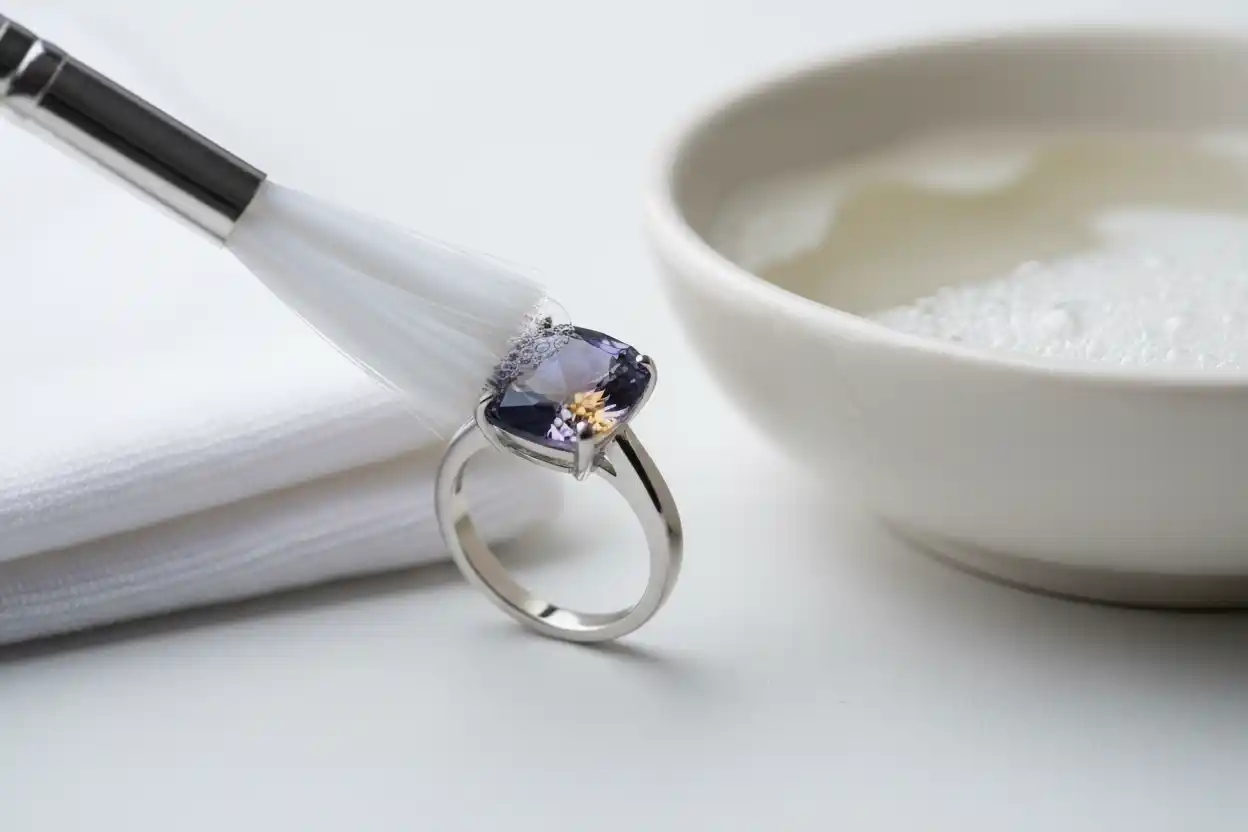
How to Clean Iolite Jewelry Safely
The safest way to clean iolite jewelry is with lukewarm water, mild liquid soap, and a soft brush. Steam and ultrasonic cleaners should be avoided because iolite has perfect cleavage in one direction and can break when exposed to a sharp blow, extreme pressure, high heat, or sudden temperature change.
Although iolite has enough surface hardness for many jewelry designs, its limited toughness requires more conservative care than sapphire, spinel, or diamond. The stone should be handled gently during cleaning, drying, storage, and everyday wear.
Why Iolite Requires Careful Handling
Iolite is the gem-quality variety of cordierite. Its color usually ranges from violetish blue to blue, although the stone can show noticeably different colors when viewed from different crystal directions.
The material’s geology, pleochroism, sources, symbolism, and uses belong to the broader Iolite meaning guide. This article remains focused on physical jewelry cleaning and setting protection.
Iolite rates approximately 7 to 7.5 on the Mohs scale. That hardness provides reasonable resistance to ordinary scratches, but it does not eliminate the risk of splitting along its cleavage direction.
| Property | Cleaning implication |
|---|---|
| Mineral species | Cordierite |
| Common color | Violetish blue to blue |
| Mohs hardness | Approximately 7 to 7.5 |
| Toughness | Fair to poor |
| Cleavage | Perfect in one direction |
| Safest routine method | Lukewarm water, mild soap, and a soft brush |
| Ultrasonic cleaning | Avoid |
| Steam cleaning | Avoid |
| Main risks | Cleavage, impact, pressure, thermal shock, and loose settings |
The difference between scratch resistance and resistance to breaking is explained in the gemstone hardness chart and Gemstone Toughness vs Hardness.
The dedicated guide to gemstone cleavage explains why a relatively hard gem can still split after a forceful impact.
Iolite’s Pleochroism Is Not Dirt
Iolite is strongly pleochroic. Depending on viewing direction, the same stone may appear violet-blue, lighter blue, grayish, or yellowish.
A color shift that remains after washing is therefore not necessarily a stain, coating, or cleaning problem. It may result from the stone’s orientation, cut, lighting, and natural optical behavior.
Cutters must position iolite carefully to emphasize its strongest blue or violet-blue direction. As a result, a stone can look richly colored from above but pale or gray from the side.
Cleaning restores surface brilliance, but it cannot change pleochroism, cut orientation, extinction, or uneven color distribution.
Inspect the Stone Before Washing
Examine the jewelry under bright, indirect light. Look for loose prongs, movement in the stone, chipped corners, worn facet edges, surface-reaching fractures, and damaged metal.
Pay particular attention to elongated rectangular, emerald, pear, and marquise cuts. Corners and pointed ends can be vulnerable when the setting no longer protects them.
Do not clean the piece at home when the iolite moves or a prong appears raised. Brushing may dislodge a stone that is already loose.
An old repair, glued component, enamel detail, hollow mounting, or delicate accent stone may also require less moisture than the iolite itself.
Treatment Is Usually Not the Main Concern
Iolite is not commonly treated. Its commercial appeal partly comes from the fact that blue-to-violet color is generally natural rather than routinely produced through heating, dyeing, or coating.
Nevertheless, an individual jewel may still contain glue, coating, fracture filler, plated metal, repaired areas, or imitation material. The broader enhancement categories appear in Gemstone Treatments Explained.
When documentation identifies an unusual treatment, follow the restrictions for that treatment rather than relying only on iolite’s normal care profile.
Cleaning should never be used as an authenticity or treatment test.
Prepare a Mild Cleaning Solution
Fill a shallow bowl with lukewarm water and add a few drops of mild liquid dish soap. Prepare a second bowl of clean water at approximately the same temperature.
Use a clean, soft-bristled toothbrush or jewelry brush. A lint-free cloth will help with blotting and final fingerprint removal.
Do not clean over an open sink. A small earring or loosened stone may disappear through the drain.
Avoid soaps containing bleach, abrasive particles, aggressive degreasers, citrus solvents, strong alkaline ingredients, or heavy moisturizers.
Clean the Iolite Gently
Place the jewelry briefly in the mild solution or hold it securely above the bowl.
Brush around the crown, pavilion, girdle, prongs, bezel, and gallery using light strokes. Skin oils beneath the stone can reduce brilliance and make blue iolite appear darker.
Do not apply force near a chipped corner, visible fracture, or exposed girdle. A hard push in an unfavorable direction could stress the stone’s cleavage.
A short wash is sufficient. Prolonged soaking offers little advantage and may affect glue, repairs, stringing materials, plating, enamel, or accompanying gemstones.
Rinse and Dry Without Heat
Rinse the jewelry in the second bowl of clean lukewarm water. Keeping the rinse close to the wash temperature reduces thermal stress.
Blot the piece with a lint-free cloth and allow moisture beneath the setting to evaporate naturally at room temperature.
Do not dry iolite with a hair dryer, heated lamp, radiator, or direct concentrated sunlight. High heat or abrupt temperature change can cause breakage.
After drying, inspect the setting again. A prong that catches on the cloth or a stone that moves requires professional repair.
Never Use an Ultrasonic Cleaner
Iolite should not go into an ultrasonic cleaner. The machine’s vibration may stress cleavage planes, enlarge a fracture, loosen a worn setting, or dislodge small accent stones.
A stone can appear visually clean while still containing internal features that are difficult to see without magnification.
The broader equipment comparison belongs to Which Gemstones Can Go in an Ultrasonic Cleaner?. Iolite belongs among the gemstones that should receive manual cleaning.
Never Steam Clean Iolite
Steam introduces concentrated heat, pressure, and a rapid temperature change. These conditions can break iolite or expose structural weakness around a cleavage plane.
Heat may also affect solder, glue, enamel, plating, and accompanying gemstones.
Lukewarm soapy water removes ordinary jewelry residue without creating those risks.
Cleaning an Iolite Ring
An Iolite ring receives more impacts than earrings or pendants. Soap, lotion, sanitizer, and skin oils also collect beneath the center stone.
Clean through the gallery openings without pressing on the girdle or pointed corners. Inspect each prong after drying.
Remove the ring before exercise, gardening, household cleaning, swimming, and heavy manual work. Protective settings reduce risk, but they cannot eliminate cleavage-related damage.
Cleaning Iolite Earrings
Iolite earrings generally experience less impact, which makes them a practical format for the gem.
Clean posts, hooks, backs, baskets, and hinges separately. Cosmetics and hair products often accumulate behind the stones.
Keep alcohol-based disinfectant on compatible metal fittings and away from glue, coatings, plating, or other vulnerable materials.
Cleaning an Iolite Necklace
An Iolite necklace or pendant may collect perfume, sunscreen, and skin oils along its back.
Apply cosmetics before putting on the necklace and allow them to dry. Prevent the chain from rubbing across the faceted stone during cleaning or storage.
Large iolite pendants may show pronounced pleochroism. A gray or pale side view does not necessarily indicate poor cleaning.
Cleaning an Iolite Bracelet
An Iolite bracelet combines repeated wrist movement with multiple settings, links, hinges, and clasp components.
Inspect each stone individually before washing the bracelet. Support the piece flat and clean one section at a time.
Bracelets should be removed before desk work or activities that repeatedly bring the wrist against hard surfaces.
Iolite Versus Tanzanite
Iolite and tanzanite can both show violet-blue color, but they are different minerals with different optical properties and care requirements.
The full visual and gemological comparison belongs to Iolite vs Tanzanite. The separate Tanzanite guide covers that zoisite variety.
Both gemstones require protection from sharp blows and unsuitable machinery. Cleaning response should not be used to decide which material is present.
Chemicals and Abrasives to Avoid
Do not use toothpaste, baking soda, scouring powder, polishing paste, stiff brushes, or abrasive cloths.
Keep iolite away from bleach, chlorine, acetone, drain cleaner, oven cleaner, concentrated acids, and aggressive alkaline solutions.
Vinegar and lemon juice offer no advantage over mild soap and may affect the metal, solder, plating, glue, or accompanying stones.
Commercial jewelry dips should be used only when every material in the piece is confirmed compatible.
Storage and Everyday Protection
Store iolite separately in a padded compartment or soft pouch. Diamond, sapphire, ruby, topaz, and other harder stones can scratch it.
Iolite can also scratch softer materials, so mixed loose jewelry should not be piled together.
The Iolite buying guide covers color orientation, pleochroism, clarity, cut, size, and setting quality. Market factors belong to the Iolite price guide.
For an important jewel, documentation can confirm identity and detectable treatment. The tracker’s gemstone certification guide and How to Read a Gem Lab Report explain what such reports contain.
When buying remotely, preserve invoices, measurements, treatment disclosures, and return terms. The principles in How to Buy Gemstones Online Without Getting Scammed can help establish the information needed for future care.
Frequently Asked Questions
1. What is the safest way to clean iolite?
Use lukewarm water, mild liquid soap, and a soft brush, then rinse and dry the jewelry at room temperature.
2. Can iolite get wet?
Brief washing is normally safe for a sound stone. Avoid prolonged soaking when the piece contains glue, repairs, stringing, enamel, or delicate components.
3. Can iolite go in an ultrasonic cleaner?
No. Ultrasonic vibration can stress cleavage planes, fractures, and weakened settings.
4. Can iolite be steam cleaned?
No. Heat, pressure, and sudden temperature change can cause the stone to break.
5. Is dish soap safe for iolite?
A few drops of mild liquid dish soap are suitable. Avoid bleach, abrasives, strong alkalis, and aggressive degreasers.
6. Can vinegar clean iolite?
Vinegar is unnecessary and may affect the metal, solder, plating, or companion materials.
7. Can toothpaste polish iolite?
No. Toothpaste is abrasive and may damage the gemstone’s polish, facet edges, or metal setting.
8. Why does my iolite show different colors?
Iolite is strongly pleochroic, so its appearance changes with viewing direction and lighting.
9. Does iolite fade in sunlight?
Its color is generally stable, but high heat and sharp temperature changes should still be avoided.
10. Why does iolite remain dull after cleaning?
The cause may be cut orientation, extinction, inclusions, surface wear, or debris trapped beneath the setting.
11. Is iolite durable enough for a ring?
It can be worn in a ring, but protective mounting and careful wear are important because of its cleavage and limited toughness.
12. When should iolite be professionally cleaned?
Professional care is appropriate for loose settings, visible fractures, valuable stones, antique jewelry, pointed cuts, or persistent cloudiness.
Conclusion
Iolite responds well to simple manual cleaning, but its cleavage prevents it from being treated like a tougher blue gemstone. Lukewarm soapy water removes ordinary residue without exposing the stone to vibration or thermal shock. When an iolite still appears uneven in color after cleaning, its pleochroism and cut orientation should be considered before stronger cleaning is attempted.