Sapphire Bracelets: Styles, Colors, Sizing and Buying Guide
A sapphire bracelet combines exceptional scratch resistance with one of the broadest color ranges available in a natural gemstone. Blue remains the classic choice, but sapphire can also appear pink, yellow, orange, green, violet, white, gray, black, parti-colored and color-changing.
Sapphire is corundum, the same mineral species as ruby. It ranks 9 on the Mohs scale and lacks perfect cleavage, making it one of the strongest colored gemstones for wrist jewelry.
Nevertheless, a bracelet receives constant movement, impact and friction. Weak links, worn clasps, exposed girdles, large fractures and extensive glass filling can still make a sapphire bracelet vulnerable.
A well-made piece should therefore be judged as a complete mechanical system. Stone color and carat weight matter, but so do articulation, setting security, metal thickness, clasp design and treatment disclosure.
The gemstone’s broader identity and symbolism appear in Sapphire: Meaning, Properties & Symbolism. Loose-stone quality belongs in the completed Sapphire Buying Guide, while current value factors remain within the completed Sapphire Price Guide.
Sapphire Bracelets at a Glance
| Bracelet type | Visual effect | Practical strength | Main concern |
|---|---|---|---|
| Tennis bracelet | Continuous line of faceted sapphires | Formal, flexible and highly visible | Numerous individual settings and links |
| Bezel bracelet | Smooth metal-framed stones | Strong girdle protection and reduced snagging | Closed construction can darken deep stones |
| Station bracelet | Sapphires spaced along a chain | Lightweight and easy to layer | Fine chain and flipping stations |
| Channel-set bracelet | Uninterrupted line with few exposed prongs | Smooth profile | Damage to one channel can affect several stones |
| Pavé bangle | Dense field of small sapphires | Strong surface color | Many small beads or prongs need inspection |
| Hinged bangle | Structured bracelet with top-facing gems | Controlled orientation and close fit | Hinge and clasp wear |
| Cuff | Open architectural form | Easy access and bold styling | Repeated bending weakens metal |
| Beaded bracelet | Continuous color at varied price levels | Casual and symbolic styling | Drill holes, stringing and material identity |
| Star sapphire bracelet | Cabochons showing asterism | Distinctive optical effect | Matching, treatment and dome exposure |
| Multi-color bracelet | Rainbow or graduated fancy sapphires | Wide visual range | Color and treatment matching |
| Sapphire-and-diamond bracelet | Strong contrast and brilliance | Classic fine-jewelry appearance | Harder diamond edges must not rub sapphire |
| Charm bracelet | One or several sapphire accents | Personalized birthstone jewelry | Moving components can strike one another |
Why Sapphire Works Well on the Wrist
Sapphire’s hardness makes it highly resistant to everyday abrasion.
It can scratch quartz, garnet, tourmaline and most softer jewelry stones. Only diamond and a few specialized materials exceed it significantly.
Corundum also has no perfect cleavage. It is less likely to split along a structural plane than topaz or tanzanite.
However, sapphire remains brittle enough to chip after a concentrated impact.
A bracelet’s repeated motion also places stress on metal links and settings. In many cases, the clasp or prong fails before the gemstone itself.
The difference between scratch resistance and impact resistance appears in Gemstone Toughness vs Hardness, while the Gemstone Hardness Chart places corundum among other jewelry materials.
Sapphire Tennis Bracelets
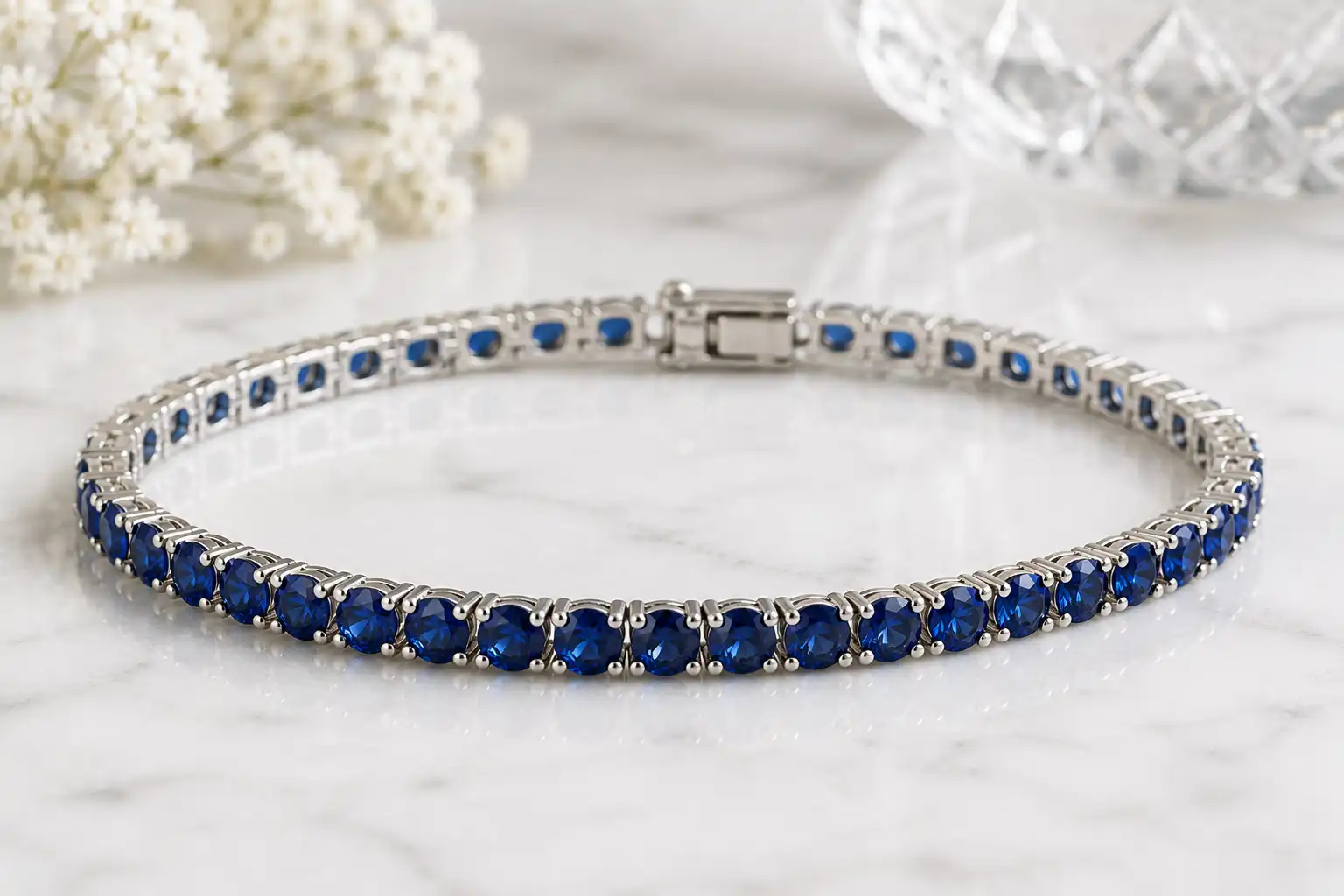
A tennis bracelet uses an articulated line of individually set stones.
Round sapphires are common because they can be calibrated consistently. Ovals and cushions provide more visible color but require larger, more complex settings.
Each link should move smoothly without excessive sideways play.
Stiff sections concentrate stress and may prevent the bracelet from following the wrist. Loose links twist and expose the sides of the settings.
Inspect every sapphire from the front and side. The stones should sit level, and prongs should contact each girdle evenly.
A box clasp should include a secondary side safety or figure-eight latch for a valuable bracelet.
Bezel-Set Sapphire Bracelets
A bezel surrounds all or part of each stone’s girdle.
This construction protects the edges and creates a smooth surface that is less likely to snag clothing.
Full bezels are especially practical for frequent wear.
However, a deep blue or black sapphire may become darker when enclosed by substantial metal. Open-backed bezels help preserve brightness and allow easier cleaning.
Partial bezels expose more of the gemstone but leave selected areas less protected.
The metal rim should remain even, continuous and free from gaps.
Station Bracelets
Station bracelets place sapphires at intervals along a chain.
The design creates a lighter appearance than a continuous tennis bracelet and allows each gem to remain visually distinct.
Bezel stations provide the smoothest construction. Prong-set stations allow more side light but can catch on fine fabric.
Each setting should connect symmetrically to prevent flipping.
Several heavy stations can distort a delicate chain, so chain gauge must match the combined gemstone weight.
An adjustable station bracelet should use a slider or extension strong enough for repeated use.
Channel-Set Bracelets
A channel setting holds calibrated stones between two continuous metal walls.
The absence of exposed prongs creates a clean, smooth profile.
Channel-set round, square and baguette sapphires can produce a strong uninterrupted color line.
Precision is essential. Stones must fit closely without pressing against one another.
A bent or worn channel wall can loosen multiple stones.
Check the bracelet from the side for gaps, tilted gems or an uneven metal edge.
Pavé Sapphire Bangles
Pavé uses many small sapphires secured by beads or fine prongs.
A bangle covered in blue, pink or rainbow sapphires can create intense surface color without relying on large individual stones.
Each gem is small, but the number of settings creates substantial maintenance.
Inspect pavé areas for missing stones and flattened beads.
Residue collects readily between the sapphires, especially where the bracelet contacts skin.
A pavé bangle should be cleaned from both the front and back with a soft brush when the treatment allows.
Hinged Sapphire Bangles
A hinged bangle opens through a mechanical joint and closes around the wrist.
This allows a closer fit than a slip-on bangle and helps keep the sapphire section on top.
The hinge should move smoothly without lateral wobble.
The clasp should close positively and preferably include a safety mechanism.
A hollow bangle may look substantial but can dent more easily than a solid or properly reinforced structure.
Ask for metal weight, not only external width.
Sapphire Cuffs
A cuff has an opening that passes over the narrow side of the wrist.
Sapphires may be arranged in a central cluster, across the upper surface or at the ends.
The cuff should not be forced repeatedly wider and narrower. Continuous bending creates metal fatigue.
A properly shaped cuff slides on with limited flex and sits securely without compressing the wrist.
Large cabochons work well in substantial bezels, while pavé cuffs require regular inspection.
Sapphire Bead Bracelets
Sapphire beads range from opaque commercial corundum to transparent faceted gems.
Affordable strands commonly use included, translucent or opaque material. Some beads may display gray, green, black or mixed blue rather than fine transparent color.
Inspect every drill hole for chips and fractures.
Knotted construction reduces bead-to-bead impact, while elastic eventually stretches and degrades.
Dark blue beads should not be identified as sapphire from color alone. Glass, dyed quartz, spinel and other materials can imitate them.
The completed Real vs Fake Sapphire guide owns the full identification process.
Star Sapphire Bracelets
Star Sapphire contains aligned inclusions that produce a moving star across a cabochon.
A bracelet may use one central star stone or a matched row of smaller cabochons.
Matching several natural stars is difficult. Bodycolor, star centering, ray sharpness and dome height should appear intentional.
Synthetic star corundum and diffusion-treated material also occur.
Bezel settings protect the cabochon perimeter, although the top of a high dome remains exposed to impact.
The star should move as the light or stone moves rather than remaining fixed on the surface.
Multi-Color Sapphire Bracelets
Sapphire occurs in nearly every color except the red classified as ruby.
A multi-color bracelet may create a rainbow sequence or a more restrained graduation from blue through green and yellow.
The completed Types of Sapphire guide explains the major gem varieties, while Sapphire Color Meaning retains the symbolism attached to each shade.
Color matching in a rainbow bracelet does not mean making every stone identical. Instead, the transitions should appear balanced and deliberate.
Treatment consistency also matters. A bracelet can legitimately contain heated and unheated stones, but the seller should not imply one uniform rarity category without evidence.
Blue Sapphire Bracelets
Blue is the best-known sapphire color.
Fine stones commonly show strong-to-vivid blue or violetish blue with enough brightness to remain lively.
Very dark navy stones may appear black in a bracelet, particularly within closed settings.
Blue sapphire pairs naturally with white gold and platinum, while yellow gold creates warmer contrast.
The completed Neelam Blue Sapphire guide addresses Vedic traditions separately from ordinary jewelry selection.
Astrological claims should not replace treatment disclosure or practical bracelet evaluation.
Pink Sapphire Bracelets
Pink sapphire ranges from delicate blush to vivid magenta and purplish pink.
Chromium creates much of the pink-to-red color in corundum.
The boundary between strongly pink sapphire and ruby depends on whether red becomes dominant and can vary among laboratories and markets.
Pink sapphire works particularly well in rose gold, white gold and mixed-color designs.
A bracelet should be matched for undertone. Peach-pink, cool pink and purple-pink stones can look inconsistent when combined without intention.
Yellow Sapphire Bracelets
Yellow Sapphire ranges from pale lemon to golden and orangish yellow.
Iron-related color, heat treatment and beryllium diffusion can all contribute to yellow appearances in the market.
A seller should disclose treatment rather than relying on color alone.
Yellow sapphire creates warm contrast in yellow gold and sharper separation in white metal.
The completed Pukhraj Yellow Sapphire guide owns Vedic traditions and should not be treated as a substitute for gemological testing.
White Sapphire Bracelets
White Sapphire is colorless or near-colorless corundum.
It offers strong durability but less brilliance and fire than diamond.
White sapphire bracelets can create a restrained colorless line or serve as accents around colored centers.
Cloudiness, windowing and surface residue become noticeable because the stone has little bodycolor to conceal them.
Lab-grown white sapphire is also common and should receive explicit origin disclosure.
A bracelet marketed as diamond alternative should be evaluated on its own optical character rather than expected to imitate diamond perfectly.
Padparadscha Sapphire Bracelets
Padparadscha sapphire is associated with a delicate balance of pink and orange.
Its accepted color range is narrow and subject to laboratory interpretation.
A dedicated Padparadscha Sapphire Bracelet guide owns the style and construction details for this rare color.
The material’s full identity appears in Padparadscha Sapphire.
A seller should not use the name for every peach or salmon sapphire. Light stability and treatment may also require laboratory analysis.
Parti-Colored Sapphire Bracelets
Parti-colored sapphires show two or more distinct colors within one stone.
Blue-green, yellow-blue and green-yellow combinations are common.
A bracelet can arrange several parti stones or use one central gem surrounded by solid-colored sapphires.
The value lies partly in how the cutter displays the zoning.
Poor orientation can create a muddy mixed color, while thoughtful cutting preserves distinct areas.
Each stone will differ, so matching should focus on overall harmony rather than identical patterns.
Choosing Sapphire Color
Color should remain attractive under ordinary lighting.
Fine blue sapphire balances saturation and brightness. Pink, yellow, green and purple stones should avoid excessive gray or brown unless those modifiers are part of the desired appearance.
Very dark sapphires can look black once set.
Pale stones may lose color against skin, especially in small sizes.
Examine the bracelet in daylight-equivalent and warm light. Some sapphires shift in apparent hue, while true color-change material shows a stronger response.
Commercial labels such as royal blue, cornflower and vivid pink are not universal grades.
Clarity
Natural sapphire commonly contains inclusions.
Crystals, needles, fingerprints, color zoning and healed fissures may appear.
Small inclusions are acceptable when they do not reduce transparency or threaten durability.
Bracelets containing many small stones should be judged for consistent brightness rather than microscopic perfection.
Surface-reaching fractures deserve more attention because they can hold filler and weaken exposed edges.
Completely clean sapphire can be natural or laboratory-grown. Clarity alone cannot establish origin.
Cut Quality
Cut controls brightness and color distribution.
Deep stones can appear dark, while shallow stones show windows.
Round and oval mixed cuts are common in bracelets. Square and baguette cuts suit channels but require precise calibration.
Matched stones should have consistent face-up dimensions, table sizes and outlines.
One badly windowed stone can interrupt an otherwise strong line.
A bracelet should be inspected under ordinary room light instead of only beneath concentrated jewelry-store spotlights.
Carat Weight and Millimeter Size
Carat measures gemstone weight.
Sapphire is dense, so it can look smaller than quartz, beryl or diamond of equal weight.
For bracelet appearance, individual millimeter size, stone count and total length are more useful.
The completed Carat vs Millimeter Size Chart explains density and cutting differences.
Confirm whether the stated weight covers all sapphires, the central stones or the complete bracelet including accents.
Measuring Bracelet Size
Measure the wrist where the bracelet will sit.
A tennis or station bracelet should move slightly without turning continually.
Beaded bracelets need additional length because bead diameter reduces the internal circumference.
| Fit | Wear result |
|---|---|
| Close | Minimal movement and lower collision risk |
| Comfortable | Slight drape without sliding over the hand |
| Relaxed | More movement and easier layering |
| Loose | Higher snagging and loss risk |
Generic small, medium and large labels are less reliable than actual internal circumference.
Clasp Security
Box clasps suit tennis bracelets and should include a secondary safety.
Lobster clasps work well on station chains.
Toggle clasps require sufficient bar length and bracelet tension.
Magnetic clasps are convenient for some wearers but can separate under a strong pull and may be unsuitable around certain medical devices.
Test the clasp several times.
It should close cleanly without unusual force, looseness or misalignment.
Sapphire and Diamond Bracelets
Sapphire and diamond create strong contrast.
Diamond is harder than sapphire, so exposed girdles should not touch during articulation.
Metal separators, channels or properly designed prongs prevent direct abrasion.
A diamond halo or repeated white accents can make blue and fancy sapphires appear more saturated.
Lab-grown diamonds may also be used and should receive clear origin disclosure.
The quality of tiny accents should remain proportionate to what is visible in the finished bracelet.
Natural and Lab-Grown Sapphire
Natural sapphire formed geologically.
Lab Sapphire is manufactured corundum with essentially the same crystal structure, hardness and basic optical properties.
Lab-grown material can provide vivid, clean and accurately matched bracelet stones at a lower price.
The completed Lab Sapphire Bracelet guide owns manufactured-sapphire styles and buying boundaries.
A bracelet should be sold clearly as natural, laboratory-grown or mixed. Lab sapphire is not glass, but it does not carry natural geological rarity.
Heat Treatment
Heating is common in sapphire.
It can alter color, improve apparent clarity or modify inclusions.
Conventionally heated sapphire remains natural corundum and is generally stable under ordinary wear.
For fine material, a laboratory finding of no evidence of heat can increase rarity and value.
A seller should not describe every heated stone as untreated or naturally perfect.
Lattice Diffusion
Lattice diffusion uses heat and added elements to change color.
The treated color may penetrate to different depths depending on the process.
Titanium diffusion commonly creates blue near the surface, while beryllium diffusion can produce or modify yellow, orange and pink-orange colors more deeply.
Repolishing a shallow diffusion-treated stone may alter its appearance.
The completed Gemstone Treatments Explained guide places diffusion within the wider treatment framework.
Fracture Filling
Some sapphires contain surface-reaching fractures filled with glass.
Extensive filling is less common than in low-quality ruby, but it occurs.
Filler can be damaged by heat, acids and jewelry repair.
A filled bracelet needs more careful cleaning than untreated, heated or diffusion-treated sapphire.
Treatment should be disclosed prominently because it changes value and long-term maintenance.
Buying a Sapphire Bracelet
Start by identifying the material and treatment.
Ask whether the sapphires are natural, laboratory-grown, heated, diffusion-treated, filled, coated or composite.
Check color under several lights.
Inspect every stone, prong, link and clasp.
Request internal circumference, individual stone dimensions, total sapphire weight, metal fineness and total bracelet weight.
A significant natural bracelet may justify independent laboratory documentation. The Gemstone Certification guide explains report options, while How to Read a Gem Lab Report helps match documents with the stones described.
For remote transactions, use How to Buy Gemstones Online and retain enough of the return period for inspection.
September Birthstone Jewelry
Sapphire is September’s traditional birthstone.
Its calendar history appears in September Birthstone.
A bracelet offers an alternative to a ring when sizing or daily hand wear creates concerns.
The broader gift formats appear in September Birthstone Jewelry.
Blue is traditional, but a September gift can use pink, yellow, white, green or another sapphire color when it suits the recipient better.
Coordinating Sapphire Jewelry
The planned Sapphire Earrings guide covers pair matching and earring construction.
A Sapphire Necklace repeats color away from the wrist, while Sapphire Rings focuses on hand wear.
The planned Sapphire Engagement Ring owns bridal durability and center-stone decisions.
Exact color matching across separate pieces is unnecessary. Repeating metal, cut or general hue often creates enough visual unity.
Cleaning and Storage
Sound untreated and conventionally heated sapphire can usually be cleaned with warm water, mild soap and a soft brush.
Filled, dyed or uncertain material may require only a damp cloth.
The complete procedure appears in How to Clean Sapphire Jewelry.
Fasten the bracelet before storing it flat in a divided compartment.
Keep sapphire away from diamond, which can scratch it, and away from softer stones that sapphire can scratch.
For belief-based cleansing, use How to Cleanse and Charge Sapphire without substituting spiritual practice for physical cleaning.
Frequently Asked Questions
1. Is sapphire suitable for a bracelet?
Yes. Sapphire’s hardness of 9 and lack of perfect cleavage make it one of the strongest colored stones for bracelets.
2. Which sapphire bracelet style is most durable?
A low bezel-set bracelet provides excellent girdle protection and reduced snagging.
3. Are sapphire bracelets always blue?
No. Sapphire occurs in pink, yellow, green, orange, purple, white, gray, black and multi-colored forms.
4. Is heated sapphire suitable for bracelets?
Yes. Conventional heat treatment is common, generally stable and compatible with regular wear when disclosed.
5. Is lab-grown sapphire durable?
Yes. Laboratory-grown sapphire is corundum and has the same basic hardness as natural sapphire.
6. Are dark-blue sapphire bracelets lower quality?
Not automatically, but stones that appear almost black may have excessive tone or extinction and generally command less than lively blue material.
7. Can sapphire bracelets contain glass filling?
Yes. Fracture filling occurs and creates additional cleaning and repair limitations.
8. How should a sapphire tennis bracelet fit?
It should move slightly without sliding over the hand or turning constantly around the wrist.
9. Can sapphire be worn beside diamond bracelets?
Yes, provided the settings prevent harder diamond edges from rubbing directly against the sapphires.
10. Does total carat weight establish bracelet quality?
No. Color, treatment, cut, matching, metal construction, setting security and clasp condition remain equally important.
11. Does a sapphire bracelet need a laboratory report?
Documentation is most useful when natural origin, treatment, geographic origin or substantial value depends on the seller’s claims.
12. How should a sapphire bracelet be cleaned?
Use warm soapy water for sound untreated or heated stones. Filled, dyed or uncertain material requires gentler treatment.
A sapphire bracelet succeeds when exceptional gemstone hardness is supported by equally strong construction. Consistent color, secure settings, flexible links and a dependable clasp determine how the jewelry performs on the wrist, while clear treatment and origin disclosure establish what the buyer is actually purchasing.
Sapphire is indexed in Crystals That Start With S and Gemstones That Start With S.