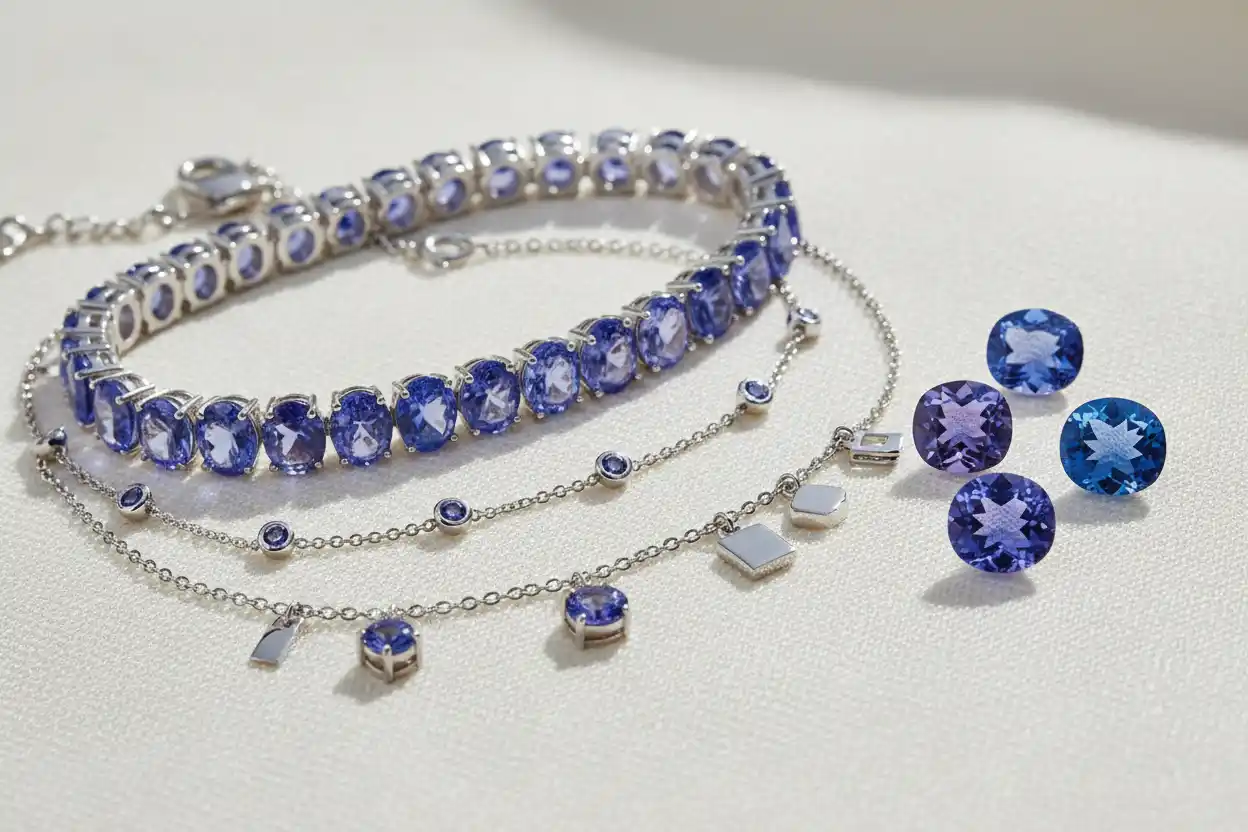
Tanzanite Bracelets: How to Choose and Wear
Tanzanite bracelets place the gem’s blue, violet and purple colors in a jewelry format that remains visible throughout the day. Fine stones can shift noticeably as the wrist moves because Tanzanite is strongly pleochroic and shows different colors along different crystal directions.
The bracelet format also presents a durability challenge. Tanzanite is softer and less tough than Sapphire, has cleavage and can chip or break after a hard blow. Secure settings, close fit and careful wearing habits are therefore essential.
Tanzanite Bracelets at a Glance
| Feature | What to Consider |
|---|---|
| Mineral species | Blue-to-violet Zoisite |
| Typical colors | Violet-blue, blue-violet, purple and bluish purple |
| Mohs hardness | 6–7 |
| Toughness | Fair to poor |
| Cleavage | Prominent |
| Popular bracelet styles | Tennis, line, station, charm, cuff and bangle |
| Safest design | Low bezel stations or protected small stones |
| Main quality factor | Attractive face-up blue or violet color |
| Common treatment | Heat treatment |
| Main durability concern | Chipping, cleavage and thermal shock |
| Safe cleaning | Warm water, mild soap and a soft brush |
| Birthstone association | December |
What Is Tanzanite?
Tanzanite is the blue-to-violet gem variety of Zoisite.
Commercially important material comes from the Merelani mining area near Mount Kilimanjaro in northern Tanzania. Its limited geographic source contributes to the gem’s market identity.
The material is strongly pleochroic, meaning it can display different colors along different crystal directions. A cut stone may show blue, violet and sometimes burgundy or brownish components depending on orientation and treatment.
The broad Tanzanite meaning guide covers its mineral identity, discovery, locality and symbolism. This article focuses on bracelet construction, quality and wear.
Is Tanzanite Suitable for Bracelets?
Tanzanite can be used in bracelets, but the design and wearer must account for its physical limitations.
Its hardness of 6–7 provides moderate scratch resistance. Quartz-rich dust and many common jewelry stones can still abrade it.
More importantly, Tanzanite has cleavage and fair-to-poor toughness. A sharp strike may cause a stone to chip or split even when its surface is not heavily scratched.
A protective, close-fitting bracelet is more practical than a loose design with exposed gems. Someone who works at a desk, handles tools or wears stacked jewelry should use additional caution.
Tanzanite bracelets are best removed before exercise, household work, gardening and any activity involving repeated impact.
Tanzanite Tennis Bracelets
A tennis bracelet places individually set stones in a continuous flexible row.
This format creates the strongest uninterrupted display of blue-violet color. However, it requires many closely matched gems and exposes each one to wrist movement.
Small round or oval stones are most common. The settings should articulate smoothly without allowing neighboring gems to strike each other.
A box clasp with at least one secondary safety latch is preferable. A valuable bracelet should not depend on a small magnetic or lightweight spring mechanism.
The row should lie flat against the wrist. Twisted settings increase impact and make color matching appear uneven.
Tanzanite Line Bracelets
Line bracelets may use graduated stone sizes, mixed shapes or alternating Tanzanite and Diamond.
A graduated design places larger gems near the center and smaller ones toward the clasp. The transition should remain visually smooth.
Diamond accents provide brightness but require careful spacing. Diamond is much harder than Tanzanite and can abrade it if the girdles touch.
Shared-prong construction reduces visible metal but places more responsibility on each prong. Individual settings provide greater separation and may make replacement easier.
Tanzanite Station Bracelets
A station bracelet spaces individual Tanzanites along a chain.
This design uses fewer gems and can provide better protection when each stone is bezel set. It also feels lighter and less formal than a complete tennis bracelet.
The stations should remain balanced so that the gems face outward rather than flipping against the wrist.
Adjustable station bracelets are practical gifts when exact wrist size is uncertain. The extension chain and clasp must still remain strong enough for the gemstone weight.
A small bezel station is among the safest Tanzanite bracelet formats for occasional or careful regular wear.
Tanzanite Charm Bracelets
A single Tanzanite charm offers color without requiring an entire matched suite.
The charm should have a protective metal rim because it can swing and strike other components. A rounded cabochon or compact faceted drop is safer than a long exposed point.
The connecting ring should be soldered or securely closed. Open jump rings can spread as the charm catches on clothing.
Do not place a Tanzanite charm beside Diamond, Sapphire or rough metal charms that repeatedly contact its surface.
Tanzanite Cuffs and Bangles
A rigid bangle or cuff can hold the gemstone in a controlled orientation.
A low bezel-set center stone works more safely than a raised cluster. The rigid structure can prevent gem-to-gem impact, although the entire bracelet may still strike hard surfaces.
Hinged bangles need a strong clasp and aligned hinge. Side-to-side play can signal wear.
Open cuffs should not be bent repeatedly during wear. Continuous reshaping can weaken the metal and transfer pressure to the gemstone setting.
Choosing Tanzanite Color
Fine Tanzanite commonly shows violet-blue or blue-violet color.
Blue-dominant stones are highly sought after, but violet-dominant gems can be equally attractive when they remain saturated and lively.
Small stones often appear paler because there is less material for light to travel through. A bracelet made from numerous small gems may therefore show a lighter blue than a large solitaire.
Darkness is not automatically quality. An excessively deep stone may appear inky or nearly black indoors.
Evaluate the bracelet in daylight-equivalent light, normal indoor lighting and lower evening conditions. Strong display lamps can exaggerate saturation.
The forthcoming blue gemstones guide places Tanzanite beside Sapphire, Iolite, Zircon and other blue gems. Violet-dominant material can be compared through the purple gemstones guide.
Pleochroism and Matching
Tanzanite’s pleochroism makes matching more difficult than simply selecting stones with the same weight.
Each gem must be oriented so that its face-up color coordinates with the rest of the bracelet. One stone may appear strongly violet while another looks blue or gray from the same viewing angle.
Cutters often choose an orientation that balances color with weight retention. A blue-dominant cut may require more rough loss than a violet-dominant orientation.
View the complete row as the wrist turns. The gems do not need to remain identical from every angle, but the color movement should look harmonious.
A high-quality suite reflects substantial sorting and cutting effort.
Clarity
Fine Tanzanite is generally expected to appear clean to the unaided eye.
Small internal crystals or veils may be acceptable when they do not affect brilliance or durability. Surface-reaching fractures deserve more caution.
A fracture near a prong or exposed edge can expand under setting pressure or impact. Bracelet stones experience more movement than earrings and pendants, making structural condition especially important.
Fracture filling is uncommon but possible. Filling should be disclosed because it affects cleaning and value.
The Tanzanite buying guide provides a fuller quality evaluation.
Cut Quality
Rounds and ovals are common in tennis bracelets because they are easier to match and fit into flexible settings.
Cushions and trillions create a more distinctive design but require closer matching.
A shallow stone may show a transparent window through the center. Excessive depth preserves weight but can produce darkness and a smaller face-up size.
Facet junctions should remain crisp. Abrasion or chips may indicate previous impact, weak setting protection or poor storage.
The cutting should distribute color evenly across the row. One heavily windowed stone can interrupt the entire bracelet.
Heat Treatment
Most Tanzanite is heated to reduce brownish or greenish components and strengthen the blue-to-violet appearance.
The treatment is widely accepted and generally stable. It does not make the stone synthetic.
A seller should still disclose the treatment. An untreated stone may retain unusual pleochroic colors and can carry collector interest, but visual appearance and documentation matter more than an unsupported claim.
Coatings and fracture filling are less common and require greater caution. The dedicated guide to treated or synthetic Tanzanite covers these distinctions without requiring this bracelet guide to repeat the full testing process.
Natural Tanzanite and Imitations
Blue-violet glass, synthetic Corundum, synthetic Spinel, cubic zirconia and other materials can imitate Tanzanite’s appearance.
Color alone cannot establish identity. Professional testing may use refractive index, birefringence, pleochroism, spectrum and inclusions.
The guide to real versus fake Tanzanite explains common imitations and home-test limitations.
A significant bracelet should have written identification and treatment disclosure. Laboratory reports are particularly valuable when the stones are large or the price depends on exceptional color.
Tanzanite Versus Sapphire
Sapphire is harder, tougher and more suitable for rugged daily bracelets.
Tanzanite generally shows stronger violet components and pleochroism. Sapphire may occur in similar blue shades but belongs to Corundum and has a hardness of 9.
The complete Tanzanite versus Sapphire comparison covers mineral identity, optical properties and buying differences.
A buyer prioritizing durability may prefer Sapphire. Someone prioritizing Tanzanite’s violet-blue color and geographic story may accept the additional care.
Tanzanite Versus Iolite
Iolite can show blue-violet color and strong pleochroism at a lower typical price.
Iolite often appears grayer and may show yellowish or nearly colorless directional hues. Tanzanite commonly produces a richer blue-violet appearance after heating.
The dedicated Iolite versus Tanzanite guide explains their optical and physical differences.
Professional testing is preferable when a bracelet’s identity materially affects value.
Choosing the Setting
A bezel offers the strongest edge protection. It surrounds the girdle and reduces snagging.
Low prongs can also work when they remain substantial and correctly positioned. Every prong should avoid obvious fractures.
Channel settings protect the sides of small stones but may complicate replacement.
Shared-prong settings create a continuous look but reduce redundancy if one prong becomes damaged.
The setting should remain low enough to avoid unnecessary impact. High baskets are particularly risky on the wrist.
Choosing the Metal
White gold and platinum create a cool frame that emphasizes Tanzanite’s blue and violet colors.
Yellow gold produces stronger warmth and contrast. It can make violet components appear richer.
Rose gold creates an unusual combination, particularly with purple-dominant gems, though it may not suit every skin tone or wardrobe.
Sterling silver offers a lower-cost option but requires sufficient structural thickness. Fine Tanzanite should not be held by weak, thin prongs.
Metal sensitivity, maintenance and clasp construction matter alongside appearance.
Bracelet Fit
Measure the wrist at the point where the bracelet will sit.
A Tanzanite bracelet should not hang excessively loose. Extra movement increases the chance that stones will strike hard surfaces.
A tennis bracelet commonly allows roughly one finger of space, though comfort varies.
A bracelet that is too tight strains links, settings and the clasp. It may also press the gemstone galleries against the skin.
Larger settings need slightly more internal circumference than fine chain bracelets.
Clasp Security
A box clasp with a safety latch is appropriate for a valuable tennis or line bracelet.
Lobster clasps suit lighter station designs. Connecting rings should be soldered or sufficiently substantial.
Magnetic clasps are convenient but rarely provide enough security for expensive Tanzanite.
Test the clasp several times. It should close positively without force, looseness or sharp edges.
Have the clasp and safety mechanism inspected during professional maintenance.
December Birthstone Meaning
Tanzanite is one of December’s modern birthstones, together with Turquoise and Zircon.
The forthcoming December birthstone guide explains the three-stone calendar tradition.
A bracelet can make a meaningful December birthday, anniversary or graduation gift. However, practical wearability should guide the format.
The forthcoming December birthstone jewelry guide compares Tanzanite bracelets with other jewelry and birthstone options.
Comparing Other Tanzanite Jewelry
Tanzanite earrings receive less impact and are generally safer for delicate or large gems.
A Tanzanite necklace can display a larger stone while keeping it away from the hands.
A Tanzanite ring offers maximum visibility but requires substantial protection and careful wear.
Bracelets create repeated color and remain visible to the wearer, but they are among the more demanding Tanzanite formats.
Price and Documentation
Color usually has the greatest influence on Tanzanite’s price. Strong saturation, attractive face-up blue-violet color and good clarity command higher values.
Matching adds cost. A bracelet requires numerous stones with coordinated size, orientation and color.
The Tanzanite price guide explains current value factors.
For an expensive bracelet, request the stone count, total weight, individual dimensions, treatment disclosure, metal fineness and return policy in writing.
A laboratory report may cover the complete piece or selected stones. Confirm exactly what was tested.
Cleaning and Care
Clean Tanzanite with warm water, mild soap and a soft brush.
Support the bracelet over a bowl or closed drain. Work carefully beneath settings where lotion and skin oils collect.
Rinse briefly and dry with a lint-free cloth.
Never use steam or an ultrasonic cleaner. Sudden temperature changes, heat and vibration can damage cleavage-prone stones.
The complete guide to cleaning Tanzanite jewelry provides a fuller procedure.
Remove the bracelet before exercise, bathing, sleeping, household cleaning and manual work.
Storage
Fasten the bracelet before placing it in a padded compartment.
Keep Tanzanite separate from Quartz, Garnet, Spinel, Topaz, Sapphire and Diamond. The gemstone hardness chart shows why these harder materials can scratch it.
Do not fold a tennis bracelet sharply or pile heavy jewelry on top of it.
Tanzanite appears among the crystals beginning with T and gemstones beginning with T directories.
Frequently Asked Questions
1. Is Tanzanite durable enough for a bracelet?
It can be used in bracelets, but its hardness of 6–7, cleavage and fair-to-poor toughness require protective settings and careful wear.
2. What is the safest Tanzanite bracelet style?
A close-fitting station bracelet with small bezel-set stones offers strong protection. Low tennis settings can also work when maintained carefully.
3. Can a Tanzanite bracelet be worn every day?
Occasional or careful regular wear is more appropriate than rugged continuous wear. Remove it for exercise, work and household activities.
4. Why do Tanzanite stones look different colors?
Tanzanite is strongly pleochroic, so different crystal directions show blue, violet and other hues. Cutting orientation affects the face-up color.
5. Is Tanzanite normally heat treated?
Yes. Most material is heated to strengthen blue and violet colors and reduce brownish or greenish components.
6. Does heat treatment make Tanzanite synthetic?
No. Heat-treated Tanzanite remains natural Zoisite whose color was modified after mining.
7. Is Tanzanite softer than Sapphire?
Yes. Tanzanite ranks 6–7 on the Mohs scale, while Sapphire ranks 9 and has stronger everyday durability.
8. How closely should stones in a Tanzanite bracelet match?
They should coordinate in hue, tone, visible dimensions, clarity and face-up color orientation.
9. Is Tanzanite a December birthstone?
Yes. Tanzanite is recognized alongside Turquoise and Zircon as a modern December birthstone.
10. Does a Tanzanite bracelet need a laboratory report?
Modest commercial bracelets may not. A report becomes more useful when the stones are large, exceptionally colored or expensive.
11. Can Tanzanite be cleaned ultrasonically?
No. Ultrasonic and steam cleaning are not recommended because vibration and heat can damage the cleavage-prone gem.
12. How should a Tanzanite bracelet be stored?
Keep it fastened in a padded compartment away from harder gemstones. Do not fold flexible settings sharply or place heavy jewelry above it.