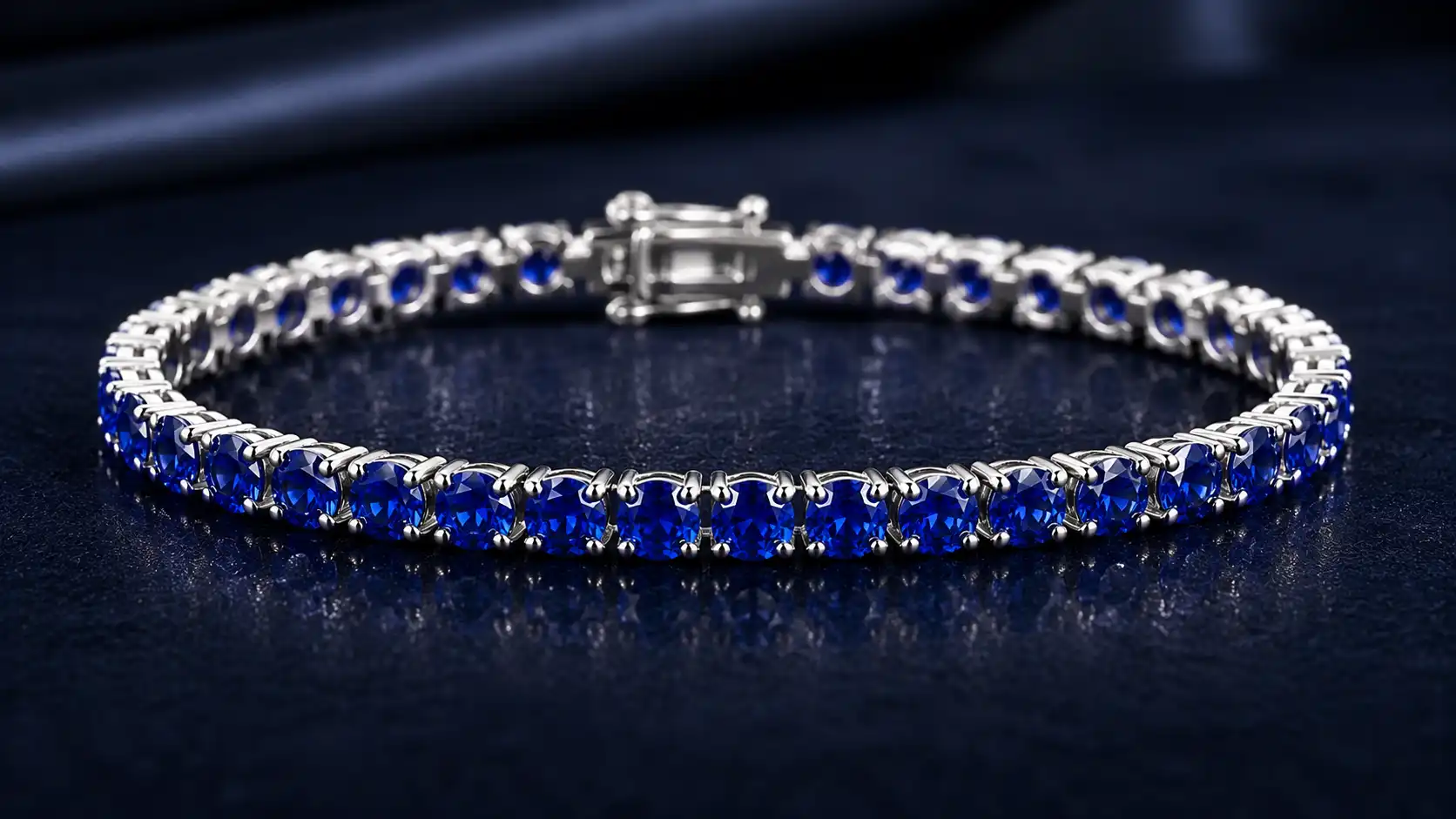
Lab Sapphire Bracelets: How to Choose and Wear
Lab sapphire bracelets combine corundum’s high scratch resistance and strong toughness with colors and matched sizes that can be manufactured more predictably than comparable natural sapphire suites. They may feature classic blue stones, pink or yellow sapphires, colorless accents, rainbow arrangements, star cabochons, beads or precision-cut calibrated links.
The gemstone itself is highly durable, but the bracelet is only as reliable as its weakest component. Prongs, hinges, clasps, solder joints, links, drill holes, coatings, fillers and thin metal structures can fail even when every sapphire remains intact.
The future lab sapphire gemstone guide will own the broad material history, growth methods and symbolism. This page focuses specifically on bracelet construction, color matching, sizing, disclosure, wear and maintenance.
Lab Sapphire Bracelet at a Glance
| Feature | Practical implication |
|---|---|
| Gem material | Laboratory-grown corundum |
| Mohs hardness | 9 |
| Toughness | Excellent when stones are sound |
| Cleavage | None in ordinary gemological use |
| Common colors | Blue, pink, yellow, orange, green, purple, white, black and color-change |
| Common growth method | Flame fusion, with flux, pulled and hydrothermal material also available |
| Best bracelet styles | Bezel links, tennis bracelets, stations, cabochons and beads |
| Main stone concern | Accurate lab-grown disclosure and post-growth treatments |
| Main jewelry concern | Prongs, links, clasps and articulation |
| Safest routine cleaning | Warm water, mild soap and a soft brush |
| Daily-wear suitability | Strong, provided the bracelet is well constructed |
Is Lab Sapphire Suitable for Bracelets?
Yes. Sapphire is corundum with Mohs hardness 9, excellent toughness and no pronounced cleavage. These properties make lab sapphire one of the strongest colored-gem choices for wrist jewelry.
Bracelets still encounter more impact than earrings and pendants. They strike desks, doorframes, countertops, watches and other bracelets. Hardness prevents many scratches, but a severe blow can chip a thin girdle or pointed corner.
The gemstone hardness chart places sapphire below diamond but above most jewelry stones. The guide to best gemstones for everyday wear explains why corundum performs well in frequently worn jewelry.
The design should remain low enough to avoid snagging and flexible enough to follow the wrist without levering against the stones.
Lab Sapphire vs Natural Sapphire in a Bracelet
Lab-grown and natural sapphire share the corundum structure, hardness and basic optical properties. Their origin, inclusions, rarity and market pricing differ.
A lab-sapphire bracelet can provide:
- Larger stones within a controlled budget
- More consistent matching
- Precisely calibrated dimensions
- Strong color uniformity
- Rainbow layouts with predictable hues
- Replacement stones that are easier to source
- Corundum durability without natural rarity premiums
A natural-sapphire bracelet may carry geological rarity, locality interest and a stronger collector market. The natural sapphire bracelet guide owns that separate purchase intent.
The lab-grown versus natural gemstones guide explains why neither origin should be hidden behind vague wording.
Main Lab Sapphire Bracelet Styles
| Bracelet style | Advantages | Main buying concern |
|---|---|---|
| Tennis bracelet | Continuous color and brilliance | Numerous prongs and matched-stone quality |
| Bezel-link bracelet | Strong perimeter protection | Accurate fit and flexible articulation |
| Station bracelet | Lightweight and modern | Flipping stones and connector wear |
| Rainbow bracelet | Broad range of manufactured colors | Color order, coatings and disclosure |
| Cabochon bracelet | Smooth surfaces and star effects | Matching domes and secure bezels |
| Bead bracelet | Flexible and accessible | Drill holes, cord and imitation material |
| Hinged bangle | Easy fit and rigid design | Hinge, clasp and stone-setting pressure |
| Cuff | Strong visual presence | Correct wrist shape and structural metal |
| Charm bracelet | Customizable and informal | Moving stones can collide |
| Vintage-style cluster | Decorative period appearance | Many prongs and difficult maintenance |
Lab Sapphire Tennis Bracelets
A tennis bracelet uses a continuous or nearly continuous line of faceted sapphires. Round, oval, cushion, square and mixed shapes can all work.
Matching is one of the main reasons to choose laboratory-grown stones. Manufacturers can produce sapphires with similar color, clarity and dimensions, allowing a consistent line across the wrist.
Still, the pair or suite should be inspected in motion. One stone may be deeper, darker, windowed or differently oriented.
Every link should articulate independently. A stiff section can transfer leverage into the setting and make the bracelet sit unevenly.
Four-prong links provide an open appearance, while bezels or shared-prong structures create different levels of protection. The setting should not rely on extremely thin metal merely to reduce cost.
Bezel-Link Bracelets
A bezel surrounds most or all of each stone’s girdle, creating smooth edges and strong protection.
Bezel links work particularly well for everyday bracelets because they snag less than tall prongs. They also suit emerald, oval, cushion and cabochon lab sapphires.
Inspect the metal around every stone. Gaps, crushed edges, glue seepage or uneven pressure indicate poor setting work.
The links must remain flexible. A bracelet that appears smooth while laid flat can become uncomfortable if the bezels do not follow the wrist.
Rainbow Lab Sapphire Bracelets
Laboratory growth allows sapphire to be produced in a broad range of colors. Rainbow bracelets may arrange pink, orange, yellow, green, blue, purple and colorless stones in a continuous gradient.
A strong design uses deliberate transitions. Sudden differences in tone or saturation can make the line look random rather than graduated.
Confirm whether every colored stone is lab sapphire. Some commercial rainbow bracelets mix lab sapphire with synthetic spinel, glass, cubic zirconia or coated stones.
The dedicated lab sapphire color meaning guide explores symbolic color associations. In buying, color should first be evaluated for consistency, stability and disclosure.
Star Lab Sapphire Bracelets
Manufacturers can produce lab sapphire containing oriented inclusions that create asterism. When cut as a cabochon, reflected light forms a star across the dome.
A well-made star should appear centered and move smoothly as the bracelet or light moves. The rays should remain reasonably straight rather than dissolving into a broad haze.
Matching several star sapphires is difficult because dome shape, bodycolor, ray sharpness and star position must align.
Synthetic star sapphires are legitimate laboratory-grown corundum when disclosed. Their deliberately induced inclusions and manufactured origin should not be represented as natural star sapphire.
The star sapphire guide covers the optical phenomenon and natural material separately.
Lab Sapphire Bead Bracelets
Sapphire beads may be round, faceted, barrel-shaped, tubular or carved. Their durability supports regular wear, but drilling creates stress points.
Inspect drill holes for chips, cracks and rough edges. Two hard sapphire beads can abrade one another, especially when they are faceted or strung too tightly.
Elastic is convenient but deteriorates. Knotted cord or engineered jewelry wire is generally more secure for a valuable strand.
Very inexpensive perfectly uniform beads may be flame-fusion corundum, another synthetic material or glass. The issue is not low price but whether the product description identifies the material accurately.
Choosing Color
Classic blue remains the most familiar option, but lab sapphire bracelets can use virtually every corundum color except red, which is classified as lab ruby.
Available choices include:
- Royal or medium blue
- Pale blue
- Teal and blue-green
- Pink
- Yellow
- Orange and pink-orange
- Green
- Purple and violet
- White or colorless
- Gray
- Black
- Color-change material
The future lab sapphire meaning guide will own the broad material identity. The natural sapphire color guide covers historical symbolism across natural colors.
In a bracelet, medium tones often show better than extremely pale stones. Very dark blue or black-looking material can lose individual facet definition.
Matching
A matched lab-sapphire bracelet should coordinate:
- Hue
- Saturation
- Tone
- Shape
- Millimeter dimensions
- Pavilion depth
- Facet pattern
- Transparency
- Brilliance
- Fluorescence response when visible
Laboratory growth does not guarantee perfect matching. Boules, crystals, cutting batches and post-growth treatments can vary.
Ask for continuous video showing the complete bracelet under diffused light and normal wrist movement.
Cut and Face-Up Appearance
Well-cut sapphire should return light across much of its face. A broad transparent center indicates windowing, while large black zones can indicate extinction or excessive darkness.
Calibrated lab sapphires are often cut for standard jewelry sizes. That makes repair and replacement easier, although commercial cutting may prioritize speed over ideal optical performance.
Step cuts display color and clarity clearly. Brilliant and mixed cuts add more scintillation. Cabochons suit star effects and opaque material.
Compare millimeter measurements rather than relying only on total carat weight.
Growth Methods
Most commercial lab sapphire is produced through flame fusion, although flux, pulled and hydrothermal material also occurs.
Flame-fusion sapphire is efficient and commonly shows curved growth banding or gas bubbles under suitable magnification.
Flux-grown and hydrothermal sapphires develop more slowly and can contain more complex growth features. They may cost more because production is less efficient.
The growth method does not change corundum’s basic hardness. It can affect inclusions, price, color distribution and identification difficulty.
Treatments, Coatings and Alterations
Laboratory-grown origin does not mean the stone received no later treatment.
Lab sapphire may be:
- Heated
- Diffusion treated
- Dyed
- Quench-crackled and dyed
- Coated
- Fracture filled
- Cavity filled
- Assembled with another material
- Irradiated
- Recut or repolished
These processes can change color stability, care and value.
The treated-sapphire guide owns treatment and synthetic-identification details. Buyers should request both origin disclosure and post-growth treatment disclosure.
Metal and Setting Choices
White gold and platinum emphasize blue, purple, white and teal stones. Yellow gold creates warm contrast with blue and complements yellow, orange and green sapphires. Rose gold suits pink, purple and pastel rainbow layouts.
Sterling silver can work for modest pieces, but thin silver prongs and links may bend more readily. Plating should be disclosed because it wears fastest around clasps and articulated joints.
The guide to gemstones and metals for sensitive skin explains nickel, gold alloys, plating and clasp materials.
Clasp Security
A valuable bracelet needs more than a decorative clasp.
Box clasps with figure-eight safeties, lobster clasps with substantial end links and well-made fold-over systems offer stronger security than tiny spring rings.
Check:
- Hinge movement
- Closure tension
- Solder joints
- Safety catches
- End links
- Jump-ring thickness
- Alignment
- Wear around moving surfaces
A safety chain can reduce loss risk, but it should remain short enough not to catch or strike the stones.
Sizing and Fit
Measure the wrist with a flexible tape. Add enough ease for comfort and bracelet width without allowing excessive sliding.
A close tennis bracelet generally suffers fewer impacts than a loose one that falls over the hand. It should not compress the wrist or leave deep marks.
Wide cuffs need more allowance than narrow chains. Hinged bangles should match the wrist’s shape rather than relying only on circumference.
Ask for wearable length, inside dimensions, width and total weight.
Everyday Wear
A sound lab-sapphire bracelet can handle frequent wear. Remove it for heavy lifting, gym work, gardening, construction, cleaning with chemicals and contact sports.
Do not stack it directly beside diamond jewelry. Diamond can scratch sapphire, while exposed metal settings can damage either bracelet.
Lab sapphire can scratch quartz, garnet, jade, emerald and many other gemstones. Separate pieces during storage.
A future lab sapphire ring guide will address hand-level settings, while lab sapphire earrings and lab sapphire necklaces provide lower-impact options.
Price and Value
The lab sapphire price guide owns detailed value factors.
Bracelet price can reflect:
- Growth method
- Stone count
- Total weight
- Color quality
- Matching
- Cut
- Star effect
- Post-growth treatment
- Metal weight
- Clasp quality
- Setting labor
- Brand
- Warranty and service
Flame-fusion stones usually cost less than comparable flux or hydrothermal material. A high retail price should be justified by workmanship, metal, design or documented growth—not by implying mined rarity.
Buying Online
The Lab Sapphire Buying Guide provides the loose-stone framework.
For a bracelet, request:
| Buying detail | What to confirm |
|---|---|
| Material | Laboratory-grown sapphire |
| Growth method | Flame fusion, flux, pulled or hydrothermal when known |
| Treatment | Heat, diffusion, dye, coating, filling or assembly |
| Color | Neutral-light video of the complete bracelet |
| Matching | Stone-by-stone consistency |
| Dimensions | Bracelet length, width, stone size and total weight |
| Metal | Alloy, hallmark and plating |
| Construction | Prongs, bezels, links, hinges and drill holes |
| Clasp | Type, safety features and condition |
| Side materials | Diamond, cubic zirconia, glass or other gems |
| Returns | Time for inspection and comfort testing |
The gemstone certification guide explains when a laboratory report is useful. A report for one center stone does not identify every small stone in a bracelet.
Cleaning and Storage
Warm water, mild soap and a soft brush are safe for sound unfilled lab sapphire.
Ultrasonic and steam cleaning may be suitable for untreated or conventionally heated corundum in sturdy settings. Dyed, coated, filled, glued or assembled stones require gentler care.
Follow How to Clean Lab Sapphire Jewelry Safely for the complete process.
Store the bracelet flat in a fabric-lined compartment. Do not allow diamond jewelry to rest against it, and do not let sapphire scratch softer pieces.
Frequently Asked Questions
1. Is lab sapphire durable enough for a bracelet?
Yes. Corundum ranks 9 on the Mohs scale, has excellent toughness and no pronounced cleavage.
2. Is a lab-sapphire tennis bracelet suitable for everyday wear?
It can be, provided the links, prongs and clasp are strong and the bracelet is removed during impact-prone activities.
3. Is lab sapphire the same as colored glass?
No. Lab sapphire is manufactured corundum. Glass has different composition, hardness and optical properties.
4. Can lab sapphire bracelets come in rainbow colors?
Yes. Laboratory-grown corundum is produced in many colors, although red corundum is classified as lab ruby.
5. Are all stones in a lab-sapphire bracelet automatically identical?
No. Color, cut, depth and growth features can vary, so the entire suite should be checked for matching.
6. Is flame-fusion sapphire low quality?
Not automatically. It is an efficient growth method that produces real lab-grown corundum. Cut, color, clarity and workmanship determine finished quality.
7. Can a lab sapphire bracelet contain treated stones?
Yes. Lab-grown stones can receive heat, diffusion, dye, coating, filling or other post-growth processes.
8. Is a bezel safer than prongs?
A well-fitted bezel generally protects more of the girdle. Prongs create an open appearance but require more maintenance.
9. Can lab sapphire scratch other bracelets?
Yes. Sapphire is harder than most colored gemstones and can scratch quartz, garnet, jade and many other materials.
10. Can it be cleaned ultrasonically?
Sound unfilled lab sapphire may tolerate ultrasonic cleaning, but the settings, coatings, glue and other stones must also be suitable.
11. Does a lab sapphire bracelet need certification?
Most commercial bracelets do not need individual reports for every stone. Documentation becomes more valuable for costly flux, hydrothermal or unusually represented material.
12. Does lab sapphire have good resale value?
Resale is usually limited by ongoing production and replacement availability. The bracelet’s metal, workmanship and brand may retain more value than the stones.
A successful lab-sapphire bracelet should be evaluated as both gem material and mechanical jewelry. Corundum supplies excellent durability, but matching, articulation, metal thickness, clasp engineering and treatment disclosure determine whether the finished piece deserves regular wear.