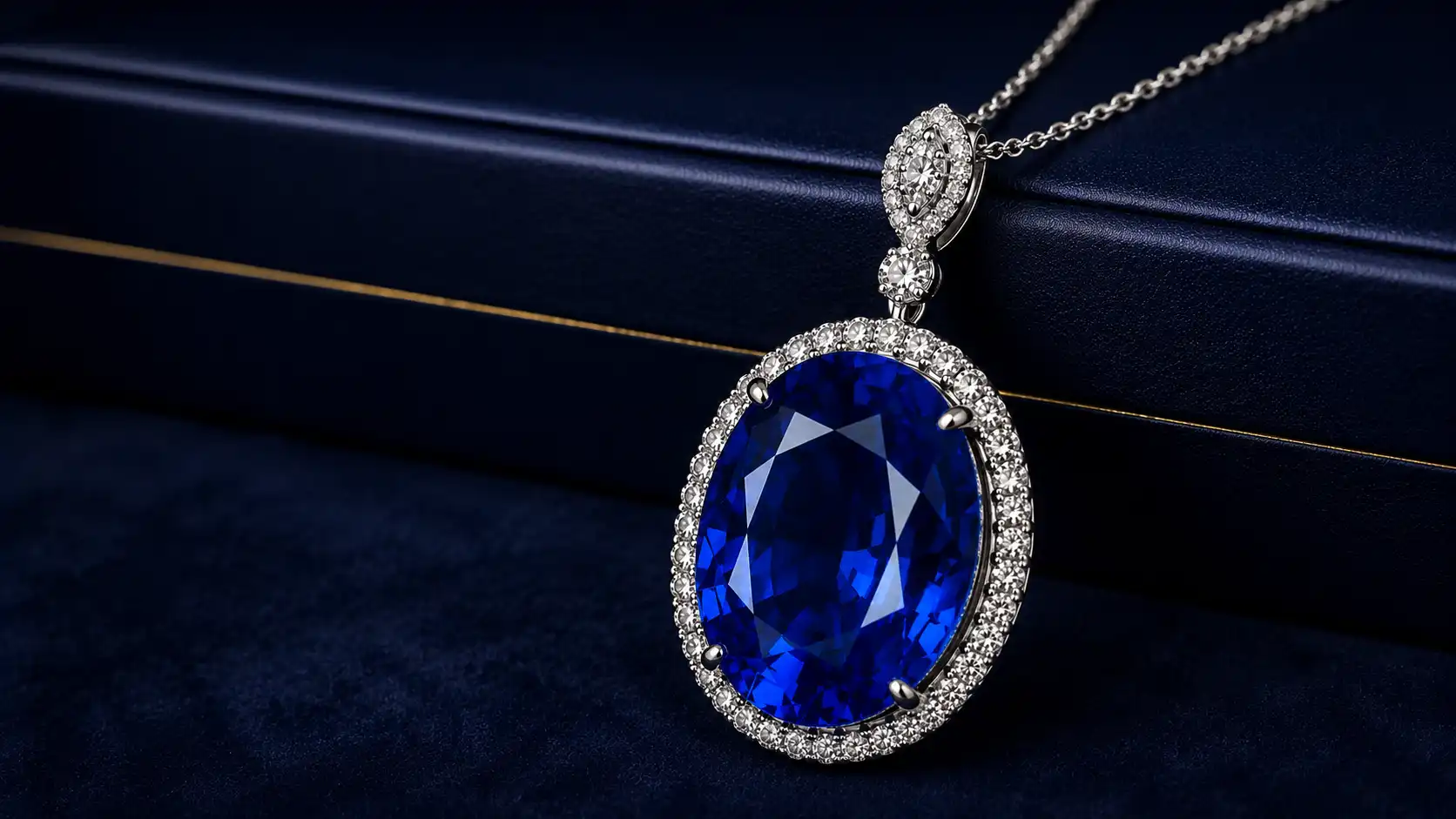
Lab Sapphire Necklaces and Pendants: Buying Guide
Lab sapphire necklaces combine corundum’s high durability with a wider range of affordable colors and calibrated sizes than many equivalent natural-sapphire designs. They can feature one vivid blue solitaire, a pink or yellow halo, a colorless station necklace, a rainbow suite, star cabochons, beads, or a large precision-cut pendant.
Necklaces protect sapphire from much of the impact faced by rings and bracelets, but the gemstone is only one part of the finished piece. Bail strength, chain gauge, clasp quality, drill holes, settings, articulation, treatments, and total weight determine whether the necklace functions safely.
The lab sapphire meaning guide owns the material’s manufacture, properties, history, and symbolism. This article focuses on necklace and pendant styles, construction, color, comfort, buying evidence, treatment, care, and repair.
Why Lab Sapphire Works Well in Necklaces
Corundum ranks 9 on the Mohs scale and has excellent toughness with no pronounced cleavage. These properties make sound lab sapphire suitable for both delicate pendants and substantial necklaces.
The chest provides a lower-impact environment than the hand. A sapphire pendant can therefore use a larger stone or more open setting than might be advisable in a ring.
Long necklaces still swing against desks, zippers, bags, and furniture. Bead strands also experience constant contact around drill holes. Design should reflect how the necklace will actually be worn.
The guide to best gemstones for everyday wear explains why sapphire is strong enough for regular jewelry use while still requiring sensible handling.
Main Lab Sapphire Necklace Styles
| Necklace style | Appearance | Practical advantage | Main concern |
|---|---|---|---|
| Solitaire pendant | One focal sapphire | Simple and easy to inspect | Bail and setting security |
| Bezel pendant | Smooth protected outline | Strong edge protection | Uneven setting pressure |
| Halo pendant | Larger visual footprint | Adds sparkle and side protection | Accent-stone identity and prong maintenance |
| Three-stone pendant | Balanced symbolic design | Uses several colors or shapes | Stone alignment and connector strength |
| Station necklace | Sapphires spaced along chain | Lightweight and modern | Flipping stones and link wear |
| Tennis necklace | Continuous line of stones | Formal and visually substantial | Numerous prongs, links, and clasp points |
| Lab sapphire bead strand | Broad color and tactile presence | Flexible and accessible | Drill holes and stringing |
| Star-sapphire pendant | Cabochon with asterism | Distinct optical effect | Star centering and dome protection |
| Color-change pendant | Different colors under different light | Interactive and unusual | Seller photography and identification |
| Rainbow necklace | Multiple sapphire colors | Predictable manufactured palette | Treatment and stone-by-stone matching |
Solitaire Lab Sapphire Pendants
A solitaire places one sapphire at the center of the design. Round, oval, cushion, pear, emerald-cut, radiant, marquise, heart, and custom shapes can all work.
A well-cut pendant should show useful brightness and an attractive color under ordinary indoor light. A broad transparent center indicates windowing, while extensive black areas can result from extinction or excessive darkness.
View the pendant from the side. Deep stones may carry hidden weight and require larger settings. A high pavilion can also cause the pendant to tilt or flip.
The bail should align with the stone’s center of gravity. A beautiful sapphire becomes frustrating when the pendant constantly turns backward.
Bezel-Set Pendants
A bezel surrounds the sapphire’s perimeter with metal. It provides strong edge protection and creates a smooth outline that catches less on clothing.
Full bezels can make a stone appear slightly smaller, while partial bezels expose more of the edge and allow additional light.
The metal should follow the outline evenly. Look for gaps, ripples, crushed corners, glue, or areas where the bezel has been forced against the crown.
A closed back can strengthen the design but may conceal treatment, backing, glue, cavities, or damage. High-value stones should remain inspectable.
Halo Lab Sapphire Pendants
A halo surrounds the center with smaller accent stones.
Possible accents include:
- Natural diamonds
- Lab diamonds
- White sapphires
- Moissanite
- Cubic zirconia
- Other lab sapphires
- Natural colored gemstones
Every material should be disclosed individually.
A low halo can enlarge the face-up outline and protect the center from lateral impact. A high open halo may add sparkle but provide little practical protection.
The center and accent stones should not touch. Hard girdles and flexible settings can create abrasion or chips over time.
Three-Stone and Cluster Pendants
Three-stone designs may represent past, present, and future, or simply combine several colors.
Lab sapphire is well suited to these pendants because manufacturers can create calibrated stones in matched or deliberately contrasting shades.
A blue center with white side stones creates a traditional appearance. Pink, yellow, and teal combinations feel more contemporary.
Cluster designs introduce many prongs and small settings. Inspect the underside for adequate metal, smooth finishing, and a bail strong enough for the complete weight.
Station Necklaces
Station necklaces place sapphires at intervals along a chain. The stones may be bezel-set, drilled, capped, or connected through small links.
A station design looks light and modern while using several colors or shapes. However, individual stations may flip unless both sides are finished or the chain enters at two balanced points.
Inspect every connector. A thin jump ring can fail even when the sapphire and main chain remain perfect.
The stones should be spaced far enough apart that they do not collide when the necklace bends.
Lab Sapphire Tennis Necklaces
A tennis necklace uses a continuous line of sapphires or a repeating pattern with diamonds and other accents.
Laboratory growth can make a matched suite more affordable and consistent. Nevertheless, every stone must still be evaluated for tone, saturation, cut, dimensions, and brightness.
Each link should articulate freely around the neck. Stiff sections can cause the necklace to kink or flip.
A substantial tennis necklace needs a dependable box clasp and one or more safety mechanisms. The clasp should not be the least secure part of an expensive piece.
Lab Sapphire Bead Necklaces
Beads may be round, faceted, oval, barrel-shaped, tubular, carved, or graduated.
Sapphire’s hardness allows bead surfaces to resist many scratches, but two corundum beads can abrade one another. Drill holes can also chip when beads are strung too tightly.
Knots between beads reduce contact and limit loss if the cord breaks. Flexible wire may support heavy strands, but crimps and end fittings require careful construction.
Perfectly uniform inexpensive beads may be flame-fusion sapphire, synthetic spinel, glass, or another manufactured material. The issue is not that the product is inexpensive; the description must identify it correctly.
The general crystal necklaces guide covers necklace forms and symbolic wearing, while this page owns lab-sapphire-specific construction and disclosure.
Star Lab Sapphire Pendants
Star sapphire is normally cut as a cabochon so aligned inclusions can create asterism.
A pendant gives the star enough movement to travel across the dome as the wearer turns.
Quality factors include:
- Bodycolor
- Star sharpness
- Centering
- Straightness of rays
- Dome symmetry
- Surface polish
- Movement
- Contrast
- Disclosure of laboratory-grown origin
The star sapphire guide explains why a manufactured star is a genuine optical phenomenon but not a natural-origin stone.
Color-Change Lab Sapphire Pendants
A color-change pendant can appear blue, greenish, gray, purple, or reddish purple as the illumination changes.
The effect should be evaluated in continuous video under two clearly identified light sources. Separate edited images can exaggerate the percentage and attractiveness of the change.
Some products are marketed as alexandrite sapphire. They are color-change corundum rather than alexandrite chrysoberyl.
The wearer should appreciate both colors. A strong change between two unattractive gray-brown tones does not create a fine gem.
Choosing Color
The lab sapphire color meaning guide owns symbolism. In a necklace, consider how the color behaves against skin, clothing, metal, and pendant thickness.
Blue
Medium blue provides the most traditional appearance. Very dark stones can become nearly black indoors, while pale material may require more size.
Pink
Pink lab sapphire ranges from blush to vivid purplish pink. Rose gold produces harmony, while white metal creates contrast.
Yellow and Orange
Yellow sapphire can look warm and bright in pendants. Pink-orange stones may resemble padparadscha colors, but a laboratory-grown piece should not borrow natural-rarity terminology without clear qualification.
The natural padparadscha sapphire guide explains that separate market.
White
White lab sapphire offers a durable colorless look. It has less dispersion than diamond but can suit minimalist solitaires and stations.
The white sapphire guide explains how its appearance differs from diamond-like alternatives.
Teal, Green, Purple, and Black
Laboratory growth provides a broad palette that can be difficult to assemble from matched natural stones. Teal works well in modern geometric pendants, purple in expressive designs, and black in graphic minimalist jewelry.
The yellow sapphire guide and other natural-color pages can provide material context without changing the necklace’s lab-grown origin.
Matching Several Stones
A multi-stone necklace should be checked across the complete layout.
Compare:
| Matching factor | What to evaluate |
|---|---|
| Hue | Shared or deliberately graduated dominant color |
| Tone | Controlled transition from light to dark |
| Saturation | Similar color strength |
| Shape | Consistent outlines |
| Dimensions | Accurate progression or uniform size |
| Cut | Similar facet patterns and brightness |
| Depth | Whether some stones project farther |
| Clarity | No isolated cloudy or fractured stone |
| Treatment | Consistent disclosure |
| Fluorescence | Noticeable differences under relevant light |
Laboratory-grown stones are easier to match, but manufacturing does not guarantee a perfect suite.
Growth Methods
The Lab Sapphire Buying Guide explains growth methods in depth.
Flame fusion supplies much of the commercial market and allows low-cost calibrated stones. Flux and hydrothermal growth take longer and can produce more complex inclusions. Pulled crystals support large, controlled production.
Growth method can affect price and identification but does not change sapphire’s basic Mohs hardness.
A seller should not describe flame-fusion sapphire as lower in authenticity. It is still lab-grown corundum. The meaningful difference lies in process, rarity of manufacture, inclusions, cutting, and price.
Post-Growth Treatments
Lab sapphire can be treated after manufacture.
Possible processes include:
- Heat
- Diffusion
- Irradiation
- Dye
- Coating
- Quench-crackling and dye
- Fracture filling
- Cavity filling
- Backing
- Assembly
- Glue-based construction
The treated-sapphire guide explains why treatment affects stability and care.
A color concentrated in a shallow surface layer may be altered by repolishing or damage. A coating can wear around edges. Filled fractures may respond badly to acids and repair heat.
Chain Length and Pendant Position
| Necklace length or style | Typical position | Lab sapphire consideration |
|---|---|---|
| Collar | High on the neck | Must articulate comfortably |
| Choker | Base of the neck | Cosmetics and skin contact increase |
| Princess | Upper chest | Versatile and relatively protected |
| Matinee | Mid-chest | More swing and desk contact |
| Opera | Lower chest | Greater leverage and snagging |
| Rope | Long or doubled | Stones may collide or tangle |
Exact placement varies with the wearer. Request the wearable chain length rather than relying only on style names.
A large pendant generally works best at princess or controlled matinee length. Long heavy pendants may strike tables and pull a weak chain.
Bail Construction
The bail connects the pendant to the chain and carries the full weight.
Check:
- Bail opening
- Chain-end compatibility
- Metal thickness
- Solder
- Articulation
- Alignment
- Glue
- Hidden repairs
- Wear at the contact point
A narrow decorative bail may not be strong enough for a large sapphire.
Drilled pendants require inspection around the hole. Chipping or cracking can begin where the drill exits.
Choosing a Chain
The chain should match the pendant’s weight.
Cable, box, wheat, rope, curb, snake, and other chain styles vary in flexibility and strength. The listed width alone does not establish durability.
White gold and platinum suit cool colors. Yellow gold warms blue and complements yellow or orange sapphire. Rose gold works well with pink and purple stones.
Sterling silver can support commercial pendants, but thin plated chains may wear faster than the durable sapphire they carry.
For metal sensitivity, consult Best Gemstones and Metals for Sensitive Skin. The clasp and solder can cause reactions even when the chain is advertised as hypoallergenic.
Clasp and Safety
A small pendant may use a spring ring, while heavier necklaces need a substantial lobster, box, toggle, or fold-over clasp.
A tennis necklace should include a secondary safety mechanism. Bead strands may use knotted ends, French wire, and reinforced clasp connections.
Test the clasp several times. It should close positively without leaving a visible gap.
A safety chain should be short enough to avoid catching while still preventing complete loss.
Price and Value
The lab sapphire price guide owns material valuation.
A necklace’s retail price can include:
- Growth method
- Stone count
- Color
- Matching
- Cut
- Phenomenon
- Treatment
- Metal weight
- Accent materials
- Chain
- Clasp
- Setting labor
- Brand
- Warranty
A simple flame-fusion pendant may be inexpensive. A custom flux-grown star-sapphire necklace in platinum can cost significantly more without possessing natural mined rarity.
Authentication and Reports
Professional gemologists can distinguish many flame-fusion sapphires through curved banding and bubbles. Flux, hydrothermal, and pulled material may require spectroscopy, fluorescence imaging, microscopy, and trace-element analysis.
The gemstone certification guide explains when testing is useful.
A report on one pendant identifies the center stone described in the document. It may not cover chain-mounted accents, side stones, beads, or interchangeable components.
Laboratory documentation is most useful when growth method, treatment, high value, vintage attribution, or seller claims create a material question.
Buying Online
Follow How to Buy Gemstones Online Without Getting Scammed and request:
| Buying detail | What to confirm |
|---|---|
| Gem origin | Laboratory-grown sapphire |
| Growth method | Flame fusion, flux, pulled, or hydrothermal |
| Treatment | Heat, diffusion, dye, coating, filling, or assembly |
| Stone data | Weight and millimeter dimensions |
| Pendant data | Total length, width, depth, and weight |
| Chain | Length, gauge, alloy, hallmark, and clasp |
| Bail | Opening, construction, and repair history |
| Accent stones | Natural, laboratory-grown, or simulated |
| Video | Front, side, back, and movement under neutral light |
| Returns | Time for inspection and wearability testing |
A generic “created sapphire” card does not establish growth method, treatment, metal quality, or value.
Wearing and Styling
Short blue solitaires can work for routine professional wear. Pink, yellow, and teal pendants create more individual birthday or occasion gifts.
A lab sapphire earring pair can repeat the color near the face. A lab sapphire bracelet adds a stronger coordinated line but receives more impact.
A future lab sapphire ring should be selected independently because hand jewelry faces different setting and wear risks.
The natural sapphire necklace guide shares many construction concerns but belongs to a distinct rarity, origin, and treatment market.
Apply perfume, hairspray, sunscreen, and cosmetics before putting on the necklace. Remove long or heavy pieces before exercise, swimming, sleep, or work where the pendant can strike a surface.
Cleaning and Storage
Follow How to Clean Lab Sapphire Jewelry Safely.
Warm soapy water and a soft brush are safe for sound lab sapphire. Support a heavy pendant while cleaning so its weight does not pull against the bail.
Ultrasonic and steam cleaning may be suitable for stable untreated or conventionally treated corundum in sturdy settings. Filled, coated, dyed, glued, or assembled necklaces require more conservative care.
Store the necklace flat or in a broad curve. Keep the pendant in a separate compartment so the chain does not scratch its setting.
Diamond can scratch sapphire. Sapphire can scratch most other colored gemstones.
Repair and Restringing
Inspect bails, prongs, bezels, jump rings, chain links, clasps, knots, drill holes, and settings periodically.
A bead necklace needs restringing when cord stretches, knots loosen, wire kinks, or crimps wear.
Tell the jeweler that the stones are laboratory-grown and disclose treatments. Heat, acids, polishing, and ultrasonic cleaning can affect coatings, fillers, glues, plating, and solder.
A damaged calibrated stone can often be replaced more easily than an equivalent natural sapphire. The new stone should still be matched for color, cut, and depth.
Frequently Asked Questions
1. Are lab sapphire necklaces durable?
Yes. Corundum is highly durable, although chains, bails, clasps, fillings, coatings, and settings may be more vulnerable than the sapphire.
2. Is a lab sapphire pendant real sapphire?
It is laboratory-grown corundum with sapphire’s composition and structure, but it does not have a natural mined origin.
3. What necklace style protects sapphire best?
A low bezel pendant provides strong edge protection and a smooth outline. A well-made halo can also shield the center.
4. Can lab sapphire necklaces come in rainbow colors?
Yes. Manufacturers can produce many corundum colors and assemble them into graduated or rainbow designs.
5. Can a lab sapphire pendant be called padparadscha?
A laboratory-grown pink-orange sapphire may resemble that color, but its origin must be stated clearly. It should not be marketed as rare natural padparadscha sapphire.
6. Are lab sapphire bead necklaces durable?
The beads are hard, but drill holes, cord, bead-to-bead contact, and clasps require inspection.
7. Can a star lab sapphire be used in a pendant?
Yes. A pendant provides good movement for displaying the star and protects the cabochon better than a ring.
8. Why does my pendant keep flipping backward?
The bail may be misaligned, the setting may be unbalanced, or the chain may be too light for the stone.
9. What chain length works best?
Princess length is versatile and relatively protected. Large or long pendants require enough clearance without excessive swing.
10. Can lab sapphire be cleaned ultrasonically?
Sound, unfilled material in secure settings may tolerate ultrasonic cleaning. Filled, dyed, coated, glued, or assembled pieces should be cleaned more gently.
11. Does a lab sapphire necklace need a certificate?
Most commercial pendants do not. Documentation becomes more useful when growth method, treatment, high price, or vintage attribution affects the purchase.
12. Does lab sapphire hold its value?
Commercial lab sapphire has limited scarcity because production continues. Metal, design, workmanship, brand, and craftsmanship may retain more value than the stones.
A successful lab sapphire necklace balances gemstone durability with mechanical design. The sapphire can resist years of wear, but the bail, chain, clasp, treatment, and setting must be equally dependable. Transparent origin and treatment disclosure, combined with appropriate scale and secure construction, make the finished necklace more valuable than unsupported claims of rarity.